
By Al Mussell
- Canada’s tariff-rate quotas (TRQs) provide access for cheese imports at low or zero tariffs, but how those quotas are allocated matters. TRQ holders can earn economic rents by importing at lower world prices and selling into Canada’s higher-priced supply-managed market, while allocating TRQs to domestic processors can help mitigate disruption to Canada’s regulated system for allocating milk to processing plants.
- Canada’s approach to allocating dairy TRQs has generated trade disputes, with challenges from the United States and New Zealand. Yet Canada’s cheese TRQs are generally well utilized: in 2025, fill rates for cheeses of all types were roughly 97-99 percent under access granted under the WTO, CETA, CPTPP, and CUSMA. The US concern therefore has less to do with the overall volume of cheese imports than with access for higher-value products and who is eligible to receive TRQ allocations.
- Giving Canadian retailers direct access to cheese TRQs could improve opportunities for US exporters, but could also increase retailers’ leverage over Canadian processors and disrupt domestic cheese production and milk allocation. If Canada works with the United States on retailer access, it should recognize the potential costs for Canadian dairy processors and ultimately producers. More broadly, the US threat to impose section 338 tariffs despite an earlier CUSMA ruling in Canada’s favour raises concerns about the reliability of bilateral trade dispute resolution.
The author extends gratitude to Daniel Schwanen for valuable comments and suggestions. The author retains responsibility for any errors and the views expressed.
Introduction
Cheese production in Canada occurs under Canada’s milk supply management system – a system that regulates milk volumes and prices and controls imports. Milk supply management is a joint initiative of dairy farmers and provincial and federal governments, segmented at provincial and regional levels.
Beginning in the late 1960s, milk supply management sought to address persistent economic problems threatening the farm segment of the dairy industry. The issues were chronic and numerous. Following the expansion of the Canadian dairy industry during the Second World War to supply cheese to Britain, Canada suddenly lost Commonwealth trade preferences and the associated export market when Britain entered the European Community. Rapid improvements in farm production technology and dairy processing throughout the 1950s and 1960s exacerbated chronic milk surpluses in local and wider regional markets. At the farm level, artificial insemination, automated milking, and profound improvements in animal nutrition increased output. The continuous butter churn and other industrial dairy processing technologies came into use, and butter and cheesemaking shifted markedly away from home production and small local factories toward larger, more concentrated industrial dairy plants.
There were further structural issues. In the 1950s, Canada had a very large number of small farms with milk cows. For many mixed farms, milk was not a focus of their operations, but because they already kept dairy cows for home use and sold the excess milk, they had little incentive to adjust production, regardless of milk prices. Low and unstable prices made it more difficult to justify investment in specialized dairy farms with efficient technology and scale. With processors becoming larger and more concentrated and dairy remaining a secondary focus for many small producers, processors’ market power contributed to low and unstable farm milk prices and limited farmers’ market access. Markets for fluid milk in cities offered higher prices to farmers on the periphery of urban centres who were prepared to invest in shipping fluid-grade milk. Others in more remote areas lacked practical access to fluid markets and were left with lower prices for milk used to make manufactured dairy products.
In the 1950s and 1960s, Canada responded to these conditions with deficiency payments to dairy producers; support prices for butter, skim milk, and cheese made from surplus milk; arrangements to export surplus products; and protection against dairy imports. However, by the late 1960s, these measures had proven both egregiously expensive and largely ineffective.
The first form of supply management, introduced in the late 1960s, limited dairy farms’ access to subsidies provided under the Agricultural Stabilization Act. Subsidy eligibility was based on historical milk production levels. Minimum production thresholds excluded very small and less efficient farms from subsidy payments; instead, these farms received payments to exit the industry. In the early 1970s, limits on subsidy eligibility became limits on actual milk production and marketing through quotas. Milk supply management expanded province by province and has evolved considerably since, with subsidies eliminated and major changes to pricing and supply controls.
How Canada’s Milk Supply Management System Works
The price of milk at the farm in Canada is adjusted periodically based on a combination of changes in the cost of production, measured through a producer survey, and changes in the consumer price index (CPI). The resulting price target is implemented through a pooled, classified end-use, multiple component pricing system. Within end-use classes, prices are established for different milk components – butterfat, protein, and lactose/other solids. Price discrimination applies across end-use price classes, with processors charged different prices for milk used to make cheese, butter and skim milk powder, fluid milk, and other dairy products, backed by a milk utilization audit system. Revenue from milk sales to processors is pooled and paid to farmers to meet the price target.
Milk production and sales from farms are determined through a process formally separate from pricing. The Canadian Dairy Commission estimates Canada’s total butterfat requirements.1Components in milk are present in essentially fixed proportions of approximately 4.4 kg butterfat, 3.3 kg protein, and 5.9 kg other solids per hectolitre of milk. Accordingly, a quota on butterfat establishes a fixed level of protein and other solids as well. Canada’s dairy import market-access obligations are then subtracted on a milk/butterfat-equivalent basis, leaving the total domestic production quota. Producer quotas, administered by provincial milk marketing boards, are based upon the total quota. Production/marketing quotas are assigned to producers and are tradable, with marketing boards retaining authority to adjust producer quotas as market conditions change, so supply equals predicted demand at the administered price.
Marketing boards allocate farm milk to dairy processing plants through a regulated system that varies somewhat across provinces. Milk used in fluid beverage products is allocated on demand based on processor orders, and some other end uses receive farm milk on demand as well. For other uses, including most cheese production, processors receive a plant supply quota entitling them to a market share or threshold volume of raw milk after on-demand uses are supplied. Milk allocation to plants is use it or lose it, and processing plant supply quotas are tradable.
Under Canada’s World Trade Organization (WTO) obligations, market access for dairy imports operates through a system of tariff-rate quotas (TRQs). A TRQ establishes a threshold volume of imports, below which a nominal or zero tariff applies. Imports above that volume face a tariff.
How Canada Allocates Cheese Import Access
Canadian cheese imports are included on Canada’s Import Control List and regulated under the Export-Import Permits Act (EIPA). Canada establishes TRQs for cheese imports under its WTO obligations and three trade agreements: the Comprehensive Economic and Trade Agreement (CETA) with the EU, the Comprehensive and Progressive Agreement for Trans-Pacific Partnership (CPTPP), and the Canada-United States-Mexico Agreement (CUSMA).
Canada has TRQs for a range of dairy products, with some variance across trade agreements in the products covered and how they are bundled. These generally include milk, butter, cheese, cream/cream powder, concentrated milk, ice cream, milk powders, milk protein substances, powdered whey, buttermilk powder, other dairy products, skim milk powder, products of natural milk constituents, and yogurt. International trade in dairy products, including Canadian dairy imports, consists overwhelmingly of manufactured products. Milk, whether in bulk or packaged form, only represents a very small proportion of trade.
Global Affairs Canada (GAC) administers market access under cheese TRQs. Under the EIPA, cheese TRQs are allocated to Canadian residents and entities continuously engaged in the cheese industry both before and during the TRQ allocation period. Eligible firms must apply for a TRQ, with some provisions for automatic renewal of a portion of past allocations. Producers (farmers) are generally ineligible for TRQ allocations. TRQs are tradable, with provisions to return and reallocate unused allocations. For example, under CUSMA industrial cheese TRQs,2Industrial cheese means cheese used as ingredients for further food processing (secondary manufacturing), imported in bulk (not for retail sale). unused allocations can be transferred to another authorized TRQ holder or returned to GAC by May 1 of the year and made available seven days later to eligible TRQ holders that have not returned any portion of their allocation.
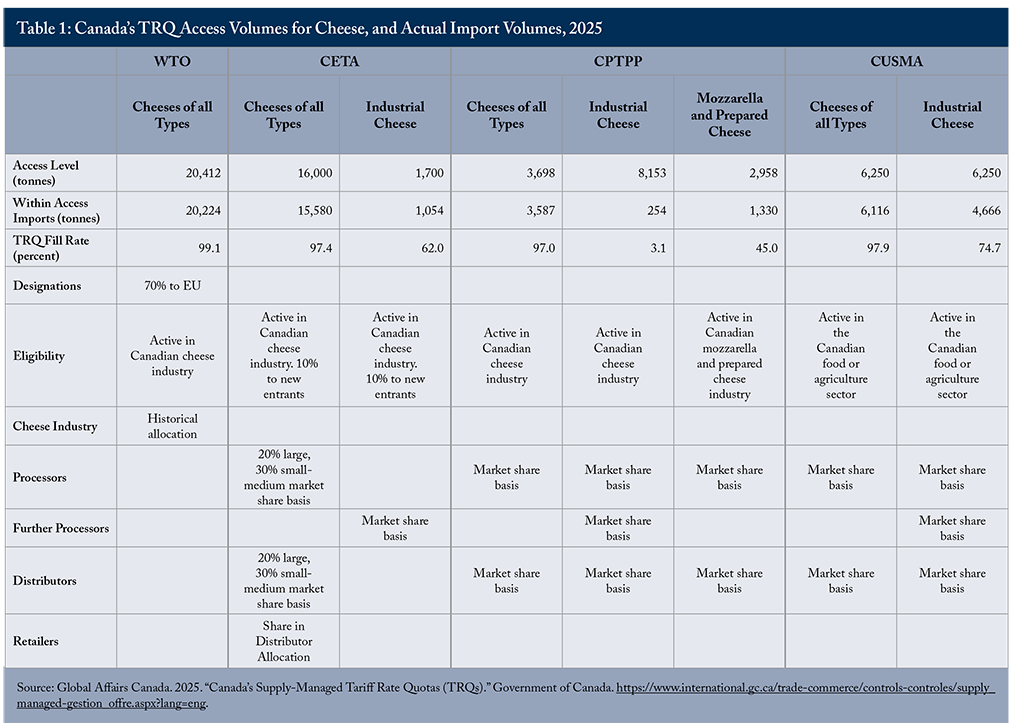
Market access under TRQs is additive across trade agreements, while distribution methods vary by agreement. Table 1 summarizes these arrangements. Under WTO global cheese market access, 70 percent of the cheese TRQ is designated for imports from EU countries, with the balance for non-EU sources. TRQs are allocated to historical permit holders, with individual allocations capped at 20 percent of the TRQ.
Under CETA, Canada offers EU countries two classes of cheese market access. For both cheeses of all types and industrial cheese, 70 percent of TRQs were initially allocated to importers of record, and 30 percent to new entrants; since 2022, 10 percent has been allocated to new entrants. Individual TRQ allocations are capped at 20 percent of the TRQ. TRQs for cheeses of all types are allocated to processors and distributors/retailers, with allocations segmented by size category3For manufacturers, 20 percent is allocated to large cheese manufacturers that use more than 50,000,000 litres of milk annually for cheese production; 30 percent is allocated to small and medium-sized cheese manufacturers that use 50,000,000 litres of milk or less annually for cheese production. For distributors and retailers, 20 percent is allocated to large distributors and retailers whose initial calculated allocation in proportion to total eligible distributor and retailer applicants equals or exceeds 20,000 kilograms, and 30 percent is allocated to small and medium-sized distributors and retailers whose initial calculated allocation in proportion to total eligible distributor and retailer applicants is less than 20,000 kilograms. and then by firm market share based on volume. TRQs for industrial cheese are allocated entirely to further processors4Further processors use an intermediate agri-food product in manufacturing a consumer-ready product. An example is cheese used in making pasta sauce in a ready-to-eat pasta product. on a market share basis. For cheese manufacturers, market share is based on the total kilograms of cheese manufactured in the preceding October 1 to September 30 reference period. For distributors, market share is based on the total amount of cheese sold by the distributor (kg) in the reference period. For retailers, market share is based on the total amount of cheese purchased and subsequently sold during the same period. For industrial cheese, market share is based on the kilograms of cheese the further processor used to manufacture processed food products during the reference period.
Under CPTPP, Canada offers three classes of cheese market access – cheeses of all types, industrial cheese, and mozzarella and prepared cheese. For cheeses of all types, the TRQ is allocated to processors and distributors5A distributor is a firm that buys cheese and resells it to other businesses. based solely on their market share during the preceding October 1 to September 30 reference period. These same allocation rules apply to mozzarella and prepared cheese, but eligible applicants must be active in the Canadian mozzarella and prepared cheese industry. Industrial cheese follows a similar allocation structure but also permits allocations to further processors, whose market share is based on tonnage of cheese used in manufacturing.
Under CUSMA, Canada provides the US with two classes of cheese market access. For both cheeses of all types and industrial cheese, TRQs are allocated to Canadian processors and distributors on a market share basis, based on volume (tonnes) in the preceding October 1 to September 30 reference period. For industrial cheese, TRQs are allocated to Canadian processors, further processors, and distributors using a market-share allocation analogous to the CPTPP approach.
The Economics of Cheese TRQ Allocation
Restrictions on imports are necessary for milk supply management – both to maintain effective supply control and to uphold the pricing target. Within the TRQ volume, importers can purchase imports at a lower world price and can sell them at a higher domestic price. This yields a deadweight loss to consumers and an economic rent associated with the TRQ that accrues to TRQ holders.
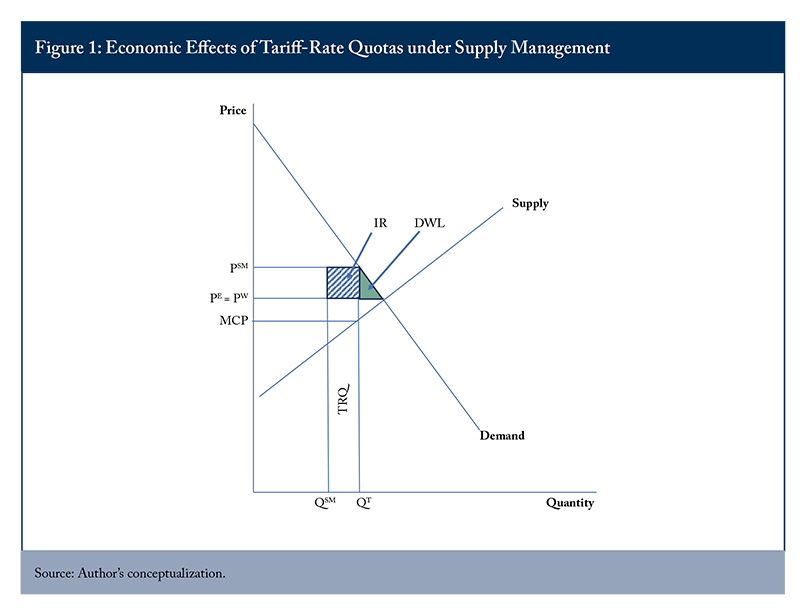
Figure 1 illustrates this relationship, with volumes of milk and dairy products normalized into a single price and volume metric. In a supply-managed market, total market requirement QT is established at the target price PSM based on the cost of production and CPI, yielding a deadweight loss (DWL). Before establishing the domestic production quota QSM, market administrators must account for Canada’s import obligations, labelled as TRQ in the figure. Within the TRQ volume, TRQ holders can import at the world price PW and sell in Canada at price PSM. This profit from importing, IR, is the economic rent associated with the TRQ, which makes TRQ allocations potentially valuable and allows them to be capitalized as quasi-assets.
TRQs have historically been allocated to processors and distributors in Canada because imports are overwhelmingly dairy products rather than raw milk to be manufactured into dairy products. As participants in the domestic market, these entities are the most clearly negatively impacted by imports, and allocating TRQs to them helps reduce these costs. Conversely, the lack of access to other potential buyers and their customers can be seen as an implicit cost to exporters.
Another aspect of TRQ allocation impacts processors quite directly. Imports displace domestic products and, in turn, the raw milk used to manufacture them. Under milk supply management, milk is allocated to plants on a use-it-or-lose-it basis to prevent surplus milk from eroding the discipline of the system. Imports that are not aligned with domestic processing and milk allocation could thus be disruptive and costly to Canadian processors. Allocating TRQs to processors helps to mitigate this risk.
Canada’s Dairy TRQ Trade Disputes
The allocation of Canadian dairy TRQs has been controversial and complex. The US initiated trade disputes against Canada under CUSMA (CDA-USA-2021-31-01 and CDA-USA-2023-31-01), while New Zealand did so under CPTPP (CDA-NZ-2022-28-01), all concerning Canada’s system for allocating dairy TRQs. The US complaints focused primarily on:
- differential treatment of TRQ applicants;
- TRQ allocation on a market-share basis using different criteria for different types of eligible applicants;
- requirements to be active in the dairy industry, presenting additional conditions, limits, or eligibility requirements on TRQ allocation;
- Canada’s mechanism for returning and reallocating unused TRQ allocations; and,
- measures favouring processors over other types of dairy TRQ applicants and a lack of safeguards to ensure allocations are made in commercially viable shipping quantities.
In late 2021, the initial CUSMA dispute resolution panel found that Canada had acted inconsistently with its obligations not to “limit access to an allocation to processors” and did not rule on other aspects of the complaint. Canada then updated its dairy TRQ allocation procedures, prompting a second US complaint and CUSMA dispute resolution panel. The second panel found Canada’s revised TRQ allocation procedures consistent with its CUSMA obligations, and the US complaint was settled in 2023.
The New Zealand complaint under CPTPP essentially shared the concerns raised by the US under CUSMA. The CPTPP panel ruled on a wider range of complaints, including priority access to TRQs for processors and limits on access for otherwise eligible participants, finding Canada’s measures inconsistent with its CPTPP obligations. The New Zealand complaint was settled in 2025, with the outcome reflected in the CPTPP TRQ procedures discussed above.
However, in its May 2026 National Trade Estimate,6Available at: https://ustr.gov/sites/default/files/files/Press/Releases/2026/National%20Trade%20Estimate%20Report%202026.pdf. the Office of the US Trade Representative again raised multiple concerns about Canada’s TRQ allocation system, including limits that exclude food retailers and food service operators:
(i) exclusion of retailers, food service operators, and other entities from eligibility for Canada’s CUSMA dairy TRQs;
(ii) use of a market-share approach for determining TRQ allocations, which applies different criteria to different segments of applicants;
(iii) failure to allow importers to fully utilize TRQ quantities; and,
(iv) 12-month activity requirements on TRQ applicants and recipients.
In a July 2026 Presidential Proclamation,7See: July 20, 2026 Presidential Action: https://www.whitehouse.gov/presidential-actions/2026/07/imposing-additional-duties-to-offset-canadian-discrimination-against-the-commerce-of-the-united-states-with-respect-to-dairy/. the president escalated the issue, stating: “By making retailers ineligible to use the USMCA TRQ for cheeses of all types, Canada discriminates against U.S. goods that are similar to EU goods that are entered pursuant to the CETA cheese of all types TRQ.” The Proclamation threatens duties of 50 percent under the never-before-used section 338 of the Tariff Act of 1930 on a wide swath of US dairy imports from Canada, effective August 19, 2026, unless Canada rectifies the matter to the satisfaction of the US. Canadian cheese exports to the US have recently been just over US$80 million, while total Canadian imports of US dairy products have been around US$400 million. Under a 50 percent tariff, much, or perhaps most, of the Canadian exports to the US would be lost.
The basis for these past dairy disputes and the ongoing tension with the United States is public US dissatisfaction with market access provided through Canada’s TRQ system. This requires further analysis. The top two rows of Table 1 present Canada’s TRQ access volumes for cheese, along with actual import volumes for 2025. In the case of cheeses of all types, actual imports are very close to the TRQ volume – a fill rate approaching 100 percent. Fill rates are somewhat lower under trade agreements that provide market access for industrial cheese. These differences require some context.
First, TRQs are volume limits established in trade agreements and do not change with demand. For products with robust and growing domestic demand, imports may be highly sought after to balance the domestic market, making the TRQ more likely to be filled. Alternatively, if the demand is soft or shrinking, there may be insufficient demand to fill the TRQ, reducing importers’ interest in importing. In Figure 1, if the demand line shifts lower and to the left while the TRQ remains constant, the economic rent from importing declines accordingly.
Second, under CPTPP, the TRQ access levels are the same as those established under the Trans-Pacific Partnership, of which the US was a member. When the US withdrew and the agreement was reconstituted as CPTPP, Canada’s dairy market access levels remained unchanged. The absence of the US, a large and diversified dairy exporter, therefore leaves Canadian dairy TRQs large relative to the export capacity of the remaining CPTPP countries.
Third, the commercial relations underlying the fill of TRQs follow patterns of broader economic integration, and forging new trade relations can take time to develop. Canada’s commercial relations are the closest with the US and other longstanding trading partners – for example, EU countries in fine cheeses. In other cases, dairy food companies operating in Canada are multinationals with operations in exporting countries, especially the US and the EU, and TRQs can facilitate internal cross-border transfers within these firms.
For reference, Beckman et al. (2021) reviewed past studies and analyzed an international database of agricultural TRQ volumes, tariffs, and actual imports compiled from WTO notifications from 1995 to 2015. They found an overall average TRQ fill rate of 56 percent.8Beckman, Jayson, Fred Gale, and Tani Lee. 2021. “Agricultural Market Access Under Tariff-Rate Quotas.” Economic Research Report No. 279. US Department of Agriculture, Economic Research Service. However, most TRQs fell into two roughly equal clusters at opposite ends of the spectrum: 40 percent of TRQs had fill rates exceeding 80 percent, while 36 percent had very low fill rates of 20 percent or less. TRQ fill rates were related to import demand, as indicated by the border price relative to the domestic price, and other factors such as the size of within-TRQ tariff rates and administrative procedures.
These observations help explain Canadian cheese imports under TRQs. Cheese is in high demand in Canada, and imports have helped meet growing demand. Thus, under each trade agreement, the TRQs for cheeses of all types have been essentially filled. Industrial cheeses used in further processing are somewhat less in demand and are primarily imported from the US and the EU. Fill rates are significantly lower for industrial cheese and mozzarella/prepared cheese under CPTPP, consistent with access levels that are large relative to the export capacity of CPTPP members and with Canadian importers having less established commercial relationships with CPTPP exporters of these products. The within-TRQ tariffs are very low or zero, and with the procedures analogous for cheeses of all types and industrial cheese, the exceptionally high fill rate for cheeses of all types suggests minimal administrative barriers per se associated with the Canadian dairy TRQ.
Sorting Out the Canada-US Cheese Trade Dispute
With the July 20 proclamation, there are now at least two questions that frame the issue of dairy/cheese TRQ allocations with the US: how significant the issue is and whether the allegations under section 338 have merit.
The first question is, “Why does the allocation of TRQs matter?” particularly when the allocation is independent of the size of the TRQ and the TRQs are largely filled (especially for cheeses of all types). From the perspective of US cheese exporters, direct access to Canadian retailers could better position them to market premium products. Under the current allocation, Canadian importers are mostly dairy processors, which may have less incentive to import premium US products. Instead, they may prefer more standard or less sophisticated imports that they can market behind their own premium brands. In some cases, TRQs are allocated to multinational processors operating in both Canada and the US, and it merely facilitates cross-border internal transfers. US exporters perhaps see a lost opportunity as a result.
Canadian dairy processors naturally see the issue differently. First, they face strong competitive pressure from their customers, particularly Canada’s concentrated grocery retail sector – as evident in the motivation for a Grocery Code of Conduct, largely devised to protect food processors and other suppliers from aggressive and costly leverage tactics by grocery retailers. Providing Canadian retailers with direct access to imported US cheeses through TRQs would only exacerbate the leverage that Canadian retailers could exercise over Canadian cheese processors.
Second, allocating cheese TRQs to retailers presents the risk that imports could become misaligned with Canadian dairy processing in serving the domestic market and the portfolio of cheeses it entails. Canadian cheese processors operate in a regulated environment that limits their ability to adjust. In particular, milk allocation from farms to processing plants is use it or lose it, so significant displacement of domestic cheese production at a given processing plant by imports could result in lost raw milk allocation to that plant and, more broadly, significant disruption for farmers and processing plants. Moreover, retailer-driven changes in the type and variety of cheese imports over time, and their effects on milk allocations to affected plants, could create significant uncertainty for Canadian cheese processors. This does not represent “normal” competition from imports; it is competition amplified as it interferes with the regulated mechanism for raw milk allocation.
Finally, there is the basic economics: Canada-US trade is overwhelmingly in cheese and dairy products, not raw milk. A different or erratically changing set of cheese imports from the US, within the existing TRQ volume and corresponding farm milk production quota, presents the prospect of price undercutting of Canadian cheeses, reducing prices received by processors in Canada. But in a supply-managed market, there is no direct or transparent mechanism by which reduced cheese prices and processor margins resulting from import competition flow upstream through lower raw milk prices, thereby sharing the effects between processors and producers. To illustrate, a Canadian cheese processor that loses some of its premium product business with Canadian retailers to imports may be forced to produce the same volume of lower-priced, lower-margin products. The processor cannot pass this adjustment upstream through correspondingly lower prices for the raw milk it purchases from farmers.
Under section 338, the legal test relates to “a foreign country’s discrimination against or unequal imposition on the commerce of the United States.” CETA provides for the allocation of cheeses of all types TRQ to retailers; CUSMA did not. On that basis, the US claims that its producers are discriminated against in favour of the EU in the Canadian market for cheeses of all types.
However, this interpretation is disingenuous. CETA was signed before CUSMA; the CPTPP was signed after CETA but also before CUSMA. The CPTPP did not provide for the allocation of cheese TRQs to retailers as CETA did – and CETA itself departed from the WTO-Global TRQ allocation system established in 1995, which does not allocate cheese TRQs to retailers. If the US wanted the same TRQ allocation approach as CETA, it could have asked for it. Canada would have needed to agree, but the parties ultimately settled on a cheese TRQ allocation system closely aligned with the WTO and CPTPP approaches. The US agreed to this knowing the approach Canada had adopted under CETA. In a guest post recently published in Reason, trade policy experts Peter Harrell and Jennifer Hillman observe that the section 338 dairy action against Canada “rests on quota levels and terms that the United States itself negotiated in the USMCA and that Congress approved. Irrespective of the original intent of 338, it is incongruous, to say the least, for the United States to denounce as discriminatory the very terms it agreed to.”9Harrell, Peter E., and Jennifer Hillman. 2026. “Prospective Legal Challenges to Trump’s Section 338 Tariffs Against Canada.” Reason. August 3. https://reason.com/volokh/2026/08/03/prospective-legal-challenges-to-trumps-section-338-tariffs-against-canada/
Viewed from this perspective, the section 338 threat looks very much like an attempt by the US to relitigate the CUSMA dairy TRQ case or apply pressure ahead of renegotiation.
But a more fundamental point should concern Canada. If the president can override a legal decision finding that Canada’s revised dairy TRQ allocation system is consistent with its CUSMA obligations, it surely imperils Canada’s ability to trust the US trade policy framework – an issue far larger than cheese TRQs.
Conclusion
Dairy trade between Canada and the US, where the US has an overarching export interest, is a long-standing irritant between the two countries. The issues are complex and nuanced, consistent with the regulated nature of dairy industries in both Canada and the US. The US perceives that it has not obtained the full dairy and cheese market access it anticipated under CUSMA. Cheese TRQ fill rates, very high for cheeses of all types and relatively high for industrial cheese, do not appear to capture or validate the US concern. Rather, the issue appears to be access for higher-value, premium products and perceived barriers to that access – a missed opportunity the US attributes to Canada’s TRQ allocation system.
Canada agreeing to reform TRQ allocation to include retailers could be costly to dairy processors. But even without an apparent mechanism to transfer lower prices upstream through raw milk prices, these costs are unlikely to remain permanently with processors. Eventually – through plant closures or other adjustments – some would likely be passed back to farmers. This also creates a dilemma as Canada seeks to increase competition in the food system – through the Grocery Code of Conduct and, most recently, a focus on concentration and competition in the food system under the National Food Security Strategy. Making cheese TRQs available to retailers could increase their leverage over dairy processors.
The recent threat of section 338 tariffs complicates matters by creating a potential precedent for Canada to make concessions under the threat of a political override of the legal trade dispute resolution mechanism. This goes far beyond a dairy trade dispute and is a larger issue of Canada-US relations. It is also quite separate from the merits of the case under section 338, which the sequence of events calls into question.
On balance, if Canada is prepared to work with the US on allocating cheese TRQs to retailers, it should recognize that there will be costs to Canadian dairy processors and, ultimately, dairy producers. That said, such a change seems unlikely to contravene Bill C-202, which is designed to prevent increases in dairy import quotas or reductions in tariffs in trade negotiations.