



Barry Gros – We Need to Align Regulation and Management of Target-Benefit Pension Plans
 From: Barry Gros To: Canada’s Pension Regulators Date: March 23, 2022 Re: We Need to Align Regulation and Management of Target-Benefit Pension Plans How should Canada regulate a target payment that is not guaranteed? This question is seldom asked, let alone answered, when it comes to setting standards for regulating target-benefit pension plans (TBPs.) Managing risk under target-benefit plans […]
 Gullo, Eaton, Schwanen – Let’s Stop Our Inter-Provincial Economic Friction
 From: Michael Gullo, Michelle Eaton, Daniel Schwanen To: Canadians Concerned About Prosperity Date: March 21, 2022 Re: Let’s Stop Our Inter-Provincial Economic Friction If we can find a small silver lining in the COVID-19 pandemic, it has been the increased collaboration between orders of government; in particular, the federal government and its provincial and territorial counterparts. Fostering this collaboration […]
 Canada has blown through our fiscal guardrails. When will our federal budgets reflect that? – Globe and Mail Op-Ed
The budget that federal Finance Minister Chrystia Freeland will present shortly will reveal whether the government is serious about putting the national finances on to a sustainable track.
There is room for doubt. Since 2015, the government had been running deficits larger than it promised, and larger than a strong economy justified. Then it responded to the COVID-19 pandemic with debt-financed spending on an unprecedented scale.
To assuage concerns about soaring federal debt – concerns heightened by the government’s equally unprecedented failure to present a budget at all in 2020 – the Finance Minister introduced a new concept in the government’s fall economic statement that year: fiscal…
Perrault, Haley – Picking up the Twenties: A Simple Proposal for Internal Free Trade
 From: Jean-François Perrault and James A. Haley To: Internal Trade Watchers Date: March 18, 2022 Re: Picking up the Twenties: A Simple Proposal for Internal Free Trade Internal trade barriers are universally understood to needlessly hobble Canadian prosperity even as a “collective action problem” prevents any serious reform. Tariffs on interprovincial trade are prohibited under the Constitution Act, […]
 The way Canada reviews foreign investments is out of date – iPolitics Op-Ed
Canada’s process for reviewing foreign investments is too opaque, and protects neither our economic nor our national-security interests.
Ottawa should therefore follow Washington’s lead and create a system wherein certain transactions must be cleared before an investment is ever made.
The timing couldn’t be better: Earlier this month, Innovation, Science and Industry Minister François-Philippe Champagne announced a review of Canadian’s Competition Act. The minister should leverage this moment to create a tailor-made solution for foreign investment reviews, as well.
Rather than prioritizing national security, the current regime is more concerned with investors. Canadian companies and their advisers would all benefit…
Kevin Comeau – Combatting Money Laundering to Help Ukraine
 From: Kevin Comeau To: Canadians Concerned About Oligarchs Date: March 16, 2022 Re: Combatting Money Laundering to Help Ukraine For more than 20 years, our weak anti-money laws have enabled corrupt politicians, criminals, and tax cheats from around the world to launder billions of dollars in Canadian real estate without disclosing the true owner. Canada has the opportunity to […]
 Zelmer, Kronick – Let’s Not Roll Out QT on the QT
 To: Bank of Canada Governing Council From: Mark Zelmer and Jeremy M. Kronick Date: February 18, 2022 Re: Let’s Not Roll Out QT on the QT As the Bank of Canada prepares to begin raising interest rates to get inflation back to target, there is also the issue of how quickly it should reduce the […]
 Ambler, Kronick – Decisions Deferred Mean Trouble to Come
 To: Canadians Worried About Inflation From: Steve Ambler and Jeremy M. Kronick Date: February 7, 2022 Re: Decisions Deferred Mean Trouble to Come The Bank of Canada surprised financial markets late last month by holding its overnight rate target constant at 25 basis points. Holding constant might seem to imply that the Bank’s monetary policy is […]
 Ambler, Kronick – The Bank That Didn’t Bark
 To: Canadians Worried About Inflation From: Steve Ambler and Jeremy M. Kronick Date: February 1, 2022 Re: The Bank That Didn’t Bark The Bank of Canada kept its overnight rate target steady at 25 basis points last week, which was a surprise to markets that had already priced in a rate increase. Despite that ample cover for a first […]
 Where’s the hike? Why didn’t the Bank of Canada act? – Financial Post Op-Ed
In a surprise move, the Bank of Canada kept its overnight rate target steady at 25 basis points Wednesday. Markets had already priced in a rate increase by the time the announcement was made, so there was ample cover to make this the first post-pandemic increase. That didn’t happen. With inflation rising at home and abroad, we believe this was a missed opportunity.
Steady increases in inflation and inflation expectations had led markets to believe the bank was set to increase its target for the overnight rate for the first time since the pandemic began. Headline inflation was up to 4.8 per cent in December, all of the bank’s core inflation measures had increased — with two of the three at or above three per cent — and its…
Ed Devlin on BNN – When you’re at a lower bound of interest rates, deflation is a greater problem than inflation
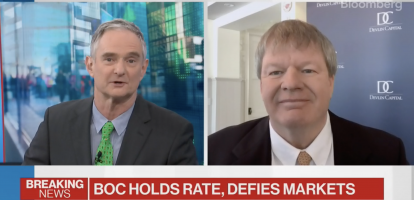
Ed Devlin, Founder of Devlin Capital, Senior Fellow at C.D. Howe Institute, and former Head of Canadian Portfolio Management at PIMCO, joins BNN Bloomberg to provide his reaction to the Bank of Canada’s decision to hold interest rates steady. He says that keeping the rates will give the bank more options to deal with the uncertainties of the pandemic.
Zelmer, Kronick – Is This Going to Be the Year for Crypto?
 From: Mark Zelmer and Jeremy M. Kronick To: Canadian Crypto Watchers Date: January 19, 2022 Re: Is This Going to Be the Year for Crypto? The world got its first digital currency, DigiCash, in 1989. Nine years later it filed for bankruptcy. We’re still waiting for digital money to take over from cash – as seems inevitable. Is 2022 […]