



Keep the virtual healthcare revolution going – Financial Post Op-Ed
One very big silver lining to 2020 was the dramatic uptake in the use of virtual health care in Canada. During the first wave of the pandemic over 70 per cent of outpatient care was delivered virtually. Before COVID-19, speaking to a family doctor about a new health problem, simply getting a prescription renewal or having a visit with a specialist required most Canadians to take time off work, travel to their local clinic or hospital and sit in a waiting room for upwards of an hour or more. But now doctors can bill for virtual visits and Canadians can receive medical care from the comfort of their own home.
As the second wave crests, and hospitals are once again filling up with COVID patients, providing care to other patients…
S2 E22: 2020 – The Year of Unprecedented Times
 2020 will be known as “the year of unprecedented times.” As COVID-19 vaccine injections begin, we look back at how Canada handled the pandemic – what we did right and what we did wrong – with crisis communications expert David Herle of The Gandalf Group, and the C.D. Howe Institute’s CEO Bill Robson.
Canada’s Virtual Care Revolution: A Framework for Success
 The Study In Brief A virtual care revolution is underway in Canada, spurred on by the COVID-19 pandemic. As of June 2020, virtual care represented over 70 percent of the ambulatory care provided by hospitals and doctors’ offices across the country, a surprising increase from just five months before. The COVID-19 pandemic has forced the […]
S2 E21: Ontario’s COVID Response with Steven Del Duca
 Ontario Liberal leader Steven Del Duca says if made premier, he would make education his top priority. But by 2022 it’s expected COVID will be behind us as vaccines are distributed through the course of next year. So what’s his plan to get the economy back on track? And is now even the time to […]
Managing COVID beyond lockdowns and vaccine research – iPolitics Op-Ed
The sharp escalation of COVID-19 cases this fall has highlighted the problem of governments’ extensive reliance on emergency powers and far-reaching orders that limit activities. Their “acute crisis” approach reflects an undue focus on vaccines as the dominant near-term solution to the pandemic. It neither recognizes nor addresses the uncertain timeline and other major challenges until safe and effective vaccines are available, well distributed, and sufficiently taken up.
Despite the very encouraging recent progress on vaccine development, vaccine-centric policies have led to serious weaknesses in government communications and inadequate resources to deal with the current resurgence. It has made the re-imposition of tough…
S2 E20: Flattening the Curve on the Second Wave
 The second wave of COVID-19 is upon us, and hard lessons learned over the spring aren’t necessarily being applied today. So how do we flatten the curve going into the holidays? Hear insights from Colleen M. Flood, University of Ottawa Research Chair in Health Law & Policy; Paul Jenkins, former Senior Deputy Governor of the Bank of Canada; […]
Daniel Schwanen – Containing Covid-19 In Ontario: Skate To Where The Virus Is Going
 To: Ontario Premier Doug Ford and Health Minister Christine Elliott From: Daniel Schwanen Date: November 18, 2020 Subject: Containing COVID-19 in Ontario – Skate to Where the Virus is Going Ontario’s lower case thresholds for triggering stages of progressively tighter socio-economic restrictions, announced Friday, recalibrate its framework to at least bring it more in line […]
Climbing Out of COVID
 New C.D. Howe Institute Book Chronicles COVID-19 Policy Insights A new book from the C.D. Howe Institute provides an overview of the Institute’s critical policy recommendations made in response to the developing COVID-19 pandemic. “Climbing Out of COVID” compiles communiqués from the Institute’s Crisis Working Groups, as well as Intelligence Memos and op-eds, published up […]
Lessons from the First Wave of COVID-19: Public Health and Emergency Measures Working Group
October 28, 2020 – Canada’s healthcare system must learn the lessons of the first wave of COVID-19 and make the changes required to improve our capacity to tackle infectious disease outbreaks in future, says a new report from the C.D. Howe Institute.
The Public Health and Emergency Measures Working Group notes as case numbers grow across Canada, insights from the first wave can be applied to better manage infection risks, while also minimizing social and economic disruption caused by public health and social distancing-related restrictions on activity.
The group of health academics, professionals and business leaders is co-chaired by Janet Davidson, Chair of the Board of the Canadian Institute for Health Information and C.…
Testing Gaps: Prevalence Of Covid-19 And Antibodies
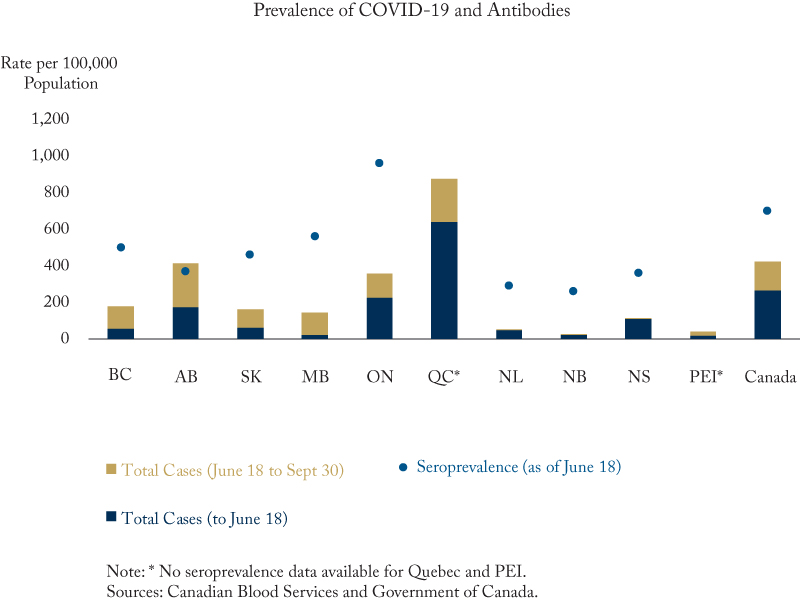 At the outset of COVID-19, access to diagnostic testing was inconsistent and provinces employed different testing strategies to direct limited testing resources. Since the beginning of the outbreak, testing rates and access to testing have been improved across the country. Most COVID-19 testing has been for diagnostic purposes – to determine whether or not someone is […]
Åke Blomqvist – The Cambie Case And Efficient Healthcare
 From: Åke Blomqvist To: Canada’s Ministers of Health Date: October 23, 2020 Re: The Cambie Case and Efficient Healthcare Privately funded healthcare was back in the news this fall as a BC Supreme Court judge ruled against Dr. Brian Day’s challenge of the province’s Medicare Protection Act. The case has had the unfortunate consequence of focusing the public debate on […]
Schwanen, Wyonch – What’s The Covid-19 Plan?
 From: Daniel Schwanen and Rosalie Wyonch To: Premier Doug Ford and Health Minister Christine Elliott Date: October 22, 2020 Subject: What’s the COVID-19 plan? The resurgence of COVID-19 cases in Ontario since mid-August has so far not been as severe as in other jurisdictions that have recently imposed sweeping restrictive measures to control their second […]