



Schwanen and Kronick – Brexiting Softly With CETA
To: The Hon. Chrystia Freeland, Minister of Foreign Affairs From: Daniel Schwanen and Jeremy Kronick Date: June 15, 2017 Re: Brexiting Softly With CETA With a seemingly clear path to a large majority in Parliament – and thus a strong hand in impending Brexit negotiations with the EU – British Prime Minister Theresa May called […]Christopher Sands – Larger Role for Congress Will Make This Negotiation Different Than CUFTA and NAFTA Talks
From: Christopher Sands To: Concerned Canadians Date: June 5, 2017 Re: Larger Role for Congress Will Make This Negotiation Different Than CUFTA and NAFTA Talks Speaking in Kenosha, Wisconsin in April, U.S. President Donald Trump scrambled expectations for the renegotiation of NAFTA when he called Canadian supply management programs for the dairy sector “a disgrace” […]Konrad W. von Finckenstein: Chapter 19 Should Not be Given Up in NAFTA Renegotiations
From: Konrad W. von Finckenstein To: The Honourable Chrystia Freeland, Minister of Foreign Affairs Date: May 31, 2017 Re: Chapter 19 is Unique and Should Not be Given Up in NAFTA Renegotiations In the upcoming NAFTA renegotiations, I urge you not to relinquish Chapter 19 on dispute settlements. In a recent for paper for the […]Jon Johnson on CTV – Ottawa’s $1B lumber lifeline risks escalating U.S. trade tensions
The C.D. Howe Institute’s Jon Johnson discusses if federal help for the softwood lumber industry will make the dispute with the U.S. worse.
Jon Johnson – Return of the Softwood Lumber Dispute (Part V)
From: Jon Johnson To: The Honourable Ministers of International Trade, and Foreign Affairs Date: May 25, 2017 Re: Return of the Softwood Lumber Dispute (Part V) Like a bad movie sequel, Canadians are enduring a fifth round of softwood lumber disputes. The US Department of Commerce (DOC) has determined that provincial stumpage fees (i.e., price to […]Jon Johnson on BNN: A sectoral deal a better option in softwood lumber dispute
Jon Johnson, senior fellow at the C.D. Howe Institute and a former advisor to the Canadian government during NAFTA negotiations, joins BNN to discuss what he believes is a better option for tackling the softwood lumber dispute.
Read Jon Johnson’s Intelligence Memo, “Return of the Softwood Lumber Dispute (Part V).”
Lawrence Herman on BNN: Freeland’s ‘battle-scarred’ team capable of tackling NAFTA renegotiations
Institute Senior Fellow, Lawrence Herman, joined BNN to discuss the upcoming NAFTA negotiations.
Lawrence Herman on BNN – NAFTA Renegotiation
Lawrence Herman of Herman & Associates and the C.D. Howe Institute walks us through the next steps in the NAFTA renegotiation process.
Don’t Fight a Losing Battle: US Trade Protectionism and Canadian Retaliation
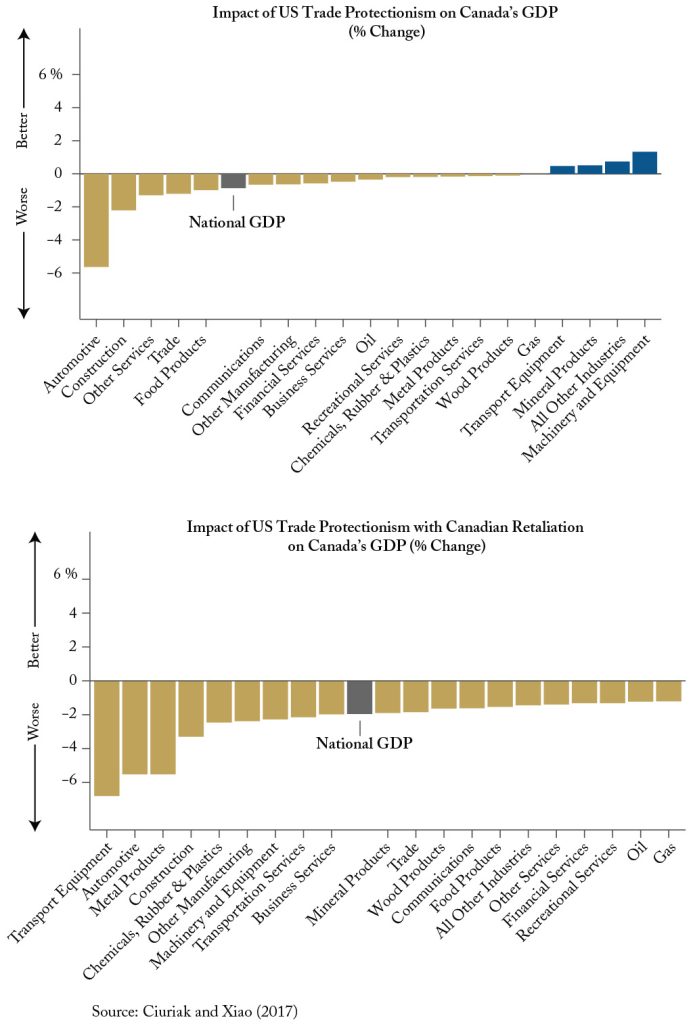 Note: GDP change in the model is equal to changes in value added plus changes in tax. Because the model only details changes in value added at the industry level, the above Figures add the national change in tax to each industry. Also, “All Other Industries” includes Canadian industries that account for less than 0.5 […]
 Jon Johnson – Trump Can’t Unilaterally Withdraw U.S. From Nafta
 From: Jon Johnson To: The Minister of International Trade and the Minister of Foreign Affairs Date: May 1, 2017 Re: Trump Can’t Unilaterally Withdraw U.S. From NAFTA Last week saw high drama on the NAFTA front, with President Trump threatening to sign an executive order giving notice of the US intention to withdraw from the […]
 Why ‘Softwood V’ Could Become Canada’s Toughest Trade Fight: Globe And Mail Op-ed
It haunts us still. Softwood lumber is back, the defining Canada-U.S. trade dispute of the ages.
The preliminary duties announced Tuesday are designed to affect billions of dollars of Canadian exports. Even ahead of final duties to be announced in June, these will decimate Canadian exports and affect the livelihood of many thousands of Canadians.
Over the coming months, softwood lumber will dominate the front pages of our newspapers (though relegated to the back pages in U.S. media).
As if there wasn’t already enough tension in the bilateral relationship, softwood lumber adds even more stress, with President Donald Trump’s demand for NAFTA renegotiations (which he describes as the most “disastrous” trade agreement…
Canadian Free-Trade Deal a Good Start, But Must Go Further: Globe and Mail Op-Ed
At this time of anxiety surrounding international trade relations, it was encouraging to see a new Canadian free-trade agreement arrive on the scene Friday. Unveiled by federal, provincial and territorial governments, the CFTA seeks to reduce government-imposed barriers that Canadians face when seeking economic opportunities across the country. But does it deliver? Only partly.
Our economic union, with all its flaws, remains a vital avenue of economic opportunities for Canadians. The CFTA represents a serious but incomplete attempt at removing barriers to accessing these opportunities. Canadians looking to buy and import alcoholic beverages more freely from other provinces will certainly be disappointed by the CFTA, which only…