



At the Global Crossroads: Canada’s Trade Priorities for 2016
 Canada must look to trade to boost future economic growth and prosperity in the face of current challenges, according to a new C.D. Howe Institute report. In “At the Global Crossroads: Canada’s Trade Priorities for 2016,” author Daniel Schwanen lays out four priorities for Canada’s trade agenda in 2016.
 National Priorities 2016
 The National Priorities 2016 series provides a high level overview of key issues that the federal and provincial governments need to address, and provides an opportunity to highlight policy recommendations made by prior C.D. Howe Institute research on these topics. Fiscal and Tax – Tax Reform Priorities for Canada: Creating More Income to Go Around […]
 How should Canada see the TPP? Depends on how we see the world: Globe and Mail Op-Ed
As International Trade Minister Chrystia Freeland embarks on her cross-country consultations on the Trans-Pacific Partnership trade agreement, her opening question should be a fundamental one. It comes down to how Canadians choose to view the world.
Do we view the world mostly as users of goods and services produced by others? Or do we see ourselves as makers, innovators and providers of goods and services to the global marketplace? Do we see the world as confined mostly to our own backyard? Or as an increasingly open market with vast opportunities on a global scale?
In may seem simplistic, but this is the first question Ms. Freeland should be asking Canadians.
The question is pertinent in the intellectual property…
Opening up New Trade Routes for Financial Services: Canada’s Priorities
 Canada should focus on five priority trade deals to open markets and benefit its financial services sector, according to a new report by the C.D. Howe Institute. In “Opening up New Trade Routes for Financial Services: Canada’s Priorities,” authors Daniel Schwanen, Dan Ciuriak and Jeremy Kronick provide, for the first time, a ranking system to […]
 With TPP, perfect must not be the enemy of the good: Embassy News Op-Ed
The Trans-Pacific Partnership Agreement, completed and announced just two months ago, is broad-ranging, opaque for many, and complex like most international trade agreements.
For Canada, the deal involving 11 of our trading partners will be good on balance, albeit it will have negative—or potentially negative—impacts on several sectors or sub-sectors on the Canadian economy.
The benefits and potential costs of this not-yet-signed or implemented agreement will need to be discussed and assessed by a wide variety of individuals and groups in Canada, including other levels of government in their areas of jurisdiction, in every part of the country.
Following this process of extended and inclusive…
Ottawa needs to give TPP decision due process and ignore all the shouting: Globe and Mail Op-Ed
By Lawrence Herman
How does Canada tackle the Trans-Pacific Partnership (TPP) agreement, now that the text is finally out?
There’s been a flurry of media reporting and commentary, some of it breathless – the Twittersphere has been going berserk – some of it more reflective and analytical. There’s a vast gourmet offering of information on legal websites.
It’s hard to digest it all. Is this deal good or bad for Canada?
My advice is to stay away from Twitter and the blogs. Don’t be influenced by the shouting of narrow or sectoral interests. This is a vast and detailed agreement, negotiated over many months by skilled Canadian diplomats. It deserves careful, reasoned and balanced assessment.
During the…
NAFTA is not TPP: Financial Post Op-Ed
By Lawrence Herman
Canadian suppliers would not be entitled to enhanced access to the U.S. market granted to the 10 other TPP members
It’s time to answer some of the misguided arguments about Canada rejecting the TPP Agreement that are being bandied about.
I was dismayed to hear pundits and political candidates claim that, because 85 per cent of our exports are covered under the NAFTA and other trade bilateral agreements, we really don’t need to be part of the TPP anyway.
This shows a regrettable misunderstanding of international trade rules and Canada’s treaty commitments, whether under the World Trade Organization Agreement or elsewhere. So let’s review all this.
Start with the WTO Agreement. It’s a…
Daniel Schwanen: TPP is a good deal for Canada: Financial Post Op-Ed
By Daniel Schwanen
The Trans-Pacific Partnership (TPP) has finally landed – or so it seems. The 12 countries who signed on to the deal announced yesterday in Atlanta still have to ratify it. This process will mean that lawmakers and the public at large will review and debate the pros and cons of the agreement, as they see it, in each signatory country.
Canada will, of course, undergo such a debate. Here are three things Canadians should keep in mind as we examine the TPP’s fine print.
First is what this agreement is all about from Canada’s perspective: making it easier for firms here – both big and small – to do business in other member economies. Many large firms and their employees will benefit, since they are…
Smooth transition needed for carbon pricing and free trade: Globe and Mail Op-Ed
By Christopher Ragan
Even if we weren’t in the middle of a federal election campaign, there would be several important policy issues being discussed this summer. One of the big ones is Canada’s part in the negotiations for the Trans-Pacific Partnership, a free-trade agreement with several Pacific Rim countries. Another is the development of carbon-pricing policies in Ontario and Alberta. Policy makers and ordinary Canadians alike should note that these policies have two big things in common, and one crucial difference.
Both free trade and carbon pricing are undertaken in the pursuit of a major, long-run prize. In the case of free trade, the prize is that our consumers get access to a wider range of products, often with…
Why trade rules for SMEs need reforms: Financial Post Op-Ed
By Dan Ciuriak
Lowering the rules of origin hurdle would boost trade, and enable more SMEs to enter into exporting
Most of Canada’s international traders are SMEs. Canada’s main trade policy tool today is the bilateral or regional free trade agreement (FTA), but FTAs come with administrative requirements, which put small and medium sized enterprises (SMEs) at a disadvantage in accessing their benefits compared to larger domestic competitors.
One important administrative requirement is to provide the necessary documentation to show that products satisfy the rules of origin provisions that restrict access to the reduced or zero tariffs of the FTAs. For some products, this is easy – a Canadian crop is Canadian.…
Making Free Trade Deals Work for Small Business: A Proposal for Reform of Rules of Origin
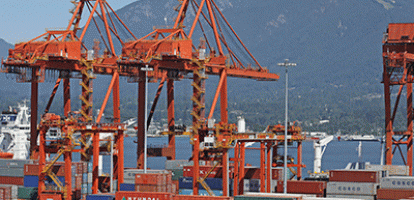 The high costs of complying with Rules of Origin (ROO) requirements mean that small and medium-sized firms (SMEs) often find it cheaper and more efficient to pay customs duties instead of producing the paperwork that would allow them access to preferential, often zero tariffs under trade agreements, according to a new report from the C.D. […]
 No turning back for Canada now that dairy protection is finally on TPP table: Globe and Mail Op-Ed
By Lawrence Herman
Once the genie is out, it’s nigh impossible to get it back into the trade negotiations bottle.
That’s what happened in the Trans-Pacific Partnership (TPP) trade talks in Hawaii last week when Canada finally offered concessions regarding its protectionist supply management system. Unfortunately, trade ministers from the 12 negotiating countries couldn’t cement a final deal in Hawaii. They got pretty close, but some tricky issues remain unresolved beyond the dairy sector – patent rights, automotive issues, investment disputes, among others.
Australia and New Zealand are pushing for greater access to the U.S. market in the TPP talks and the U.S., in turn, is demanding concessions from…