





by Don Drummond
- The pandemic has highlighted and amplified the economic, social and health vulnerability of many Canadians. There is much that should be done. But how much can be tackled without risking large costs in the future? And what are the most effective and efficient approaches? Canadians should weigh in on such questions before the federal government decides on future policy.
- I lay out four scenarios for Canada’s fiscal future. Each scenario targets a deficit and debt track into the 2030s. Among the takeaways:
- Restoring and then maintaining fiscal stability as defined by most, calls for some degree of fiscal restraint once the pandemic subsides.
- Such restraint could be a combination of curtailing program spending or increasing taxation; the latter option is not examined here as the government has indicated that, with minor exceptions, it does not intend to increase the tax burden.
- The expensive initiatives set out in the Speech from the Throne cannot be fully implemented within the bounds of any reasonable definition of a fiscal anchor.
Even before the pandemic, Canada was not well positioned for big increases in federal government spending. It is even more constrained now by the borrowing associated with pandemic-related revenue declines, and far more by pandemic-related spending. The September Speech from the Throne paid no heed to this reality. To make the country’s fiscal choices clearer to Canadians, and perhaps to itself also, the government must provide more economic and fiscal information, and reveal the results of the internal deliberations that took place during its drafting of the Speech from the Throne.
A National Discussion is Needed on Canada’s Economic and Fiscal Future
Canada needs a national debate over its economic and fiscal future. We are at a crossroads and not just because of the pandemic. We have been locked into a path of mediocre productivity and real income gains for far too long. Our major trading partner, the United States, no longer appears to offer a reliable economic relationship. Plan B of tightening relations with China is proving to be challenging. The so-called emerging economies that offered promise are fading for the most part. The resource and manufacturing sectors that historically have provided so much of Canada’s wealth face enormous challenges. The pandemic has highlighted and amplified the economic, social and health vulnerability of many Canadians. There is much that should be done. But how much can be tackled without risking large costs in the future? And what are the most effective and efficient approaches? Canadians should weigh in on such questions before the federal government decides on future policy.
But they cannot do so without some basic information sorely lacking from the near-term focus of the Economic and Fiscal Snapshot of July 2020 (Canada 2020a) and the vagueness of the Speech from the Throne of September 2020 (Canada 2020b). Speeches from the Throne are not known for their detail, but this one did not even settle the most basic question on the direction of future policy. All we know is that with one possible exception (a guaranteed basic income which received no mention) all the big-ticket initiatives under consideration remain on the table. There are no suggestions of delay, phasing or scaling to reduce cost. There is mention of fiscal responsibility, but it established a new level for vagueness even by the standard of Speeches from the Throne; it included one line simply saying plans must be implemented “responsibly.”
It is not even clear what remaining on the table means for an initiative. Many have been government commitments for several years with little or no tangible action having been taken. Will things be different now? The Speech says progress will be accelerated on National Pharmacare. That would be an acceleration from what appears to have been a virtual standstill. The Speech said the Government will engage with any willing provinces, but none seems willing and will surely say “show me the money” before putting up its hand. Furthermore, a willing province will likely insist that other health-related fiscal demands – additional support for dealing with COVID-19 and restoration of a larger federal share in total public healthcare spending – be met before opening a new pharmacare initiative. At their September 2020 meeting of the Council of the Federation, premiers presented their healthcare funding demands, excluding pharmacare, of $28 billion annually. And pharmacare is joined by childcare and early childhood learning, training, some of the green and infrastructure measures, and most of the specific health pledges squarely in provincial jurisdiction.
In this fog, this note sets out some future economic and fiscal considerations in the interest of informing a national debate that hopefully will emerge in the coming months.
A Few Key Economic and Fiscal Assumptions Are Required
To make manageable the consideration of Canada’s possible economic and fiscal future, a few assumptions must be made. The values chosen can, and should be challenged, generating alternative perspectives.
a) Economic Growth
Canada’s fiscal fortunes will rest largely on the pace of economic growth. As the focus here is on the long term, we look through the economic decline and eventual recovery from the pandemic and use an average growth rate over the next 10 to 15 years. We estimate that to be 3.5 percent average annual growth in nominal GDP, composed roughly of 1 1/2 percent real growth and 2 percent inflation. The former is based on a study done by the Centre for the Study of Living Standards (Drummond, Capeluck 2015).11 This rate of growth is slightly lower than in some other studies. Finance Canada for example featured 1.7 percent growth in the last long-term projection published (Canada 2018). The slightly lower figure is predicated on Canada’s productivity growth not picking up and the trend continuing in the decline in hours worked.
Three and one-half percent could even be on the high side considering the impact of the pandemic on potential output. While most attention has been on the effects on aggregate demand, the economy’s capacity may be lowered for many years due to the hits to business investment, immigration, and a greater mismatch between labour demand and supply. The Bank of Canada indicated in the July 2020 Monetary Policy Report that it had lowered the estimate of capacity a whopping 4 percent for 2023 relative to its projection done just 8 months earlier. Finally, it should be mentioned that if the CPI, a fixed-weighted index, increases 2 percent per annum, the chain-linked GDP deflator,22 The GDP deflator is a price index that tracks the average prices of goods and services produced across all sectors of a nation’s economy over time. It helps economists compare the levels of real economic activity from one year to another. in the absence of a resource boom, could increase slightly less. For longer-term fiscal projections, the nominal GDP growth rate used should not exceed 3.5 percent.
b) Interest Rates
Much is made of the policy flexibility offered by today’s extremely low interest rates. They will almost certainly rise as economies around the world recover once the pandemic is more subdued. Indeed, they need to rise to restore incentives to save. How far is an open question. Another is how much protection should be built into a fiscal plan to cover the possibility of a significant rise.
The effective interest rate on public debt, defined for our purposes as public debt charges divided by public debt (the accumulation of deficits), is only 1.8 percent in the 2020-21 forecast in the July Snapshot. That is by far the lowest in post-War experience. In 2018-19 and 2019-20, the effective rate was 3.4 percent. The average from 2011-12 through 2019-20 was 3.7 percent. For the projections here, a conservative estimate of 3.4 percent is proposed for the future effective interest rate on federal public debt. Given that some debt is locked in for many years at very low rates, this average implies an effective interest rate below 3.4 percent in the early years of the projection and somewhat above that average by the end. We must be cognizant of significant risk against that average effective interest rate over time. Looking back further, the average effective interest rate on debt during the 1990s was 8.9 percent. From 2000-01 to 2010-11 it was 7 percent. With debt crossing the 1 trillion-dollar mark, every one percentage point rise in the effective interest rate adds more than $10 billion per annum to the deficit.
c) The Starting point
The projections are best done off a stable starting point, devoid of the extremes connected with the pandemic. For the economy, the base chosen is 2019. For the fiscal parameters it is 2019-20, although for program spending $8.1 billion is deducted from the figure in the Snapshot to exclude the impact of pandemic measures taken at the very end of last fiscal year. The deficit and debt for 2020-21 are taken from the Snapshot with $36.8 billion added to reflect measures announced since (taking this year’s deficit from $343.2 to $380 billion). With an economy still not fully recovered in 2021-22 and some of the pandemic measures being extended, the deficit is forecast at $120 billion that year.
d) The Revenue Elasticity
Total revenue is assumed to grow at the same pace as nominal GDP. Personal income taxes are progressive so their revenue yield grows faster than the economy. But other taxes, especially specific taxes, do not rise in tandem with the economy.
The Search for a Fiscal Anchor
We will be testing the fiscal projections against various metrics proposed as a fiscal anchor. The prime minister’s suggestions over recent months of large pending spending increases has intensified debate over possible anchors, a debate still encumbered by some false notions. Here are important considerations:
a) A variety of metrics for the fiscal anchor are appropriate
No fiscal metric is ideal for a fiscal anchor. When fiscal situations go bad most fiscal tests fail and when the fiscal situation is stable, most fiscal tests pass. Most things in life are judged by a variety of metrics and there is no reason why the fiscal situation should not be viewed the same way.
b) Governments cannot precisely control any of the fiscal metrics
There is a clear advantage to a metric over which the government can exert tight policy control. However, the reality is that little in the fiscal domain can be tightly controlled in the sense of hitting a precise figure at a precise time. The deficit is the difference between two large numbers and as a result swings around a lot. Being a stock, debt is more stable, but the debt metric is typically the debt burden, being the ratio between debt and nominal GDP, and the government has little control over that denominator.
David A. Dodge, former Governor of the Bank of Canada and former Deputy Minister of Finance, has recently proposed keeping interest payments on public debt under 10 percent of revenues (Dodge 2020). But that metric is subject to interest rate changes and revenue cycles. The issue of control leads some to propose program spending as the anchor. But elements of program spending, such as Employment Insurance, are sensitive to the economy. And program spending is typically looked at as a ratio to nominal GDP and we are back again to the inability to control that denominator.
Recognition that the government cannot precisely control any of the fiscal metrics offers some respite from the overly constrained set of choices. For all measures though, the government can exert influence that moves a fiscal position toward a certain position over time.
c) Uncertainty over what the target for an anchor should be
Considerable debate and concern are expressed over the difficulty of choosing optimal levels for any anchor candidate. There is close to unanimity that the budget does not always need to be balanced; indeed, most would say that would be harmful, as it would mean running pro-cyclical policy under which spending would need to be cut in a downturn (and/or taxes raised) if the policy were blindly adhered to. At most, the budget should be balanced over an economic cycle. But even that may be too strict. In the 2019 election campaign, the Liberal Party’s fiscal platform was based on a pledge to move the debt-to-GDP ratio down slightly to 30 percent and keep it there. With 3.5 percent annual growth in nominal GDP, annual deficits of around $25 billion would keep the debt burden at that level.
Economics does not lead to clear views on an appropriate level for the debt-to-GDP ratio. Much has been made of late of the conditions required to ensure the ratio is stabilized or comes down, namely that growth in the economy be at least as high as the effective interest rate. But the level matters. Stabilizing the debt burden at a high level could still be dangerous in that high public-sector borrowing could crowd out private investment and an associated high level of government spending could crowd out private-sector economic activity. A high debt burden would be unfair intergenerationally, as more debt than public assets would be passed forward to future taxpayers. The situation would also be ripe for future tax increases that would exact further economic damage, with the extent depending upon the taxes relied upon.
The next generation may be hard pressed to handle a large stock of inherited debt because, relative to current and past generations, there will be fewer of them of working age relative to the number of people in retirement. A specific issue of intergenerational fairness is whether the cost of dealing with COVID-19 should be passed forward to future generations. That is what would effectively be done if the debt burden were to remain at today’s pandemic-bloated level.
Any specific target for the ratio of interest payments to debt is also rather arbitrary. But we know the higher the ratio, the less money is available to provide for the current and future needs of citizens. Similarly, there is no magic to any rate of growth in program spending or in the ratio of program spending to the size of the economy. But the higher the ratio, the greater the chance government activity will crowd out the private sector.
d) Unwillingness to embrace several indicators and levels as guides
Many of the concerns with past and current discussions over fiscal anchors would be resolved if there were a willingness to consider several metrics as a combined fiscal anchor. The Liberal Party’s commitment in the 2019 election to a 30 percent debt-to-GDP ratio established a very loose sense of intergenerational equity; unless interest rates went quite a bit higher, it would keep the ratio of interest payments to revenues within the Dodge rule of 10 percent. If a debt burden of 30 percent were established, annual deficits of around $25 billion could be tolerated. Things get trickier, as discussed below, if the starting point is much above 30 percent. Should that debt-to- GDP ratio be restored and if so, how quickly?
A very loose rule for program spending is that it should increase no faster than nominal GDP to lessen the risk of crowding out. If it increases in pace with the economy, of course, the ratio remains flat. But here, too, the level likely matters. Over the 24 years prior to the pandemic, program spending averaged 13.3 percent of GDP. However, that was affected by the need for many years to drive very large operating surpluses to address the fiscal crisis that built from 1975-76 to its zenith in 1995-96. Over the 14 years 1971-72 through 1984-85, program spending averaged 18.4 percent of GDP; a high rate of spending that led to the fiscal crisis. Especially damaging was the excess of program spending over revenues, the operating deficit, that existed every year over the 12year span 1975-76 through 1986-87. The more recent spending ratio of 13.3 percent may be on the low side of optimal whereas the ratio of 40-50 years ago of 18.4 percent was likely too high. Of course, the ratio of program spending to GDP need not be bound by history. But depending upon the fiscal anchors chosen, shifts in spending would need to be reflected in shifts in taxation effort relative to the historical record.
e) Focus on aggregates misses the devil in the details
All the fiscal indicators discussed as potential anchors are highly aggregated. But spending policy could still be terrible, even if the tests suggested for the anchors were passed. Spending could be within a limit relative to GDP, but ineffective and inefficient in meeting the country’s needs. The aggregate indicators must not divert attention away from the need to satisfy the condition that every dollar of spending justifies the cost to present and future taxpayers of the taxes required to finance it.
The Fiscal Scenarios Considered
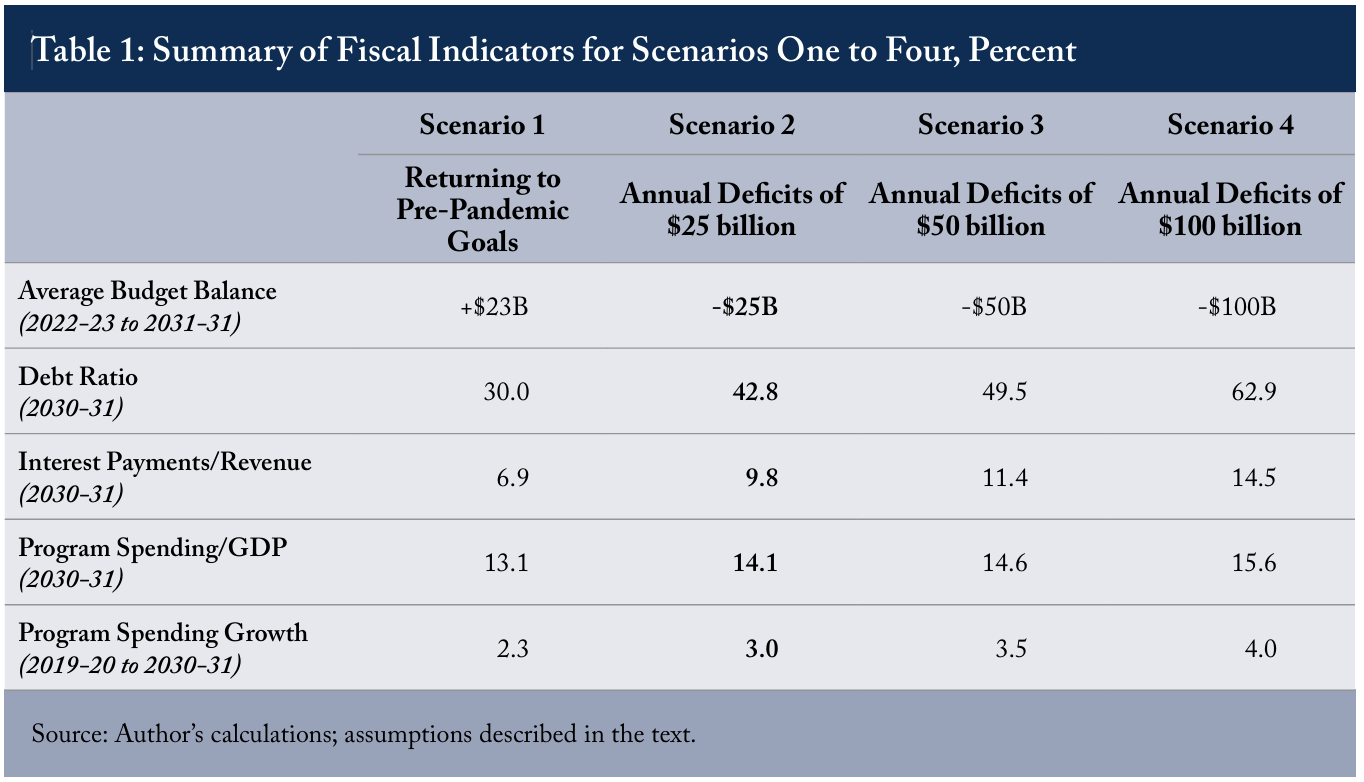
The fog obscuring Canada’s fiscal future forces the use of scenarios as opposed to point estimates. Each scenario targets a deficit and debt track into the 2030s. With the budget balance and hence debt level given, and revenues and the effective interest rate on debt fixed and applied the same across all scenarios, the exercise is to calculate the implied program spending level as a residual. The approach fits the central question, which is to inform how much spending room is available. The results of the scenarios considered here are summarized in Table 1.
Scenario One: Returning to Pre-Pandemic Goals
The objective in this scenario is to return to the 30 percent target for the debt-to-GDP ratio. As the ratio will rise above 50 percent for a few years, it is not realistic to think of that happening any time soon. Hitting 30 percent within 10 years, by 2030-31, would require average annual surpluses of $23 billion for the nine years 2022-23 through 2030-31. Postponing the target until 2035-36 would require annual surpluses of $1 billion; essentially 14 years of balanced budgets after the pandemic deficit surges of 2020-21 and 2021-22.
Persistent surpluses, or even balanced budgets, are out of character with Canada’s fiscal history and incompatible with recent musings of the government and plans referenced in the Speech from the Throne. By 2030-31, the ratio of program spending to GDP would be around 13.1 percent, below the average since the mid-1990s, and average annual growth in program spending could only be around 2.3 percent. Few if any of the initiatives in the Speech from the Throne could proceed without very large tax increases, rendering their implementation unachievable.
While returning to a 30 percent debt burden would involve sacrifice, rejection of getting there even by 2035-36 is tantamount to a decision to pass part of the cost of addressing COVID-19 to a future generation.
Scenario Two: Pre-Pandemic Deficit Aspirations of $25 billion a Year
As noted above, a debt burden of 30 percent could have been maintained with annual deficits of around $25 billion. This scenario basically accepts the fiscal hit from the pandemic and returns to a target of $25 billion for annual deficits as of 2022-23. By 2030-31, the debt burden would be 42.8 percent, still relatively high but down a bit from that expected this year and for the next few years. Public debt charges would be 9.8 cents on the revenue dollar, narrowly satisfying the Dodge rule. Program spending would be 14.1 percent of GDP, a bit above the ratio since 1995-96 but well below that preceding the fiscal crisis. Program spending could increase at an annual pace of 3.0 percent. Pushing the framework out to 2035-36 provides very little relief.
One reason why there is so little room for spending in future is that any targets for the budget balance or deficit must be met while carrying the ongoing cost of paying interest on the pandemic-related borrowing. The deficits for this year and next are estimated here to sum to $500 billion, whereas they might have totaled only $50 billion had the pandemic not occurred. Even at an effective interest rate of 3.4 percent, that extra borrowing has an ongoing, annual cost of $15.3 billion, money that is not available for spending on future programs.
This scenario seems to be the most spend-thrifty that satisfies, but barely, most of the fiscal conditions that have been suggested of late. Yet it does not provide much room for major new spending initiatives. Program spending would be a lower portion of the economy than in recent years and only slightly higher than the post1995-96 average. It provides a nod to fiscal stability but does seem incompatible with the aspirations set out in the Speech from the Throne.
Scenario Three: Annual Deficits of $50 billion
This scenario features annual deficits of $50 billion every year beginning in 2022-23 with the extra $25 billion a year going to higher spending to cover new initiatives. By 2030-31, the debt burden is 49.5 percent. In brief, the pandemic-inflated debt burden gets locked in and stabilized. This would mean that the roughly $450 billion of pandemic-induced debt incurred during 2020 and 2021 is passed in its entirely onto future generations. Interest payments would be 11.4 cents on the dollar, violating the Dodge rule. Program spending would be 14.6 percent of GDP by 2020-31, just above the values of late, meaning program spending growth could be around the same 3 ½ percent pace as nominal GDP.
With this scenario we see violation of the key fiscal indicators being suggested as an anchor. Yet while there is more room for new spending initiatives, there would still be a need to ration the ambitious aspirations set out in the Speech from the Throne.
Scenario Four: Annual Deficits of $100 billion
This scenario features annual deficits of $100 billion every year beginning 2022-23, all due to higher program spending. By 2030-31, the debt burden would be 62.9 percent. Public debt charges would be 14.5 cents on the revenue dollar. Program spending would be 15.6 percent of GDP, essentially straddling the pre-and post-1995-96 figures. Program spending growth could be 4.0 percent per annum, ½ a percentage point faster than the growth in nominal GDP, tilting the private-public split in economic activity significantly toward the public.
If this scenario is extended to 2035-36, the debt burden hits 68 percent and public debt charges go to 15.6 percent on the revenue dollar.
If debt burdens of 62.9 and 68 percent of GDP sound familiar, it is likely because the peak in the postWar period was 66.8 percent at the fiscal crisis of 1995-96. It is worth remembering the sacrifices that were necessary to deal with that crisis. It is perhaps best captured in the observation that in 2000-01, Canadians only benefitted from 67 cents in program spending for every dollar they sent to Ottawa in taxes. The rest was required to service the debt and record a modest budget surplus.
Alarming as the fiscal risks connected with Scenario Four are, it is not obvious that the aspirations of the Speech of the Throne could be realized within its parameters. Could ambitious economic and social reengineering be pulled off within 4 percent annual growth in program spending and a share of program spending in the economy not much higher than in recent years?
It is tempting to consider yet another scenario. If program spending growth were 5 percent per annum, the debt burden in 2030-31 would be 69 percent instead of 62.9 percent. That would mark a post-War record high. Such a scenario seems too fraught with risks to consider further.
The Scenarios May Not Cover Risks
These scenarios are based upon assumptions that may not hold. It is certainly possible things could be more favourable; economic growth could be stronger, interest rates might not rise as much, especially as much of the debt is currently being locked into long-term borrowing. But things could also be worse and reasonable risk management strategy pays a lot of attention to the downside. The fiscal track implicitly assumes that the pandemic subsides to a considerable degree in 2021, allowing the extraordinary spending initiatives to be withdrawn and the economy to grow more firmly. We cannot, however, rule out COVID-19 lingering longer.
Looking longer-term, whether it stems from economic, financial or health factors, Canada tends to be hit with some sort of fiscal shock every decade or so. None is incorporated in the scenarios described. Once the pandemic subsides and the economy recovers fully, growth is projected to proceed smoothly and interest rates rise slowly and modestly. No insurance is built into any scenario through the creation of a buffer to handle shocks such as lower growth, whether that be weaker potential growth, or a recession, or a more significant rise in interest rates. Simply returning to the average effective interest rate on public debt that prevailed over the 10 years prior to the 2008 financial crisis would add more than $40 billion per year to the annual deficits in each of the scenarios.
Lessons from the Fiscal Scenarios
- Restoring and then maintaining fiscal stability as defined by most, calls for some degree of fiscal restraint once the pandemic subsides.
- Such restraint could be a combination of curtailing program spending or increasing taxation; the latter option is not examined here as the government has indicated that, with minor exceptions, it does not intend to increase the tax burden.
- The expensive initiatives set out in the Speech from the Throne cannot be fully implemented within the bounds of any reasonable definition of a fiscal anchor.
- Scenario II which foresees annual deficits of $25 billion after 2021-22 is the most spend-thrifty, satisfying most of the definitions of a fiscal anchor or fiscal responsibility that are being bandied about. It leaves the debt burden relatively high, but at least brings it down from current, bloated levels. It keeps interest payments just under 10 cents on the revenue dollar. It has program spending increasing somewhat less strongly than the economy.
- Scenario III with $50 billion per year deficits after 2021-22 violates most prudent fiscal parameters. It stabilizes the debt burden, but at close to the peak level of this year. All the cost of addressing COVID-19 is effectively passed to future generations. Interest payments rise above 10 cents on the revenue dollar. Still, program spending does not rise above the recent share of the economy and that puts into question whether many of the Speech from the Throne initiatives could be implemented.
- Implementing the Speech from the Throne initiatives fully likely implies running annual deficits of $100 billion or higher. That puts the country squarely back into the conditions that precipitated the mid-1990s fiscal crisis and any future shock would put the country into debt country not experienced since WWII.
- None of the scenarios deal with all the plausible downside risks, both near-term and longer-term.
These lessons from the scenarios dictate that the focus must shift from how much money should be thrown at Canada’s challenges to how they can be addressed most effectively and efficiently – and what else can be pared back to create the fiscal room to do so. Otherwise, much higher taxes will need to be considered, preceded by a discussion on the economic damage such taxes would inflict.
Within the government of Canada, analysts must have conducted scenarios like those outlined above over recent months. The architects of the Speech from the Throne must be aware that fiscal interpretation of its plans features deficits of at least $50 billion a year as far as the eye can see and likely quite a bit higher, even $100 billion a year or more. The debt burden may stabilize but at the bloated current level; it could even go higher.
Conclusion
Before the pandemic Canada was not well positioned to embark upon an era of very strong government spending increases. It is even more constrained now by the longer-term borrowing costs associated with paying for pandemic-related spending. The Canadian public must be more engaged in discussion of the challenges and choices that lie before the country. To make that discussion productive, the government must provide more economic and fiscal information and reveal the results of the internal deliberations that took place during its drafting of the Speech from the Throne.
References
Canada. 2018. Update of Long-Term Economic and Fiscal Projections 2018. Department of Finance Canada. December.
______. 2020a. Economic and Fiscal Snapshot 2020. Department of Finance Canada. July.
______. 2020b. Speech from the Throne to open the Second Session of the Forty-Third Parliament of Canada. Privy Council Office. 23 September.
Dodge, David. 2020. “Two Mountains to Climb: Canada’s Twin Deficits and How to Scale Them.” Public Policy Forum. September.
Drummond, Don, and Evan Capeluck. 2015. “Long-term Fiscal and Economic Projections for Canada and the Provinces and Territories, 2014-2038.” Centre for The Study of Living Standards: CSLS Research Report 2015-08. July.