




by Steve Ambler and Jeremy M. Kronick
- The current pandemic and the accompanying economic lockdowns have led to the deepest economic downturn since the Great Depression. Fiscal and monetary authorities have acted in kind, with unprecedented stimulus and expansion of balance sheets.
- The Bank of Canada, for its part, dropped the overnight rate to 25 basis points – considered by the Bank to be its effective lower bound – and intervened heavily in various asset markets to ensure market liquidity and well-functioning financial markets. With these interventions come challenges and risks, both in terms of hitting the Bank’s 2 percent inflation target and navigating a balance sheet with assets outside its usual holdings of federal government debt.
- In this paper, we review the Bank’s market interventions, and discuss their implications for achieving the 2 percent target, alongside additional credit and political risks.
The Short Run
The Bank of Canada has introduced a tremendous number of monetary policy measures since the COVID-19 crisis began, summarized in Table 1.
The Bank began its COVID-related stimulus in March 2020 with two 50-basis-point cuts to its target overnight rate 10 days apart. Two weeks later, it cut by another 50 basis points, bringing the overnight rate to 25 basis points, a rate which the Bank now considers to be its effective lower bound.11 The Bank’s previous research, as in for example Witmer and Yang (2016), suggested that its effective lower bound could be as low as -50 basis points. We would recommend that the Bank explain this change in its thinking. Only the first of the three reductions occurred on a normal announcement date.22 The Bank of Canada schedules eight “fixed action date” announcements per year at which it announces any changes to its overnight rate target.
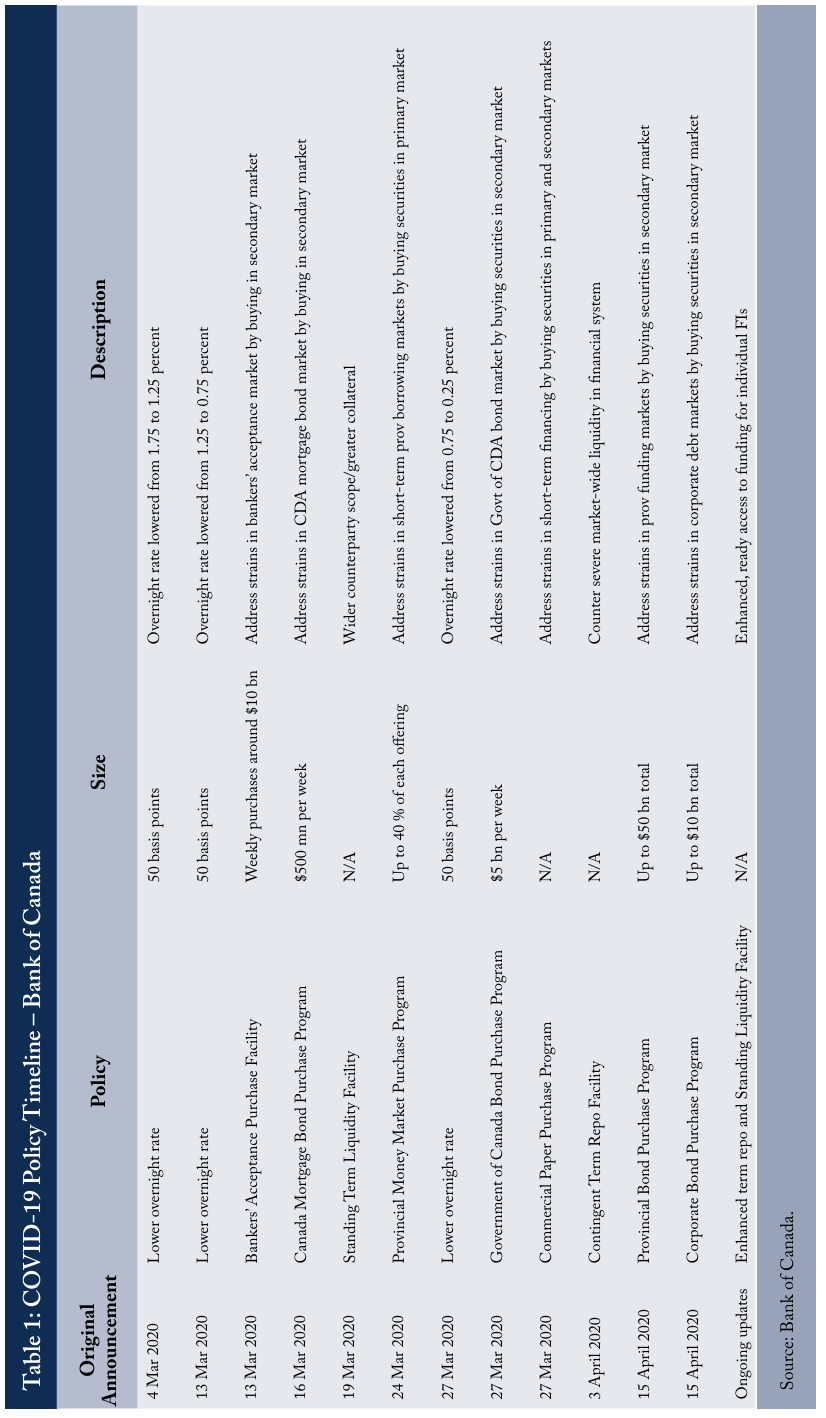
It quickly became apparent that the response needed to this crisis went far beyond conventional monetary policy. Fearing that this economic shutdown could turn into a financial crisis as well, the Bank engaged in policies geared towards supporting critical financial markets and shoring up liquidity at financial institutions. Box 1 describes these facilities in greater detail. These policies include the Bank of Canada’s first major foray into large-scale asset purchases beyond monetary policy’s usual federal government debt purchases – specifically, involving purchases of private-sector and provincial debt. As we detail below, the Bank of Canada has taken on additional credit and political risks through these purchases.
Has it Worked?
How have these programs worked so far? During the week of March 11, the Bank of Canada’s balance sheet sat at a little over $120 billion. In a little over two months, it almost quadrupled to $442 billion, a remarkable increase. The rate of growth has slowed, with total assets and liabilities peaking at $542.6 billion on the week of August 19th, and has actually fallen to $535 billion at the time of writing (week of September 9th).
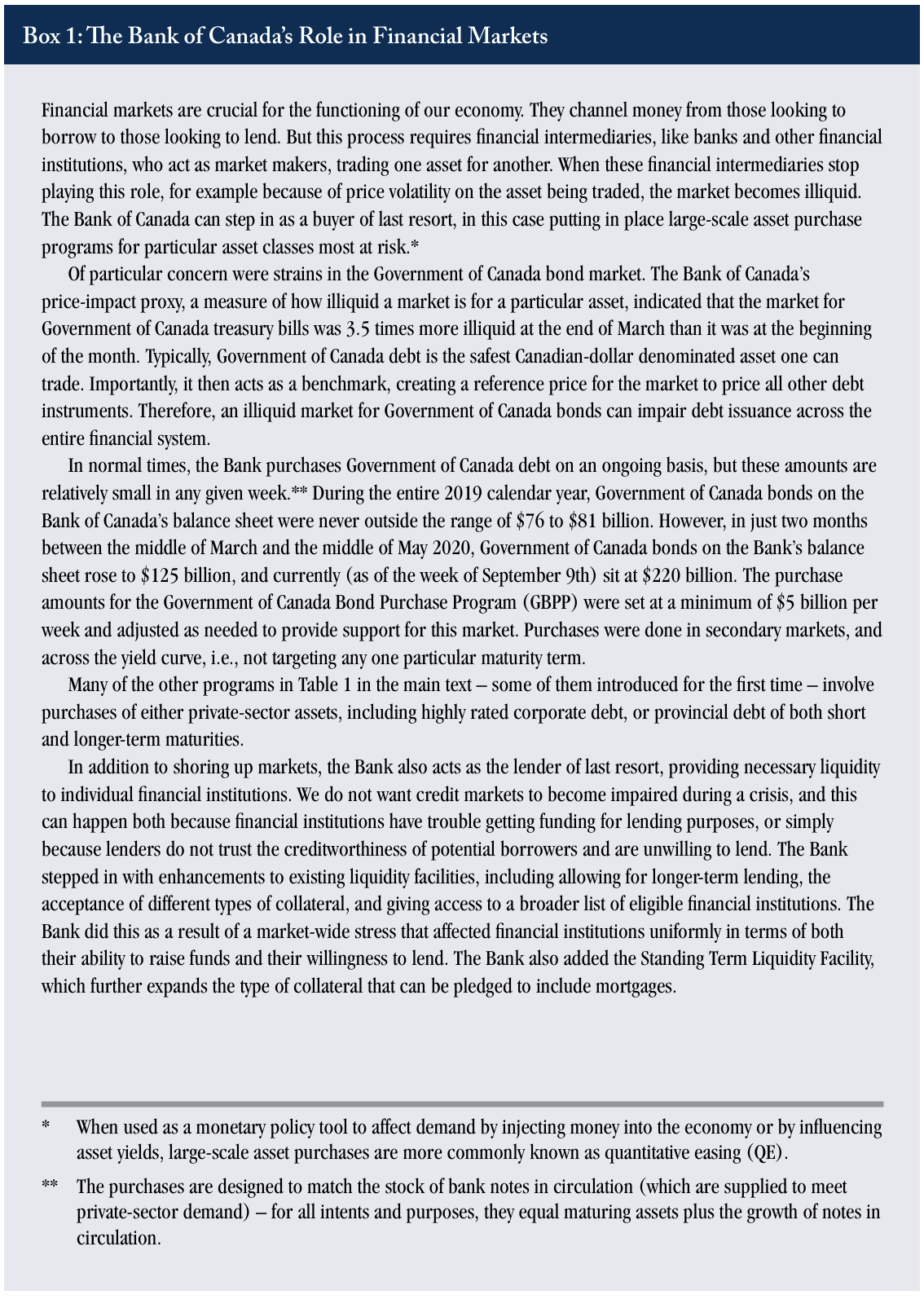
Table 2 details the change in asset and liability categories from the week of March 11 to the week of September 9. As we see, the bulk of the increase on the asset side has been purchases of federal debt and repurchase agreements, a form of temporary loans, with financial institutions. Most of these repurchase agreements are short-term in nature, and will mature and roll off the balance sheet, with a commensurate decrease in the reserves on the liabilities side of the balance sheet.33 It should be noted that nearly 70 percent of the securities purchased under resale agreements are corporate securities, while another 20 percent are provincial debt, both securities outside the Bank’s traditional remit. The Bank will have to be careful that, when these assets roll off the balance sheet, it will not cause a re-widening of the spreads they worked so hard to narrow (as we document next).
Two criteria for judging the success of these programs, according to the Bank of Canada’s recent Financial System Review (Bank of Canada (2020), henceforth FSR), are (i) improvements in liquidity and (ii) a declining use of the programs since they began.
First, consider liquidity access. One can evaluate this using different measures, including the Bank of Canada’s price-impact proxy, a measure of how much the price of the debt instrument moves as a result of one trade (the higher this measure the less liquid and more volatile the market is).44 See Gungo and Yang (2017) for more detail.
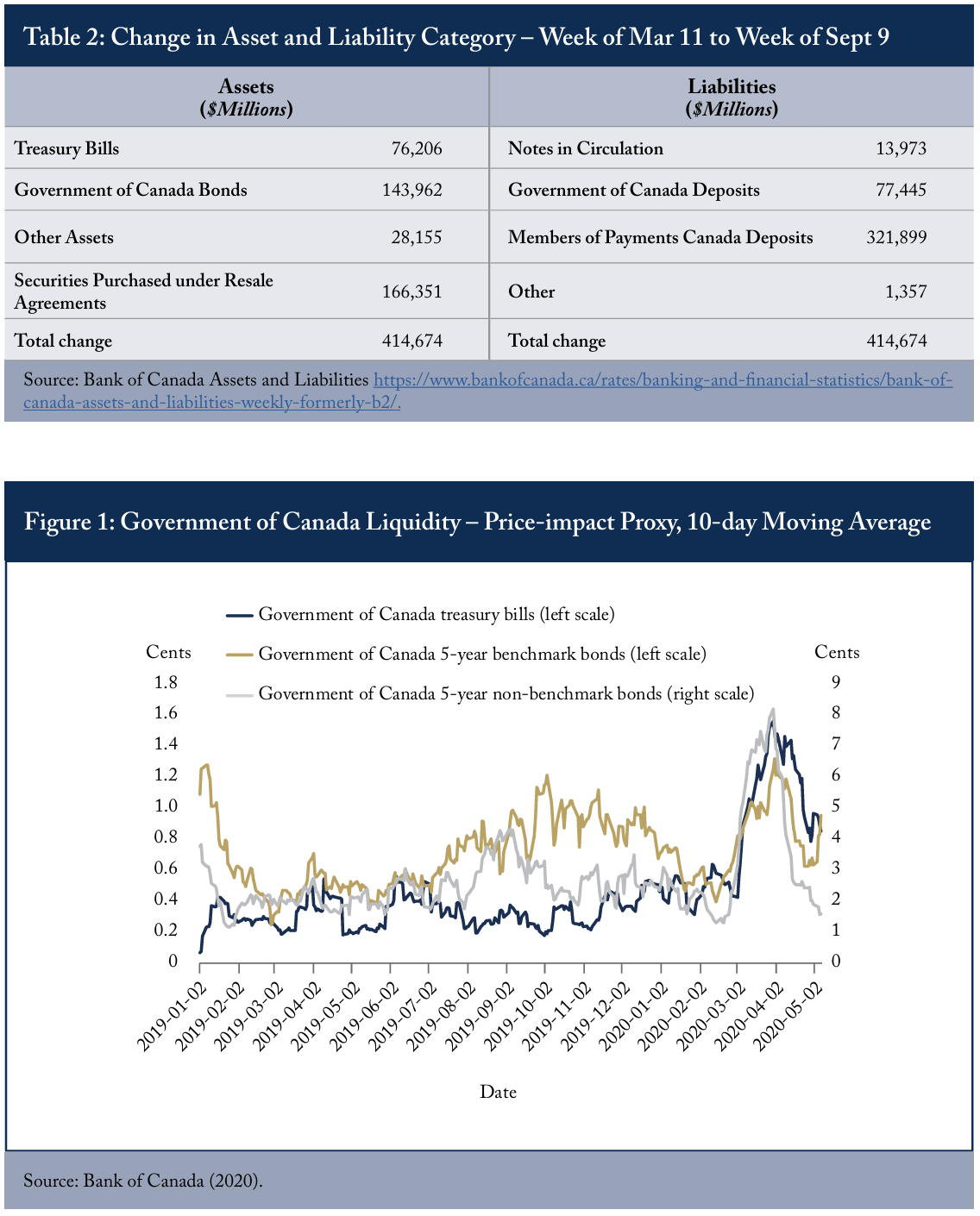
We focus in Figure 1 on Government of Canada debt, since this is the benchmark against which all other debt is measured. After huge spikes in March, the price-impact proxy fell to much more normal levels indicating improved liquidity and less volatility.55 Of course, other policy actions were happening simultaneously, including interventions south of the border by the Federal Reserve. It is beyond the scope of our paper to run a horse race to determine which policy contributed most to the spreads here stabilizing.
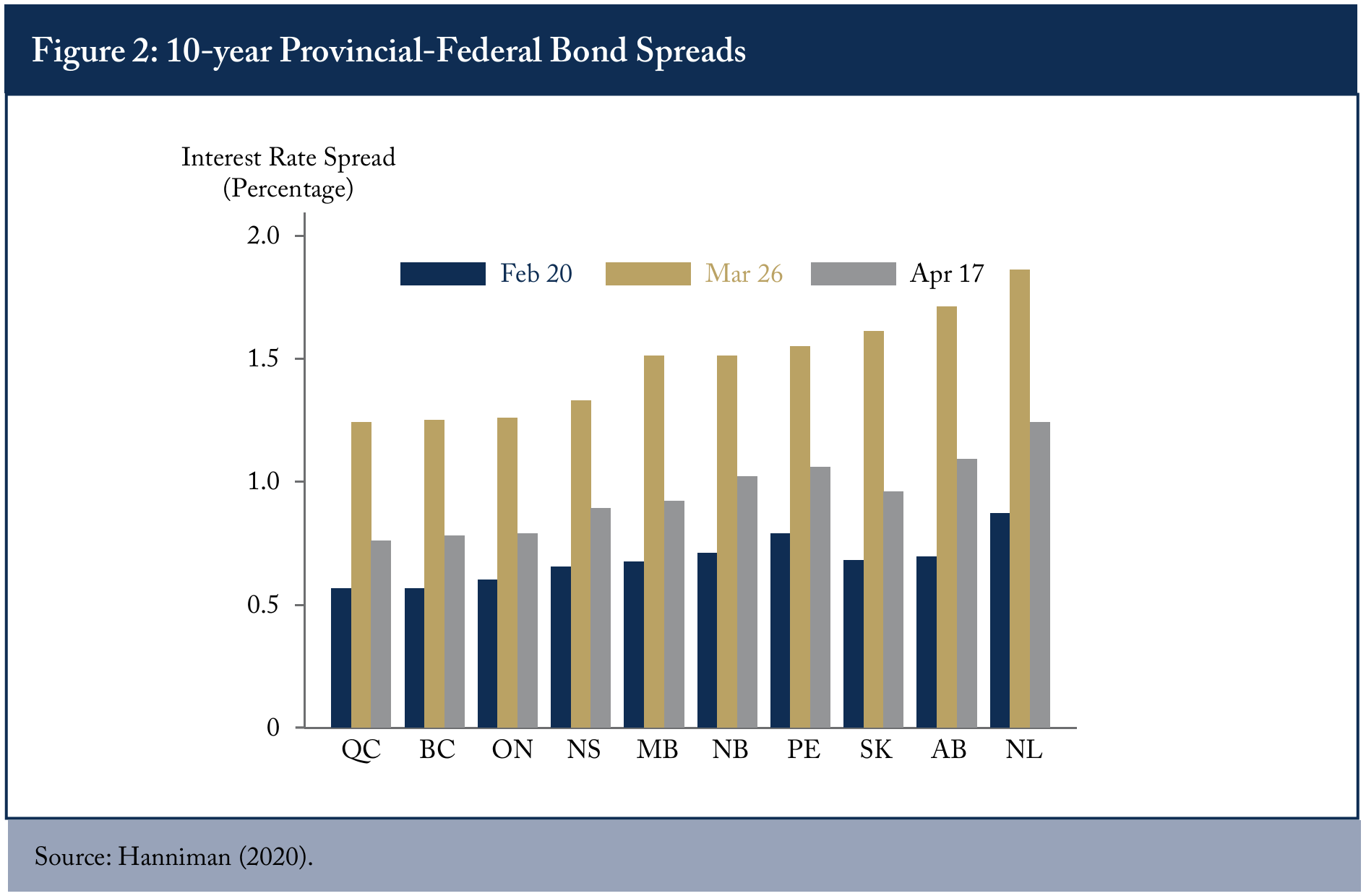
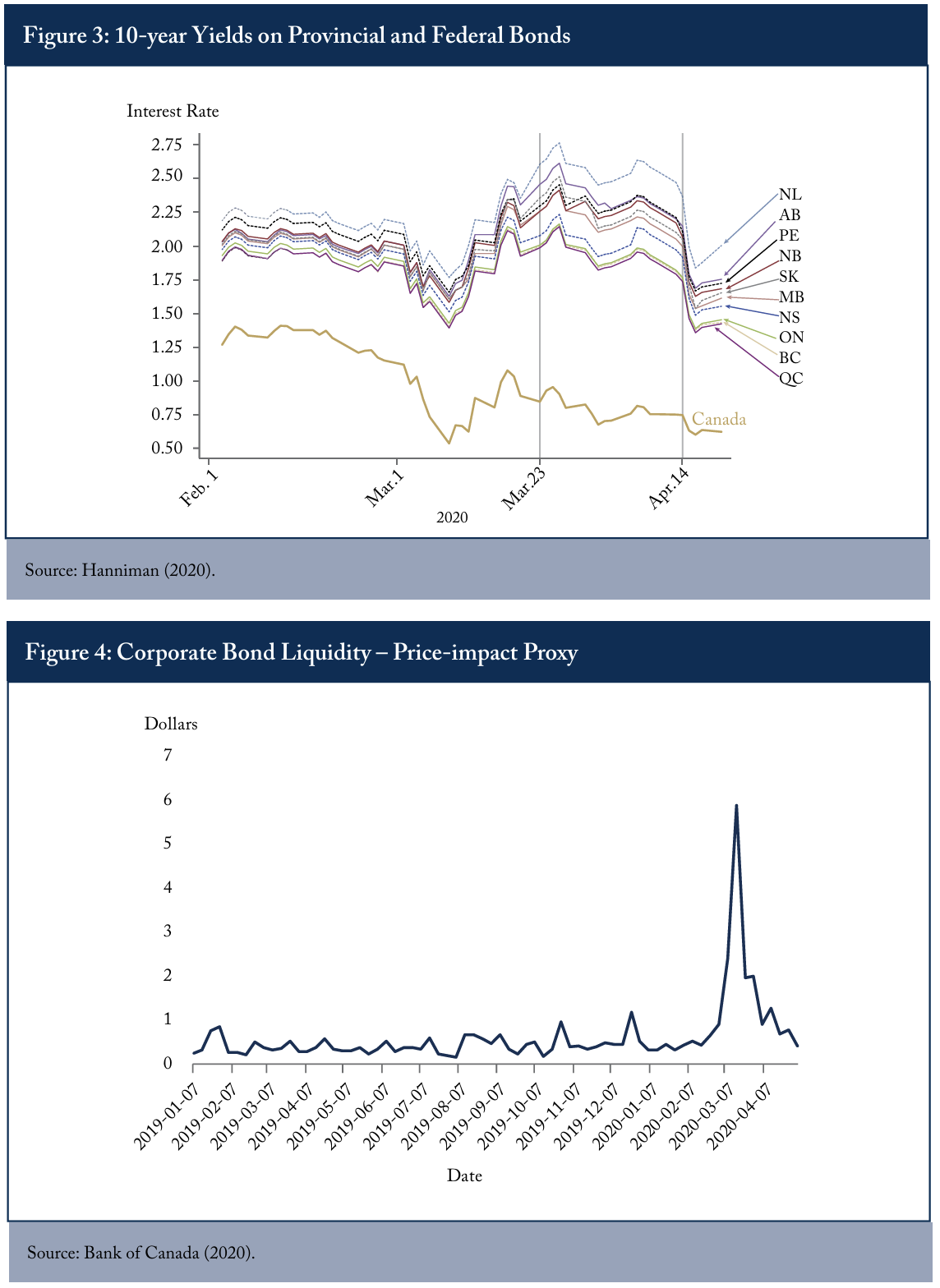
Similarly, even though provincial debt purchase programs have not seen large uptakes, the mere presence of the Bank of Canada standing ready to purchase that debt had a huge impact by narrowing the yield spreads between provincial bonds and federal government bonds. Before the crisis, all 10 provinces had spreads over federal debt below 100 basis points (Figure 2). On March 26, the day before the Bank announced it would start buying short-term provincial debt, spreads over federal debt across all provinces were well above 100 basis points, with Newfoundland closing in on 200 basis points. By April 17, two days after the Bank announced it would also buy longer-term provincial bonds, thus increasing their prices and lowering their yields, spreads had returned to much more normal levels. The latter announcement also had the effect of reducing actual borrowing costs across all provinces back to the levels seen in February before the crisis (Figure 3).
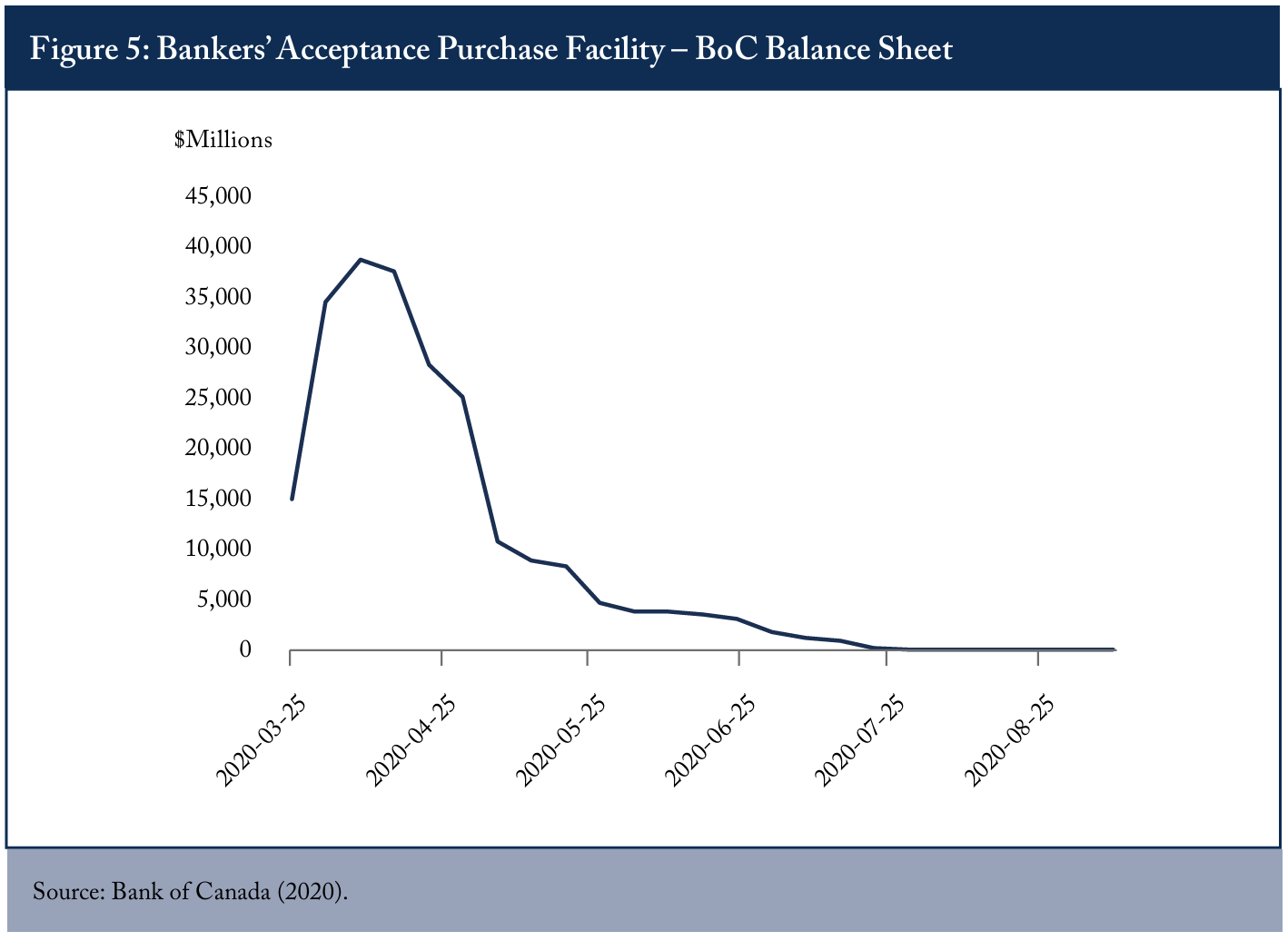
A similar story holds for private-sector debt. Early March saw a massive spike in the price-impact proxy of corporate bonds (liquidity dropped and volatility rose), a result of businesses being unable to raise cash through usual corporate bond issuances (Figure 4). The Bank’s private-sector purchase programs clearly increased liquidity, as we see a fall back to normal levels for the proxy following these interventions.
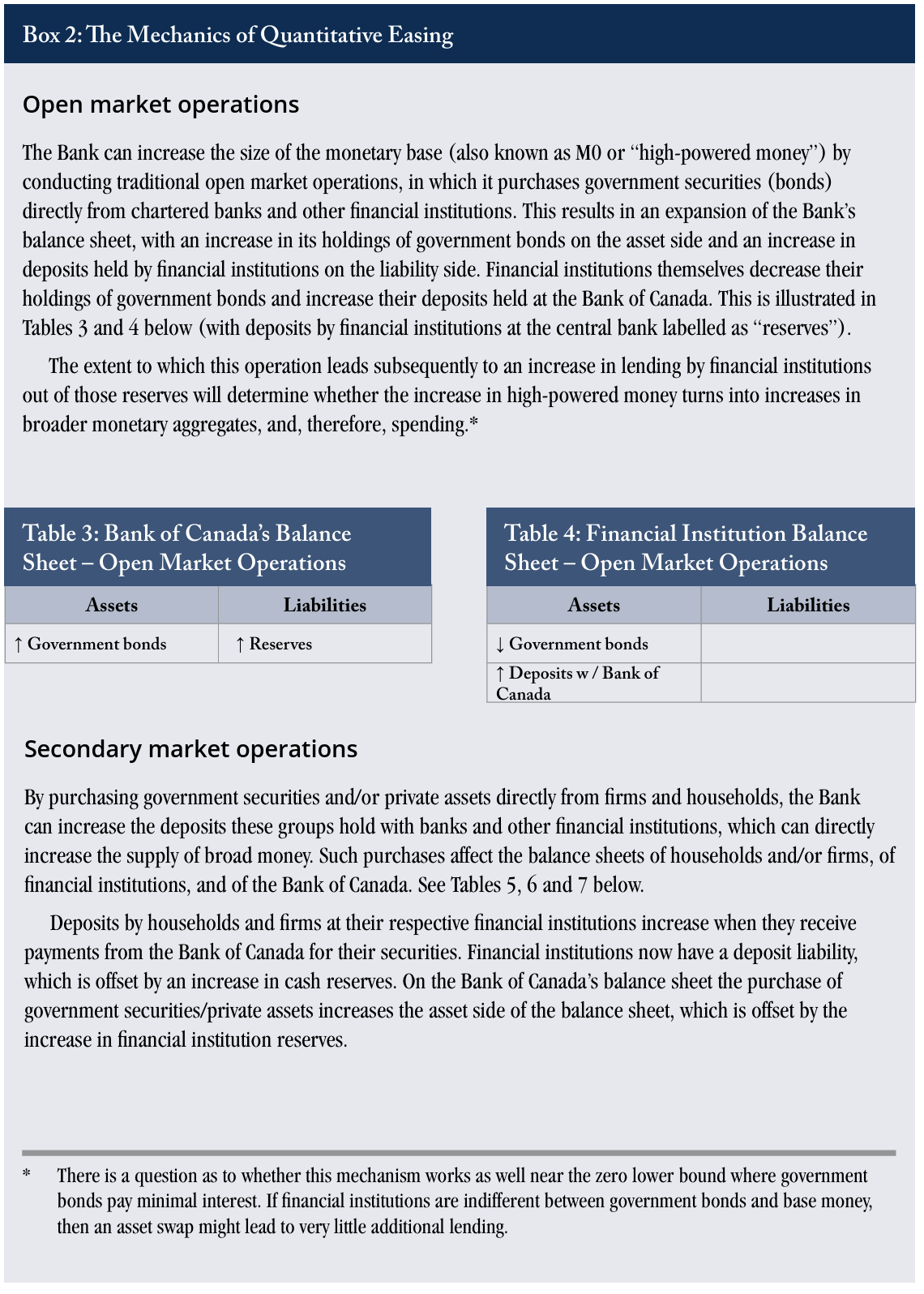
The use of these programs has also fallen since they were first announced. For example, the bulk of the bankers’ acceptances66 From McRae and Auger (2018): “A Bankers’ Acceptance is a direct and unconditional order from a corporate borrower (client) to draw down against its established line of credit (called a “BA facility”) at a Canadian bank. Once the drawdown occurs, the accepting (or lending) bank guarantees the principal and interest by stamping the paper, thus becoming fully liable for the payment upon maturity in case of nonpayment by the underlying corporate borrower….Once stamped, the BA is transferred to the bank’s (or dealer’s) stock of money market inventory, where it can be sold to investors in the secondary market.” purchased by the Bank of Canada early on in the crisis have matured and have not been replaced, as can be seen by the size of the program on the asset side of the balance sheet, illustrated in Figure 5. In the week of March 25, the first $15 billion was offered and used. Another $20 billion was offered and used the week after, and the total amount peaked during the week of April 8, but the rate of use was well below 100 percent (Bank of Canada 2020, chart 3-B). The amount has shrunk steadily since, from a peak of $39 billion to zero by the end of July.
A massive expansion of the Bank of Canada’s balance sheet entails risks. When the Bank ventures into privatesector and provincial debt, it takes on credit as well as political risk, though the government has indemnified the Bank for any losses on the former.77 Political risk can come in different forms. A first example would be how the formula for purchasing different provinces’ debt could be seen to favour some provinces at the expense of others. A second example would be how the future sale of provincial debt could put upward pressure on provincial borrowing costs. Another possible downside is that it may flatten yield spreads and hide the market’s judgement concerning the relative riskiness of different assets. But it is clear that the Bank’s actions in the short term helped Canada avoid turning an economic shutdown into a financial crisis, which would have exacerbated the fall in economic activity. With credibility, independence, and inflation pressures, the medium and long run are where the real challenges lie.
The Medium and Long Run
With the fall in demand at the start of the pandemic, inflation has fallen in the short run. Headline inflation, measured by growth in the Consumer Price Index, dropped to 0.9 percent in March, just under the Bank of Canada’s target band of 1–3 percent, the first time it has been outside the target band since May 2015. In April, headline inflation turned negative (-0.2 percent) for the first time since September 2009. Inflation was even more negative in May (-0.4 percent), but rebounded to 0.7 percent in June before falling to 0.1 percent in July, the latest available data point at the time of writing.
With lockdowns in place, the Bank of Canada could do very little to stimulate demand, even by pumping money into the system with asset purchases. It therefore made sense for it to concentrate on the smooth functioning of financial markets. It was able to expand its balance sheet to deal with liquidity and financial stability without worrying that the expansion would generate inflation.
As economic activity slowly picks back up, it becomes more sensible to focus on the Bank of Canada’s impact on aggregate demand and inflation.
The Bank will be faced with trade-offs among three interrelated concerns88 If the economic downturn were entirely the result of a negative shock to demand, there would, in principle, be no trade-off between the first two objectives. A negative demand shock causes both output and inflation to fall, and expansionary monetary policy boosts demand and indirectly puts upward pressure on inflation. With respect to this pandemic, however, it is both a demand and supply shock, where the latter could lead to a high inflation low demand scenario, which necessarily causes a trade-off between the two objectives. – with each directly tied to the Bank’s independence and credibility:
- Provide stimulus to aid in the recovery.
- Hit its inflation target within a time horizon, which will likely be extended beyond the usual six to eight quarters.
- Manage its holdings of government and private-sector debt.
We note that, while monetary policy is the focus of this paper, there can be no doubt that fiscal policy will have an outsized role in the COVID-19 recovery phase, and will therefore factor into the tradeoffs the Bank faces.
Providing Stimulus
The Bank of Canada stimulates aggregate demand mainly by lowering real interest rates. In normal times, it achieves this by lowering its overnight target rate, the very short-term interest rate the Bank targets for monetary policy purposes, thereby reducing other short-term and longer-term nominal rates. When the overnight rate is at its effective lower bound, this is no longer possible.99 The Bank considers 25 basis points to be its effective lower bound. Some central banks such as the Swedish Riksbank, the Swiss National Bank, the European Central Bank, and others, have experimented with negative policy rates during the period since the financial crisis; the theory being that there are costs to holding cash, meaning zero is not the true lower bound. However, it is unclear to what extent these negative rates have been effective in pushing retail interest rates (short and long term) below zero. At the lower bound, an alternative way to achieve lower real interest rates is to raise inflation expectations through, for example, forward guidance (a commitment to keep the overnight rate low for long), or to affect longer-term yields by purchasing assets with longer maturities. Its main tool to achieve this is quantitative easing (QE), the expansion of its balance sheet via the purchase of different assets with different term premiums.
Much of the empirical literature on the effectiveness of QE has focused on the impact of asset purchases of bonds on interest rates in the economy and, particularly, the reduction in the upward slope of the yield curve from short to long term. In general, researchers (e.g., Thornton 2015) have found the impact to be very limited in quantitative terms, because longer-term yields are typically already very low at the lower bound.1010 When researchers find significant effects, they can be measured in tens of basis points even for very large asset purchases. Thornton (2015) gives a detailed summary of the literature and writes (page 1) that “in fact, there is virtually no credible evidence that QE led to persistent reductions in long-term yields via the channels identified by the Fed.”
We use a more monetarist focus, looking at the impact of QE on broad monetary aggregates, the liabilities which are created when the banking system expands credit to the private sector.1111 The narrowest definition of the money supply (M1+ in Canada) generally includes currency in circulation and chequable deposits at banks and other financial institutions. Broader measures include less liquid assets such as savings deposits, time deposits, and money market funds. For the exact definitions see https://www.bankofcanada.ca/rates/banking-and-financial-statistics/selected-monetary-aggregates-and-their-components-formerly-e1/. They are not just the flip side of credit expansion: an expansion of broad monetary aggregates can directly affect aggregate demand as argued in more detail in Ambler (2016).
There are essentially two different ways the Bank can implement QE: through open market purchases from banks and other financial institutions and through purchases in secondary markets (see Box 2 below for the mechanics of both. We also reference the July 2020 MPR, which discusses the different channels with which quantitative easing provides monetary stimulus.).
Traditional open market operations involve the purchase (and sale) of government securities from the banking sector, thereby affecting the amount of settlement balances, or reserves, held by banks at the central bank.1212 This operation expands the quantity of so-called high-powered money, which equals currency in circulation plus commercial bank deposits held at the central bank – otherwise known as the monetary base. The normal response for banks in exchanging government securities for cash is to expand their lending, which would in turn lead to an increase in broader monetary aggregates as households and businesses spend some of what they borrow and deposit the rest. These aggregates are more closely tied to spending in the medium term.
In crisis times, things are not so simple. Banks normally earn interest on their deposits at a rate 25 basis points below the overnight rate (the deposit rate). The overnight rate itself is the rate for borrowing and lending between these financial institutions. Keeping the deposit rate below the overnight rate encourages banks to lend to each other.1313 Especially because the Bank rate – the rate banks get if they borrow from the Bank of Canada – is set 25 basis points above the overnight rate. However, when the Bank of Canada lowered its target overnight rate to 25 basis points on March 27, its deposit rate was set equal to the target overnight rate, creating a de facto “floor system.” In the middle of the crisis, this is appropriate as the system is awash in reserves, with the Bank of Canada expanding its balance sheet, which will drive down the overnight rate towards the deposit rate. However, as the recovery takes hold, a floor system with an expanded balance sheet can act as a drag on the so-called money multiplier (the ratio of broad monetary aggregates to high-powered money) if banks evaluate their portfolios and determine that the interest they earn leaving deposits at the central bank outweighs the risk-adjusted return on lending.1414 For a more detailed description of the operation of floor and corridor systems, see Beckworth (2018), Selgin (2018) and Appendix A. With less of an incentive to increase lending, there is less of an expansion of credit and deposits, and consequently less of an impact on private-sector spending.
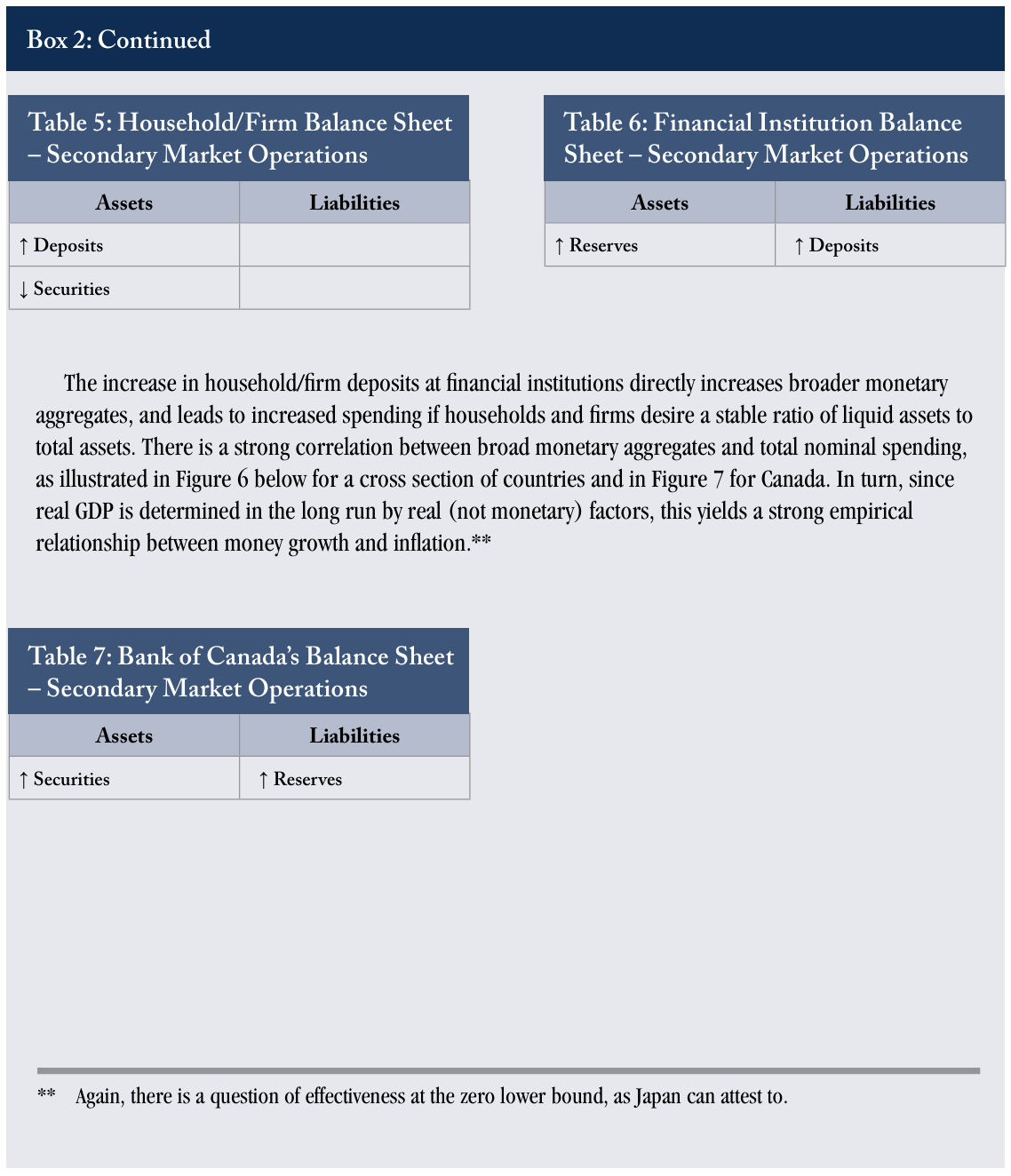
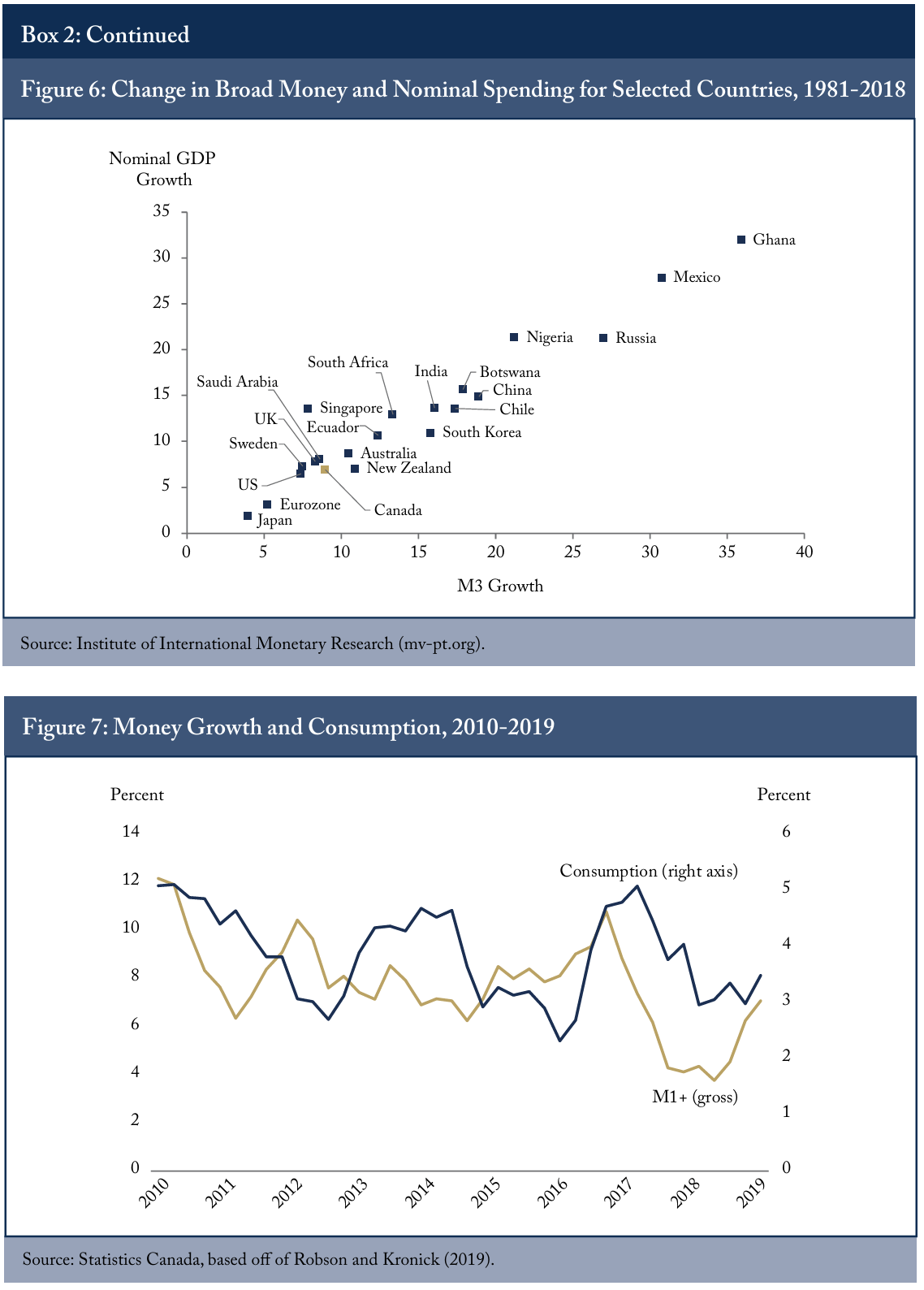
Instead of more traditional open market operations, the Bank could purchase longer-term government bonds and private-sector securities directly from the private sector. These operations in secondary markets1515 Congdon (2010) goes into more detail on the distinction between open market operations and operations in secondary markets, which he calls credit market operations. have the effect of directly increasing broader monetary aggregates and the liquidity of private-sector portfolios if firms and households desire a stable ratio of liquid to total assets in their portfolios, since this will have the effect of encouraging spending.
Regardless of how QE is implemented, the effect on spending and inflation will be sensitive to the expected path of monetary aggregates. If private-sector agents expect that the Bank of Canada will quickly reverse these operations, they will have an incentive to simply hold on to their liquid assets.1616 Ambler (2017) demonstrates this permanence issue in the context of a simple New Keynesian model and discusses how this is confirmed by empirical evidence. This means that the Bank of Canada should continue to be explicit about how its balance sheet will evolve, while explaining the rationale for continued intervention now that markets appear to have stabilized.
Longer-run Pressures on Inflation and how to Deal with Them
As discussed above, inflation fell below the 1-3 percent target band in March, and fell into negative territory in April for the first time since September 2009. Because of the forced shutdowns of many markets, some of the goods that go into the basket used to calculate the CPI were not available during the lockdown period, making the standard measures of inflation less reliable than normal. The Bank of Canada acknowledged as much in the July 2020 MPR, where it discussed an adjusted price index that better reflects pandemic spending patterns. But even here, strong disinflationary pressures are present.
In normal times, under the Bank’s inflation targeting (IT) framework, it would plan to get inflation back up to target within a six- to eight-quarter horizon. Given the magnitude of the current crisis, they will likely be forced to extend the usual horizon.
An inherent part of the IT framework is that past failures to hit the inflation target are treated as bygones. Past undershoots don’t affect the continuing 2 percent target. This suggests that while exerting efforts to get inflation back up to target, the Bank will likely resist the idea of an inflation overshoot. However, in theory, the optimal monetary policy under inflation targeting involves correcting past mistakes and implies a constant price level in the long run or a reversion to the trend price-level path.1717 See Clarida, Galí and Gertler (1999). Amano, Ambler and Shukayev (2012) analyze conditions under which a constant price level is optimal only to a first-order approximation. On the optimality of price-level path targeting see Ambler (2009, 2014). If inflation undershoots the target, a credible promise to correct this mistake with higher inflation boosts inflation expectations, lowers real interest rates, and stimulates demand.
This means that aiming for inflation to overshoot the target would help in the recovery. The Bank should explicitly acknowledge this, while at the same time emphasizing that the overshoot will be temporary in order to keep longer-term inflation expectations anchored at 2 percent. A concrete way to achieve this would be to move to target the average rate of inflation over a horizon of two or three years, which would lead to the partial correction of both undershoots and overshoots of the target.1818 This would be a minor modification of the Bank’s inflation control agreement with the Government, which in any case will be renewed late in 2021. The Federal Reserve Bank announced on August 27 that it would henceforth target an average inflation rate of 2 percent (without specifying the horizon over which the inflation rate would be averaged). See https://www.federalreserve.gov/newsevents/pressreleases/monetary20200827a.htm.
To ensure credibility that the overshoot will be temporary, the Bank will simultaneously have to address the implications of its massively inflated balance sheet. The Bank has two main options.
The first would be simply to taper the balance sheet once the crisis period is deemed over. Many of the Bank’s newly acquired assets are short-term, including most of the repos. These could simply be allowed to expire without rolling over the financing. In the case of outright purchases of longer-term assets, the Bank will have to sell them off with either open market operations or secondary market operations. As mentioned, it will need to consider the relative sizes of narrow and broader monetary aggregates as it does this, and provide guidance to the private sector in order to manage expectations.
The second option would be to keep a floor system. The Fed’s floor system allowed it to maintain a greatly expanded balance sheet after 2009 without leading to high inflation. Because banks and other financial institutions were paid interest on their excess reserves, their opportunity cost of using these reserves to expand loans and deposits was higher. Loans and deposits expanded much more slowly than the Fed’s balance sheet, which mitigated inflationary pressures but had the adverse effect of slowing down the recovery from the financial crisis.1919 See, for example, Beckworth (2018), Selgin (2018) and Ireland (2019). See Appendix A for more. There is also the political risk of paying interest on what amounts to hundreds of billions of dollars of settlement balances being held at the Bank.
Therefore, we advocate for the first option, with an orderly return to a corridor system once it is clear that the size of settlement balances can be safely (from an economic point of view) reduced.
Moreover, there are already signs that the current crisis is quite different than the Great Recession in terms of the behaviour of broad monetary aggregates, both in Canada and the United States. The growth rates of M3 in both countries declined rapidly at the beginning of the Great Recession,2020 See Figure 6.1 in Ambler and Kronick (2018). which contributed to keeping inflation in check. In the US, its floor system kept broad money growth low. The Bank of Canada quickly abandoned its de facto floor system by 2010 and very quickly contracted the size of its balance sheet. Inflation remained muted in the years after the crisis in both countries. By contrast, in the COVID-19 crisis, the growth rate of M3 in the US in June exceeded 26 percent year-over-year2121 See Congdon and Petley (2020). and the growth rate of M1+ reached 22.7 percent in Canada in July.2222 See Bank of Canada (2020b). This means that inflationary pressures may be more quick to surface once the recovery gets underway than during the recovery from the Great Recession.
Concerns over Debt Management
The Bank of Canada also faces a delicate balancing act with respect to the debt of governments across Canada. As the economy re-opens and inflation starts to re-appear, the Bank will use both changes to its expanded balance sheet and the overnight rate to fight inflation. Increasing the overnight rate in particular is the standard or orthodox way of fighting inflation in IT regimes. Any increase in the overnight rate will push up interest rates, affecting the debt service costs of federal and provincial governments. To the extent that governments have borrowed using short-term instruments, rolling over their debt will become more expensive. For this reason, the Bank might come under pressure to keep its policy rate low.
However, keeping interest rates artificially low to reduce debt service costs could easily jeopardize the Bank’s credibility and independence. It also suppresses any market signals with respect to the riskiness of government debt. Canada has benefited from strong fiscal and monetary anchors over the last 25 years, including through low risk premiums on government debt.2323 See Kronick, Zelmer, and Dodge (2020). The 2 percent target gives investors the confidence that their debt holdings will not decrease in value through runaway inflation, and because the minister of finance is forced to consider the actions of the Bank of Canada when determining fiscal policy. It is imperative that governments clearly lay out a plan for bringing back fiscal anchors that were set aside during the pandemic, with a clear plan for achieving the optimal level for these anchors. It is also imperative for the Bank of Canada to re-commit, alongside the government, to hitting the 2 percent target as part of the 2021 inflation-control renewal.
One option for minimizing the credit and political risk associated with the Bank’s holding of provincial and private debt outside of its usual remit would be to exchange those assets for Government of Canada debt.2424 See Zelmer (2020) and Kronick and Zelmer (2020). The federal government could open a new account in the Public Accounts of Canada to hold these securities. The decision to buy up the assets in the first place would still rest solely with the Bank of Canada, but once those purchases have been made the exchange would put the federal government in charge of managing the associated credit risk, leaving the Bank to deal with only federal debt, thereby simplifying the process of achieving its inflation target.2525 Note that this exchange would not change the size of the Bank’s balance sheet.
Conclusions
In response to the pandemic, the Bank of Canada rapidly reduced its overnight target rate to its effective lower bound and expanded its balance sheet at an unprecedented pace. Its asset purchases calmed financial markets, boosting liquidity and reducing yield spreads. The downside of its actions is that it has stepped outside its traditional remits of monetary policy and lender of last resort to engage in credit allocation, buying provincial and private debt of various types, taking on credit and political risk and weakening market signals of relative riskiness. The framework of flexible inflation targeting does, however, allow the Bank to devote some attention in the short run to secondary objectives such as stabilization of the “output gap” between actual and potential economic output.
When the Bank is under pressure to help meet objectives that are outside its official remit, communication about how it is planning to achieve its inflation target is more important than ever. This will mean being clear about the projected path of inflation, intermediate targets such as monetary aggregates, and the Bank’s intentions concerning the main aspects of its operational framework.
The Bank faces delicate tradeoffs. It should re-commit to the 2 percent target with the government as part of the 2021 inflation-control renewal, and simultaneously look for ways to exit from holding assets that bring on potential credibility and independence challenges.
Appendix A
The overnight rate target is the main tool used by the Bank of Canada to conduct its monetary policy. The way it uses this tool differs between its use in normal times and its use during the financial crisis and since the onset of the current pandemic.
The overnight rate is the rate at which major Canadian financial institutions borrow and lend money overnight among themselves. These institutions are members of the Large Value Transfer System (LVTS), which is used to make large electronic transactions. At the end of each day, institutions settle with each other. Some institutions may have surplus funds while others have a deficit. The rate at which banks lend to each other is the overnight rate.
Until the pandemic, the Bank of Canada operated a so-called corridor system. It set its overnight rate target and then supplied just enough balances to the system to hit its target. Since Canada has no minimum reserve requirements, this quantity in normal times is quite small, just sufficient to grease the wheels of the overnight market.
When the overnight rate is at or above the Bank Rate (the rate at which the Bank of Canada itself lends funds overnight to banks), banks will prefer to borrow from the Bank of Canada rather than another member of the LVTS. When the overnight rate is at or below the Deposit Rate (the interest rate the Bank of Canada pays on settlement balances left on its books), banks will generally prefer simply to keep balances with the Bank of Canada rather than lend them to other financial institutions in the overnight market.
As the Bank of Canada purchased a substantial amount of assets at the onset of the pandemic, this drove up the supply of settlement balances held by commercial banks and other Canadian financial institutions, putting downward pressure on the overnight rate and driving it towards the Deposit Rate. The Deposit Rate is now acting as a floor on the overnight rate, and the volume of loans in the market is reduced.
Aggregate settlement balances at the Bank of Canada are determined solely by the Bank of Canada’s balance sheet management policies. When the Bank of Canada wants to increase settlement balances, it will buy up government securities from financial institutions. The asset side of its balance sheet will increase, alongside a corresponding increase in settlement balances on the liabilities side. For the financial institution, this transaction lowers the government securities side of its assets and increases its reserves. Its decision to then lend out these funds is determined by two factors: the interest it earns on the settlement balances at the Bank of Canada, and the risk-adjusted return it can earn on extending credit to firms and households (and governments for that matter) versus the rate it must pay out to attract deposits.
The Bank has promised to keep the target overnight rate at its current level (25 basis points) until inflation returns to the 2 percent target in sustainable fashion. At present, the risks of lending and the low yields on competing safe assets will keep financial institutions’ balance sheets from expanding alongside the Bank of Canada’s balance sheet. In this environment, a floor system is appropriate. In the recovery stage, it is less clear.
A permanently larger balance sheet means permanently higher settlement balances. 25 basis points might not seem like a lot of interest, but on billions of dollars in settlement balances it might be significant for financial institutions. As banks evaluate their portfolios, it could disincentivize lending in the recovery if financial institutions determine the risk-adjusted return on lending is not worth it given the returns they can get on deposit at the central bank. On the other hand, it does allow the central bank to keep the balance sheet expanded without necessarily leading to increased credit, money supply, and therefore, runaway inflation. It also provides the Bank an additional tool – the deposit rate – to tighten monetary policy in the future (beyond just the contraction of the balance sheet).
References
Amano, Robert, Steve Ambler, and Malik Shukayev. 2012. “Optimal Price-Level Drift under Commitment in the Canonical New Keynesian Model.” Canadian Journal of Economics 45, 10231036.
Ambler, Steve. 2009. “Price-Level Targeting and Stabilization Policy: A Survey.” Journal of Economic Surveys 23, 974–997.
___________. 2014. Price-Level Targeting: A Post Mortem? Commentary 400, Toronto: C.D. Howe Institute.
___________. 2016. “Putting Money to Work: Monetary Policy at the Zero Lower Bound.” E-Brief 249. Toronto: C.D. Howe Institute.
___________. 2017. “A Tale of Two Velocities.” draft, Université du Québec à Montréal. http://www.steveambler.uqam.ca/papers/velocitypuzzle.2017.pdf.
Ambler, Steve, and Jeremy M. Kronick. 2018. Navigating Turbulence: Canadian Monetary Policy since 2004. Toronto: C.D. Howe Institute. Available through Renouf Publishers.
Bank of Canada. 2012. How Monetary Policy Works: The Transmission of Monetary Policy. Ottawa, Bank of Canada. https://www.bankofcanada.ca/wp-content/uploads/2010/11/how_monetary_policy_works.pdf.
___________. 2020. Financial System Review – 2020. May. https://www.bankofcanada.ca/2020/05/financial-system-review-2020/#Introduction.
___________. 2020b. “Summary of Key Monetary Policy Variables.” Accessed August 25, 2020. https://www.bankofcanada.ca/rates/indicators/key-variables/.
___________. 2020c. Monetary Policy Report – July 2020. July. https://www.bankofcanada.ca/2020/07/mpr-2020-07-15/.
Beckworth, David. 2018. “The Great Divorce: The Federal Reserve’s Move to a Floor System and the Implications for Bank Portfolios.” Mercatus Research, Mercatus Center at George Mason University. https://www.mercatus.org/system/files/beckworth-great-divorce-mercatus-research-v6.pdf.
Clarida, Richard, Jordi Galí, and Mark Gertler. 1999. “The Science of Monetary Policy: A New Keynesian Perspective.” Journal of Economic Literature 37, 1661–1707.
Congdon, Tim. 2010. “Monetary Policy at the Zero Lower Bound.” World Economics 11, 11–46.
Congdon, Tim, and John Petley. 2020. “Global money round-up in summer 2020.” July 28, Institute of International Monetary Research. https://mv-pt.org/wp-content/uploads/2020/07/Monthly-e-mail2007-Global-money-round-up.pdf.
Gungor, Sermin, and Jing Yang. 2017. “Has Liquidity in Canadian Government Bond Markets Deteriorated?” Bank of Canada Staff Analytical Note No. 2017-10. https://www.bankofcanada.ca/2017/08/staff-analytical-note-2017-10/.
Hanniman, Kyle. 2020. “Backstopping Provincial Debt: How the Bank of Canada Made its Move.” C.D. Howe Institute Intelligence Memo. April 28. https://www.cdhowe.org/intelligence-memos/kylehanniman-$%$E2$%$80$%$93-backstopping-provincial-debt-how-bank-canada-made-its-move.
Ireland, Peter. 2019. “Interest on Reserves: History and Rationale, Complications and Risks.” Cato Journal 39, 327–337.
Kronick, Jeremy M., Mark Zelmer, and David Dodge. 2020. “Inflation Target: The Only Anchor Left.” C.D. Howe Institute Intelligence Memo. May 26. https://www.cdhowe.org/intelligence-memos/kronick-zelmer-dodge-$%$E2$%$80$%$93-inflation-target-only-anchor-left.
Kronick, Jeremy M., and Mark Zelmer. 2020. “Can the Bank of Canada Keep Inflation on Target When the Economy Recovers?” C.D. Howe Institute Intelligence Memo. May 6. https://www.cdhowe.org/intelligence-memos/kronick-zelmer-$%$E2$%$80$%$93-can-bank-canada-keep-inflation-targetwhen-economy-recovers.
McRae, Kaetlynd, and Danny Auger. 2018. “A Primer on the Canadian Bankers’ Acceptance Market.” Bank of Canada Staff Discussion Paper 2018-6.
Robson, William B.P., and Jeremy M. Kronick. 2019. Money Growth in Canada is Ominously Weak. C.D. Howe Institute Intelligence Memo. January 9. https://www.cdhowe.org/intelligence-memos/robsonkronick-money-growth-canada-ominously-weak.
Selgin, George. 2018. Floored!: How a Misguided Fed Experiment Deepened and Prolonged the Great Recession. Washington, DC: Cato Institute.
Statistics Canada. 2020. “Consumer Price Index, March 2020.” https://www150.statcan.gc.ca/n1/dailyquotidien/200422/dq200422a-eng.htm.
Statistics Canada. 2020b. “Consumer Price Index, April 2020.” https://www150.statcan.gc.ca/n1/dailyquotidien/200520/dq200520a-eng.htm?HPA=1.
Thornton, Daniel. 2015. “Requiem for QE.” Policy Analysis 783, Center for Monetary and Financial Alternatives, Cato Institute.
Witmer, Jonathan, and Jing Yang. 2016. “Estimating Canada’s Effective Lower Bound.” Bank of Canada Review Spring, 3–14.
Zelmer, Mark. 2020. “Facilitating an Exit Strategy for Bank of Canada Market Interventions.” C.D. Howe Institute Intelligence Memo. April 27. https://www.cdhowe.org/intelligence-memos/markzelmer-$%$E2$%$80$%$93-facilitating-exit-strategy-bank-canada-market-interventions.