





By: Stephen Williamson
The Study In Brief
Leading up to the Bank of Canada’s 2021 renewal of its agreement with the government of Canada, this Commentary evaluates alternatives to the Bank’s current inflation-targeting agreement, and recommends that the agreement continue in its present form.
The important elements of monetary policy are the central bank’s mandate, its goals, its policy rule, and implementation. The goals, policy rule, and implementation have to fit together in a coherent fashion so that the central bank’s mandate – as written in the Bank of Canada Act in Canada’s case – can be achieved in an efficient manner, in light of frontline economic science.
Inflation targeting has served Canada well. The Bank of Canada has been successful, since 1991, in keeping inflation close to its 2 percent target, with inflation falling within the 1 percent to 3 percent bounds, for the most part. And success in hitting the inflation target has been consistent with good macroeconomic performance.
Suggested alternatives to the current inflation targeting agreement include: (i) retaining the inflation targeting approach, but increasing the target above 2 percent; (ii) price level targeting; (iii) average inflation targeting; (iv) nominal income targeting; (v) a dual mandate. In this Commentary I argue that none of these changes would provide a clear improvement over inflation targeting at 2 percent. In some cases, the alternatives clearly fall short because: (a) there would be a loss in central bank credibility; (b) macroeconomic performance would be worse; (c) it would be more difficult for Bank of Canada officials to explain policy in an understandable way.
Since 1991, the Bank of Canada has conducted policy within the framework of its inflation-targeting agreement with the government of Canada.
Every five years, the agreement comes up for renewal,1For helpful comments on an earlier draft, the author thanks Jeremy Kronick, William B.P. Robson, Farah Omran, Steven Ambler, John Crow, Pierre Duguay, David Johnson, David Laidler, John Murray, Pierre Siklos and anonymous reviewers. The author is responsible for any errors and the views expressed. See Government of Canada/Bank of Canada (2016) for details of the last renewal of the inflation-targeting agreement. and in advance of the renewal the Bank reviews its performance under the existing agreement and considers changes. The Bank’s review is conducted with public input, including consultation with academics, researchers, the business community and the general public. This Commentary is part of the process of providing input to the Bank prior to the 2021 renewal.2This Commentary follows in the footsteps of earlier C.D. Howe Institute work evaluating Canadian monetary policy, including Laidler and Robson (1994, 2004); Ambler (2016); and Ambler and Kronick (2018). It evaluates the Bank’s performance under the inflation-targeting agreement, considers alternative arrangements and concludes that the current arrangement is sound. Although there have been many proposals for approaches other than the Bank’s existing one, none of the alternatives is clearly superior to the status quo.
Central Bank Mandates, Goals, Policy Rules and Implementation
In organizing one’s thinking about what the Bank of Canada does, and what it should be doing, it helps to think of Bank policy in terms of its mandate, its goals, its policy rule and implementation.
The Bank of Canada’s mandate is written into the Bank of Canada Act. In particular, the preamble to the Act states:
WHEREAS it is desirable to establish a central bank in Canada to regulate credit and currency in the best interests of the economic life of the nation, to control and protect the external value of the national monetary unit and to mitigate by its influence fluctuations in the general level of production, trade, prices and employment, so far as may be possible within the scope of monetary action, and generally to promote the economic and financial welfare of Canada.
The preamble lays out some important principles. It states that the Bank is to be engaged in stabilization policy, and it should be concerned with money, credit, prices, the exchange rate and financial conditions. But it also states that monetary policy might have to confront limits – monetary policy cannot do everything. Absent in the preamble, and in the rest of the Act, are any specific quantitative goals, and the qualitative goals are sufficiently vague to allow considerable flexibility in interpretation.
The second component of monetary policy, the central bank’s goal (or goals) is a quantitative objective designed to fall within the bounds specified in the mandate. The Bank of Canada began phasing in inflation targeting in 1991, and, since 1995, its goal has been to target the rate of inflation, as measured by the headline consumer price index, at 2 percent per annum, within a range of 1 percent to 3 percent. This goal implies that past inflation is a bygone – the Bank cares only about targeting future inflation, and does not attempt to make up for past misses of the inflation target, on either the high or the low side. Although inflation targeting is common among the world’s central banks, some central banks have other goals. For example, the Federal Reserve System (the Fed) in the United States operates under a legislative dual mandate and, under the August 2020 revision of its explicit goals and strategy, specifies its goals in terms of a 2 percent inflation target and “maximum employment” (see Federal Open Market Committee 2020). As well, the Fed’s inflation targeting is currently a modified average inflation-targeting procedure, under which past misses of the inflation target on the low side are to be made up in the future.
The Bank of Canada has had goals other than inflation targeting – for example, between 1975 and 1982, the Bank targeted narrow money supply growth, under a monetarist approach intended to reduce inflation. As well, in the past, the Bank sometimes has emphasized targeting the Canada-US exchange rate, in pursuing, perhaps, different ultimate goals (other than inflation control, for example).
This Commentary considers the wisdom of a change in the Bank’s goal. The primary alternatives that have been put forward run from changing the inflation target from 2 percent to more radical changes, including makeup strategies such as price-level targeting or average inflation targeting, along with nominal gross domestic product (GDP) targeting and a dual mandate. Each of these is discussed in detail, followed by a recommendation.
Why is adopting a specific quantitative goal a good idea for a central bank? The principal reason is that, since the 1970s at least, macroeconomists have recognized the value of a central bank’s commitment to an easily understood goal. To be understood easily, and to represent a solid commitment, that goal must necessarily be quantitative. Given such commitment, the central bank can, in principle, be more effective in fulfilling its mandate. But there are good goals and bad goals. What properties should a central bank goal have?3See Robson (2009) for an analysis of central bank goals in a Canadian context.
- The goal should be easily understood by central bankers and the public.
- It should be easy for the public to determine when the central bank is achieving its goal, and when it is not.4Points 1 and 2 are essentially identical to stating that the central bank should be transparent and accountable.
- It should be feasible for the central bank to achieve its goal.
- Achieving the goal should imply that economic performance, according to some objective criterion that conforms to the mandate, and given the best available economic science, is better than under the best alternative.
The third key component in central bank policymaking is the policy rule, which determines the central bank’s current policy action given the state of the economy. Inflation-targeting central banks typically do not specify such a policy rule explicitly, although some have suggested that an explicit rule would be appropriate (see Bernanke 2015). For example, a common policy rule used in macroeconomic research and in central bank policy discussions is the Taylor rule (Taylor 1993). Under this rule, the policy action is a choice by the central bank for an overnight nominal interest rate target, which one could consider the central bank’s intermediate target. A typical Taylor rule specifies that the central bank should increase the target for the overnight nominal interest rate if the inflation rate rises or if the output gap – the difference between actual real GDP and some measure of potential real GDP – increases.
In principle, the central bank’s intermediate target, which it uses to achieve its goal, need not be a market nominal interest rate. Whatever this intermediate target might be, however, the central bank should be able to assure us that it can hit the intermediate target – on a day-to-day basis in the case of the overnight nominal interest rate – and that the policy rule will achieve the central bank’s goal efficiently. The fact that policy rules are typically not made explicit by central banks – and the Bank of Canada conforms to typical behaviour in this regard – is justified, given our imperfect knowledge of the economy and uncertainty about the future (see Bernanke 2015). But the central bank should be able to systematically justify its actions in terms of its goal, even if the systematic nature of monetary policy can and should evolve over time.
The last component of monetary policy, implementation, is the means by which the central bank achieves its intermediate target. In the typical case in which the intermediate target is an overnight nominal interest rate, there are two means for achieving the target on a daily basis. First, central banks can operate under a corridor system, which is the system that evolved in Canada, with all the components in place by 1999. In a corridor system, the overnight nominal interest rate is bounded by the central bank lending rate – the Bank Rate in Canada – on the high side, and by the central bank deposit rate on the low side. In Canada, the specified corridor was a 50-basis-point spread between the Bank’s deposit rate and the Bank Rate, with the target overnight interest rate at the midpoint. Over the period from spring 2009 to spring 2010, however, and again from March 2020 to the present, the Bank has operated a floor system. Under such a system, the Bank assures that there are sufficient overnight deposits of Payments Canada members with the Bank to guarantee that financial market arbitrage equates the Bank’s deposit rate and the overnight nominal interest rate. At times, arbitrage is not perfect, but in general, the central bank deposit rate – set administratively – determines the overnight interest rate under a
floor system.
Although implementation might seem to be a minor technical issue, it is related in important ways to the other elements of monetary policy. For example, the choice to implement monetary policy through a floor system can be intimately related to quantitative easing, as sufficient reserve balances (or Bank of Canada deposits, in Canada) are required for a floor system to work. So, under a floor system, quantitative easing is a key part of the monetary policy mix, in that the size of the central bank’s balance sheet becomes separated from its policy rate, and must therefore be integrated into the Bank’s policy rule. But, aside from some details of monetary control that come into play, the floor system itself does not appear to be an important issue for inflation-targeting renewal, as the Bank of Canada appears to be capable of successfully controlling the overnight nominal interest rate in either a corridor or a floor system – as we have seen during the COVID-19 pandemic.
So, in general, a central bank chooses its goal or goals to optimally satisfy its mandate, and then chooses a policy rule and an implementation procedure so as to achieve the goal or goals, in the context of some degree of consultation with the government, as specified in its mandate. A central bank might have reasonable goals, but it can fail to achieve those goals if the policy rule or implementation is poor. The rest of this Commentary reviews and evaluates the goals themselves, along with policy rules and implementation, with an eye toward the 2021 inflation-targeting renewal.
The Bank of Canada’s Inflation-Targeting Regime: An Evaluation
The goal of the Bank of Canada, phased in from 1991 to 1995 and explicit since then, has been to achieve stable headline consumer price index (CPI) inflation of 2 percent per year within a range of 1 percent to 3 percent. In terms of the criteria set out in the previous section, first, the goal is easy to understand. Basically, to comprehend the Bank’s goal, one needs to understand what inflation is and to know one number: 2. As well, 2 percent inflation appears low enough that most people need spend little time in their daily lives thinking about inflation, which reduces the average person’s general cognitive load. Second, given the Bank’s inflation-targeting approach, it is easy to evaluate its performance. There is general agreement that inflation is the responsibility of the central bank, so failure to achieve the goal cannot be passed off on the federal government, for example. Such buck-passing would be possible if, for example, the Bank announced a target for the unemployment rate.
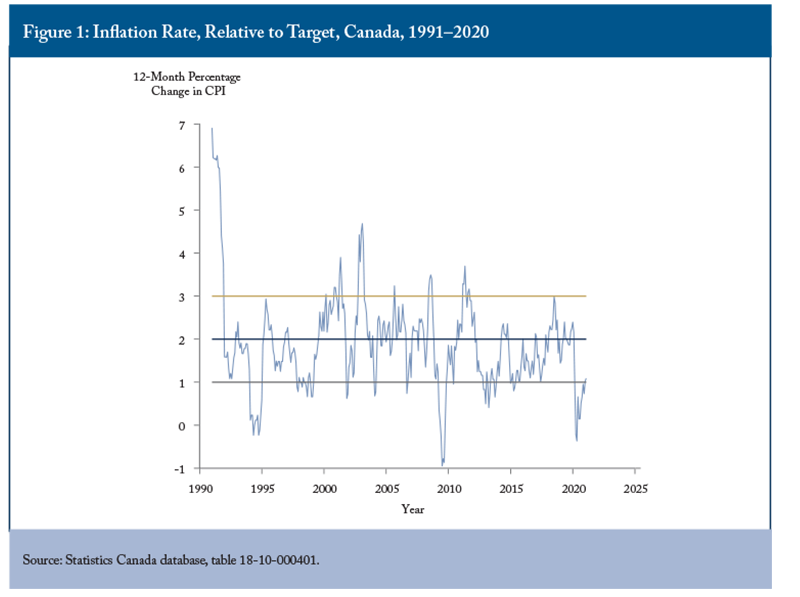
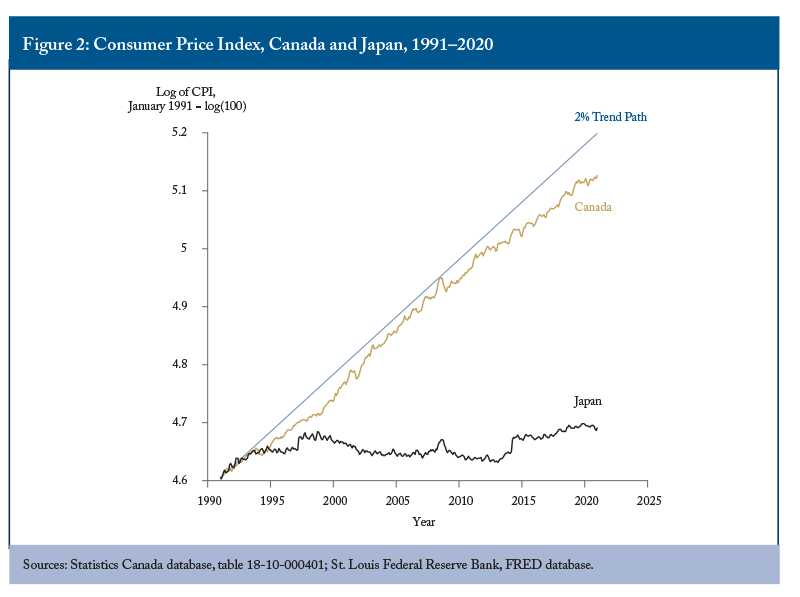
Figure 1 shows the inflation rate in Canada since 1991, along with the 2 percent target and the 1 percent and 3 percent bounds. After 1991, inflation quickly moved into the target range, and it has remained there, for the most part, ever since.5To keep things simple, the phase-in period, which ended in 1995, has been ignored. There have been misses on both the high and low side, but these misses have been transitory. To get another perspective on the Bank of Canada’s performance, Figure 2 shows the log of Canadian CPI relative to a 2 percent inflation path for the period since 1991. It also shows the path for the log of the CPI in Japan, so that one can compare the Bank’s performance with that of a central bank that has had some difficulty in achieving its inflation target.6The intention here is not to evaluate the Bank’s inflation-targeting performance relative to other central banks, but to demonstrate that a central bank can have an inflation target and consistently fail to hit it. The Bank of Japan has had a 2 percent inflation target since 2013. In the figure, even though the Bank of Canada did not set out to target a 2 percent growth path for the price level, it came close to achieving that outcome. That is, the cumulative deviation from a 2 percent inflation path has been small: average inflation over the entire period from 1991 to 2020 was 1.8 percent. Even for the 2009–20 period, when the Bank tended to undershoot its inflation target, average CPI inflation was 1.7 percent – not far off the 2 percent target (as inflation-targeting regimes go) and well within the 1–3 percent range. A caveat, however, is that recent negative deviations from the target have been persistent, which is cause for some concern.7Undershooting during the COVID-19 pandemic is at least in part due to measurement, as the CPI is a fixed-weight index, but actual expenditure has shifted dramatically from goods and services where prices are falling to those where prices are rising. For more, see Beaudry and Ruge-Murcia (2017), who evaluate inflation targeting in Canada.
As Figure 2 shows, the average inflation rate in Japan has been close to zero since 1995. Despite the adoption of a 2 percent inflation target by the Bank of Japan in 2013, there has been no significant sustained increase in the inflation rate, especially if one takes account of the effect of a three-percentage-point increase in the consumption tax on prices in 2014. This helps to illustrate that adopting an inflation-targeting approach does not imply that the central bank can hit its target.
So, the Bank of Canada’s inflation-targeting regime is easy to understand and to evaluate, and it is feasible to achieve the goal, as the Bank has been doing that – more or less – since 1991. But why target inflation? The modern consensus among macroeconomists is that central bank control of inflation is feasible, as is consistent with Canadian experience since 1991. There is no similar consensus on the ability of a central bank to control real aggregate economic activity or asset prices (other than the price of short-term government debt), for example. Further, there is strong evidence that both anticipated and unanticipated inflation are costly in terms of economic welfare. Anticipated inflation distorts intertemporal decisions (see Cooley and Hansen 1989), and causes significant redistributive effects (see Doepke and Schneider 2006). And variability in inflation results in distortions due either to sticky prices and wages (Woodford 2003) or to the uncertainty it creates in credit markets because of the predominance of nominal debt contracts. Thus, commitment to low inflation reduces intertemporal distortions (e.g., choices made today based on fear of inflation in the future), and commitment to low variability in inflation around an inflation target cuts down on uncertainty.8See also Howitt (1990) for an analysis of the costs of inflation in a Canadian context, and Crow (2002) for background on the details of the adoption of inflation targeting in Canada.
But economic science does not tell us that a 2 percent inflation target is optimal. Measures of the cost of anticipated inflation typically are small (see, for example, Cooley and Hansen 1989), and Schmitt-Grohe and Uribe (2010) argue that there is nothing to justify the choice of 2 percent as an inflation target by most of the central banks in the world with inflation-targeting regimes. In Canada, there was early support for a 0 percent inflation target (literal price stability; see, for example, Crow 1988), while there have been some recent proposals for an inflation target higher than 2 percent (see Ball 2014).
So, could the Bank of Canada improve on its inflation-targeting regime? Could the Bank be performing better relative to its stated goal? Should the Bank have a different goal, or goals?
A Change in the Target Inflation Rate?
Safe assets, particularly the sovereign debts of fiscally responsible governments, play an important role in financial markets. Since about 1980, the real interest rate on safe assets – defined as the nominal interest rate on safe assets minus the realized inflation rate – has fallen in the world, and has been persistently low relative to history since the 2008–9 recession. Proposed explanations for low real interest rates include the effects of low productivity growth and demography, but the most likely primary cause is high demand for safe assets, relative to supply.9Other potential explanations include a world savings glut and a dearth of investment opportunities. If either were the case, then this would cause all rates of return to fall. Gomme, Ravikumar, and Rupert (2015) show, however, that the rate of return on capital has not been falling. This evidence is consistent with low real rates of return being specific to safe assets and their close substitutes, and driven by a high demand for and low supply of safe assets. Demand is high due to the expanded use of safe assets as collateral, particularly in overnight markets, and regulatory demand coming from Basel III banking regulations. The supply of safe assets is low in part because of mistrust of some private assets (some asset-backed securities, for example) since the global financial crisis. As well, there could be an effect on the net supply of safe assets from central banks’ use of quantitative easing, which turns government debt and other forms of high-quality, liquid safe collateral into bank reserves. These reserves are confined to a subset of financial institutions, however, and are therefore less useful to the financial sector as a whole.
A low real rate of interest has important implications for how monetary policy is conducted. To see why, first note that, in the long run, the central bank has no control over real variables, including the real interest rate. It is well accepted that changes in monetary policy matter for real activity only in the short run. So, if the central bank wishes to hit an inflation target of 2 percent, then it must, on average, set its overnight nominal interest rate target to be consistent with the 2 percent target and the long-run real rate of interest. That is, if the long-run real rate of interest, over which the central bank has no control, were 1 percent, then to hit a 2 percent inflation target the central bank would have to target the overnight nominal interest rate at about 3 percent, by the logic of the late American economist Irving Fisher.
Central bankers like to think in terms of a neutral rate of interest, defined as the nominal rate of interest that holds when the central bank has been achieving its goal for some time. In particular, the Bank of Canada defines the neutral rate of interest as the long-run real rate of interest – conditional on the Bank’s achieving its inflation target and aggregate output at potential – plus 2 percent. In the example above, the neutral rate is 3 percent. Currently, the Bank judges the neutral rate of interest to be in the range of 1.75–2.75 percent (see Bank of Canada 2020). This contrasts with an average actual target nominal interest rate of 4.6 percent over the January 1991 to December 2007 period, which was consistent with good performance with respect to the 2 percent inflation target. The large drop in the neutral interest rate reflects the secular decline in the long-run real rate of interest.
Over time, as the Bank of Canada attempts to control inflation and stabilize real economic activity, the actual nominal interest rate will fluctuate around the neutral rate of interest. But there is a limit to how low the nominal interest rate can go. Currently, the Bank views the effective lower bound on the overnight nominal interest rate as 0.25 percent, but even if the Bank were to adopt a negative interest rate policy – as have some central banks, including the Bank of Japan, the European Central Bank, the Swedish Riksbank and the Swiss National Bank – it might not be feasible for the overnight nominal interest rate to fall below about –1 percent, given that consumers and firms always have the option of fleeing from negative-interest-rate assets to zero-interest currency (that is, cash). Thus, a low neutral rate of interest can limit the Bank’s ability to control both inflation and real economic activity. For example, from late 2007 to mid-2008, the Bank reduced its target nominal interest rate by 425 basis points in response to the unfolding global financial crisis. But if the nominal interest rate were at a neutral rate of, say, 2.25 percent, then the Bank would have only 200 basis points of monetary accommodation available, given an effective lower bound of 0.25 percent.
If low real rates of interest were a temporary phenomenon, then this would not be a concern for long-run monetary policy decisions. However, all the potential causes of the low-real-interest-rate problem are highly persistent, so the problem might remain with us for a long time. Many governments in the world are currently running large budget deficits, but it remains to be seen whether the resulting expansion in the supply of government debt will have a significant effect on real rates of interest. Although the policy response to the COVID-19 pandemic has increased the supply of safe assets substantially, the pandemic also has caused a flight to safe assets, increasing demand, and that demand effect might persist.
If the Bank of Canada were to increase its inflation target to 3 or 4 percent, this could, in principle, allow more monetary policy accommodation in a recession. Roughly, this would increase the nominal neutral interest rate by 100–200 basis points. There are, however, at least three problems with this solution.
First, the change would increase the average welfare losses from inflation. Second, it would call the Bank’s credibility into question. A key benefit of inflation targeting is that commitment to an inflation-rate target reduces uncertainty, no matter what the specific target is. But if the Bank were seen as willing to change the target, what would prevent it from doing it again, repeatedly? Loss of credibility would mean an increase in publicly perceived inflation uncertainty, which would eliminate a key benefit of commitment to the inflation target. Third, many central banks have been experiencing difficulty in hitting their 2 percent inflation target, with chronic inflation-target undershooting. Given that the Bank of Canada recently has been subject to a milder version of this problem, an increase in the inflation target could lead to an increase in the undershoot – another avenue for loss of central bank credibility.
Another approach to dealing with low real interest rates and frequent encounters with the effective lower bound is unconventional monetary policy: forward guidance, quantitative easing and negative nominal interest rates. The prevailing view in central banks seems to be that these tools are effective. If that view is correct, central bankers might be reassured that, despite the problem of low real interest rates, inflation targeting could proceed as in the past, with some modification of the policy rule to allow for greater use of unconventional policies.
But we now have some evidence on the implementation and effects of unconventional monetary policies in other countries. For example, in the United States, the Fed used forward guidance extensively during and after the global financial crisis. This guidance proved rather intricate and confusing, with the length of policy statements expanding considerably, and changing in important ways over time, which damaged any notion that it represented commitment on the part of the Fed. Forward guidance also had unintended consequences – for example the “taper tantrum” episode of 2013. The other unconventional policies – quantitative easing and negative interest rate policy – saw the most aggressive implementation in Japan, Switzerland and the euro area following the financial crisis. In some instances, particularly in Japan, these policies were part of a program to correct inflation-target undershooting, but they proved ineffective in generating a sustained increase in inflation.
So, two proposed solutions to the problem of low real interest rates are to increase the inflation target and to make extensive use of unconventional monetary policy at the effective lower bound. But the benefits of the first are arguably smaller than the costs, while the second has not been as effective as hoped where implemented.
Alternatives to Inflation Targeting
What about the most prominent proposals for more radical changes in the Bank of Canada’s inflation-targeting agreement with the federal government?
Price-Level Targeting
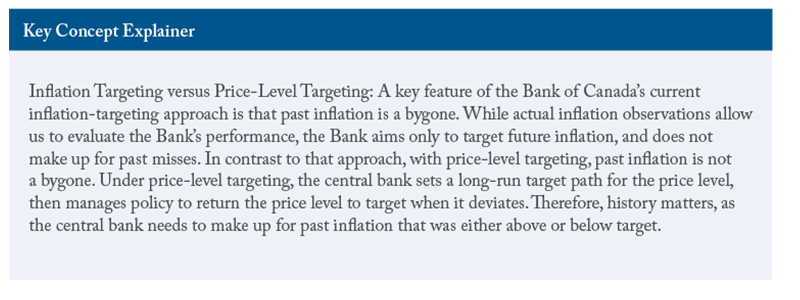
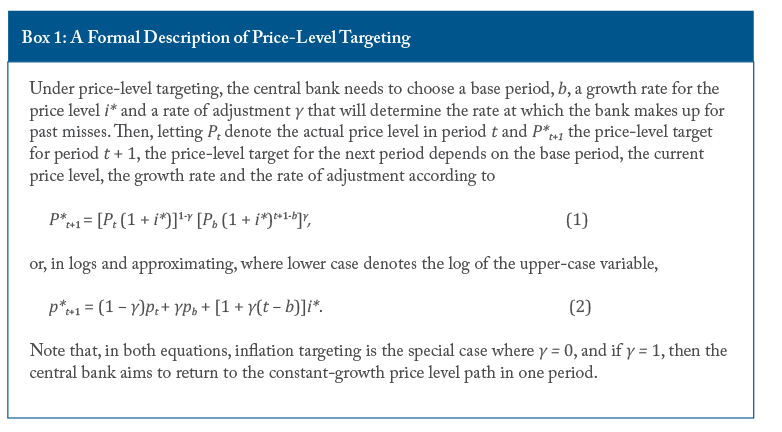
A key feature of the Bank of Canada’s current inflation-targeting approach is that past inflation is a bygone. While actual inflation observations allow us to evaluate the Bank’s performance, the Bank aims only to target future inflation, and does not make up for past misses. In contrast to that approach, with price-level targeting, past inflation is not a bygone. Under price-level targeting, the central bank sets a long-run target path for the price level, then manages policy to return the price level to target when it deviates. Therefore, history matters, as the central bank needs to make up for past inflation that was either above or below target. See Box 1 for a more formal description of price-level targeting.
In order to exploit the benefits from commitment to its goal, under price-level targeting the central bank needs to provide more details than under simple inflation targeting. In particular, it must specify a base period in the past from which it projects its target price-level path. Then, it needs to specify the target growth rate – for example, 2 percent per annum, as under the current inflation-targeting procedure. Further, since price-level targeting involves making up for past misses, the central bank needs to specify the rate at which it plans to return to the target price-level path in the event that the actual price level departs from that path.
In theory, the potential benefit of price-level targeting is that, if well understood, it reduces inflation uncertainty over all horizons. At each date, the price-level target for the immediate future is known, in that both the central bank and the public know where the bank wants the price level to be, based on the target path and the current actual price level. In contrast, inflation targeting can potentially cumulate misses from a would-be price-level target over time, leading to high uncertainty about the price level in the future, and corresponding uncertainty about the real value of contracted nominal payments in the future – payments associated with debt or long-term labour contracts for example.
Price-level targeting is also sometimes seen as potentially useful in a recession, particularly in an effective-lower-bound episode, in helping to provide forward guidance (Bernanke 2017). If inflation falls below target in these circumstances, temporary price-level targeting can mimic the forward guidance that is justified in theory – see, for example, Eggertsson and Woodford (2003); Werning (2012).10See, for example, Ambler (2009), for a review of arguments for and against price-level targeting.
A drawback of price-level targeting is that, in general, anticipated inflation will be different at different horizons. For example, if the price level is currently below the constant-growth price-level path, then anticipated inflation will be higher in the immediate future than in the distant future. In other words, price-level targeting involves knowing three numbers: the base period, the growth rate and the rate of adjustment to the desired growth path. In contrast, inflation targeting involves knowing just one number: the target inflation rate. Inflation targeting is much easier to understand, both for the public and for central bankers, and much easier for central bankers to explain, than is price-level targeting.
As well, elements of price-level targeting make central bank performance difficult to evaluate, potentially giving central bankers too much wiggle room. The rate of adjustment to the target price-level path is important for how price-level targeting performs and how it is evaluated, but this parameter likely would be unspecified if price-level targeting were implemented. One possible approach would be for the central bank to announce target bands around the constant-growth price-level path, as the Bank of Canada did with M1 (narrow money) targeting during the 1975–82 period. But such target bands would have to change over time, just as was the case in that period, further complicating communication with the public.
It is important to note that these arguments would hold even if the goal of the central bank were price stability – that is, a price-level path with a 0 percent growth rate. As was reasoned above, for a well-specified price-level-targeting approach, the central bank would have to specify a base period and the rate at which it intended to make up deviations from the 0 percent target. We would still need to know three numbers: the growth rate for the target path (zero, in this case), the base period and the adjustment rate.
Average-Inflation Targeting
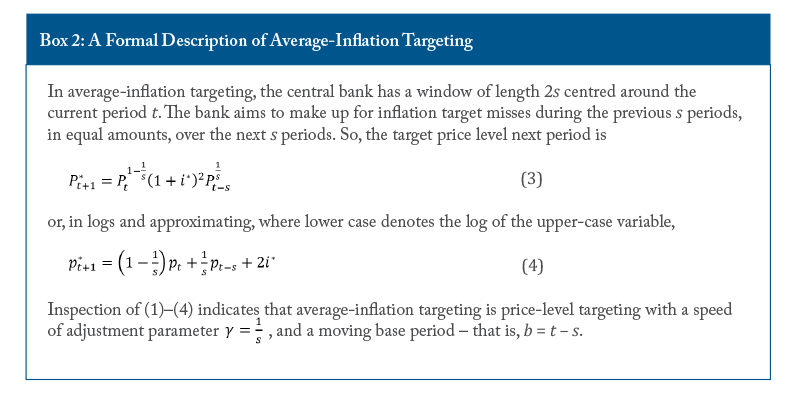
A closely related approach to price-level targeting is average-inflation targeting. In contrast to the current inflation-targeting approach, but similar to price-level targeting, this is a makeup strategy. Under this type of goal, the history of inflation matters, but in a somewhat different way than with price-level targeting. One can specify an average-inflation-targeting regime as involving the choice of a moving window of time over which average-inflation targeting is to occur, and a target rate of inflation. That is, under average-inflation targeting, the central bank could average inflation over a given period of time up to the present, and then plan to make up the deviation of that average inflation rate from the target, over a period extending from the present into the future of the same length as the past averaging period. For example, if the inflation target is 2 percent and inflation averages 1 percent per year over the previous five years, the central bank could plan, over the next five years, to make up for the undershoot of inflation, in equal amounts, so that, in five years, inflation over the previous ten years would average 2 percent.11This is not to suggest that, if a central bank were to adopt average-inflation targeting, the optimal window should be ten years; this is just a numerical example. In this example, there are two numbers to know: the length of the moving window, which is ten years, and the inflation target, which is 2 percent. See Box 2 for a more formal description of average-inflation targeting.
Average-inflation targeting is simpler than price-level targeting, in that it can be summarized by two numbers instead of three. But basically it has all of the drawbacks of price-level targeting. It hampers central bank communication, potentially permits excessive discretion by the central bank and, in practice, might make little difference to the bank’s behaviour.
In the United States, the Federal Open Market Committee (FOMC) has adopted a modified average-inflation-targeting approach in the latest revision of its Statement of Longer Run Goals and Monetary Policy Strategy (see Federal Open Market Committee 2020). This is a good example of how not to specify central bank goals. The focus here is only on the average-inflation-targeting aspect of the statement.
The relevant part of the statement reads: “the Committee seeks to achieve inflation that averages 2 percent over time, and therefore judges that, following periods when inflation has been running persistently below 2 percent, appropriate monetary policy will likely aim to achieve inflation moderately above 2 percent for some time.” Note the differences between the statement and how average-inflation targeting was specified above. The FOMC leaves unspecified the time window over which it intends to average, and also whether it will make up for misses on the high side of its 2 percent inflation target. There are two problems with this. First, it is impossible to evaluate the FOMC’s performance relative to its goal, as the goal is not completely specified. Second, one might conclude from the statement, given the asymmetry in how averaging is to take place, that this is an implicit increase in the 2 percent inflation target. So the same criticisms apply as for an increase in the inflation target.
Nominal-Income Targeting
Nominal-income (NGDP) targeting appears to have evolved from monetarist ideas (see McCallum 1987). In monetarist economics, the quantity equation, MV = PY, plays an important role, where M is the nominal quantity of money, V is the income velocity of money, P is the price level and Y is real GDP, so PY is NGDP. In monetarist doctrine, V is viewed as predictable, so that there is a systematic relationship between the money stock and nominal income. But central banks abandoned money-growth targeting because the relationships among money growth, inflation and real GDP growth are unstable – that is, velocity is not predictable. But advocates of NGDP targeting argue that instability in velocity becomes irrelevant if the central bank focuses on growth in NGDP, rather than money growth, as a goal.
What are the virtues claimed for NGDP targeting? These depend in part on how the goal is specified. For example, there could be an NGDP growth target, an NGDP level target or NGDP growth averaging, corresponding respectively to inflation targeting, a price-level target and inflation averaging. Here, it is convenient to confine attention to the NGDP level target, as this is the goal most frequently emphasized by NGDP-targeting enthusiasts. Under NGDP-level targeting, the central banker specifies a base period, a desired growth rate and a rate at which the bank desires to make up deviations from the NGDP target path.
Advocates of NGDP targeting (for example, Sumner 2014) argue that the rule is simple and easily understood, and propose examples in which NGDP targeting performs better than inflation targeting if the central bank hits the NGDP target. For example, it is argued that NGDP targeting performs well in response to “supply shocks” – that is, shifts in the aggregate supply curve in textbook aggregate demand/aggregate supply models. According to the logic of such models, a negative supply shock raises the price level and reduces output below potential, and a price-level targeting central bank would worsen the problem by causing a further reduction in output. In this model, however, NGDP targeting could approximate an optimal policy in response to the shock.12Sheedy (2014) provides an example where NGDP targeting helps to fill in for missing insurance markets.
In terms of simplicity, of course, NGDP targeting does not provide any gains over conventional inflation targeting, although, in principle, it is simpler than a dual-mandate approach. A problem with NGDP targeting relative to inflation targeting is that NGDP is observed only quarterly, and with a longer lag than is the case for the monthly CPI. Further, NGDP is typically revised multiple times, which introduces measurement noise into the NGDP-targeting process, making it difficult for the central bank to achieve its goal and for the public to evaluate the central bank’s performance.
Another key problem with NGDP targeting is that it requires the central bank to take a stand on the future long-run growth rate of real GDP, something macroeconomists in general know little about, as future productivity growth cannot be foreseen. For example, suppose that, in 1991, the Bank of Canada had chosen to target a path for nominal GDP. Also, suppose that the Bank had taken the average growth rate of real GDP for the 1961–91 period as an estimate of future real GDP growth. Then, given the average growth rate of 3.8 percent for real GDP over that period, and allowing for 2 percent inflation, the Bank would have targeted NGDP growth at 5.8 percent per year.
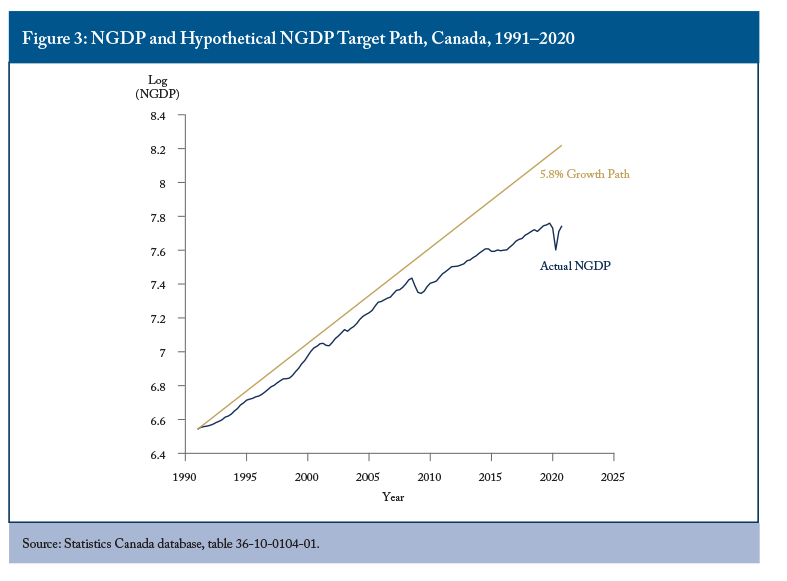
Figure 3 shows a 5.8 percent growth path and the path of actual NGDP for Canada from 1991 to 2020. Until the 2008–9 recession, the Bank of Canada would have been performing reasonably well, if evaluated based on a 5.8 percent NGDP growth target. That is, over the 1991–2007 period, it would not have made much difference if the Bank had announced that it was targeting NGDP rather than CPI inflation. After 2008–9, however, the actual path for NGDP diverged from the 5.8 percent growth path due to a drop in NGDP during the recession and a decline in the growth rate of NGDP after the recession. Then, with the COVID-19 crisis in 2020, there was a further large drop of NGDP below the 5.8 percent growth path.
It is hard to argue that monetary policy could have increased the growth rate of real GDP over the ten-year period from 2009 to 2019, since the real effects of monetary policy typically are regarded as temporary and as having no effect on long-run real GDP growth rates. So, if an NGDP target had been in place, the Bank of Canada would have been faced with two alternatives: it could have conducted monetary policy over the 2009–19 period to generate higher inflation, thus increasing the inflation rate above 2 percent for a long time; or it could have announced a lower growth rate for the target path of NGDP. The first option is undesirable if we value low and predictable inflation, while the second brings the Bank’s credibility into question. The key idea behind an announced goal is that the central bank’s commitment reduces uncertainty for the public. In this scenario, further problems would have ensued as NDGP fell further below the target in 2020 – the COVID-19 pandemic is an instance where it seems obvious that monetary policy could not undo the large drop in NGDP. This example illustrates one facet of the difficulty with NGDP targeting. Since we cannot be confident in predicting the long-run trend growth in real GDP, low and stable inflation and central bank credibility could be on the line.
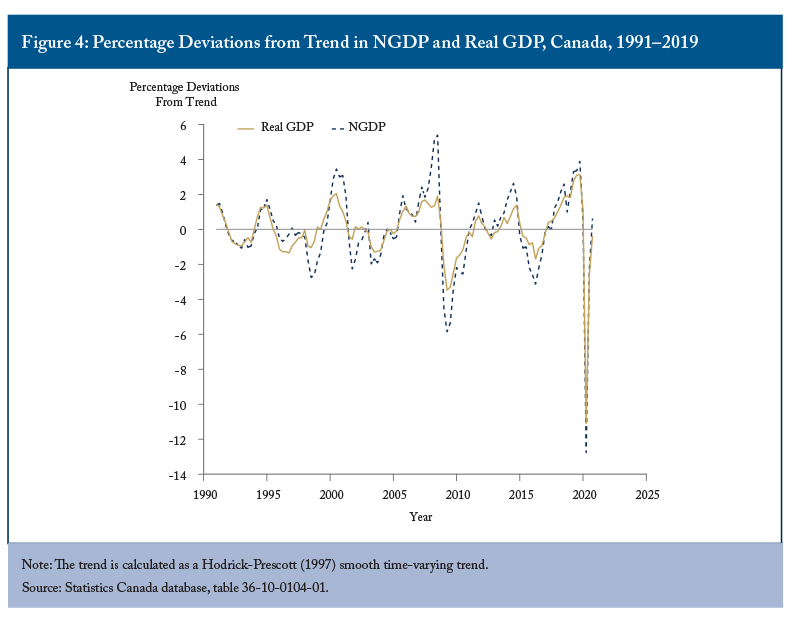
Figure 4 illustrates a potential second problem with NGDP targeting. First, note that fluctuations in NGDP follow closely the fluctuations in real GDP about trend. This is consistent with Figure 2, which indicates that the price level over this period was smooth, through some combination of the Bank of Canada’s success in stabilizing prices and inherent price inertia. In any case, most of the variation in NGDP over the 1991–2020 period can be attributed to real GDP variation. Second, note that the deviations from trend in NGDP are large and highly persistent.
Therefore, if the goal in an NGDP-targeting regime is to induce a smooth path for NGDP, the Bank of Canada would necessarily have been doing something very different over the 1991–2020 period to achieve that. If NGDP targeting could have eliminated much of the variation about trend in real GDP, that could well have been beneficial. But it is hard to make the case that monetary policy could have done more in the way of conventional stabilization policy during this period, and it does not seem that inflation targeting somehow impeded the Bank’s stabilization efforts. Indeed, as shown in Williamson (2020), since 1991 the Bank has tended to respond strongly to movements in the unemployment rate in the short run, reducing its nominal-interest-rate target when unemployment rises and increasing the target when unemployment falls. That is, the Bank’s approach to its inflation-targeting agreement is quite flexible, in that short-run stabilization policy is an important element in its decisions, even if it argues in good faith that this approach is intended only as a means of targeting inflation.
So, if the Bank of Canada had adhered to an NGDP-targeting regime over the 1991–2020 period, there would have been two possible outcomes. First, if the Bank had been successful in achieving a smooth path for NGDP, this would necessarily have made inflation, and possibly real GDP, more variable. If we value stable inflation and stable real GDP, that would have been a poor outcome. Second, if it had adopted NGDP targeting, the Bank could have set itself up for failure: NGDP might have fluctuated much as in Figure 4, and the Bank’s performance would have been judged as poor relative to its goal.
Dual Mandate
Many central banks have adopted inflation targeting, typically with some flexibility to focus on other goals when required – in financial crises, for example – or to pursue active conventional stabilization policy, provided this does not imply excessive sacrifice with respect to the inflation target. The United States is somewhat different, in that Congress has established a dual mandate for the Fed in the Employment Act of 1946 and the Full Employment and Balanced Growth Act of 1978. The Fed’s dual mandate is typically characterized as specifying that the Fed pursue both price stability and maximum employment.
The FOMC, however, recognizes that this dual mandate creates some thorny issues. In particular, it states that “[t]he maximum level of employment is a broad-based and inclusive goal that is not directly measurable and changes over time owing largely to nonmonetary factors that affect the structure and dynamics of the labor market” (Federal Open Market Committee 2020). The Fed’s dual mandate specifies that it should care about inflation and real aggregate economic activity. But the consensus of economic science is that, while it is feasible for a central bank to control inflation in both the short and long run, it cannot control real aggregate economic activity in the long run. Further, even though there are short-run non-neutralities of money, the pitfalls for a central bank in setting numerical targets for real quantities – the unemployment rate, for example – are well-known, at least since Friedman (1968).
So, even when a dual mandate has been put into practice, as in the United States, central bankers appear disinclined to address the real part of the mandate quantitatively, although public statements by the Fed typically speak to the dual mandate in some fashion. It is certainly feasible for a dual mandate to enter explicitly into the agreement between the Bank of Canada and the federal government, and doing so appears to be well within the Bank’s mandate, as specified in the Bank of Canada Act. But the Bank’s flexible approach to inflation targeting is a good compromise, and its actual behaviour is in the spirit of the Fed’s dual mandate. Further, under some theories of monetary policy, inflation targeting acts to correct inefficiencies in the aggregate economy, making it possible to simultaneously fulfil both parts of a hypothetical dual mandate. For example, under some versions of New Keynesian economics, there is a “divine coincidence” under which there is no tradeoff between inflation targeting and closing the output gap.
Inflation Target Undershooting and Policy Rules
Specifying an explicit quantitative goal for the central bank is, of course, no guarantee that the central bank can achieve the goal. For example, as shown in Figure 2, the Bank of Canada has done a good job of achieving its inflation target, but the Bank of Japan has had a 2 percent inflation target since 2013, and has fallen well short of achieving that goal. Indeed, since the 2008–9 recession, inflation-target-undershooting has been common among the world’s inflation-targeting central banks. For example, the Fed, the Swedish Riksbank, the European Central Bank and the Swiss National Bank all have experienced extended periods with inflation below 2 percent over the past 11 years. As noted above, the average inflation rate in Canada over that period has been 1.7 percent, so the Bank of Canada has shown a recent tendency for inflation-target undershooting, although not to the same extent as in other countries.
Is inflation-target undershooting an important problem for the Bank of Canada? And if so, does this need to be addressed through a change in the Bank’s goals, as specified in its agreement with the federal government? Could inflation-target undershooting be the result of a poor policy rule or inappropriate implementation?
One could make the case that inflation-target undershooting is not a serious problem in Canada – recent undershooting of the target has been much less serious than in other countries. Further, even in countries with greater shortfalls from inflation targets, one could argue that the consequences for economic welfare might have been only mildly negative, or perhaps positive, given the benefits of low inflation. It is possible that the only negative repercussions in these countries were for central bankers, who were embarrassed at missing inflation targets on the low side.
But suppose one places a high weight on the loss of central bank credibility due to below-target inflation, or thinks that inflation-target undershooting implies a loss in aggregate output – due to a Phillips curve effect, for example? Does this imply that a change in the inflation-targeting agreement is appropriate? Not necessarily. It seems clear that the Bank of Canada’s approach to implementation (corridor or floor system) has not mattered for its ability to hit its overnight interest-rate target – any misses of the overnight target have tended to be small. So, the remaining candidate that could explain inflation-target undershooting is the policy rule.
For example, if central bankers agree that it is feasible to raise the inflation target from 2 percent to 4 percent and to hit this higher target consistently, then it must be feasible for the central bank to hit its 2 percent inflation target consistently, rather than persistently undershooting. And, if the Bank wishes to avoid the degree of inflation-target undershooting observed in the United States, Japan, Switzerland or the euro area, for example, perhaps it would be better to study how monetary policy rules in those countries contributed to those outcomes, rather than attempting to solve the problem with an alternative to inflation targeting.13For example, a body of theory and evidence supports the view that aggressive Taylor-rule behaviour by central banks, and/or more aggressive interest-rate cutting than interest-rate hiking, leads to persistent inflation-target undershooting. See, for example, Benhabib, Schmitt-Grohe, and Uribe (2001); Cochrane (2016); Rupert and Sustek (2016); Uribe (2018); and Williamson (2018, 2019). There appear to be no compelling reasons to alter the agreement in light of inflation-target-undershooting experience, in Canada or elsewhere.
Conclusion
There are good arguments in favour of inflation targeting. It is easy for central bankers and the public to understand, it makes the central bank’s performance straightforward to evaluate and, judging from the Bank of Canada’s record, it makes good performance feasible. As well, inflation targeting has led to relatively good macroeconomic performance. Since 1991, the Bank has been successful in achieving the goal laid out in its inflation-targeting agreement with the government of Canada. Further, there are good reasons to doubt that macroeconomic performance, relative to the Bank’s mandate as laid out in the Bank of Canada Act, would have been better under some alternative. Therefore, the inflation-targeting agreement should be renewed in its current form.
References
Ambler, S. 2009. “Price-level Targeting and Stabilization Policy: A Review.” Bank of Canada Review, Spring: 19–29.
———. 2016. Toward the Next Renewal of the Inflation-Control Agreement: Questions Facing the Bank of Canada. Commentary 453. Toronto: C.D. Howe Institute.
Ambler, S., and J. Kronick. 2018. Navigating Turbulence: Canadian Monetary Policy Since 2004. Policy Study 47. Toronto: C.D. Howe Institute.
Ball, L. 2014. “The Case for a Long-Run Inflation Target of Four Percent,” IMF Working Paper WP/14/92. Washington, DC: International Monetary Fund.
Bank of Canada. 2020. Monetary Policy Report – October 2020. Ottawa.
Beaudry, P., and F. Ruge-Marcia. 2017. “Canadian Inflation Targeting.” Canadian Journal of Economics 50 (5): 1556–72.
Benhabib, J., S. Schmitt-Grohe, and M. Uribe. 2001. “The Perils of Taylor Rules.” Journal of Economic Theory 96 (1-2): 40–69.
Bernanke, B. 2015. “The Taylor Rule: A Benchmark for Monetary Policy?” Brookings Institution, April 28.
———. 2017. “Temporary Price-Level Targeting: An Alternative Framework for Monetary Policy.” Brookings Institution, October 12.
Cochrane, J. 2016. “Do Higher Interest Rates Raise or Lower Inflation?” Working paper. Hoover Institution.
Cooley, T., and G. Hansen. 1989. “The Inflation Tax in a Real Business Cycle Model.” American Economic Review 79 (4): 733–48.
Crow, J.W. 1988. “The Work of Canadian Monetary Policy.” Eric John Hansen Memorial Lecture Series II (Winter). Edmonton: Department of Economics, University of Alberta.
———. 2002. Making Money: An Insider’s Perspective on Finance, Politics, and Canada’s Central Bank. Toronto: Wiley.
Doepke, M., and M. Schneider. “Inflation and the Redistribution of Nominal Wealth.” Journal of Political Economy 114 (6): 1069–97.
Eggertsson, G., and M. Woodford. 2003. “The Zero Bound on Interest Rates and Optimal Monetary Policy.” Brookings Papers on Economic Activity 34: 139–235.
Federal Open Market Committee. 2020. “Statement of Longer-Run Goals and Monetary Policy Strategy.” Washington, DC: Board of Governors of the Federal Reserve System.
Friedman, M. 1968. “The Role of Monetary Policy.” American Economic Review 58 (1): 1–17.
Gomme, P., B. Ravikumar, and P. Rupert. 2015. “Secular Stagnation and Returns to Capital.” Federal Reserve Bank of St. Louis, Economic Synopses.
Government of Canada/Bank of Canada. 2016. “Joint Statement of the Government of Canada and the Bank of Canada on the Renewal of the Inflation-Control Target.” Ottawa: Bank of Canada.
Hodrick, R., and E. Prescott. 1997. “Postwar U.S. Business Cycles: An Empirical Investigation.” Journal of Money, Credit, and Banking 29 (1): 1–16.
Howitt, P. 1990. “Zero Inflation as a Long-Run Target for Monetary Policy.” In Zero Inflation: The Goal of Price Stability, Policy Study 8, ed. R.G. Lipsey. Toronto: C.D. Howe Institute.
Laidler, D., and W. Robson. 1994. The Great Canadian Disinflation: The Economics and Politics of Monetary Policy in Canada, 1988–93. Policy Study 19. Toronto: C.D. Howe Institute.
———. 2004. Two Percent Target: The Context, Theory, and Practice of Canadian Monetary Policy since 1991. Policy Study 37. Toronto: C.D. Howe Institute.
McCallum, B. 1987. “The Case for Rules in the Conduct of Monetary Policy: A Concrete Example.” Economic Review, Federal Reserve Bank of Richmond (September): 10–18.
Robson, W. 2009. To the Next Level: From Gold Standard to Inflation Target – to Price Stability? Commentary 285. Toronto: C.D. Howe Institute.
Rupert, P., and R. Sustek. 2016. “On the Mechanics of New Keynesian Models.” Working paper, University of California, Santa Barbara.
Schmitt-Grohe, S., and M. Uribe. 2010. “The Optimal Rate of Inflation.” In Handbook of Monetary Economics, ed. B. Friedman and M. Woodford, 653–722. Amsterdam: Elsevier.
Sheedy, K. 2014. “Debt and Incomplete Financial Markets: A Case for Nominal GDP Targeting.” Brookings Papers on Economic Activity (Spring): 301–73.
Sumner, S. 2014. “Nominal GDP Targeting: A Simple Rule to Improve Fed Performance.” Cato Journal 34 (2): 315–37.
Taylor, J. 1993. “Discretion versus Policy Rules in Practice.” Carnegie-Rochester Conference Series on Public Policy 39 (December): 195–214.
Uribe, M. 2018. “The Neo Fisher Effect: Econometric Evidence from Empirical and Optimizing Models,” NBER Working Paper 25089. Cambridge, MA: National Bureau of Economic Research.
Werning, I. 2012. “Managing a Liquidity Trap: Monetary and Fiscal Policy.” Working paper. Cambridge, MA: Massachusetts Institute of Technology.
Williamson, S. 2018. “Inflation Control: Do Central Bankers Have It Right?” Federal Reserve Bank of St. Louis Review (Second Quarter): 127–50.
———. 2019. “Neo-Fisherism and Inflation Control.” Canadian Journal of Economics 52 (3): 882–913.
———. 2020. “The Role of Central Banks.” Canadian Public Policy 46 (2): 198–213.
Woodford, M. 2003. Interest and Prices. Princeton, NJ: Princeton University Press.