



To: Immigration watchers
From: Tingting Zhang
Date: August 25, 2026
Re: Canada’s Asylum System Needs a New Engine
Canada’s asylum system is uniquely difficult to manage. The principle of non-refoulement prevents Canada from returning individuals who seek protection without first assessing their asylum claim.
Meanwhile, the system has demonstrated sensitivity to domestic policy choices, and a series of decisions over the past decade has driven asylum volumes to unsustainable levels.
Three distinct problems are compounding at once: too many claims are being filed, claims take too long to resolve, and there is no benchmark for what constitutes a reasonable success rate.
Since 2016, asylum claims in Canada have nearly quintupled, from fewer than 24,000 to over 114,000 in 2025, excluding a pandemic-era dip. Last year, Canada ranked fifth in the world for new asylum applications, behind only the United States, Egypt, Spain, and Italy.
The surge in claims has primarily come from people already in the country, not those arriving without authorization. Since 2023, claimants with prior legal status have accounted for an average of 79 percent of all claims, up from 52 percent before the pandemic.
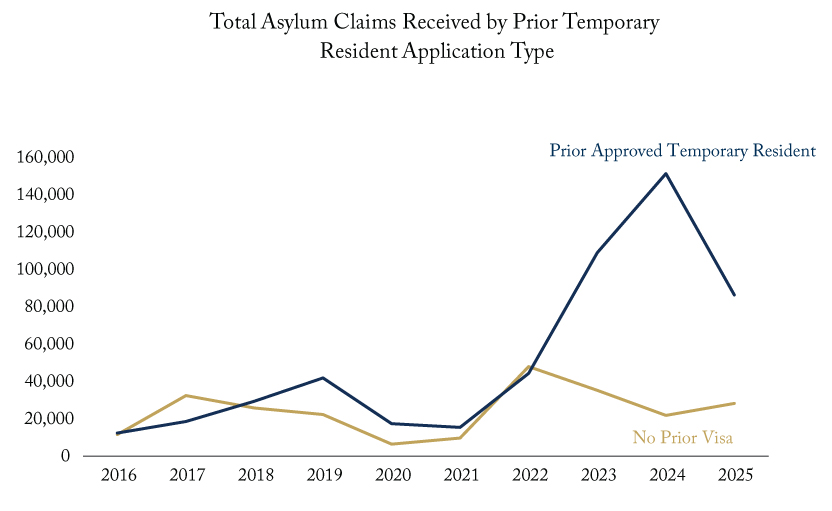
Note: The data represent asylum claims received by IRCC and CBSA in each calendar year
Source: PBO and IRCC.
The introduction of the Electronic Travel Authorization in 2016 coincided with the sharpest acceleration: Claims from visa-exempt countries rose 672 percent between 2017 and 2023, compared with a 459 percent increase among individuals with other types of temporary resident applications and only a 7 percent increase among those without a visa.
International students were a major source, with refugee claims rising by 650 percent between 2018 and 2023, well before Ottawa tightened rules for student and temporary foreign worker programs in 2024 — a shift that has raised questions about whether the tightening itself is now pushing people toward asylum claims as their only route to remain in Canada.
The decline in 2025 is promising, coinciding with the current reforms: Canada has issued fewer visitor visas, capped temporary immigration programs, and tightened screening. However, these measures primarily affect new arrivals. They do little to address individuals already in Canada.
Meanwhile, most claims deemed eligible and referred to the IRB’s Refugee Protection Division for determination are approved: Canada’s overall acceptance rate rose from 67 percent in 2016 to 80 percent in 2024, reinforcing its reputation as a preferred asylum destination. The backlog has grown in step, now standing at about 277,000 cases awaiting adjudication – roughly $4.6 billion in potential costs, based on the PBO’s estimated average cost of $16,500 per claimant.
The system’s lengthy due process makes it more complex: claimants can proceed through several stages of review and appeal. The average finalization time was 19 months in 2025, while claimants who exhaust all available stages can remain in the system for years. This prolonged process, combined with the relatively high likelihood of success, further encourages new applicants.
And underlying incentives reinforce the trend. Claimants receive free legal aid, housing assistance, and healthcare (recently shifted to a copayment model). For someone whose study permit is expiring or whose temporary status is ending, filing a refugee claim buys time and access to benefits – and if approved, opens a direct path to permanent residency.
In 2024, Canada granted permanent residency to 27,400 refugees – more than any other country. In 2026 and 2027, Canada plans to grant permanent residence to approximately 115,000 Protected Persons already in Canada, accounting for 15 percent of its total permanent resident admission targets over the two years. The system, designed to protect the persecuted, has no effective mechanism to distinguish strategic claims from genuine ones.
Ottawa’s response, Bill C-12, tries to address the margins.
Claims made more than a year after entry will no longer get full Immigration and Refugee Board hearings, the bill expands removal powers, streamlines applications, and clears inactive cases. These are welcome measures. However, the length of processing, combined with the benefits available during that period, creates incentives to file even when claimants know their case is weak.
Facing a similarly strained asylum system, the United Kingdom has recently moved away from automatic permanent settlement toward a temporary, reviewable protection: 30 months of permission to stay instead of the previous five years, with cases reassessed every 30 months thereafter, and a 20-year wait – rather than five – before becoming eligible to apply for permanent residence.
Those whose home countries have become safe are expected to return. The policy draws on Denmark’s approach, which has cut asylum claims by more than 90 percent over the past decade. International law itself permits refugee status to be withdrawn once conditions in the home country have fundamentally changed, a principle that supports the shift toward temporary protection.
Canada should begin a similar conversation. It needs to consider whether a direct pathway to permanent residency upon a successful claim remains the most appropriate approach, or whether temporary, reviewable protection, paired with robust due process, would better align Canada’s obligations with the fiscal and operational realities. Denmark’s experience suggests such a shift reduces pressure at the source: removing the guarantee of permanent settlement lowers the incentive to file in the first place.
At the same time, Canada should consider measures that strengthen the integrity and efficiency of the system. For example, the IRB’s File Review policy, which allows certain claims from designated countries and claim types to be accepted without a hearing, may warrant review and revision. Canada should also streamline the judicial review process so that enforcement can accompany broader system reforms, including meaningful consequences for misuse of the system.
Tingting Zhang is a Policy Analyst at the C.D. Howe Institute.
To send a comment or leave feedback, email us at blog@cdhowe.org.
The views expressed here are those of the author. The C.D. Howe Institute does not take corporate positions on policy matters.