



Ben Dachis on BNN: Why Albertans’ energy bills don’t benefit from daylight savings time
Ben Dachis, Associate Director of Research at the Institute, joins BNN to discuss a report that finds there is a strong case behind abolishing daylight savings time in Alberta while those in Ontario see energy savings.
Click here to read part 1 and part 2 of the Intelligence Memo by Blake Shaffer and Nic Rivers.
Rivers and Shaffer – Does Daylight Saving Time Reduce Energy Consumption? (Part 2)
 From: Nic Rivers and Blake Shaffer To: Canadians with one less hour of sleep Date: March 8, 2017 Re: Does Daylight Saving Time Reduce Energy Consumption? (Part 2) In Part 1 of this memo we showed the findings that in some regions, daylight saving time (DST) decreases electricity demand, while in others DST either increases or leaves overall demand […]
 Rivers & Shaffer – Does Daylight Saving Time Reduce Energy Consumption? (Part 1)
 From: Nic Rivers and Blake Shaffer To: Canadians with one less hour of sleep Date: March 7, 2017 Re: Does Daylight Saving Time Reduce Energy Consumption? (Part 1) Every spring and fall, clocks across much of North America, Europe and a few other parts of the world are shifted forward or back one hour. This […]
 Paying for Pipelines – How Consumers Can End Up Footing Some of the Bill: CBC News
“My Region First!”
It’s a rallying cry we’re hearing more these days, as regionalism becomes more a part of public policy.
The B.C. government recently approved the Trans Mountain pipeline that will haul Alberta oil to port. And it did so after squeezing up to a cool billion dollars out of Kinder Morgan — money which will go into an environmental protection fund.
Sounds good. Alberta gets an economic boost, B.C. gets a share of the spoils and some environmental help, and Kinder Morgan foots the bill. Or does it?
Things aren’t always how they appear. More often than not, the person who has to cut the cheque is not the one who ends up paying.
So who does? It’s a complex question.
But in…
Making Sense Of Alberta’s New Energy Efficiency Program: Maclean’s
Following a report by Alberta’s Energy Efficiency Advisory Panel, the government announced a large program last week aimed at improving the energy efficiency of homes, businesses and non-profits. It will fund free installation of energy efficiency products throughout the province, and provide rebates on efficient appliances, lighting, and so on. With a budget of $645 million over the next five years, funded by carbon tax revenue, it’s no small endeavour and is worth a careful look.
First, let’s take a step back and ask: What is the purpose of energy efficiency programs?
Simply put, they can potentially solve two market failures: (1) environmental externalities; and (2) behavioural biases. The success of the program should…
Nic Rivers – Will Consumers Respond to a Carbon Tax?
 From: Nic Rivers To: Concerned Canadians Date: January 6, 2017 Re: Will Consumers Respond to a Carbon Tax? As Alberta rolls out its carbon tax this week and Ontario’s cap and trade system starts up, the question for many is whether people and businesses will change their behavior and reduce fossil fuel consumption and carbon […]
 Benjamin Dachis – The Good, The Bad, And The Ugly Of Ontario’s Electricity
 From: Benjamin Dachis To: Minister Glenn Thibeault Date: December 15th, 2016 Re: The Good, the Bad, and the Ugly of Ontario’s Electricity You recently gave a speech in which you laid out your proposed direction for Ontario’s electricity sector. Like any change, the time will come one day for the inevitable showdown with those who […]
 Shaffer And Tombe – Reconciling Pipelines With Canada’s Climate Goals
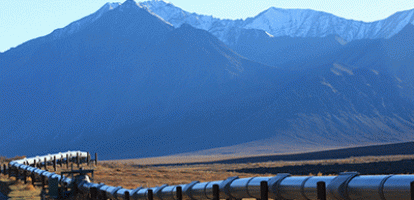 From: Blake Shaffer and Trevor Tombe To: Concerned Canadians Re: Reconciling Pipelines with Canada’s Climate Goals The federal government’s approval of Kinder Morgan’s Trans Mountain and Enbridge’s Line 3 pipelines has sparked intense opposition. Indeed, the #StopKinderMorgan movement may become this generation’s Clayoquot Sound. While pipelines raise important concerns regarding land issues, indigenous rights, and […]
 Ben Dachis on BNN: pipeline decisions now ‘divorced’ from carbon emissions
C.D. Howe Institute’s Ben Dachis joins BNN to discuss the policy approach to pipeline approvals and why he thinks it’s important to note that carbon emissions have now been “divorced” from pipeline decisions.
Electricity – There’s Something Happening Here, What It Is Ain’t Exactly Clear: Calgary Herald Op-ed
It was quite the week for Alberta electricity policy. There’s no shortage of changes, but what are we to make of it all?
Moreover, what do some of these things even mean? What the heck is a capacity market? And the real question on everyone’s mind: are Alberta electricity bills about to skyrocket like those in Ontario?
Many will draw the connection between Ontario and Alberta. They share the objectives of reducing emissions by shutting down coal and increasing renewables, such as solar and wind. But the policies to get there are critically different. So let’s move past the rhetoric and dig a little deeper into the policies.
Let’s start with renewables. Ontario made a costly mistake selecting the prices for their…
Blake Shaffer – What Does a Capacity Market Mean for Alberta?
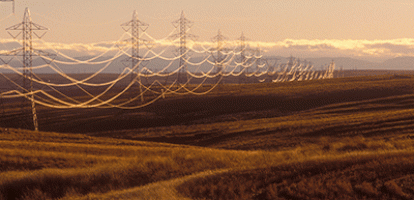 From: Blake Shaffer To: Alberta’s Electricity Consumers Date: November 24, 2016 Re: What Does a Capacity Market Mean for Alberta? Alberta has just announced a significant change to its electricity market: the introduction of a capacity market. But what does this mean? And why are they making this change? Broadly speaking, electricity systems are either market-based or […]
 Ben Dachis – What Does The Us Election Mean For Canada’s Energy Sector?
 From: Benjamin Dachis To: Canada’s Energy Sector Date: November 9, 2016 Re: What does the US election mean for Canada’s energy sector? For Canada’s energy sector, the lesson of the US election is to focus on competitiveness. For Canada’s oil sector, there is a widespread expectation that Mr. Trump will approve TransCanada’s Keystone XL pipeline. […]