



Werner Antweiler – Trouble Looming For Quebec’s Cap-and-trade System Should Make Ontario Think Twice Before Joining In
 From: Werner Antweiler To: Ministers of Environment Quebec and Ontario Date: November 4, 2016 Re: Trouble looming for Quebec’s cap-and-trade system should make Ontario think twice before joining in In 2015 Quebec joined California’s carbon cap-and-trade system and committed to gradually reduce its emissions to about 55 Megatonnes in 2020. As Ontario is about to […]
 Ben Dachis – Home Energy Tax Credits Are Not The Right Way to Reduce Emissions
 From: Benjamin Dachis To: The Hon. Catherine McKenna, Minister of Environment and Climate Change Canada Date: October 20, 2016 Re: Home energy tax credits are not the right way to reduce emissions Your government has plans to re-introduce incentives for home-energy retrofits. If so, this will follow a long line of policies that have provided […]
 Trevor Tombe – What Carbon Pricing Means for Canadian Households
 From: Trevor Tombe To: All Canadians Date: October 19th, 2016 RE: What Carbon Pricing Means for Canadian Households This month, the Government of Canada proposed a national price on greenhouse gas emissions. Provinces have two choices: (1) a carbon tax of $10 per tonne in 2018, rising to $50 by 2022; or (2) a cap-and-trade […]
 Tracy Snoddon – Federal Carbon Price: Now the Real Excitement Begins
 From: Tracy Snoddon To: The Hon. Catherine McKenna, Minister of Environment and Climate Change Date: October 6, 2016 Re: Federal Carbon Price: Now the Real Excitement Begins In a C.D. Howe Institute e-brief last month, I called on the federal government to set a carbon price floor and impose a carbon tax in provinces with […]
 Steve Ambler – Getting Monetary Policy Right as a Response to Oil Shocks
 From: Steve Ambler To: The Bank of Canada Date: September 20, 2016 Re: Getting Monetary Policy Right as a Response to Oil Shocks Uncertainty is harming Alberta’s petroleum sector in many ways. Oil prices are likely to remain depressed until well into next year, though this result depends on many factors including world demand and the Saudi […]
 Time for Canada to install a federal floor under lagging carbon prices: Globe and Mail Op-Ed
With our major trading partners, the United States and China, having recently ratified the Paris climate agreement, there is mounting pressure on Canada to come up with a plan to meet its emissions reduction targets. It’s time for Ottawa to take action and put in place a floor price on carbon nationwide.
If the goal is to reduce Canada’s carbon emissions in a way that causes the least amount of economic damage, a uniform price on carbon that applies across the entire country is the best option. A national carbon price has many advantages: It eliminates unproductive jockeying between provinces to attract business and doesn’t push firms across borders solely because of carbon price differentials.
To date, the provinces have…
Carbon Copies: The Prospects for an Economy-Wide Carbon Price in Canada
 Ottawa should establish a nationwide floor price for carbon, according to a new C.D. Howe Institute report. In “Carbon Copies: The Prospect for an Economy-Wide Carbon Price in Canada,” author Tracy Snoddon argues that a single economy-wide carbon price is required to achieve emissions reductions at the lowest possible cost.
 How Ontario can cut electricity bills without using tax dollars: Toronto Star Op-Ed
The Ontario government has signaled that it is going to find a way to reduce your electricity bill. For this to work, it should stop relying on hiking your taxes to lower your electricity bill and instead focus on real reform of the electricity system.
Most previous plans to reduce electricity bills relied on having taxpayers or other electricity users foot the bill for lower electricity costs only for some. The first plan was the Ontario Clean Energy Benefit, which came straight from tax dollars. That was replaced by the Ontario Electricity Support Program for low-income households. The province puts the cost of that program on other electricity users.
The government also recently eliminated the Debt Retirement…
Dachis, Jacobs And Muthukumaran – Why Is Ontario’s Electricity Now More Expensive Than Its Neighbour’s?
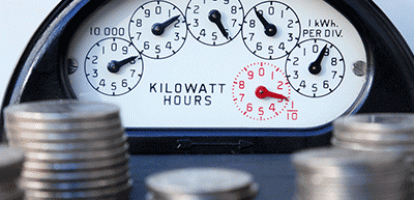 From: Benjamin Dachis, Aaron Jacobs and Ramya Muthukumaran To: The Hon. Minister Glenn Thibeault, Ontario Minister of Energy Date: September 12th, 2016 Re: Why is Ontario’s Electricity Now More Expensive than its Neighbour’s? This week’s throne speech focused on getting the cost of electricity down. It’s now your job to figure out how. A comparison of […]
 Ben Dachis – Ontario should let markets lead to energy savings, not arbitrary rules (Part II)
 From: Benjamin Dachis To: Ontario Ministry of Energy CC: Independent Electricity System Operator Date: September 2nd, 2016 Re: Ontario should let markets lead to energy savings, not arbitrary rules A few weeks ago, I showed what happened to electricity prices during the highest demand hour of the year so far in Ontario: 6 PM on August 10th. What happened […]
 Ben Dachis – Dans Quelle Mesure Un Nouveau Pipeline A-t-il Réduit La Dépendance Du Canada Sur Le Pétrole étranger?
 To read the English version, click here. Expéditeur : Ben Dachis Destinataire : L’honorable Jim Carr, ministre des Richesses naturelles Date : 1er septembre 2016 Objet : Dans quelle mesure un nouveau pipeline a-t-il réduit la dépendance du Canada sur le pétrole étranger? Les nouveaux pipelines pourraient-ils faire en sorte que le Canada consomme moins de pétrole étranger? Les dernières indications […]
 Ben Dachis – How Much Did A New Pipeline Reduce Canadian Dependence on Foreign Oil?
 Pour la version française, cliquez ici. From: Ben Dachis To: The Hon. Jim Carr, Minister of Natural Resources Date: September 1st, 2016 Re: How Much Did A New Pipeline Reduce Canadian Dependence on Foreign Oil? Could new pipelines result in Canada using less foreign oil? The latest evidence from the recent reversal and capacity expansion of […]