



Kronick, Ambler – Bank of Canada should keep cutting interest rates, whatever the U.S. Fed does
Published in The Globe and Mail.
With CPI inflation slowing to 2.5 per cent in July, the rate cut announced by the Bank of Canada on Wednesday surprised no one.
Given the dovish tone of the bank’s announcement, it would be reasonable to expect at least one and possibly two more 25-basis point cuts before the end of this year (a basis point is one-hundredth of a percentage point).
This cut widened the gap between the Bank of Canada’s overnight rate target and the top of the U.S. Federal Reserve’s band for its equivalent, the federal funds rate, from 50 basis points at the end of May to 1.25 per cent.
Should this gap worry the Bank of Canada – perhaps lead it not to cut the overnight rate again even if it…
C.D. Howe Institute Monetary Policy Council Calls for Bank of Canada to Cut Overnight Rate to 4.25 Percent Next Week and to 3.00 Percent in a Year
August 29, 2024 – The C.D. Howe Institute’s Monetary Policy Council (MPC) calls for the Bank of Canada to lower its target for the overnight rate, its benchmark policy interest rate, to 4.25 percent at its next announcement on September 4th. The MPC further calls for the Bank to lower the target to 4.00 percent at the following announcement in October and to 3.00 percent by September of 2025.
The MPC provides an independent assessment of the monetary stance consistent with the Bank of Canada’s 2 percent inflation target. MPC co-chair, William Robson, the Institute’…
Bourque and Caracciolo – How to Improve Financial Regulation. Pruning Would Help
 To: Canada’s financial regulators From: Paul C. Bourque and Gherardo Gennaro Caracciolo Date: August 27, 2024 Re: How to Improve Financial Regulation. Pruning Would Help Regulation is an important part of Canada’s financial landscape. And to ensure the rules support an efficient and effective financial regulatory framework, regulators need to be “constant gardeners.” Canada has 44 different federal and […]
 Gherardo Gennaro Caracciolo – What Vancouver’s empty home tax really means for Canada’s housing supply
Published in The Hub.
The Canadian housing market is in turmoil. Supply has lagged far behind demand as the population surges. This imbalance has led to soaring property prices, high rents, and increased homelessness.
The situation calls for urgent action, and while long-term solutions, like building more homes, are essential, policymakers are also deploying short-term measures—most notably, vacant property taxes. As these policies are becoming increasingly popular, the potential impact and drawbacks of such taxes call for careful examination.
My new C.D. Howe Institute publication with Enrico Miglino aims to shed further light on this matter by using Vancouver’s empty homes tax as a case study. Implemented in 2017,…
Bourque, Caracciolo – Financial regulation needs constant pruning
Published in the Financial Post
Regulation is an important part of Canada’s financial landscape. But to ensure the rules support an efficient, effective financial regulatory framework regulators need to be “constant gardeners.”
Canada has 44 different federal and provincial financial regulators and, as our recent analysis for the C.D. Howe Institute shows, the word count of their various rules and mandates continues to rise significantly year over year. The rules’ predominant focus is on risk reduction and consumer protection. Much less attention is paid to market efficiency, innovation and growth — though in the big picture they are at least as important. Our research shows that the balance is almost five-to-one: 85 per…
Edward Waitzer – Change Needed: Crooks Shouldn’t Get Out of Fines Through Bankruptcy
 From: Edward Waitzer To: Bankruptcy law watchers Date: August 8, 2024 Re: Change Needed: Crooks Shouldn’t Get Out of Fines Through Bankruptcy Insolvency laws in Canada (as in the United States, Britain and Australia) have long enshrined the principle that bankruptcy should not assist dishonest debtors. But the Supreme Court of Canada recently determined that fraudsters are able to […]
 Ripple Effects: The Impact of an Empty-Homes Tax on the Housing Market
 The Canadian housing market is experiencing an unprecedented crisis. One solution being explored is the adoption of demand-side measures like Vancouver’s 2017 empty-homes tax. This E-Brief evaluates the tax’s impact on housing affordability and availability, helping policymakers balance efficient property use with ensuring a steady supply of new homes. We use the difference-in-difference (DID) method […]
 The Good, the Bad and the Unnecessary: A Scorecard for Financial Regulations in Canada
 Canada’s regulatory burden has increased significantly over the past decade, resulting in higher compliance costs and decreased competitiveness. This paper evaluates whether Canadian financial regulators employ a sound approach. There is a need for a balanced approach that ensures regulations address financial stability and consumer protection while fostering innovation and market efficiency. The analysis includes […]
 Graph of the Week: The 5-Year Fixed Interest Rate
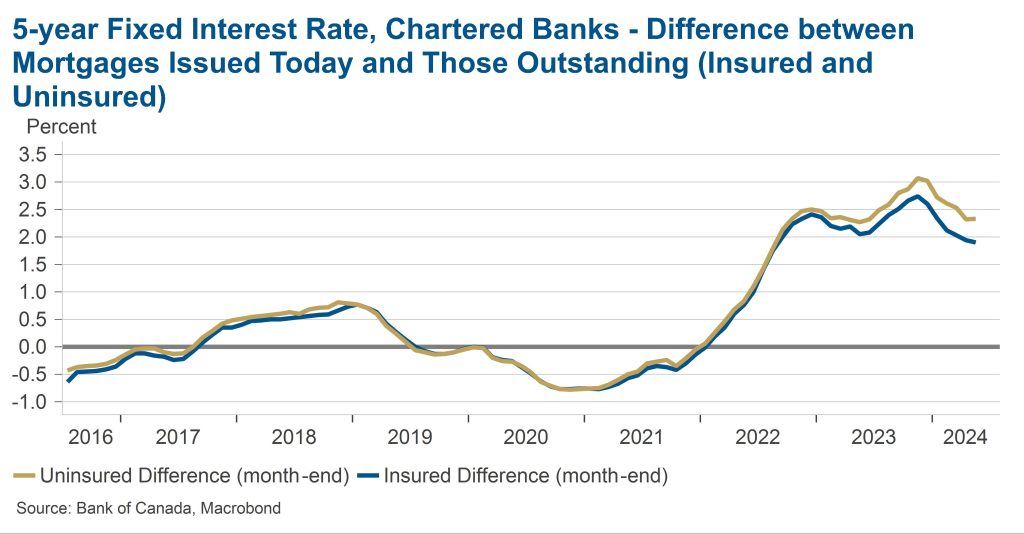 Introducing Graph of the Week, a new series from the C.D. Howe Institute’s Graphic Intelligence that presents valuable and easily digestible data. Each Monday we will unveil one new captivating chart or graph with interesting insights, explaining it in two-to-three sentences. Dive into the data with us. The 5-year fixed interest rate is the most […]
 C.D. Howe Institute Monetary Policy Council Calls for Bank of Canada to Lower Overnight Rate to 4.50 Percent, Cut to 3.25 Percent by July 2025
July 18, 2024 – The C.D. Howe Institute’s Monetary Policy Council (MPC) calls for the Bank of Canada to lower its target for the overnight rate, its benchmark policy interest rate, to 4.50 percent at its next announcement on July 24th. The MPC further calls for the Bank to lower the target to 4.25 at the following announcement in September, on the way to a target of 3.25 percent by July of 2025.
The MPC provides an independent assessment of the monetary stance consistent with the Bank of Canada’s 2 percent inflation target. MPC co-chair, Jeremy Kronick, the Institute’s Associate Vice President and Director of the Centre on Financial and Monetary Policy, chaired this meeting. MPC members make…
Mark Zelmer – Let’s Not Rush New Bank Rules on Capital and Lending
 From: Mark Zelmer To: Office of the Superintendent of Financial Institutions Date: June 13, 2024 Re: Let’s Not Rush New Bank Rules on Capital and Lending Canada’s financial regulator is in a ticklish situation. On March 6, Federal Reserve Chairman Jerome Powell signalled that US regulators are reconsidering their plans to hike capital requirements for large banks in accordance with what […]
 Bob Baldwin – Don’t Handcuff Big Pension Plans to Canada
 From: Bob Baldwin To: Finance Minister Chrystia Freeland Date: May 28, 2024 Re: Don’t Handcuff Big Pension Plans to Canada Last month’s budget unveiled a working group led by former Bank of Canada governor Stephen Poloz to collaborate with pension fund leaders to encourage funds to invest more of their assets in Canada. This initiative is not consistent with […]