





The Study In Brief
When the British Columbia government announced in 2018 that it would implement a publicly accessible registry of beneficial ownership of land, hopes were high that the registry would effectively combat the province’s money laundering problem. However, in the ensuing months, the BC government stripped the highly touted public registry of almost all its potential power and functionality. The final product, scheduled to be launched this fall, will likely do little to stop money laundering in BC real estate. And, once again, Canada will have failed to show it is serious about combatting money laundering.
Created under BC’s Land Ownership Transparency Act, the registry has significant flaws that greatly undermine its ability to help deter and detect money laundering in BC real estate.
There is no proactive verification of identification information for beneficial owners, which renders that information of little value to law-enforcement agencies and other searchers of the registry.
The searchability and discoverability of information filed on the registry is unreasonably restricted, which deters use and limits searchers’ ability to connect falsely declared beneficial owners with perpetrators of predicate crimes.
There is no confidential tip line through which searchers from around the world can send key information and evidence to Canadian law-enforcement agencies and Canada Revenue Agency.
And sanctions for false filings do not include prison sentences, the absence of which creates minimal deterrence to members of organized crime, undermines the integrity of information filed, and decreases law-enforcement agencies’ ability to negotiate plea deals in exchange for information leading to the arrest and conviction of perpetrators of predicate crimes.
In other words, the information on the registry will be unreliable, difficult to access, difficult to process and, even if it helps a searcher spot a falsely declared beneficial owner, the ability to communicate that discovery to Canadian law-enforcement officials and their ability to leverage it to catch criminals will be curtailed.
The good news is that these flaws can all be fixed.
Introduction
It sounded so promising. In 2018, in the wake of several highly publicised money-laundering scandals and the public outcry that something be done about laundered money driving up Vancouver real estate prices,11 Transparency International Canada’s 2016 report, “No Reason to Hide” found that nearly half of the 100 most valuable residential properties in Greater Vancouver are held through structures that hide their beneficial owners. Nearly one-third of the properties are owned through shell companies, at least 11 percent have a nominee listed on title and more than a quarter of the high-end homes bought in the last five years are owned by students or homemakers with no clear source of income. the British Columbia government announced it would implement a publicly accessible registry of beneficial ownership of land, the first of its kind in the world.
It was important that the BC government build a world-class public registry of beneficial ownership, not just because such a registry is a powerful tool to combat money laundering. For years Canada has been an international laggard in the battle against money laundering (Meunier 2018). The new registry would show the world that, finally, Canada would take a meaningful lead. Other countries have already implemented publicly accessible registries of beneficial ownership for companies.22 In January 2020, the BC government began a public-consultation process respecting the implementation of a beneficialownership registry for private companies. This Commentary does not attempt to discuss the various possibilities for such a registry, which is still in the early planning stages. The BC registry would be the first for land.
Over the course of the next 18 months, the BC Ministry of Finance worked diligently with private industry, non-governmental organizations and members of the general public in the apparent hope of building a world-class public registry. But as the enabling Land Owner Transparency Act (“LOTA”) moved through the legislative process, it became evident that even the most basic lessons learned from existing public registries were being ignored.33 For example, see Open Ownership and Global Witness. 2017. “Learning the lessons from the UK’s public beneficial ownership register.” See https://www.openownership.org/uploads/learning-the-lessons.pdf. Also see Global witness. 2019. “Getting the UK's House in Order.” May. See https://www.globalwitness.org/en/campaigns/corruption-and-money-laundering/anonymous-company-owners/getting-uks-house-order. In an apparent attempt to reduce set-up and operating costs, the BC government stripped the highly touted public registry of almost all its potential power and functionality. The final product, scheduled to be launched this fall,44 Filings on the registry are scheduled to commence November 30, 2020, and public searches of the registry are scheduled to commence April 30, 2021. See https://landtransparency.ca/. will likely do little to stop money laundering in BC real estate. And, once again, Canada will have failed to show it is serious about combatting money laundering.
Making matters worse, had the registry been constructed to combat money laundering more effectively, the registry would likely have become a significant money-maker for the province.
The following discussion sets out the primary purpose and power of a public registry of beneficial ownership and then identifies four fundamental flaws in the LOTA registry. It then explains why a properly constructed public registry of beneficial ownership is a powerful weapon in combatting money laundering, and why a beneficial ownership registry for land offers a unique opportunity to generate significant revenue that likely would exceed its costs. Finally, it sets out suggested changes that would increase the registry’s power, profit potential and functionality.
Part I: Purpose and Power of a Public Registry of Beneficial Ownership
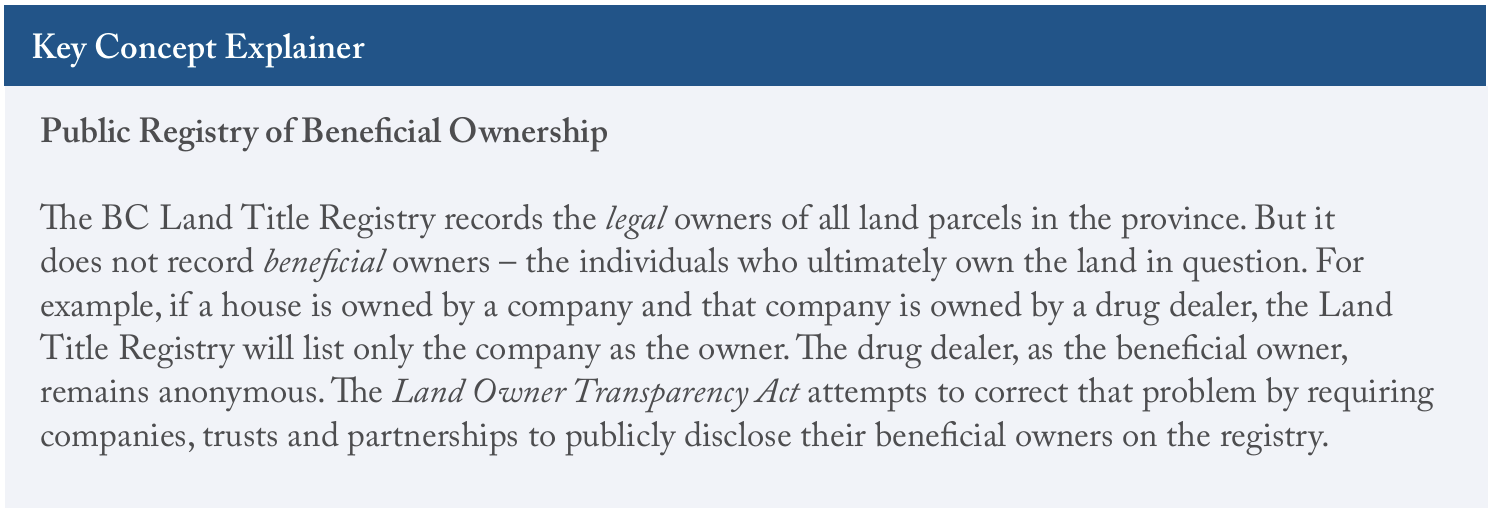
The BC Land Title Registry records the legal owners of all land parcels in the province. But it does not record beneficial owners – the individuals who ultimately own the land in question. For example, if a house is owned by a company and that company is owned by a drug dealer, the Land Title Registry will list only the company as the owner. The drug dealer, as the beneficial owner, remains anonymous.
The LOTA attempts to correct that problem by requiring companies, trusts and partnerships to publicly disclose their beneficial owners on the LOTA registry. The primary purpose of such registration is to help law-enforcement agencies detect, investigate and prosecute money laundering by providing quick access to critical information that otherwise is often unobtainable.
But the real power of a public registry rests in its ability to enable searchers – ordinary citizens from around the world – to assist lawenforcement agencies in that endeavor by: (i) identifying frontmen and other falsely declared beneficial owners; (ii) using their local knowledge to connect those falsely declared persons with the perpetrators of the underlying crimes predicate to money laundering (e.g., drug trafficking, political corruption, etc.); and (iii) communicating that key information to Canadian law-enforcement agencies.
That begs the question: What do these searchers need from the LOTA registry to maximize their ability to make those connections and communicate their findings? Here are three key needs:
- The identification-information filed on the registry must be accurate, reliable and inclusive of key distinguishing facts that enable searchers to identify frontmen and other falsely declared beneficial owners.
- The search fields in the registry must be userfriendly, enabling searchers around the world to quickly and easily gather information, including information that is specifically relevant to their particular city, province, state or country.
- The registry must have a means of communication through which searchers can confidentially disclose key information and evidence to Canadian law enforcement officials.
Unfortunately, the BC public registry fails on all three fronts. As discussed below, the LOTA registry has surrendered almost all the key elements and advantages of a public registry of beneficial ownership.55 One helpful recommendation that the LOTA did adopt was lowering the reporting threshold for shareholders of a corporation with an interest in land. Under the LOTA, reporting obligations are triggered when an individual obtains 10 percent or more of the issued shares or voting rights of such a corporation. That reporting threshold under other Canadian legislation dealing with beneficial ownership, such as the Canada Business Corporations Act, is 25 percent, which leaves a large opening for money launderers to avoid disclosure of beneficial ownership by maintaining individual shareholdings just below that threshold.
Part II: Fundamental Flaws in the LOTA Registry
There are four fundamental flaws in the LOTA registry. Individually, they significantly weaken the effectiveness of the registry. Collectively, they render the registry of little value in combatting money laundering.
1 No Requirement to Verify Identities
The biggest flaw in the LOTA registry is that there is no requirement that registry officials, or any other persons, independently verify all identification information filed on the registry. There is not even a requirement that filers submit copies of government-issued photo-identification documents such as passports or driver’s licences.66 There is a requirement to file the “individual’s social insurance number, if any” and to file the “individual’s tax number, if any, assigned to the individual by the Canada Revenue Agency.” However, it would be quite easy for criminals to invent a person that was never assigned either of those identification numbers. In other words, money launderers can avoid detection by simply making up a name and creating a nonexistent beneficial owner with no connecting factors to the true beneficial owner or his criminal organization. The chances of getting caught will be minimal because no one at the LOTA registry office will be proactively verifying the identification information being submitted.
To be clear, the LOTA does include two limited safeguards against false identification, but they are likely to do little to prevent or detect the filing of false identities.
First, the LOTA requires a transferee or a reporting body (a corporation, a trustee of a trust or a partner of a partnership) to certify a transparency declaration or transparency report to be correct and complete. But there is no requirement that the identification information for an individual be verified and certified by an independent third party, which means criminal organizations and their frontmen can themselves certify their transparency declarations and reports.
Second, the LOTA gives the registry administrator or an enforcement officer designated by the Minister the discretionary power to demand verification of information for the purpose of determining compliance with the Act. In other words, verification of information will generally occur only by way of random spot check or when the administrator or an enforcement officer has reason to believe there has been non-compliance with the Act.77 While it is possible that the administrator or enforcement officers appointed under of the LOTA might attempt to implement a “risk-based approach” to verify the accuracy of beneficial-ownership filings, it would likely be ineffective. The lack of a pre-filing, identity-verification system means money launderers can simply make up names, dates of birth, citizenships and residencies, effectively registering phantom persons as beneficial owners. That false information is then added onto the registry with the information for more than one million other registered beneficial owners. Thereafter, on what basis can an enforcement officer effectively assign a risk level to each registrant? More specifically, how can an officer effectively assess the risk that the information concerning one registrant (e.g., John Smith, born April 23, 1968, UK citizenship, residing at 123 Bywater Street, London UK) has a higher risk of falsification than that of another registrant (Mary Brown, born June 15, 1972, US citizenship, residing at 456 Oak Trail Drive, Libertyville, Illinois) – particularly when no registrants have filed copies of government-issued photo identification, such as a passport, to prove they even exist? Unfortunately, that approach builds inherent risk and circular weakness into the system. More specifically, if the identification information filed on the registry is false or misleading, particularly if the name is fictitious, it minimizes the ability of law-enforcement agencies and public searchers to identify criminal frontmen with connections to the perpetrators of crime. This reduces the number of cases that might be brought to the attention of the administrator or enforcement officer to give them reason to believe there was noncompliance with the Act.
As a result, the LOTA registry will be of limited value to law-enforcement agencies or other searchers of the registry. They can discover information about honest beneficial owners, but they are unlikely to discover information in connection with sophisticated criminals who have laundered their dirty money in BC real estate with impunity.
Additionally, the registry’s lack of an identityinformation verification system means BC real estate brokers and sales representatives will not be able to use the LOTA registry as a reliable source to meet their new “know-your-client” obligations that come into effect on June 1, 2021.88 The Regulations to the Proceeds of Crime (Money Laundering) and Terrorist Financing Act were amended in the spring of 2020 to require reporting entities that are designated non-financial businesses and professions, including real estate brokers and sales representatives, to verify the identity of the beneficial owners of their clients. Those amendments, which are scheduled to come into force on June 1, 2021, will make it more difficult in many instances for money launderers to simply invent a person. However, they will still leave numerous loopholes in the LOTA registry. For example, although the LOTA requires all corporations, trusts and partnerships that currently own land in BC to file initial transparency reports on the registry, none of those initial reports will involve persons acting in their capacity as real estate professionals. Furthermore, money launderers can avoid future scrutiny by real estate professionals simply by purchasing and selling homes without agent representation. Finally, real estate brokers and sales representatives have no expertise in verification of identification information and are a weak substitute for the LOTA registry staff conducting its own expert verification of all identity information filed on the registry. These professionals, who do not have expertise in identity verification and often lack the financial resources to implement or access proper verification systems, were hoping to rely on the LOTA registry as an independent verification source. The omission of a proper verification system in the LOTA registry may force a number of those professionals, particularly those in smaller businesses, to either merge with large real estate companies or simply go out of business.99 Perhaps the biggest problem of all may be that, in an attempt to meet their new “know-your-client” obligations, some real estate agents and other reporting entities may use the LOTA registry as a “reliable source” to confirm the accuracy of beneficial ownership information concerning their clients. In particular, they may think they have taken “reasonable measures” as required under the guidance standards established by the Financial Transactions and Reports Analysis Centre of Canada (FINTRAC). However, because the identity information on the LOTA registry will not have been verified, the registry would not be a reliable source. In that regard, it may be necessary that FINTRAC clarify its guidance to address the limited usefulness of the LOTA registry in helping reporting entities to meet their know-your-client obligations.
2 Weak Sanctions
There are no prison sentences for false declarations under the LOTA, only fines. From a criminal justice perspective, that makes little sense. Under the BC Securities Act, a person who makes a materially false or misleading statement in a filing with the securities commission is subject to a fine of up to $5 million and five years in prison.1010 See Sections 155 and 168.1 of the BC Securities Act. Yet, a person who makes a materially false or misleading statement in a LOTA registry filing is subject only to a fine.1111 Under the LOTA, an individual who provides false or misleading information in a transparency declaration or transparency report is subject to a maximum fine equal to the greater of $25,000 or 15 percent of the assessed value of the property. For a person other than an individual, the maximum fine is the greater of $50,000 or 15 percent of the assessed value. (Section 92.) Maximum fines for providing false or misleading information to a reporting body are $50,000 for an individual and $100,000 for a person other than an individual. (Section 93.)
When one considers that money laundering and its underlying predicate crimes (e.g., drug trafficking, human trafficking, child pornography) destroy millions of lives every year, it is hard to justify a set of sanctions that exclude prison sentences for materially false filings on a registry established to help detect and prosecute those crimes.
The omission of prison sentences also undermines the ability of law-enforcement agencies to negotiate plea deals with criminal frontmen and false declarants in exchange for evidence leading to the prosecution and conviction of perpetrators of those predicate crimes. To money launderers and their frontmen, fines are merely the cost of doing business. A frontman can sell the house, pay any fine and remain silent. But when faced with five years in prison, he is much more likely to cooperate with the police.
3 Counterproductive Barriers to Searching the Registry
The LOTA registry has numerous barriers to efficient searches of the registry. Here are two.
(i) User fees. The LOTA registry charges a $5 fee for each search.1212 Land Title and Survey Authority of British Columbia – Land Owner Transparency Registry. 2020. See https://landtransparency.ca/wp-content/uploads/2020/10/LOTR_Policy_Presentation-Oct-27.pdf. That fee nonsensically applies to all law-enforcement agencies and government regulators such as the RCMP, the Canada Revenue Agency and the Canada Border Services Agency.1313 Pursuant to Section 23 of the LOTA Regulations (Order in Council 549), only the enforcement officer appointed under the LOTA and an official or employee of the ministry of the BC Minister of Finance are exempt from fees for searches and inspections of the LOTA. See https://www.bclaws.ca/civix/document/id/oic/oic_cur/0549_2020.
The fee also applies to members of the general public. A principal purpose of a publicly accessible registry of beneficial ownership is to enable members of the public to help combat money laundering by identifying falsely declared beneficial owners. Charging user fees, even small ones, to search a registry of beneficial ownership makes about as much sense as charging fees for providing assistance to our police departments. “I’d like to report a crime.” “That’ll be five dollars, please.”
Those user fees also undermine the BC government’s potential to generate significantly greater revenues. User fees suppress usage,1414 Global Witness reported in its May 2019 article “Getting the UK’s House in Order,” that after the UK government removed user fees from the UK company register, registry searches per year increased from six million to more than two billion. See https://www.globalwitness.org/en/campaigns/corruption-and-money-laundering/anonymous-company-owners/getting-uks-house-order. which reduces the number of searchers reporting critical information to Canadian authorities, thereby reducing the number of potential convictions, fines and property forfeitures obtained by the BC government.
(ii) Keyword searches. The LOTA registry does not allow keyword searches. The public can search only the name of a specific person or the land parcel identifier number for a specific property.1515 Section 35 of LOTA, which comes into force on April 30, 2021. If that search discloses an individual who is an interested holder in land (e.g., a beneficial owner) the search will reveal his or her country of citizenship and city and country of principal residence.1616 If the person is Canadian, there is no public disclosure of their other citizenships on the LOTA Registry. If the person is a permanent resident of Canada, there is no public disclosure of any of their citizenships whatsoever on the LOTA registry – only their permanent residency of Canada is disclosed. If the person is not a Canadian citizen or permanent resident of Canada, there is public disclosure of each of their countries or states of citizenship. Public disclosure of principal residency of Canadians and permanent residents is limited to city and province. Public disclosure of principal residency of persons who are neither Canadian nor a permanent resident of Canada is limited to city and country. See Sections 8 and 30 of the LOTA. [Note: for countries with multiple cities of the same name, the inclusion of state or province would have been helpful. For instance, there are 34 cities and towns named “Springfield” in the US. See https://www.usgs.gov/faqs/what-most-common-citytown-name-united-states?qt-news_science_products=0#qt-news_science_products] But there is no ability to simply enter a keyword such as a country name in the search engine to obtain the names of anyone with a connection to that country. That restriction makes no sense given that a key objective of the registry is to enable the public to connect criminal frontmen and falsely declared beneficial owners to the perpetrators of predicate crimes.
For example, if someone in a foreign country wished to obtain a list of all persons on the LOTA registry with a connection to his country, he would have to either enter the parcel identifier number for every separate parcel of land in BC or enter the name of every person in his country. However, if the LOTA registry allowed keyword searches, he could simply enter the country name to obtain a list of all persons who are citizens or residents of his country. Voilà, the 20-year old niece of our country’s biggest drug dealer owns 14 houses in Vancouver.
4 No Conduit to Communicate Key Information to Law-Enforcement Agencies
As currently constructed, the LOTA registry provides only a one-way flow of information. It sends information out into the world that enables persons to connect a falsely declared beneficial owner or frontman with the true beneficial owner – the perpetrator of a predicate crime. But there is no mechanism built into the registry – such as a confidential tip line – that enables the potential informant to pass along critical information to Canadian law-enforcement agencies. In many cases, particularly where the searcher lives under an authoritarian or corrupt regime, the searcher would have no idea where and to whom he could safely deliver the information and evidence.
Part III: Understanding the Potential Power of a Public Registry
To understand how best to maximize the power of a public registry of beneficial ownership, it is important to first understand the form such power should take. Here are three fundamental ways in which a properly constructed registry of beneficial ownership revolutionizes the way we can combat money laundering.
1 Disrupting the foundation upon which international money-laundering systems are built
One of the most important powers of a properly constructed public registry of beneficial ownership is its ability to undermine the primary structure through which the proceeds of crime secretly move through the international financial system. A public registry can do so by effectively eliminating the participation of thousands of professional enablers that practise at the outer edges of the law. More specifically, it reduces criminals’ ability to use lawyers, accountants, trust officers and their respective corporate-services companies as ownership frontmen.
Those enabling professionals, found not just in tax havens but in virtually every country in the world, are willing to act as nominee directors and shareholders of shell companies and as trustees of secret trusts because none of that is technically illegal unless they know they are part of a moneylaundering scheme or other criminal activity, which they conveniently often don’t know. But clearly breaking the law by falsely claiming to also be a beneficial owner would likely be a bridge too far for most of those professionals.
And if the ethical issues don’t scare them off, the loss of plausible deniability likely will. A lawyer may not know he is acting as a nominee shareholder for a drug trafficker, but he surely would know he is not himself the true beneficial owner of a house in Vancouver.
Additionally, even if some of those professionals were willing to falsely declare themselves beneficial owners, they would be limited in the number of times and clients for whom they could safely do so. A public registry, which collects and verifies beneficial ownership information for all land in its jurisdiction, makes it too easy to spot a tax-haven lawyer with 17 homes in West Vancouver.
In other words, by requiring corporations, trusts, partnerships and nominees to disclose the names of their ultimate beneficial owners, a properly constructed public registry undermines the primary foundation upon which many international money-laundering systems are built. In doing so, it effectively forces criminals to use individuals whom they personally know and trust. That’s because picking the wrong person might be the difference between a life of wealth and a life behind bars.
Accordingly, money-laundering criminals are likely to use relatives, close friends or trusted business associates to falsely declare themselves as beneficial owners. But that creates a new problem for these criminals – a closely connected accomplice increases the probability of detection.
That forced shift away from professional enablers in tax havens to persons with whom a criminal has a close relationship makes it much easier for lawenforcement agencies to connect falsely registered frontmen with the drug traffickers, human traffickers and corrupt politicians laundering the proceeds of their crimes. Furthermore, placing the names of all beneficial owners on a public registry with verified identification information greatly increases the number of persons around the world who can use their local knowledge to help make those connections.
2 Helping law-enforcement agencies connect laundered money to the predicate crime.
Money laundering is a derivative crime. It is the process by which a person disguises the origin or ownership of illegally obtained proceeds so that they appear to be from a legitimate source. Additionally, to establish the crime of money laundering, the funds in question must be proven to be connected to their underlying predicate crime.
Helping law-enforcement agencies make that connection is perhaps the most obvious benefit of a public registry of beneficial ownership. Quick and easy access to the registry’s beneficial ownership information enables the police to obtain critical information without tipping off criminals that they are under investigation. Furthermore, and perhaps most important, because the beneficial ownership information is publicly accessible, nongovernmental agencies, investigative journalists and ordinary citizens around the world can use their local knowledge to help law-enforcement agencies make connections between falsely declared frontmen and perpetrators of the predicate crimes.
But none of that is achievable to any meaningful degree if the registry’s beneficial ownership information is inaccurate, misleading or simply made up. That’s why it is imperative that the registry have a proactive verification system in place that ensures the information submitted for filing is accurate and of high integrity.
Make no mistake, the registry verification system itself will not automatically detect that a filer is lying when he claims to be a beneficial owner. If the verification system could do that, investigators wouldn’t need the registry; they would only need its verification system. However, the verification system does perform a key function – it further minimizes a registrant’s ability to provide false information on the registry without getting caught. It does so by proactively verifying the identity of each person reported to be a beneficial owner.1717 Verification of identity is already widely used in Canada and around the world in combatting money laundering. For example, FINTRAC (Canada’s financial intelligence unit for money laundering) sets out identification verification methods that Canadian financial institutions must use under know-your client rules, such as obtaining certified copies of government-issued photo identity documents (e.g., passport or driver’s licence). See: https://www.fintrac-canafe.gc.ca/guidance-directives/client-clientele/Guide11/11-eng. Digital ID authentication processes are also instrumental in verifying identity information. In other words, it establishes a baseline of evidence that the person exists and they are whom they claim to be. The system augments that baseline of evidence by also verifying key supporting information (e.g., date of birth, country of citizenship/residency, etc.) that would help law-enforcement agencies and other searchers of the registry connect falsely declared beneficial owners and other frontmen to the true beneficial owners.
Furthermore, the verification process itself can help unearth frontmen when it discovers their identification information is false or their supporting documents, such as passports, have been doctored. If meaningful sanctions, including prison sentences, were attached to false declarations, law enforcement would be able to use the threat of prosecution and imprisonment to help flip frontmen and false declarants into providing evidence to help investigate, prosecute and convict the true beneficial owners – the perpetrators of the predicate crimes.
Finally, that increased threat of detection, investigation and prosecution creates deterrence. It makes it more difficult for criminals to find willing frontmen, and it poses a greater threat that if a frontman is caught, he will disclose the identity of the beneficial owner.
In other words, if there is proactive verification of information being filed on the registry and meaningful sanctions are attached to false declarations, the registry will significantly help lawenforcement agencies deter, detect, investigate and prosecute money laundering.
3 Circumventing official channels in authoritarian regimes
Without a public registry of beneficial ownership, Canadian law-enforcement agencies are often limited to official channels when attempting to trace dirty money from an apparently clean asset, like real estate in Vancouver, through a web of tax-haven companies and trusts to the perpetrator of the predicate crime. That is an extremely difficult task at the best of times (Comeau 2019a). But when the predicate crime is committed in an authoritarian or corrupt regime, it’s almost impossible. That’s because official agencies in those countries are often controlled by corrupt government officials who are themselves laundering their dirty money around the world, including in Canada.
A publicly accessible registry of beneficial ownership would help circumvent that limitation. It enables ordinary citizens from around the world to search the registry and use their local knowledge to identify beneficial-ownership registrants as family members, close friends or business associates of known criminals and corrupt politicians. “Hey, our governor’s 19-year-old nephew owns five houses in Kitsilano.”
That’s likely not a small matter in the context of money laundering in Canada and not simply because authoritarian and corrupt regimes may be responsible for as much as half the world’s laundered money.1818 Based on GDP. Also, see “World Bank National Accounts: https://data.worldbank.org/indicator/NY.GDP.MKTP.CD. Although money laundering is an invisible crime and, therefore, it is extremely difficult, if not impossible, to accurately estimate total amounts laundered in Canada, it is likely that over the last 20 years significant amounts of dirty money from authoritarian and corrupt regimes have been laundered in our major cities, including Vancouver. That’s because Canada provides a double attraction for criminals from these countries.
Criminals in authoritarian and corrupt regimes have always suffered from the significant risk that someone closer to power could arbitrarily confiscate their assets. Historically, some of those criminals reduced that risk by using international financial markets to transfer their assets to Western liberal democracies where our strong rule of law protects against arbitrary confiscation. But many of those criminals, particularly those from Soviet-block countries and other communist nations, did not have access to international financial markets used and controlled by Western nations. Their significant risk of arbitrary confiscation continued unabated.
Globalization greatly reduced that risk. As international trade and financial flows expanded exponentially over the last 20 years, so too did the ability of criminals to transfer their assets to large, Western liberal democracies for safekeeping. The Cold War had ended and so, too, did barriers to access.
When transferring their assets, international criminals have another important decision to make: how best to reduce their risk of detection and prosecution. All else being equal, criminals will seek out those liberal democracies with comparatively weak anti-money laundering laws pertaining to the disclosure of beneficial ownership of companies, trusts and real estate.1919 As noted by the international Financial Action Task Force, “Differences between national anti-money laundering systems will be exploited by launderers, who tend to move their networks to countries and financial systems with weak or ineffective countermeasures.” See https://www.fatf-gafi.org/faq/moneylaundering/ Unfortunately, Canada’s weak rules concerning corporate transparency and beneficial ownership, particularly when compared to other Western liberal democracies,2020 The 2020 Tax Justice Network, Financial Secrecy Index ranks Canada the 19th worst financial-secrecy jurisdiction in the world and the fifth worst among large Western liberal democracies. See https://fsi.taxjustice.net/PDF/Canada.pdf have made Canada a significant target.
Given that double incentive to send dirty money to Canada – to reduce risk of arbitrary confiscation at home and reduce risk of detection abroad – it is likely that a significant portion of the hundreds of billions of dollars laundered annually from authoritarian and corrupt regimes2121 The “consensus range” of annual global money-laundering transactions, as announced by the International Monetary Fund in 1998, is 2 to 5 percent of global GDP. In 2011, the United Nations Office of Drugs and Crime confirmed that range and estimated an annual amount equal to 2.7 percent of global GDP was laundered through the international financial system (UNODC 2011, p. 7). Global GDP in 2018 was estimated at $100 trillion, of which approximately half was attributed to authoritarian and corrupt regimes. That implies $1.35 trillion of dirty money from authoritarian regimes enters the international financial system each year ($100 trillion x 2.7 percent x 0.5). has been coming to Canada, possibly much of it invested in real estate in our major cities, including Vancouver.2222 “Opacity: Why Criminals Love Canadian Real Estate (And How to Fix It)” (Transparency 2019) noted that: “The same factors that make real estate attractive to legitimate investors – its relative stability and potential to appreciate in value – also appeal to money launderers. Yet real estate has several other characteristics that uniquely appeal to criminals: its high value, the potential to manipulate prices, a lack of regulatory oversight and enforcement, and the ability to remain anonymous.”
In other words, if the BC government’s goal is to construct a beneficial ownership registry that effectively deters and detects money laundering in BC real estate, it is imperative that the LOTA registry be structured from both a Canadian and international perspective. It must anticipate common methods of falsifying beneficial information, including in transliteration of names from foreign alphabets, and it must maximize the registry’s searchability and discoverability to enable efficient and effective searches from around the world, including searches by persons living in authoritarian and corrupt regimes.
Part IV: The Profit Potential of a Public Registry of Beneficial Ownership of Land
Money laundering is not a victimless crime; it is the natural extension of its predicate crimes. From drug trafficking to human trafficking to political corruption and tax evasion, money-laundering crimes destroy millions of lives each year, destabilize developing and transitioning countries and undermine democratic safeguards around the world (McDowell and Novis 2001).
The global benefits of deterring, detecting and prosecuting money-laundering are enormous and self-evident. The specific benefits of reducing money laundering in BC real estate are also enormous but perhaps not as self-evident.
It might be obvious that reducing high levels of money laundering in real estate, particularly in Vancouver, would likely alleviate upward pressure on housing and rental prices, decrease the number of vacant houses that hollow out the local economy,2323 See footnote 21 of Kevin Comeau (2019a). and improve BC’s reputation both within Canada and around the world. But it is likely less obvious that a properly constructed public registry of beneficial ownership of land has the potential to generate significant provincial revenues.
More specifically, a properly constructed registry will help law-enforcement agencies detect, investigate and prosecute money laundering and its predicate crimes. Sanctions for those and other related offences under the Criminal Code include fines and forfeiture of property that would provide a potential revenue source for the BC government. Fines for LOTA violations would add to that potential revenue source.2424 Maximum fines for offences under the LOTA are the greater of $50,000 and 15% of the assessed value of the property. Those fines would be paid to the BC government. See the LOTA, Part 6 – Offenses. Most important of all would be the maximization of that potential – the more effectively the registry is constructed to help catch and convict the bad guys, the greater the BC government’s potential to capture those significant revenues.
That potential is augmented by the government’s increased ability to successfully collect those fines and make those forfeitures because the subject matter of the registry is land, an immoveable asset. Criminals can’t secretly run away with land or hide it in some tax-haven bank account as they can with drug money and other assets. Furthermore, the provincial attorney general can obtain a restraint order prohibiting the sale of the land during a criminal investigation;2525 See Section 462.33 of the Criminal Code. that order can be registered against the property on the Land Title Registry;2626 See Section 462.33(9) of the Criminal Code. and, after conviction, a forfeiture order can be obtained against the property.2727 See Sections 462.37 and 462.38 of the Criminal Code (Canada) and Section 3 of the Civil Forfeiture Act (BC). Also, Section 73 of the LOTA authorizes the enforcement officer to register a lien against the real property of a person who has failed to pay an administrative fine under the Act. In other words, the government is akin to a secured creditor when it comes to obtaining forfeiture of the proceeds of crime and collecting fines levied against registered and beneficial landowners. From a revenue-generation and collection perspective, that’s particularly advantageous in the case of money laundering sourced outside of Canada by perpetrators that have no other connection to Canada.2828 At present, the LOTA does not place any restrictions on owners selling their land during a notice period to comply with a demand for information. For example, if the LOTA administrator requests verification of the identity of a beneficial owner or proof of a fact in a transparency report, the landowner can simply sell the land during the notice period. While the landowner may eventually be found in breach of the Act for non-compliance and thereby subject to an administrative fine, the BC government’s effective security for payment of that fine – the house – will be gone. And if the landowner resides outside Canada, the government’s chances of collecting payment of the fine will be further diminished.
Finally, under the existing federal Seized Property Management Act (Canada), the more important the information contributed by the BC government to the investigation and prosecution of federal crimes, the greater the province’s share of revenues from the fines and forfeited property obtained upon convictions.2929 Section 7 of the Forfeited Property Sharing Regulations promulgated under the Seized Property Management Act (Canada) sets out factors that determine the federal and provincial government’s percentage share of fines and forfeited property. That percentage share is generally based on the nature and importance of the information provided by each jurisdiction and the participation of the agencies of each jurisdiction in the investigation and prosecution. If both jurisdictions have contributed a significant portion of the total contribution, the proceeds are shared equally. If one jurisdiction has provided only minimal contribution, the proceeds are shared 10 percent/90 percent. In other words, even from a fiscal perspective, it pays to make the BC LOTA registry as effective as possible in helping to detect, investigate and prosecute money laundering and its predicate crimes.
Part V: Key Recommendations – Supercharging the Power of the LOTA Registry
Still, the fundamental flaws in the LOTA registry can be fixed to create the world’s most powerful publicly accessible registry of beneficial ownership. Here are 10 improvements.
(i) Implement a verification system. The LOTA should be amended to provide the LOTA registry with a proactive system for verification of identification information filed on the registry, and the registry administrator should be provided with the financing and expert staff needed to meet that mandate. Furthermore, filers should be required to submit proof of identity, such as independently certified copies3030 LOTA regulations should stipulate the class of persons (e.g., lawyers, notaries, etc.) who are acceptable as “independent certifiers” of copies of identification documents. of government-issued photoidentification documents (e.g., a passport or driver’s license) for all beneficial owners and other persons for whom identity information is required under the Act. Those changes will create a baseline of evidence that the identified persons exist and they are whom they claim to be. This will help disrupt a principal foundation upon which international money laundering systems are built and help lawenforcement agencies and other searchers of the registry connect frontmen and other falsely declared beneficial owners with the perpetrators of predicate crimes.
A proactive verification system will be expensive, likely costing several million dollars a year to staff and operate and many millions more for the initial set-up phase. However, as discussed in this Commentary, the potential revenues from making such improvements should significantly exceed those costs, and the societal benefits in both BC and around the world would likely be enormous.
(ii) Impose prison sentences and fines up to the value of the property. The LOTA should be amended such that persons who commit major offences under the Act (such as providing false or misleading information in a transparency declaration, in a transparency report or to a reporting body) shall be liable to (i) a fine of not more than the greater of (a) $5 million or (b) the value of the property or (ii) not more than five years in prison, or both.
Sanctions that include prison sentences and larger fines will have five benefits. They will
- reflect both the seriousness of the offences and the BC government’s commitment to combat money laundering;
- change the risk/reward dynamic of laundering money in BC real estate – no longer will the cost of doing business be limited to fines;
- increase law-enforcement agencies’ ability to negotiate plea deals with frontmen and false declarants in exchange for information to prosecute and convict perpetrators of predicate crimes;
- deter money laundering in BC real estate; and
- increase government revenue.
(iii) Implement a Unique-Identifier system. As currently constituted, the registry does not assign a unique identifier (such as an assigned sequential number or “tag”) for each beneficial owner and filer.3131 A unique identifier system is dependent upon the implementation of a proper verification system. Assuming the LOTA is amended to include an identity verification system, the LOTA Registry staff would first verify the identity information of a person (i.e., that the person exists and they are whom they say they are) and then assign a unique identifier number to that person, which would be publicly disclosed on the registry in connection with each of his filings. That omission is significant because, for privacy-protection reasons, only the city and country of residence of a beneficial owner is publicly disclosed. So, without a unique identifier, there is no way for the public to know whether John Smith from London England owns 12 houses in West Vancouver, or 12 John Smiths from London each own one house in West Vancouver.
Furthermore, the assignment of unique identifiers would minimize the ability of criminals to intentionally misidentify themselves when translating their names and identification information in their registry filings. As explained by Oliver Bullough3232 Oliver Bullough is an investigative journalist and the author of “Moneyland: Why Thieves & Crooks Now Rule the World & How to Take it Back.” in his testimony to the Cullen Commission of Inquiry into Money Laundering in British Columbia,3333 Commission of Inquiry into Money Laundering in British Columbia. Transcript of Oliver Bullough. June 2, 2020. See https://cullencommission.ca/data/transcripts/Transcript%20June%202,%202020.pdf
[a unique identifier] would be enormously valuable and it would also get around a problem caused by transliteration from different alphabets into Latin script. If you transliterate from, for example, the Cyrillic [Russian] alphabet or the Arabic alphabet or Chinese characters into Latin script, there are multiple different systems that can be used, which means that the same person can spell their name in many, many different ways - and they do, deliberately.3434 An individual’s ability to deliberately misspell his or her name during transliteration would be significantly reduced if the LOTA required the filing of independently certified copies of government-issued photo identification documents (which would be in the script of the language of the issuing country) and the registry assigned a unique identifier for each individual.
(iv) Disclose names in their original alphabet script. Laundered money in BC real estate comes from countries all around the world, many of which use different alphabet scripts. Providing names of beneficial owners only in English (Latin script) on the LOTA registry makes it difficult for searchers from countries that use non-Latin script (e.g., in Russia, China, Saudi Arabia) to identify frontmen and other falsely declared beneficial owners and connect them to the perpetrators of predicate crimes. Presenting names in both English and in the original script of the government-issued identification document filed on the LOTA registry will greatly enhance the ability of searchers from around the world to identify falsely declared beneficial owners and connect them to the underlying predicate crimes.
(v) Disclose commonly used names. Both a person’s legal name and all other names by which the person is commonly known should be disclosed on the registry. If Dimitri Mikhail Popov has been known as Alexi Popov his entire life, tell the world it’s Alexi.
(vi) Disclose both present and former countries of principal residency. Residency can be changed by simply moving over the border. If a searcher is trying to obtain a list of all persons on the LOTA registry with a connection to his or her country, it would be helpful that past residencies be publicly disclosed. The same goes for countries of citizenship.3535 Public disclosure of past and present citizenships may be vulnerable to constitutional challenge under the privacy protections of the Canadian Charter of Rights and Freedoms. For that reason, as is already the case under the LOTA for present citizenship, it may be prudent to exempt Canadians and permanent residents from the requirement to disclose past countries of citizenship on the LOTA registry.
(vii) Remove the $5 user fee. User fees undermine a principal objective of the registry – to encourage and enable anyone to search the registry to identify falsely declared beneficial owners and frontmen and connect them to perpetrators of predicate crimes. Inhibiting searches decreases the likelihood of users discovering and reporting key information to help Canadian authorities prosecute and convict criminals, which undermines the BC government’s ability to generate revenue from those prosecutions under the Criminal Code and the LOTA. It also undermines efforts to obtain restraint, seizure and forfeiture orders on real estate owned by criminals and to secure a greater share of revenue from the sale of that real estate, as determined under the Seized Property Management Act (Canada).
(viii) Enable keyword searches. The LOTA registry should have a relational database to increase searchability and discoverability, with appropriate filters to narrow scope and tags to enhance identification search fields. More specifically, lawenforcement agencies, investigative journalists, nongovernmental agencies, ordinary citizens around the world and the BC government itself should be able to conduct keyword searches (such as the name of a specific country or city) as well as statistical and data-specific searches. For example, these searches could include “all persons who own more than three houses” or “all persons with a non-Canadian address,” which would not only help combat money laundering but also help clarify who is buying BC homes and how many houses are likely unoccupied.
(ix) Require universal registration of beneficial ownership upon launch of the registry. There is no present requirement that, upon the launch of the LOTA registry, all registered owners of land must file an initial transparency report disclosing their beneficial ownership. Those requirements apply only to corporations, trusts and partnerships. That loophole enables money launderers who already own houses in BC to avoid registration and detection altogether. As stated in Comeau (2019b): While corporations are easily identified as such by their name in the land registry, all other nominee owners are not. In other words, it is impossible to tell by the registered name whether “John Smith” is a trustee, a partner or simply an individual owning both the legal and beneficial interest in land. That means individual trustees and partners who, on behalf of money launderers, have already purchased B.C. real estate can simply not comply with the requirement to file an initial transparency report. The chances of their being caught are minimal because, unlike a corporation, they are not easily identified as acting on behalf of third-party owners. And if caught, they can simply claim they didn’t know they had to make the filing, in which case they will likely get a minimal fine as punishment or, if caught after the six-year limitation period, no penalty at all.
That flaw in the legislation can be remedied by requiring that all registered owners of real estate file an initial transparency report. The administration of such filing requirement could be efficiently achieved by attaching the declaration form to the annual land tax notice and requiring the declaration be submitted at the time tax payments are remitted. That universal disclosure requirement would force money launderers and their nominees to act. They either sell their real estate before the legislation comes into effect, thereby freeing up their vacant houses that helped cause rents and home prices to soar, or they file a false declaration of beneficial ownership. But they can no longer simply do nothing at minimal risk of detection or consequence.
(x) Implement a Confidential Tip Line. Installing a confidential tip line on the LOTA registry would provide a mechanism through which registry searchers could pass along critical information to Canadian law-enforcement agencies and designated regulators such as the Canada Revenue Agency. That safe conduit would be particularly helpful for searchers living in authoritarian or corrupt regimes who would have no idea where and to whom they could safely deliver information and evidence that would help Canadian authorities connect falsely declared beneficial owners with the perpetrators of predicate crimes.
Furthermore, a confidential tip line would likely generate significant revenue for the province. Tip lines, like those used by FINTRAC, Canada Revenue Agency, Canada Border Services Agency, and Crime Stoppers, not only provide critical information for investigations and prosecutions, but can also be extremely profitable. For example, the Canadian Crime Stoppers program has resulted in 200,000 arrests and has recovered more than $4 billion.3636 See Canada Crime Stoppers Statistics: http://www.canadiancrimestoppers.org/aboutus If the LOTA registry tip line were to help recover even a small fraction of that amount, it would not only cover all the costs of a properly constructed registry, it would also generate a significant profit.
Conclusion
The LOTA registry has significant flaws that greatly undermine its ability to help deter and detect money laundering in BC real estate. There is no proactive verification of identification information for beneficial owners, which renders that information of little value to law-enforcement agencies and other searchers of the registry. The searchability and discoverability of information filed on the registry is unreasonably restricted, which deters use and limits searchers’ ability to connect falsely declared beneficial owners with perpetrators of predicate crimes. There is no confidential tip line through which searchers from around the world can send key information and evidence to Canadian law-enforcement agencies and the Canada Revenue Agency. And sanctions for false filings do not include prison sentences, the absence of which creates minimal deterrence to members of organized crime, undermines the integrity of information filed, and decreases law-enforcement agencies’ ability to negotiate plea deals in exchange for information leading to the arrest and conviction of perpetrators of predicate crimes.
In other words, the information on the registry will be unreliable, difficult to access, difficult to process and, even if it helps a searcher spot a falsely declared beneficial owner, the ability to communicate that discovery to Canadian law enforcement officials and their ability to leverage it to catch criminals will be curtailed.
The good news is that these flaws can all be fixed, as identified in this Commentary. The choice rests with the BC government. Through legislative amendments and proper financing, the LOTA registry can be transformed into a powerful tool to combat money laundering in BC real estate, which would reduce upward pressure on housing costs, generate significant government revenue, provide a shining example to other provinces, and improve Canada’s international reputation in the fight against money laundering. Or the LOTA registry can be delivered to the world unchanged – broken on arrival.
References
Canadian Association of Crime Stoppers. Available online at http://www.canadiancrimestoppers.org/ aboutus
Comeau, Kevin. 2019 (a). “Why We Fail to Catch Money Launderers 99.9% of the Time.” E-Brief. Toronto: C.D. Howe Institute. May.
__________. 2019 (b). “B.C.’ s anti-money laundering efforts deserve praise, but more needs to be done.” The Globe and Mail. April 8. Available online at https://www.theglobeandmail.com/business/commentary/article-bcs-anti-money-launderingefforts-deserve-praise-but-more-needs-to
Commission of Inquiry into Money Laundering in British Columbia. 2020. “Transcript June 2, 2020.” Vancouver. Available online at https://cullencommission.ca/data/transcripts/Transcript%20June%202,%202020.pdf
Financial Action Task Force (FATF). “What influence does money laundering have on economic development?” Paris: FATF. Available online at https://www.fatf-gafi.org/faq/moneylaundering
Financial Transactions and Reports Analysis Centre of Canada (FINTRAC). 2019. “Methods to verify the identity of an individual and confirm the existence of a corporation or an entity other than a corporation.” October. Available online at https://www.fintrac-canafe.gc.ca/guidance-directives/clientclientele/Guide11/11-eng
Global Witness. 2019. “Getting the UK’s House in Order.” May. Available online at https://www.globalwitness.org/en/campaigns/corruption-andmoney-laundering/anonymous-company-owners/getting-uks-house-order
McDowel, John, and Gary Novis. 2001. “The Consequences of Money Laundering and Financial Crime” Economic Perspectives, An Electronic Journal of the U.S. Department of State . Vol. 6, No. 2. May.
Meunier, Denis. 2018. Hidden Beneficial Ownership and Control: Canada as a Pawn in the Global Game of Money Laundering. Commentary 519. Toronto: C.D. Howe Institute. September.
Open Ownership and Global Witness. 2017. “Learning the Lessons from the UK’s public beneficial ownership register.” October. Available online at https://www.openownership.org/uploads/learningthe-lessons.pdf.
Tax Justice Network. 2020. “Financial Secrecy Index 2020: Narrative Report on Canada.” February. Available online at https://fsi.taxjustice.net/PDF/Canada.pdf
Transparency International Canada. 2019. “Opacity: Why Criminals Love Canadian Real Estate (And How to Fix It).” Toronto. March. Available online at https://www.taxfairness.ca/sites/default/files/resource/bot-gta-report-web_copy.pdf
__________. 2016. “No reason to Hide: Unmasking the Anonymous Owners of Canadian Companies and Trusts.” Toronto. December. Available online at https://static1.squarespace.com/static/5c8938b492441bf93fdbc536/t/5cc245569140b70799b79a66/1556235627381/No-Reason-ToHide.pdf
United Nations Office of Drugs and Crime (UNODC). 2011. Estimating Illicit Financial Flows Resulting from Drug Trafficking and Other Transnational Organized Crimes. Vienna: UNODC. October. Available online at https://www.unodc.org/documents/data-and-analysis/Studies/Illicit_financial_flows_2011_web.pdf
U.S. Geological Survey. “What is the most common city/town name in the United States?” Available online at https://www.usgs.gov/faqs/what-mostcommon-citytown-name-united-states?qt-news_science_products=0#qt-news_science_products
World Bank. GDP National Accounts: Available online at https://data.worldbank.org/indicator/NY.GDP.MKTP.CD