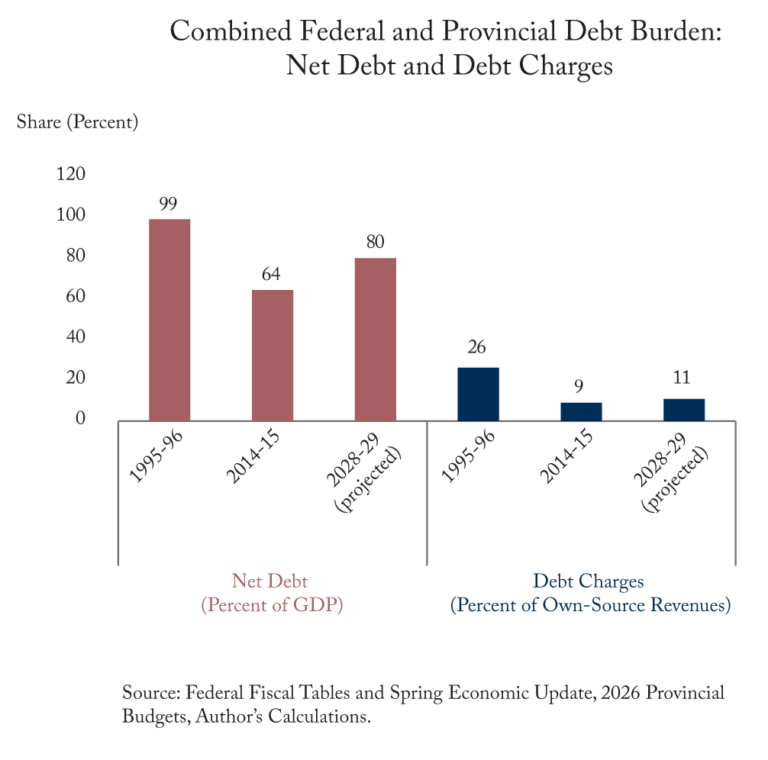
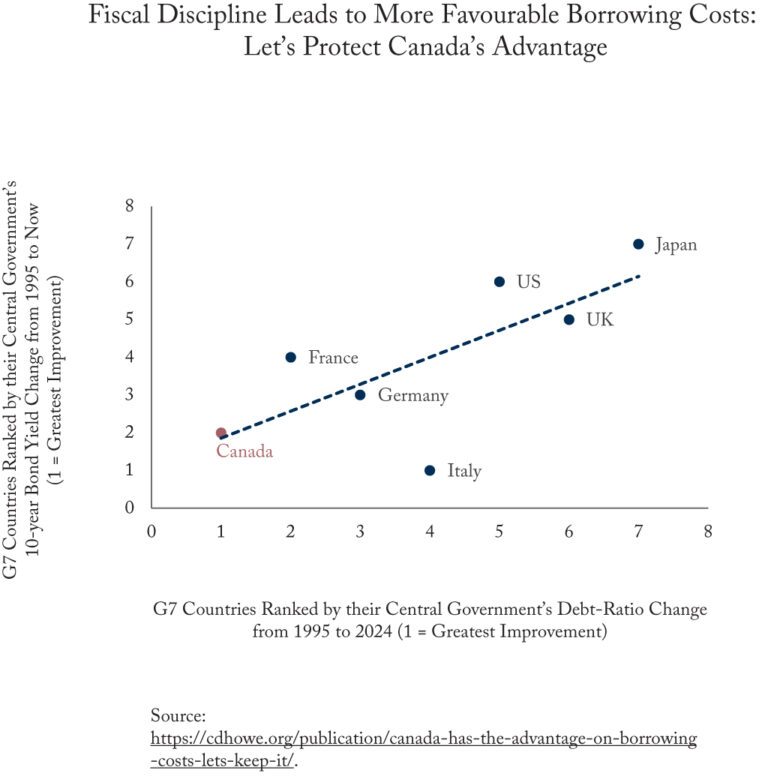
Since 2012, Canada’s 10-year bond yield has been 49 basis points on average lower then the US’ giving Canada a borrowing-cost advantage. This was not always the case. In the period from 1960-1990, before the introduction of inflation targeting, when inflation generally ran higher in Canada than in the United States and both countries’ federal governments took on significant debt, Canada’s 10-year bond yield was above the US equivalent by an average of 100 basis points. In the years that followed, as inflation in Canada and the United States began to broadly align, the debt story diverged. Canada’s federal net-debt remained comparatively stable, only surpassing 50 percent of GDP in 2020, while the American debt burden climbed steadily higher, exceeding 95 percent of GDP in recent years, reducing and eventually reversing the large gap in the 10-year bond yields that characterized previous decades.
To learn more about why Canada should solidify its advantage on interest costs by further reducing its debt burden and renewing the inflation targeting agreement between the Bank of Canada and the Government of Canada, read: https://cdhowe.org/publication/keeping-our-edge-the-benefits-of-sound-monetary-and-fiscal-policy/