



by Christopher Ragan
- Federal and provincial governments need the fiscal capacity to borrow heavily when major crises occur. Drawing on five premises about public debt, fiscal policy, and public behaviour, this Commentary argues that preserving the necessary fiscal capacity requires reducing debt-to-GDP ratios after crises; otherwise, repeated borrowing from progressively higher debt levels risks undermining investor confidence, raising borrowing costs, and eventually forcing governments into painful tax increases or spending cuts.
- Canada’s combined federal-provincial net debt-to-GDP ratio is now roughly 74 percent, placing it in a zone of “fiscal complacency.” This report divides public debt into three illustrative zones: “fiscal prudence” below roughly 67 percent, “fiscal complacency” between roughly 67 and 95 percent, and “forced austerity” above roughly 95 percent. These boundaries are deliberately approximate, but the framework highlights the value of maintaining enough fiscal room to absorb a large future shock without triggering higher borrowing costs.
- Canada’s current geopolitical and economic challenges require greater spending on priorities such as defence, trade infrastructure, and economic security, but much of this spending is likely to persist rather than representing a temporary crisis response. Governments should therefore not rely on continued borrowing or assume that favourable interest rates and economic growth will reduce debt burdens for them. Instead, they should review existing programs and reduce lower-priority spending to make room for higher-priority commitments, while working to bring debt ratios down and preserve fiscal capacity for the next crisis.
My thanks to John Lester and the C.D. Howe Institute for inviting me to present on this issue at their conference in May of 2024. I also thank Paul Boothe, David Dodge, and Paul Rochon for early conversations that helped me formulate my thoughts. I am grateful to Nicholas Dahir, Don Drummond, Yves Giroux, Alexandre Laurin, John Lester, Michael Lubetsky, Peter MacKenzie, Kevin Milligan, William Scarth, Geoffrey Turner, and several anonymous referees for many helpful comments and suggestions.
Introduction
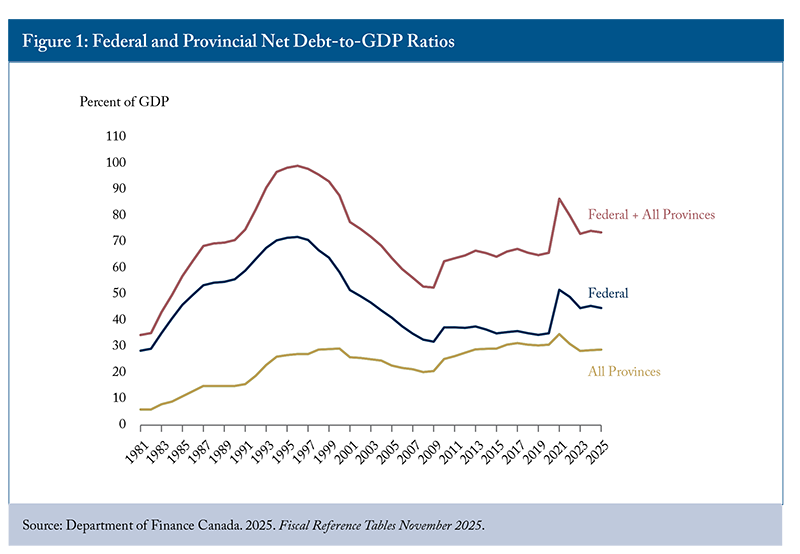
Canadian federal and provincial governments have been running significant budget deficits in recent years, gradually increasing their net debt-to-GDP ratios (TD Economics 2026a). As Figure 1 shows, the total provincial debt ratio has risen gradually from about 6 percent in 1981 to just under 30 percent today. The federal debt ratio experienced a large run-up of 44 percentage points from 1981 to 1995, then saw a 30-point reduction before the onset of the global financial crisis in 2008. Over the next 15 years, policy responses to the financial crisis and the COVID-19 pandemic pushed up the federal debt ratio by another 18 percentage points. The combined federal and provincial debt ratio, which today stands at almost 74 percent, is beginning to approach the 1996 peak of 99 percent, a year after Canada hit the “debt wall” (Watson and Clemens 2020).
Should Canadians worry about rising public debt today? If so, what problems does this indebtedness cause? Or does the current geopolitical situation justify large-scale government borrowing? Do today’s relatively low interest rates on government bonds and prospects for higher economic growth indicate that governments have plenty of fiscal room to continue adding to this debt?
This Commentary provides a framework for thinking about prudent levels of government debt, built upon five central premises about public and private behaviour.11 There is some debate over the most appropriate measure of government debt in discussions of fiscal prudence. Based on data from the Public Accounts and contained in the Fiscal Reference Tables November 2025 from the Department of Finance, the difference between gross debt and net debt is the government’s holdings of financial assets. Because these assets generate a return and both the interest and the assets themselves can be used to service or repay the government’s existing debts, net debt is usually the preferred measure of government indebtedness. Note, however, that when the International Monetary Fund compares indebtedness across many countries, its measure of “net debt” also subtracts out accumulated assets in social security pension funds, such as the CPP and the QPP, which are far larger in Canada than in most other countries, and strips out unfunded future liabilities related to government employee benefits, resulting in a very low net debt-to-GDP ratio for Canada (roughly 10 percent in 2025). The CPP and QPP funds, however, have been accumulated solely to finance future pension liabilities and are not available to the government to finance its general liabilities. In addition, the CPP and QPP liabilities themselves do not appear as part of government gross debt. So, while it is undoubtedly an enormous policy advantage that Canada has a public pension system designed to stabilize its pay-as-you-go contribution rate in the face of an ageing population, these assets cannot be used to offset existing government debt and thus should not be used to further reduce the measure of net debt. For this reason, this paper focuses on the Public Accounts measure of net debt, as shown in Figure 1. See Carmichael et al. (2020) for a primer on Canadian federal debt and Fuss et al. (2024) for a discussion of issues that complicate the comparison of public debt ratios across countries, including the approach taken by the IMF. At the core of my argument is the view that government has an essential role in using its spending and borrowing power to address economic crises as they occur, but maintaining this power – keeping our fiscal powder dry – requires reducing public indebtedness following each crisis so that governments have ample fiscal room to face the next one. The problem is that this post-crisis behaviour is politically challenging in democracies because it requires governments to do unpopular things when there is no obvious crisis; as a result, governments are often complacent. This fiscal complacency can easily lead debt ratios to rise to imprudent levels, reducing governments’ ability to deal with the next crisis.
In what follows, I begin by explaining the five premises that form the foundation of my argument. I then bring them together to conclude that the government debt ratio can exist in three different zones: “forced austerity” occurs when the net debt ratio is so high that bondholders demand a large premium to purchase government bonds; “fiscal complacency” occurs when the debt ratio is in a middle zone where borrowing remains easy but well-advised spending cuts or tax increases are politically difficult; and “fiscal prudence” exists when the debt ratio is low enough that even a large shock can be addressed by heavy public borrowing at moderate interest rates. As of 2026, the combined net debt ratio for federal and provincial governments is in the middle zone of fiscal complacency, with governments unwilling to take action to prevent their debt ratios from rising further.
I also address two claims often heard in discussions of public debt today: that Canada is currently facing a crisis that justifies significant increases in public debt; and that high government debt is acceptable because future interest rates are likely to remain below the growth rate of GDP. I explain why I do not find either claim credible, and conclude that governments in Canada should thoroughly review their spending programs to identify and reduce low-priority spending, thereby making room for recently introduced higher-priority spending that appears likely to persist for several more years.
Five Premises for Fiscal Prudence
Premise #1: Governments should use their fiscal power to address crises
Many commentators concerned about public debt are also concerned about “large” government; their view often boils down to keeping government small and taxes low, and that government should not try to do too many things.
While sharing the view that governments are often guilty of overreach and frequently fail to recognize the limitations of their actions, I begin from the normative position that a central role for governments is to use their spending and borrowing powers to address crises of various kinds, an argument Barry Eichengreen and his co-authors (2021) have also made. Most crises that warrant significant government action are not good times to increase taxes, but they are obvious and desirable times for governments to increase spending and finance it through borrowing.
The details of spending vary hugely with the nature of each crisis, but large increases in government spending and borrowing are common during crises. Consider five examples from Canada’s past hundred years:
- The Canadian government spent (and borrowed) massively to mobilize and equip a large military force to fight in the First World War from 1914 through 1918. The federal net debt-to-GDP ratio increased by 42 percentage points.
- During the Great Depression from 1929 through the mid-1930s, the Canadian government borrowed to finance public spending as tax revenues slumped. The federal debt-to-GDP ratio increased by 35 percentage points.
- Beginning in 1940, the Canadian government massively increased its spending to equip its military and expand military production, much of which was shipped to its key allies – Great Britain, the United States, and the Soviet Union. The federal debt-to-GDP ratio increased by 70 percentage points between 1941 and 1946.
- The global financial crisis began in the fall of 2008 and created the largest economic downturn since the Great Depression. Canadian federal and provincial governments embarked on classic Keynesian fiscal stimulus packages over the next few years. The combined federal plus provincial debt-to-GDP ratio increased by 13 percentage points from 2008 to 2013.
- The COVID-19 pandemic began in early 2020 and led Canadian governments to increase their spending and borrowing to provide financial relief to families and businesses whose incomes had evaporated with the shuttering of the economy. Within a single year, the combined federal plus provincial debt-to-GDP ratio increased by 20 percentage points.
From wars and depression to financial crisis and pandemic, these five economic crises differed from one another but were all enormous shocks to the Canadian economy. Though it would be easy to debate the details of the governments’ spending policies during each crisis, it would be impossible to argue that the governments of the day should have sat on their hands and done nothing. The crises demanded action, and governments responded by borrowing hugely to finance large-scale spending designed to address each one. When the next crisis occurs in Canada – as it surely will – we will all be better off if federal and provincial governments can use their fiscal power to good effect.
Premise #2: Governments must maintain their ability to borrow at reasonable interest rates
This second premise follows directly from the first: if governments are committed to using their fiscal power to address crises when they occur and doing so requires large-scale borrowing from private capital markets, then governments must maintain their ability to borrow at reasonable interest rates. But that requires actual and potential buyers of newly issued government bonds to see them as safe investments.
For investors to view government bonds as safe assets, they must believe that the issuing government can service the debt for many years and repay it when it eventually matures. They must also believe that the indebted government will not erode the real value of its debt by producing higher-than-expected inflation – a serious threat since almost all government bonds are issued in nominal terms and their yields are not automatically indexed to inflation. Central to investors’ perceptions, therefore, are the intrinsic dynamics of government debt (see Box 1) and the central bank’s commitment to low and stable inflation.
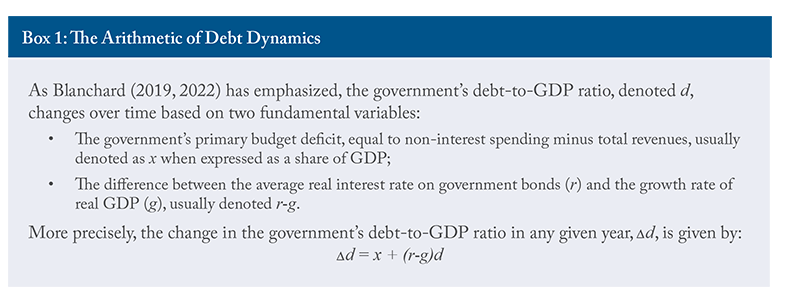
Primary budget deficits tend to increase the debt-to-GDP ratio because they create new debt, quite apart from the need to pay interest on existing debt. And when the average real interest rate on government debt exceeds the economy’s growth rate, the debt rises faster than GDP, pushing up the debt-to-GDP ratio. The higher d is already, the stronger this second effect is.22 This relationship is an approximation, but it is almost exact if the rate of inflation, nominal interest rates, and GDP growth rates take on the kinds of values familiar in most economies today. Only when these rates are very high, as would be the case during a period of extremely high inflation, does this approximation break down.
For investors, the implication is that when d is already quite high, r exceeds g, and the government is running a primary budget deficit (x > 0), the debt-to-GDP ratio will rise. If this dynamic continues for several years, with d rising steadily over time, bond investors may eventually come to believe that the government has no credible plan to reduce d or repay its existing debt. Once this perception takes hold, the government bonds become less attractive. Demand falls, prices fall, and yields rise, reflecting the greater default risk associated with the bonds.
A separate risk involves the central bank’s commitment to maintaining low and stable inflation. In most advanced countries today, central banks are operationally independent of their governments and have established credible commitments to low and stable inflation. But if this commitment wanes in the presence of high and rising government debt, perhaps combined with political pressure from the government, bond investors may come to expect higher future inflation. Since government bonds do not generally offer inflation protection, the fears of higher future inflation would lead bond prices to fall and their yields to rise, reflecting the greater risk of future inflation.
High and rising government indebtedness therefore carries a significant risk of rising bond yields and government borrowing costs. Maintaining access to capital markets at moderate interest rates requires governments to preserve confidence in their ability and willingness to repay their debts without relying on future inflation to erode their real value. The problem is that bond investors’ perceptions are highly context-specific, and it is almost impossible to know the level of debt at which investors start to demand higher yields because of the greater risks, or how much extra yield they will require when this occurs.
Once investors decide they will purchase government bonds only if their yields include a significant risk premium, the government is placed in a difficult position. Borrowing has now become more expensive than normal, and perhaps hugely so. The only way to avoid the high costs of borrowing is to borrow less, but this requires either raising more revenues through taxation or reducing the current level of spending. Both actions are politically unpopular and tend to reduce economic growth in the short run. If the economy is already slumping, these fiscal adjustments could push the economy into a full recession. But unless the government can continue its fiscal plans by borrowing from some other investors (and this is where lenders such as the IMF come forward in extreme situations), it will find itself in a state of “forced austerity.”
In Canada in 1995, bondholders viewed the country’s high public debt as excessive and saw no credible plan to reduce it, and government bond yields increased by over a percentage point for about a year. The Canadian government then embarked on a significant fiscal contraction – mostly by cutting spending – which eventually decreased the federal debt-to-GDP ratio by over 35 percentage points within 14 years (Watson and Clemens 2020). In Greece, however, where the debt ratio was much higher than Canada’s, government bond yields increased by over 25 percentage points between 2010 and 2012. The government was soon forced to implement a partial debt default and significant cuts to public spending, contributing to the country’s dismal economic performance for several years (PIIE 2020; Thomsen 2019).
Governments should always seek to avoid forced austerity. But avoiding these economically painful and politically unpopular fiscal decisions requires preventing debt ratios from getting so high that investors view government bonds as risky assets. This, in turn, requires governments to heed the third premise.
Premise #3: Following a debt-raising crisis, governments should reduce their debt ratios quickly to prepare for the next crisis
Having used its fiscal power to borrow and spend to address an economic crisis, the government will be left with a higher debt-to-GDP ratio. Depending on the size and nature of the crisis, the government’s debt ratio may have increased considerably, as was the case following the two world wars and, to a lesser extent, the COVID-19 pandemic. The greater debt ratio may itself not be an immediate problem for the government because bondholders may still view the debt as low enough for the government to service and repay, and may not expect the government to use future inflation to reduce the real value of its liabilities. In this situation, the government can still finance budget deficits at moderate interest rates.
The problem, however, is that if the government takes insufficient action to reduce its debt ratio following the crisis, another crisis may soon occur and force another increase in the debt ratio – but this time from a higher starting point. With a big enough “new” crisis, the government could easily find its efforts to borrow frustrated by bondholders’ perceptions that its debt has become too high and that it has no credible fiscal plan in place to address it. If bond yields begin to rise sharply, the government will be unable to command as much fiscal power as it intended. Its fiscal powder will no longer be dry.
The dangers associated with not reducing the debt ratio following a crisis are easy to imagine but difficult to quantify. Recent work by Lester and Laurin (2023, 2025) provides some scale of the sensitivity of the fiscal situation to shocks to interest rates and economic growth – familiar shocks for contemporary policymakers. But shocks can also have unfamiliar sources and surprising magnitudes, as the pandemic certainly proved. How do we put a realistic number on the probability of a future crisis or estimate the amount of government borrowing required to address it? Can we quantify, or even imagine, all the kinds of crises that may occur?
In contrast, the costs of making the fiscal adjustments necessary to reduce the debt ratio are more tangible and easier to quantify. Governments have two basic policy approaches for generating the primary budget surpluses required to lower the debt ratio (i.e., reducing x in the equation in Box 1): reducing spending and increasing tax revenues.
With a progressive tax-and-transfer system, the beneficiaries of most spending programs are disproportionately at the low-to-middle end of the income spectrum, while those who pay the taxes to finance them are disproportionately at the middle-to-high end of the spectrum. As a result, program cuts are resisted by those who are not required to pay most of the associated costs, and tax increases are resisted by those who expect to receive little of the benefits that their higher taxes could finance.
Both approaches are politically unpopular and difficult to achieve, and each also tends to reduce aggregate demand and, in the short run at least, slow economic growth. If the economy is already in a slow-growth phase, these actions could actually tip the economy into a recession. In either case, the growth rate of real GDP, g in the above equation, falls or becomes negative, pushing the debt-to-GDP ratio higher. So, there are offsetting forces at play: spending cuts and tax increases directly reduce the primary deficit and thus the debt ratio; but by reducing the economy’s growth rate in the short run, they also push the debt ratio in the opposite direction.
The political and economic difficulties associated with these fiscal adjustments help explain why governments often choose to avoid them – especially when the recent crisis appears to be over, and no new one is visible on the horizon. This is the essence of “fiscal complacency” and is especially understandable for governments elected for short terms, which often find it difficult to think about longer-term issues.33 The public’s lack of trust in government probably plays a role in this fiscal complacency. Some people will doubt the government’s claim that there are important benefits from reducing the budget deficit and debt; others may believe that any planned tax increases will be used to finance new spending instead of reducing the deficit. See Dabla-Norris and Valdes (2026) for some evidence of a lack of trust across countries and how this complicates the already tough decisions faced by policymakers in high-debt countries.
Adding to this complacency is a problem faced by any government attempting to operate a budget surplus for an extended period, which brings us to the final two premises.
Premise #4: Many taxpayers demand services at least equal to the value of current taxes
When government debt-service payments become large enough to drive a significant wedge between the taxes paid and the (non-interest) government services received, many taxpayers come to view the fiscal situation as out of balance, with taxes too high for the services they receive. This displeasure is often manifested in comparisons of the size of debt-service payments with other specific services. In 1995, for example, federal debt-service payments were 26 percent of total federal expenditures and were viewed as inappropriately crowding out other spending. Even in the past two years, with lower interest rates and a lower debt ratio than in 1995, people commonly complain that the federal government’s annual debt-service payments – roughly $55 billion in 2025 – are now about 10 percent of government spending and exceed total annual federal health transfers to the provinces.
There is something odd about comparing debt-service payments with other spending categories. It is obviously true that if governments did not have to make interest payments to service their debts, they would have more funds available for other things. But debt-service payments do not come out of nowhere; the need to make them today reflects past borrowing for some, presumably useful, purpose. Such complaints seem to be based on the faulty idea that debt-service payments are somehow wasted money – as if the past spending financed with the debt being serviced today provided no benefit. Or perhaps they are based on the idea that the debt was initially incurred to finance programs now seen as a waste of money. Whatever the underlying reasoning, many voters and taxpayers clearly seem alarmed by high and rising debt-service obligations and see them as evidence that the fiscal situation needs to be adjusted.
One important implication of this public perspective is that governments find it difficult to run significant budget surpluses for extended periods. Surpluses are certainly possible, and do exist from time to time, but a string of large budget surpluses will fairly quickly be met with the view from taxpayers that the government is taxing too much because it does not need so much revenue to finance the lower level of current services it provides. During Canada’s fiscal adjustments following the 1995 federal budget, it took only three years for large budget deficits to turn into small budget surpluses. The debt ratio had only fallen by a few percentage points, yet after just two years of budget surpluses there was little public support for paying down the debt further; the dominant fiscal conversation had then become how Canadians should “spend the fiscal dividend” (Courchene 2002).44 The political challenges associated with planning a string of budget surpluses partly explain why the federal budgets in the late 1990s and early 2000s significantly underestimated the surpluses that ultimately occurred. In his 2005 report on the federal government’s forecasting process, Tim O’Neill suggested that the government commit to using the average forecasts from independent, private sector economists – a practice which was soon adopted and continues today. See Russell (2005) for a discussion of the O’Neill report.
If significant budget surpluses for extended periods are not possible politically, then how is a highly indebted government ever supposed to reduce its indebtedness?
Premise #5: To reduce the debt-to-GDP ratio, governments need to focus on producing primary surpluses and hope that economic growth outpaces interest rates
This final premise follows directly from the previous one. If sustained and significant budget surpluses are not politically possible, then sustained and significant reductions in the stock of nominal debt are also not possible: after all, budget surpluses constitute nothing more than a reduction in the government’s existing stock of debt. Yet reductions in the debt-to-GDP ratio do not require reductions in the stock of nominal debt; they only require some combination of small primary deficits and a low (or negative) value of r-g.
Some reductions in nominal government debt are nonetheless possible and have occurred at various points in Canada’s economic history. The most significant episodes were:
- Between 1922 and 1930, as the economy grew quickly and just before the onset of the Great Depression, the federal government’s nominal debt fell by about 10 percent.
- In the dozen years immediately following the Second World War, when the economy was growing quickly, the federal government’s nominal debt fell by about 15 percent.
- Following the 1995 federal budget through the onset of the global financial crisis in 2008, the federal nominal debt fell by about 16 percent.
These episodes may suggest that premises #4 and #5 miss the mark and that large budget surpluses are indeed possible. But these highlighted percentage declines are actually quite small, and much smaller than the change in debt-to-GDP ratios over the same periods. To illustrate the difference, Figure 2 shows the federal government’s net debt ratio from 1940 onward. In the dozen years after the end of the war, the debt ratio fell by a remarkable 80 percentage points, from 110 percent in 1946 to 30 percent in 1958. This enormous decline in the debt ratio occurred even though the outstanding stock of nominal debt fell by only 15 percent over the same period.
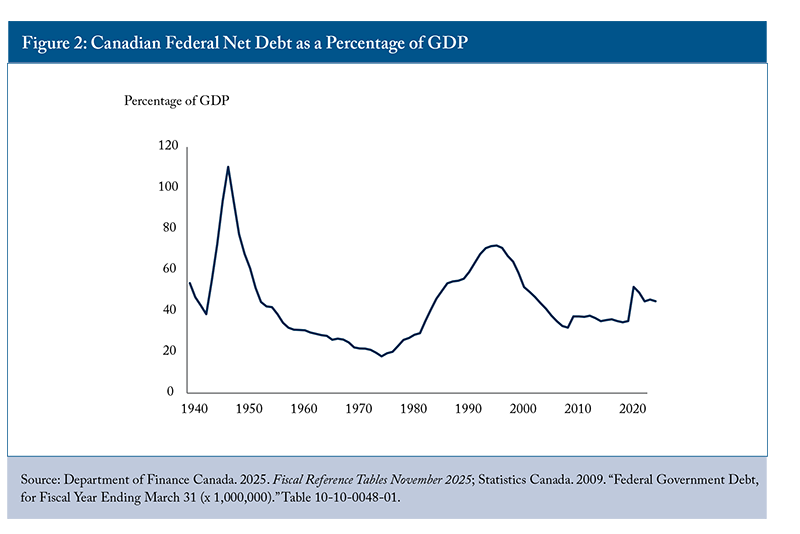
The difference is explained by the arithmetic of debt dynamics, as highlighted in the equation in Box 1. If the government is running large primary surpluses (x < 0) and the interest rate on government debt is less than the growth rate of GDP (r < g), the debt-to-GDP ratio will fall. And this is exactly the situation during the early post-war period shown in Figure 2: the economy was growing quickly, and the federal government ran primary surpluses in most years, even though overall surpluses (and thus outright debt reduction) were quite limited.55 Some unexpected inflation, which reduced the ex post real interest rate on government bonds, also played a role in reducing the debt-to-GDP ratio during this early post-war period. During the late 1960s and especially the 1970s, unexpected inflation played an even larger role in reducing the debt ratio. Eichengreen and Esteves (2022) provide evidence of the role of inflation in reducing public debt across two centuries and many countries.
The central policy implication of premises #4 and #5 is as follows: if governments seek to reduce their debt-to-GDP ratios following a debt-raising crisis, large and sustained budget surpluses will be politically challenging. Instead, they need to run significant primary surpluses and hope for healthy economic growth and modest interest rates. While governments have discretion over their spending and taxation policies and thus considerable influence on their primary budget balances, they have much less influence on either the real interest rate (r) or the growth rate of real GDP (g). The less governments can rely on favourable values of r and g, the more they must rely on the spending cuts and tax increases necessary to generate sufficient primary surpluses. As argued earlier, these policy decisions are usually politically challenging, and governments often succumb to the forces of fiscal complacency – with the result being gradual increases in the debt ratio.
Putting it all Together: Three Zones of Public Debt
The five premises discussed so far provide the foundation for my overall argument and for Figure 3, which shows the combined federal and provincial net debt ratio across three coloured zones. The red zone shows that at debt ratios greater than approximately 95 percent, Canada’s governments (collectively) are likely to face forced austerity, requiring them to raise taxes or cut spending to avoid deficits which would need to be financed at excessive interest rates. The yellow zone shows the range of debt ratios in which fiscal complacency is the central issue; reductions in the debt ratio are warranted to prepare for future shocks, but these fiscal adjustments are politically difficult to achieve. The green zone shows that at debt ratios below about 67 percent, governments are well prepared to face even a large future crisis and are thus displaying fiscal prudence; their fiscal powder is dry.
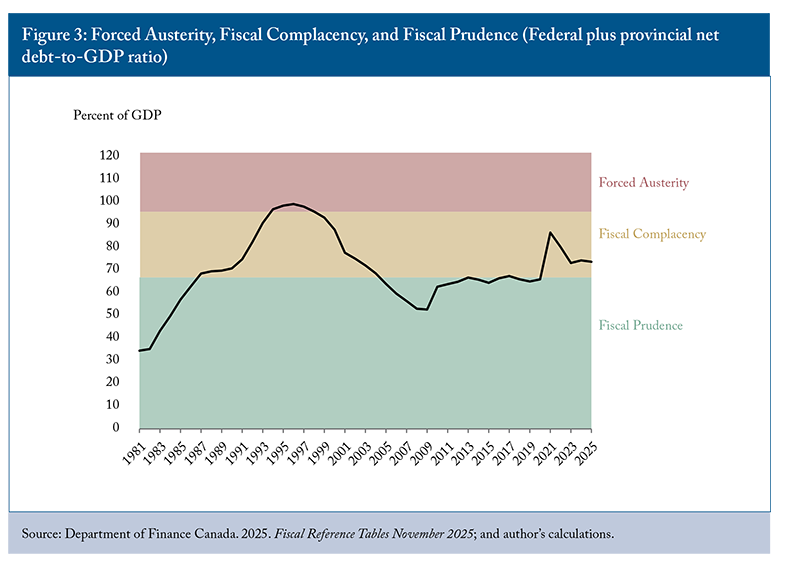
The two boundaries shown, one at a 95 percent debt ratio and the other at a 67 percent debt ratio, should be viewed as rough approximations, but their positions are based on solid reasoning. In particular, the boundary between the red and yellow zones – where bondholders’ perceptions of risk begin to lead to significant increases in borrowing rates – reflects the following observations:
- Canada hit the “debt wall” in 1995, when the combined debt ratio was 99 percent, which led to increases in government bond yields and several years of forced austerity (Courchene 2002; and Watson and Clemens 2020). Since it is impossible to know exactly when bondholders will perceive greater risks of future default or inflation, and because there is value in erring on the side of greater fiscal prudence, I arbitrarily placed the lower bound of the red zone at 95 percent, a few percentage points below the 1996 peak.
- The red-yellow boundary should not be viewed as constant over time; it depends importantly on the economic context. In particular, the higher the real interest rate (r) is relative to the growth rate of real GDP (g), the more the debt-to-GDP ratio tends to rise under its own dynamics, and the more likely bondholders are to perceive greater risk. In other words, the higher the value of r-g, the lower the red-yellow boundary will be.
- It is worth noting that the value of r-g was higher in the late 1990s than it is today. Between 1995 and 1999, the real interest rate on government bonds averaged roughly 2.5 percentage points higher than it is today, while the growth rate of real GDP was about 1.5 percentage points higher. So, when Canada last hit the “debt wall,” the value of r-g was about one percentage point higher than it is today. This means the intrinsic dynamics of the debt ratio are less threatening today than they were three decades ago, suggesting that the red-yellow boundary is likely higher today – though precisely how much higher is difficult to know.
- A final consideration is whether there is a causal connection between the debt-to-GDP ratio and future GDP growth, as highlighted in prominent research by Carmen Reinhart and Kenneth Rogoff (2010). If high public indebtedness today tends to reduce the future growth rate of real GDP, as their empirical results suggest, then bondholders may begin to perceive greater risk at lower debt ratios, thus lowering the red-yellow boundary. Interestingly, Reinhart and Rogoff find across a large cross-section of countries that the key threshold for the debt ratio, above which future growth tends to be slower, is 90 percent.
The green zone in Figure 3 shows the range of debt ratios within which Canada’s governments are collectively being fiscally prudent. For the purposes of this report, fiscal prudence means that the debt-to-GDP ratio is low enough that no realistic shock could increase public borrowing needs enough to leave governments immediately facing sharp increases in borrowing costs. In other words, the highest debt ratio that can still be considered fiscally prudent is one that is “one large shock” away from entering the red zone. But how large is “one large shock”?
Recall the five shocks mentioned earlier, all of which led to substantial increases in government debt: the First World War, the Great Depression, the Second World War, the global financial crisis, and the COVID-19 pandemic. The average increase in the federal debt ratio during the first three shocks was 49 percentage points, but these were highly unusual and dramatic events. The average increase in the combined (federal plus provincial) debt ratio during the two most recent crises was 17 percentage points, and these two shocks will hopefully provide a better guide for contemporary governments than the three earlier events, which involved two global wars and a massive economic depression. But many observers now emphasize the growing possibility of a “polycrisis” – multiple crises occurring simultaneously whose individual effects interact to magnify their combined impact – so shocks larger than the most recent ones should not be ruled out (Lawrence et al. 2022).
Here I assume that the largest realistic shock governments should consider would increase the combined debt ratio by about 28 percentage points, 8 percentage points (40 percent) more than the pandemic-related increase. This assumption allows for either a very large single-cause shock or a multi-cause shock whose components interact to produce an impact of this magnitude. The implication of this prudent but admittedly arbitrary assumption is that the yellow-green boundary in Figure 3 occurs at a debt ratio of about 67 percent. Of course, if policymakers wish to adopt a more prudent fiscal stance by placing more weight on the likelihood of even larger shocks, then the yellow zone would extend further downward, meaning that an even lower debt ratio would be required before governments could claim to be fully prepared to face the uncertain future.
The middle, yellow zone shows the range of debt ratios that give rise to fiscal complacency – a range that contains Canadian governments’ current combined debt ratio of roughly 74 percent. For debt ratios between 67 percent and 95 percent, governments are well advised to cut spending or raise taxes to produce the primary budget surpluses required to reduce the debt ratio further and better prepare for the next crisis. The fact that there is no current crisis, however, combined with the short-run economic costs and political challenges of such fiscal adjustments, often leads governments to take little or no action toward reducing their debt ratio.
But the real problem with such fiscal complacency is that it is an expensive gamble. If things turn out well and no shock occurs, the government can breathe a sigh of relief and continue running budget deficits financed at moderate interest rates. If a large shock occurs in the near future, however, governments’ borrowing needs may push the debt ratio into the red zone, causing bond yields to rise sharply, and the government will enter a situation of forced austerity. A short-sighted government will often be inclined to take this gamble; a far-sighted government will instead make the difficult short-run fiscal adjustments required to reduce the debt ratio toward the green zone, putting itself in a much better position when the next shock occurs. This far-sighted government behaviour is the essence of fiscal prudence – and of what it means to keep our fiscal powder dry.
Is Canada in a Crisis Now?
My analysis suggests that Canadian governments are collectively being fiscally complacent by not considering seriously enough the benefits associated with reducing their debt ratios to more fully prepare for the next large economic crisis. But one obvious response to this claim – perhaps in the minds of Canada’s political leaders today – is that we are currently experiencing a significant crisis, so running large budget deficits and increasing the debt-to-GDP ratio is entirely appropriate.
Canada’s major economic challenges today – connected with our fraying relationship with the United States, the associated threats to our sovereignty, and rising geopolitical tensions – are fundamentally different from the five shocks discussed earlier. Each of those shocks – the two world wars, the Great Depression, the global financial crisis, and the pandemic – was a temporary event. While it was obviously not clear at the start how long each would last, it is reasonable to assume that few people viewed them as permanent. Instead, they were viewed as short-lived events that were nonetheless serious enough to warrant massive spending and borrowing on the part of Canadian governments to protect the safety and economic security of Canadians. The large increases in public indebtedness that resulted were then reduced, through some combination of debt repayment and economic growth, in the years following the shocks.
In contrast, as the federal government has often argued, including in the prime minister’s widely discussed 2026 Davos speech (Carney 2026), Canada is entering a new world order. The United States, which was the driving force behind the development of the rules-based international order in the years following the Second World War, is now pulling back from that leadership role. It is becoming much more protectionist in its trading relationships and more aggressive in seeking to prevent other leading countries from playing a significant role in the Western Hemisphere. It is pushing its North Atlantic Treaty Organization (NATO) allies to spend much more on defence so that the United States does not bear such a disproportionate burden within the alliance. And just as the United States is withdrawing from its post-war leadership position, China and Russia are openly flexing their muscles and threatening the sovereignty of other countries. Unlike even a few years ago, Canadians now perceive a genuine risk to the country’s sovereignty and national security, perhaps especially in the Arctic.
The key fiscal point is this: while this new world order may not last forever, and the United States may once again re-engage as a driving force in a liberal rules-based economic order, there is considerable pessimism that this outcome is likely in the near future. Even the expected change in US administrations in 2029 is seen as insufficient to return the United States to its previous position of constructive global leadership (Gordon 2026). In contrast, the new world order to which we are now adjusting is usually seen as the “new normal” – one that will last for a few decades, at least, and maybe much longer. And the associated increases in government spending – from improving Canada’s trade infrastructure and expanding the military to increasing the country’s presence in the Arctic and improving internal trade capacities – should not be seen as expenditures that will last only a few years. Instead, they should be viewed as greater expenditures that will last for as long as this new world order itself endures, maybe permanently.
If most of this new public spending will end up being permanent, or even lasting for “only” a few decades, there is little justification for financing it through government borrowing. If the world is now a more dangerous and complicated place, Canadians may simply have to accept that military expansion is needed to better protect the country and make investments to enhance economic self-sufficiency in key sectors. If such new spending is essential to Canada’s national and economic security, it would be more appropriate to finance it either by taxing more heavily or by deciding that other lower-priority spending should be reduced to make room for the greater defence spending. Financing this spending through budget deficits would instead shift the burden to future generations, with little justification for asking younger generations to foot the bill for greater benefits today. The same argument applies to increased spending to ensure sovereignty in the Arctic or to improve the ability to develop natural resource projects. Temporary increases in government spending are reasonable candidates for deficit financing; permanent increases require more enduring adjustments in taxes or other spending.
Of course, the distinction between temporary and permanent changes in the global geopolitical landscape is probably not as sharp as suggested in the previous paragraphs. For example, if the geopolitical landscape is actually shifting permanently but it takes several years for Canadian governments to adjust to these changes through large increases in spending, then the transition period to that new world order can be viewed as a temporary shock, and borrowing to finance many of these transitional expenditures may be appropriate. In practice, however, it is almost impossible to distinguish precisely between temporary and permanent changes in spending requirements, at least until many years have passed. Yet fiscal authorities should still be mindful of this difference and of the strong case for financing permanent changes in high-priority spending either through tax increases or reductions in lower-priority spending, thereby avoiding large increases in the debt-to-GDP ratio.
Can Canada Rely on Low Interest Rates and Rapid Economic Growth to Reduce Its Debt?
Over the past decade, Lawrence Summers (2015) and others have postulated that advanced economies are experiencing a “secular stagnation” caused by increases in the supply of saving and a changing structure of investment demand, resulting in lower real interest rates and slower-than-expected economic growth. This argument has been used to explain why the long-run equilibrium real interest rate – the rate that exists after all cyclical influences, including those from monetary policy, have dissipated – appears to have been falling over the past few decades.
Within this overall economic context, Olivier Blanchard (2019, 2022) has argued that low real interest rates imply that the welfare cost of government debt is very low and may be zero, or even negative. In particular, as we saw in Box 1 in the equation describing debt dynamics, if the real interest rate on government debt is less than the growth rate of real GDP (r < g), and the government also runs a small enough primary budget deficit (a small x), the debt-to-GDP ratio will decline even if there is an overall budget deficit and thus a rise in total debt. In this setting, the burden on future generations from current expansions in government debt is negative because the tax rates required to service and repay that debt in the future will be lower than the tax rates faced by the current generation. Put more bluntly, this line of reasoning suggests that if r < g and primary budget deficits are small enough, there is little need to worry about government debt.
This argument immediately leads to the following question for Canadian governments: can we safely rely on the real interest rate (r) being less than the growth rate of real GDP (g) for the foreseeable future and continue to run substantial budget deficits without pushing up the debt-to-GDP ratio?
It is impossible to know where real interest rates or real GDP growth rates are headed, and projections based on short-run cyclical factors are likely to be less relevant than those based on longer-run secular trends. Kenneth Rogoff (2025, chapter 25) has expressed considerable skepticism about the belief that interest rates will remain low and emphasizes that, when examining data over several centuries, it is hard to avoid the conclusion that the recent decline emphasized by Summers (2015) and Blanchard (2019, 2022) is likely to be a short-lived phenomenon. Rogoff provides many reasons to expect real interest rates to rise over the next decade or so, including increases in investments to address climate change, a renaissance in military spending in the face of rising geopolitical tensions, populism-driven policies that redistribute income toward income groups with higher propensities to spend, and new investments in infrastructure to accommodate the growing energy demands of artificial intelligence (AI).
At the top of Rogoff’s list of reasons to expect real interest rates to rise, however, are increases in global public (and private) debt. The International Monetary Fund (IMF) has also warned of rising government debt in many countries and notes that global government (gross) debt, equal to 80 percent of global GDP in 2015, is projected to exceed 100 percent of GDP by 2030, only slightly below its level at the end of the Second World War (IMF 2024). For the 20 most advanced economies, the current debt-to-GDP ratio already exceeds its 1946 level. The IMF emphasizes the role of higher government debt in driving up interest rates and dampening future GDP growth rates.
At the same time, many Canadians note our low government debt-to-GDP ratio in comparison to those in other advanced countries – and they are right to recognize Canada’s better fiscal position (Fuss et al. 2024). Our lower debt-to-GDP ratio provides us with more “fiscal room” to respond to shocks when they occur. This greater fiscal room was a large part of the reason why Canada had more aggressive policy responses to both the global financial crisis and the COVID-19 pandemic than other G7 countries: before the onset of these shocks, the combined federal plus provincial debt ratio in Canada was only 53 percent (2008) and 65 percent (2019). As of the fall of 2026, that same debt ratio is 74 percent and rising.
Those who emphasize the strength of Canada’s current fiscal position may go one step further and argue that the high level of public debt in other countries is not relevant to the country’s domestic situation and, if anything, suggests that Canadian governments have greater access to funds for financing budget deficits. However, global financial markets are highly integrated, and since investors view Canadian government bonds as close substitutes for those issued by governments in the United States, the United Kingdom, Germany, and other advanced countries, the yields on these bonds tend to rise and fall together. In other words, to understand where real government bond yields are likely to go, it is important to examine global public debt, not just Canadian public debt (TD Economics 2026b).
The connection between public debt and interest rates has a long history in economics. The traditional view is that government budget deficits increase the overall demand for credit and tend to push interest rates higher. Through this mechanism, budget deficits can “crowd out” private investment, since higher interest rates reduce the amount of planned private investment. Any resulting decline in private investment has the potential to reduce the future growth rate of real GDP (Boskin 2020).
What is the estimated impact of higher government debt on interest rates? In the United States, Salmon (2025) reviews a large body of empirical work on this question and finds that a one-percentage-point increase in the debt-to-GDP ratio raises long-term government bond yields by between an estimated 4.6 and 6.1 basis points. In other words, a 10-percentage-point increase in the US federal debt-to-GDP ratio, say from 100 percent to 110 percent, is expected to increase long-term government bond yields by about 50 basis points, or one-half of a percentage point. Baldacci and Kumar (2010), using panel data from 31 countries between 1980 and 2008, found that a 10-percentage-point increase in the debt-to-GDP ratio increased long-term government bond yields by between 200 and 500 basis points, depending on the initial fiscal conditions; the higher the initial budget deficits and initial debt ratio, the larger is the impact of greater debt on government bond yields. The much smaller estimated effect for the United States likely reflects the fact that US government bonds continue to be viewed, at least for now, as among the safest government assets, not least because of the US dollar’s continued role as the world’s dominant reserve currency (Rogoff 2025). But whether the focus is on the United States or other countries, the evidence is clear that increases in government debt tend to push up interest rates.
The upshot of all this is that Canadian governments should probably not comfortably assume that interest rates on government bonds will remain low for the foreseeable future. The interest rate on Canadian 10-year government bonds has increased by about 250 basis points since the end of 2021, with inflation expectations likely better anchored now than they were five years ago. Similar interest rates in the United States, which show little sign of reining in the growth of its public debt, have increased by over 400 basis points since 2021. During the first eight months of 2026, there has been a significant increase in 10-year bond yields across many advanced countries, a natural part of the widespread sell-off of government bonds (TD Economics 2026c). If global government debt continues to rise as projected by the IMF, there is good reason to expect interest rates to continue rising.
Future growth rates of real GDP are harder to predict. Various economic forces, including population ageing, slowing population growth, adjustment to a warming climate, and the emergence of AI-driven technological change, will combine to produce a highly uncertain impact on GDP growth rates in Canada and elsewhere.
Amid this considerable uncertainty, two other factors suggest that Canadian governments should probably not rely on significantly faster GDP growth to reduce their debt-to-GDP ratios. The first is the greater uncertainty that confronts businesses in all countries, but perhaps especially in Canada. This uncertainty has been caused by a combination of greater trade protectionism, initially from the United States but then through retaliation by other countries, and greater geopolitical instability that appears to be a key characteristic of today’s world. Since business investment involves forward-looking decisions in which assets are built or purchased with time horizons measured in decades, heightened uncertainty tends to be an enormous drag on the amount of investment actually carried out. The weakness of business investment in Canada – which has been true for over a decade – threatens future real GDP growth (Robson and Bafale 2024).
On the other hand, the federal government has responded to Canada’s weak investment climate with a series of pro-investment policies – including identifying major projects deemed to be in the national interest, referring these projects to the newly created Major Projects Office with a mandate to expedite the project review process, introducing corporate tax policies to substantially accelerate business investment write-offs, and seeking to attract foreign financial capital to Canada.
These policies, combined with a greater commitment by the federal government to increase its own spending on infrastructure projects, will hopefully lead to a substantial increase in Canadian investment over the next few years. If domestic investment increases markedly, a short-run multiplier effect can be expected to increase the growth rate of GDP, at least for a few years. In the longer run, any positive impact on the growth rate will depend crucially on the extent to which these investments increase the economy’s productive capacity, which in turn will depend on the nature of the investments themselves. Expanding the capacity of our port facilities may well increase the economy’s productive capacity, whereas improvements in Canada’s military capability, while beneficial on security grounds, may have little or no impact on our economic capacity. So, while it would be inappropriate to assume that these pro-investment policies will have no effect on the growth rate (g) over the next few years, it may also be overly optimistic to expect any short-run impact to persist in the longer term. At this point, it is simply too early to know.
The second reason not to be too optimistic about future growth rates is the level of government debt itself. If the IMF projections of rising global government debt (cited above) end up being correct, there will be good reasons to expect increases in real interest rates, and this effect alone will likely lead to a reduction in private investment. In addition, if the results highlighted by Reinhart and Rogoff (2010) and Sever (2025) are correct – that high government debt tends to negatively affect future growth rates – then governments in all countries should be alert to this possible drag on future growth.
So, can Canadian governments realistically rely on low interest rates and rapid GDP growth (r < g) to help reduce the debt-to-GDP ratio, without taking the more difficult actions required to produce moderate primary surpluses? Such reliance would be a significant gamble. If r remains low and g increases modestly, governments may win the bet and avoid the tough fiscal decisions. But if r continues to rise and g remains low or even falls further, the debt-to-GDP ratio will have a built-in upward dynamic which can only be reversed by running primary budget surpluses. If governments remain fiscally complacent and avoid the adjustments needed to generate such surpluses, the debt ratio will continue to creep upward – thereby reducing the ability to respond to the next economic crisis.
Conclusion: Keeping Our Fiscal Powder Dry
The combined federal plus provincial debt-to-GDP ratio today is roughly 74 percent, well below its 1996 peak but also far above its level just before the onset of the global financial crisis in 2008. Federal and provincial governments are currently in a state of “fiscal complacency,” comforted by the fact that their current budget deficits are being easily financed by borrowing at moderate interest rates. As a result, they feel no compelling need to either raise taxes or trim spending to run the primary budget surpluses needed to reduce their debt ratios; they likely judge that such fiscal adjustments would offer little or no short-term political payoff. We are therefore likely to see the debt-to-GDP ratio continue its gradual upward drift.
If Canadian governments wished to display longer-run fiscal prudence, however, they would place more weight on the possibility of a future crisis that would necessitate large-scale borrowing. They would also recognize that a large enough shock might raise the debt ratio so much that bondholders begin to perceive greater risks of either default or inflation. Once such perceptions take hold, Canadian governments would find themselves in a situation of “forced austerity” in which they would be under pressure to raise taxes or cut spending (or both) to avoid borrowing at punishingly high interest rates. To avoid such an undesirable outcome, governments should make difficult short-run decisions to gradually but significantly reduce their debt-to-GDP ratios.
To make matters more challenging, large increases in public spending are coming in the near future. Elderly support programs and healthcare spending will continue to grow faster than GDP as the population ages, putting pressure on both provincial and federal budgets. Investments designed to smooth and speed a transition toward a cleaner energy system will be costly, and some of this spending will come from public funds. Significant public investments in our trade infrastructure will be made to help diversify Canadian trade away from the United States by improving access to other foreign markets. And probably the biggest new spending pressures will come from increases in defence and national security budgets, which appear to be permanently increasing to honour Canada’s new NATO commitments made in response to significant changes in the geopolitical landscape. Based on the federal 2025 budget, however, only a small portion of these future spending increases has been incorporated into the fiscal framework. When the bulk of the new spending is eventually built into the budget projections, how will it be financed?
Such increases in spending can be financed in only three general ways. Almost certainly the easiest approach politically is to finance this new spending by borrowing, as it requires no unpopular tax increases or cuts to spending programs. Yet avoiding these unpopular actions and instead further increasing the public debt not only shifts the economic burden to future generations but also raises the likelihood of the undesirable scenario described above. But when Canadian governments find themselves in the zone of fiscal complacency, as they do today, it should not be surprising if this is the approach ultimately taken. This outcome may reflect as badly on voters’ unwillingness to accept tough realities as on political leaders’ unwillingness to promote policies for the long term.
The second general approach is to increase government revenues, either through higher taxes or through the sale of government assets, an option the prime minister recently mentioned at the investment summit held in Toronto. Higher taxes are always politically unpopular, and depending on which taxes are increased, they may also create disincentives for work and investment, with negative impacts on future economic growth. So, in an environment in which governments are rightly concerned about low rates of domestic investment and GDP growth, avoiding tax increases has an obvious appeal. Selling large government assets (such as airports) can certainly generate funds to finance some new spending, although this revenue can be received only once and, depending on the assets sold, the sale may attract considerable political opposition.
The third approach is to cut other lower-priority spending, thereby making room for new, higher-priority spending commitments. The difficulty of this exercise should not be underestimated, not least because support for existing programs can quickly become entrenched among program recipients. An apolitical, evidence-based review process run by professionals who can assess both the effectiveness of existing programs and whether they continue to be required in the current economic and social context is likely to be much more successful over the longer term than more politically charged short-term approaches (Bourgon 2009). Though the federal government has now embarked on a plan to cut its operating expenditures by 15 percent within three years, it has also exempted from the exercise major transfers to provinces and individuals, thus massively reducing the potential scope of these planned cuts (Lester 2025). In short, the federal government’s current spending-reduction exercise will only free up a small fraction of the resources required to finance its planned spending increases.
The bottom line is that Canadian governments are in a difficult fiscal situation, though they may not yet fully appreciate it. There is no immediate crisis, which is obviously good, but the absence of a crisis contributes to the state of fiscal complacency. Governments are not yet making the prudent but difficult choices required to reduce their debt ratios to a safer level where they would be more fully prepared for future crises. Which existing spending programs can be significantly trimmed? Which programs are low priority enough to eliminate altogether? Which taxes can be increased while maintaining a sense of fairness without being a drag on economic growth? New spending plans only increase the need for these difficult decisions. Now is the time for governments across the country to think carefully about their fiscal options. At a minimum, Canadians and their governments need to be discussing these issues in an honest and transparent manner.
References
Baldacci, E., and M. Kumar. 2010. “Fiscal Deficits, Public Debt, and Sovereign Bond Yields.” IMF Working Paper.
Blanchard, O. 2019. “Public Debt and Low Interest Rates.” American Economic Review: 1197–1229.
__________. 2022. Fiscal Policy Under Low Interest Rates. MIT Press.
Boskin, M. 2020. “Are Large Deficits and Debt Dangerous?” American Economic Review: 145–148.
Bourgon, J. 2009. “Program Review: The Government of Canada’s Experience Eliminating the Deficit, 1994–1999.” Centre for International Governance Innovation.
Carmichael, K., et al. 2020. “A Basic Primer on Federal Government Debt: Definitions, Numbers, and Issues.” Finances of the Nation.
Carney, M. 2026. Speech delivered at the World Economic Forum, Davos, Switzerland.
Courchene, T. 2002. “Half-Way Home: Canada’s Remarkable Fiscal Turnaround and the Paul Martin Legacy.” Institute for Research on Public Policy.
Dabla-Norris, E., and R. Valdes. 2026. “High Debt, Hard Choices.” Finance and Development. International Monetary Fund. March.
Department of Finance Canada. 2025. Fiscal Reference Tables November 2025. Ottawa: Government of Canada.
Eichengreen, B., et al. 2021. In Defense of Public Debt. Oxford University Press.
Eichengreen, B., and R. Esteves. 2022. “Up and Away? Inflation and Debt Consolidation in Historical Perspective.” Oxford Open Economics: 1–20.
Fuss, J., et al. 2024. “Caution Required When Comparing Canada’s Debt to That of Other Countries.” Fraser Institute.
Gordon, P. 2026. “Don’t Give Up on the Global Order.” Foreign Affairs. June 9.
International Monetary Fund. 2024. Fiscal Monitor: Putting a Lid on Public Debt.
Lawrence, M., et al. 2022. “What Is a Global Polycrisis?” Cascade Institute Discussion Paper.
Lester, J. 2025. “Federal Expenditure Review: Welcome But Flawed.” E-Brief. Toronto: C.D. Howe Institute. https://cdhowe.org/publication/federal-expenditure-review/.
Lester, J., and A. Laurin. 2023. “Ottawa Needs a New Approach to Fiscal Policy.” E-Brief. Toronto: C.D. Howe Institute. https://cdhowe.org/publication/ottawa-needs-new-approach-fiscal-policy/.
Lester, J., and A. Laurin. 2025. Canada’s Debt Problem: What Can Be Done? Commentary 675. Toronto: C.D. Howe Institute. https://cdhowe.org/publication/canadas-debt-problem-what-can-be-done-a-report-on-the-institutes-2024-debt-conference/.
Peterson Institute for International Economics. 2020. “The Greek Debt Crisis: No Easy Way Out.” PIIE Case Study.
Reinhart, C., and K. Rogoff. 2010. “Growth in a Time of Debt.” American Economic Review: 573–578.
Robson, W., and M. Bafale. 2024. Underequipped: How Weak Capital Investment Hurts Canadian Prosperity and What to Do about It. Commentary 666. Toronto: C.D. Howe Institute. September. https://cdhowe.org/publication/underequipped-how-weak-capital-investment-hurts-canadian-prosperity-and-what/.
Rogoff, K. 2025. Our Dollar, Your Problem. Yale University Press.
Russell, E. 2005. “The O’Neill Report on Federal Fiscal Forecasting.” Briefing Paper. Canadian Centre for Policy Alternatives.
Salmon, J. 2025. “The Impact of Public Debt on Interest Rates.” George Mason University Policy Brief.
Sever, C. 2025. “Government Debt and Growth: The Role of R&D.” IMF Working Paper.
Summers, L. 2015. “Demand Side Secular Stagnation.” American Economic Review: 60–65.
TD Economics. 2026a. “Provincial Budget Season Wrap-Up.” April 23.
TD Economics. 2026b. “Canada’s Price-Taker Problem.” June 15.
TD Economics. 2026c. “Bond Yields: Higher for Longer—and for Fundamental Reasons.” September 10.
Thomsen, P. 2019. “The IMF and the Greek Crisis: Myths and Realities.” Speech delivered at the London School of Economics. September 20.
Watson, W., and J. Clemens. 2020. The Budget that Changed Canada. Fraser Institute.