



Miscounting of temporary residents working in Canada: C.D. Howe Institute
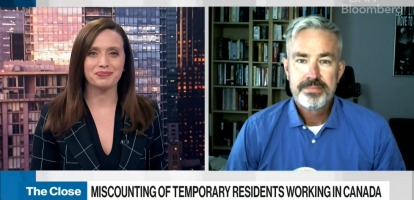
Mikal Skuterud, professor at department of economics at University of Waterloo, and director at Canadian Labour Economics Forum, joined BNN Bloomberg to discuss his recent report which outlines the miscounting of non-permanent residents working in Canada and where the bias in count may be coming from.
Francke, Hans, Korevaar and van Bekkum – Buy-to-Live vs. Buy-to-Let: The Impact of Real Estate Investors on Housing Costs and Neighborhoods
To: The Hon. Sean Fraser, Minister of Housing Infrastructure and Communities of Canada cc: The National Housing Council From: Marc Francke, Lianne Hans, Matthijs Korevaar, and Sjoerd van Bekkum Date: September 7, 2023 Re: Buy-to-Live vs. Buy-to-Let: The Impact of Real Estate Investors on Housing Costs and Neighborhoods In many places across the world, housing […]Canada in the Dark about Temporary Residents in the Workforce
Policymakers are in the dark when it comes to dealing with the growing number of temporary residents in Canada. The large difference in estimates by Statistics Canada’s Labour Force Survey (LFS) and Immigration, Refugees and Citizenship Canada’s (IRCC) data on Canada’s…Reducing emissions will cost. Governments need to admit that – Financial Post
Ottawa’s policies to reduce greenhouse gas emissions will cost Canadians, both directly and indirectly. In 2021, the Royal Bank estimated that reaching net-zero emissions by 2050 could cost as much as $2 trillion — which is almost three-quarters of last year’s entire GDP. We will also need to spend more to protect against a changing climate. To pay for all this, Canada badly needs economic growth.
Though virtually all governments and opposition parties twist themselves into knots to avoid saying it, trying to prevent climate change will cause economic pain. Yes, there will be new “sustainable” jobs and businesses, but the net impact will almost surely be negative. Assigning a price, by tax or regulation, to…
Mahboubi, Zhang – Our Underemployed Economic Immigrants: How to Stop Wasting Talent
 To: Canadian immigration watchers From: Parisa Mahboubi and Tingting Zhang Date: September 6, 2023 Re: Our Underemployed Economic Immigrants: How to Stop Wasting Talent Canada consistently fails to fully utilize immigrants’ skills, which limits efforts to address labour-market needs and costs the economy. Economic immigration is Canada’s largest and most popular admission category. To make it more responsive to the […]
 Tiff Macklem reads the tea leaves: Bank of Canada was right to hit pause on interest rates – Globe and Mail
The Bank of Canada held its policy rate at 5 per cent Wednesday – a smart move.
Although the central bank’s governing council may have made its decision ahead of the weak GDP numbers released last week, those numbers underlined the reasons to hold. Real GDP contracted at an annualized rate of 0.2 per cent in the second quarter of 2023 and fell 0.2 per cent month-over-month in June (annualized as well). Looking ahead, Statistics Canada’s advanced estimate for July was flat. The household consumption the bank has been battling finally seems to be flagging. Data on bank deposits and job vacancies also testify to an economy losing steam.
Monetary policy works with a lag, and these latest figures suggest…
Canada’s Missing Workers: Temporary Residents Working in Canada
 In 2022, Canada’s population grew by more than 1 million people for the first time in its history. Although the federal government’s ambitious targets for new permanent residents are receiving much attention, the reality is that 58 percent of 2022’s record-breaking population increase reflected growth in the temporary resident (TR) population.For a detailed analysis of […]
 As costs of fires and floods mount, Canadians need better climate risk management – Globe and Mail
Severe forest fires, floods and other extreme weather events have hit many Canadian regions hard, with climate change the probable cause. These severe events have destroyed housing, commercial property and infrastructure with a lengthy recovery period ahead. Insured and uninsured losses will be in the billions, in addition to the cost of repairing public infrastructure. Lives have been lost in some cases.
These events are a wake-up call. We need improved risk management and climate adaptation, since there will be many other extreme weather events. A forward-looking risk management plan through comprehensive property insurance and climate adaptation would reduce the need for governments to assume an open-ended climate damage risk…
Charles Plant – Marketing and Sales are Canada’s Missing Productivity Link
 From: Charles Plant To: Productivity observers Date: September 5, 2023 Re: Marketing and Sales are Canada’s Missing Productivity Link Our national productivity gap has spurred analyses, reports and media articles for decades. While public debate in Canada has focused on productivity improvement for more than 50 years, we have made limited progress. Fresh thinking is required. While innovation through […]
 Today’s BoC pause is more data-dependent than the one in March: C.D. Howe’s Jeremy Kronick
 Jeremy Kronick, director of monetary and financial services research at the C.D. Howe Institute, joins BNN Bloomberg to discuss the Bank of Canada’s decision to hold its key interest rate at 5 per cent. He says the BoC would have noted signs of slower spending and softening in the job market, and adds the central bank’s restrictive policy will take some more time to work through the economy. He says there are already signs that Q3 GDP growth could be negative, but it’s tough to call a technical recession amidst a strong labour market.
 Jon Johnson – Canada Goes it Alone on a Digital Services Tax – Issues Loom
 From: Jon Johnson To: Finance Minister Chrystia Freeland Date: August 31, 2023 Re: Canada Goes it Alone on a Digital Services Tax – Issues Loom The federal government is pushing ahead with a digital services tax (DST) despite agreement among 138 of 143 members of the OECD/G20 Inclusive Framework on Base Erosion and Profit-Shifting (BEPS) […]
 C.D. Howe Institute Monetary Policy Council to Bank of Canada: Hold Overnight Rate at 5.00 Percent until Early 2024, Cut to 4.25 Percent by Next September
August 31, 2023 – The C.D. Howe Institute’s Monetary Policy Council (MPC) recommends that the Bank of Canada maintain its target for the overnight rate, its benchmark policy interest rate, at 5.00 percent on September 6th. The MPC further recommends that the Bank keep the target at 5.00 percent at least until March of 2024, then reduce it to 4.25 percent by September of 2024.
The MPC provides an independent assessment of the monetary stance consistent with the Bank of Canada’s 2 percent inflation target. William Robson, the Institute’s CEO, chairs the Council.
Council members make recommendations for the Bank of Canada’s upcoming interest-rate announcement, the subsequent announcement, and the announcements…