



Canadian Expats Are A Valuable Resource. So Why Isn’t The Country Putting Them To Use? – Globe And Mail Op-ed
In the years leading up to the pandemic, Canada’s place on the world stage was fading.
We told ourselves we were a special nation – the country that works in a world that does not. And domestically, we were indeed always stable, mostly prosperous and sometimes even cool.
But to the rest of the world, what value did Canada bring?
We struggled to attract foreign investment, and foreign buyers for our goods. In peacekeeping, we were a shadow of our former selves. In sports, we claimed the podium less often than we hoped. And in science, our victories often proved episodic.
In June, when we lost the vote for a Security Council seat at the United Nations, the rebuke was a shock only to Canadians who didn’t fully…
Canadian Monetary Policy in the Time of COVID-19
 Tricky Juggling Act Ahead for Bank of Canada The Bank of Canada must handle three challenges simultaneously—providing economic stimulus, hitting inflation targets and managing its massively expanded balance sheet—all while dealing with associated credit and political risks. Authors Steve Ambler and Jeremy M. Kronick explore the challenges the Bank of Canada faces as it goes […]
 Martin Eichenbaum Re-appointed As C.D. Howe Institute International Fellow
William Robson, President and CEO of the C.D. Howe Institute, announces the re-appointment of Martin Eichenbaum as an International Fellow. “Marty brings a wealth of insights about macroeconomics…Miles Corak Re-appointed As C.D. Howe Institute Research Fellow
William Robson, CEO of the C.D. Howe Institute, announces the re-appointment of Miles Corak as a Research Fellow. “Miles has distinguished himself throughout his career as a key thinker on social mobility and…Tricky Juggling Act Ahead For Bank Of Canada
The Bank of Canada must handle three challenges simultaneously—providing economic stimulus, hitting inflation targets and managing its massively expanded balance sheet—all while dealing with associated credit and political risks, says a new report from the C.D. Howe Institute…For the Bank of Canada, what does the link between monetary policy and inequality mean? – Globe and Mail Op-Ed
A global pandemic that has crushed the economy. A stock market improbably rising in an economic downturn. Is it the job of the Bank of Canada to address this contradiction, and the inequality that arises?
Not directly, but the link between monetary policy and inequality is very real and affects the ability of the central bank to reliably hit its 2-per-cent inflation target.
In March and April, when we went into complete lockdown because of the COVID-19 pandemic, GDP fell more than 18 per cent, the largest two-month economic decline on record. A myriad fiscal policies were put in place, including household income supports, such as the Canada Emergency Response Benefit, and business supports, such as the Canadian Emergency…
Alberta can help jump-start its economy with three simple words: Come on in – Globe and Mail Op-Ed
Governments across Canada are still coming to grips with the COVID-19 pandemic, but looking toward recovery all the same. For Alberta, this is a uniquely challenging endeavour. Oil prices remain low, and may stay there for some time. But there are options, and one stands out: making it easier for skilled individuals to move in.
Ensuring Alberta is as open as possible to the best talent from across Canada and abroad to exercise their profession, ply their trade or conduct their business can help boost the province’s economy. Not all moves make sense, but there are artificial regulatory barriers currently deterring some potential migrants from helping build Alberta’s economy. Those should be lifted.
It may seem strange, at a…
Tammy Schirle – Unemployment In The 21st Century
 From: Tammy Schirle To: Employment Insurance Policymakers Date: October 7, 2020 Re: Unemployment in the 21st Century “This pandemic has shown that Canada needs an EI system for the 21st century, including for the self-employed and those in the gig economy.” – Speech from the Throne, September 23, 2020 The fact that a large number of Canadians lack a […]
 Jenkins, Kronick – Health And The Economy – With Numbers
 From: Paul Jenkins and Jeremy M. Kronick To: Canadian policymakers Date: October 5, 2020 Re: Health and the Economy – With Numbers When the pandemic nature of the COVID-19 virus was finally recognized, Canada acted boldly to contain and control its spread. We didn’t know as much as we know now, and as such we were forced into unmeasurable […]
 Bill Robson on BNN – Canadians are now ‘desensitized’ despite ‘very serious’ deficit numbers
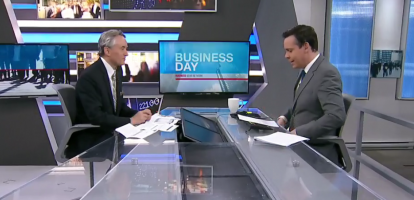
Bill Robson, CEO at C.D. Howe Institute, joins BNN Bloomberg with his take on the nearly $27 billion cost of Ottawa’s COVID-19 benefits. He says that governments’ big budget misses are not just a COVID problem and that these misses are not appropriate if we think of all the stakes.
Le Coït Interrompu De La Banque Du Canada – La Presse Opinion
D’habitude, les révisions quinquennales de la cible de la Banque du Canada suscitent un long bâillement, sauf pour les mordus de la politique monétaire qui ressentent le petit frisson d’un changement possible, mais toujours déçu, tel un coït interrompu.
Les crises qui se succèdent et l’essoufflement de la politique monétaire et de son outil – le taux d’intérêt – suggèrent des ajustements plus significatifs cette fois-ci, sans aller jusqu’à brûler les manuels de macroéconomie.
Peintes en nuances subtiles, les décisions sur les objectifs et les moyens utilisés par la banque centrale exercent néanmoins un effet puissant sur le bien-être de tous, sur le pouvoir d’achat, sur l’emploi et sur la création de richesse. En période…
Åke Blomqvist – Bc Ruling Should Spark A Real Conversation About Private Healthcare
 From: Åke Blomqvist To: Canadians Concerned about Healthcare Date: October 2, 2020 Re: BC ruling should spark a real conversation about private healthcare The long-awaited ruling in the Cambie case, Dr. Brian Day’s challenge to British Columbia’s Medicare Protection Act, has upheld the rules that effectively bar private provision of publicly covered medical services. But it does not say whether suppressing privately […]