



Schwanen and Kronick – Brexiting Softly With CETA
To: The Hon. Chrystia Freeland, Minister of Foreign Affairs From: Daniel Schwanen and Jeremy Kronick Date: June 15, 2017 Re: Brexiting Softly With CETA With a seemingly clear path to a large majority in Parliament – and thus a strong hand in impending Brexit negotiations with the EU – British Prime Minister Theresa May called […]Different Approaches to Meeting Canadians’ Electricity Needs
 Electricity systems can be considered in three independent parts – generation (converting energy to electricity), transmission (sending the electricity over long distances) and distribution (running power lines from local transformer stations to houses). In this infographic we illustrate the potential configurations of companies to meet these different electricity steps. Publicly or privately owned companies can […]
 Ben Dachis – Getting the Big (and Small) Things Right in National Energy Board Review
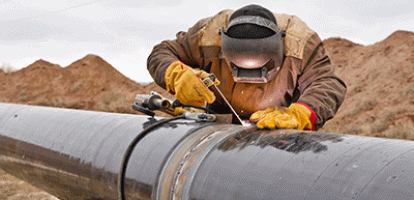 To: The Hon. Jim Carr, Minister of Natural Resources From: Benjamin Dachis Date: June 14, 2017 Re: Getting the Big (and Small) Things Right in National Energy Board Review It’s been a busy month on pipeline news. The National Energy Board (NEB) is setting the scope of its review of TransCanada’s Energy East pipeline; there’s […]
 To fix health system we need to invite competition from private sector: Globe and Mail Op-Ed
Until a few years ago, the main concern in the Canadian debate over health policy was how to control costs. When provinces managed to restrain health-care spending growth to an average rate below that of the economy as a whole (since 2010), that concern subsided somewhat; we had “bent the cost curve” and things seemed to be under control. But as a devastating pair of reports in The Globe and Mail makes clear, the cost-cutting in health care is threatening to make a mockery of the claim that access to health care in Canada does not depend on ability to pay.
As wait times even for things like urgently needed orthopedic and eye surgery become impossibly long, there are more and more desperate patients who are…
Steve Robins on BNN – There’s money to be made in Canada’s seaports
Steven Robins, 2017 Joint MBA and Master in Public Policy Recipient from Harvard University, joins BNN to discuss the C.D. Howe Institute’s latest report about Canada’s seaports. He says Canada stands to gain around $3 billion if the federal government invests the money made from seaports into other infrastructure projects.
Leo De Bever Re-appointed As A C.D. Howe Institute Senior Fellow
William Robson, President and CEO of the C.D. Howe Institute, announces the re-appointment of Leo de Bever, former CEO of Alberta Investment Management Corporation, as a Senior Fellow. “Leo de Bever is a top-notch economist with an extraordinary range of…Parisa Mahboubi – Canada Can Do More in Race for Skilled Workers
 From: Parisa Mahboubi To: Concerned Canadians Date: June 12, 2017 Re: Canada Can Do More in Race for Skilled Workers A number of global destinations are tightening immigration and temporary foreign workers controls. This presents Canada with the opportunity to get more out of the world’s mobile skilled workforce. The new Global Skills Strategy seems […]
 How to patch up the National Energy Board’s reputation: Edmonton Journal Op-Ed
Ottawa is now accepting public comment on the recently released report of its expert panel on the modernization of the National Energy Board (NEB).
The panel made 46 recommendations to the minister of natural resources. Many recommendations, if accepted, would fundamentally change the structure, mandate and governance of the NEB. They would also change how decisions are made about pipelines and transmission lines that cross provincial borders. Unfortunately, the report missed a major opportunity to restore the tattered reputation of the NEB.
Reform is needed to assist the federal government and the NEB, or any successor organization, to regain public credibility and trust in decision-making related to federally…
Blocking pipeline will make it harder to reduce greenhouse gas emissions: Calgary Herald Op-Ed
Last week, politicians made it harder for Canada to meet its greenhouse gas emissions reduction target.
Think I’m talking about Donald Trump’s withdrawal from the Paris agreement? No, it’s a potential attempt by B.C. politicians to block the building of Kinder Morgan’s Trans Mountain pipeline. By rejecting the pipeline, B.C. politicians are going to make it harder to reduce Canada’s emissions.
The B.C. NDP and Green parties agreed to “immediately employ every tool available to the new government to stop the expansion of the Kinder Morgan pipeline,” despite federal approval of the project, itself subject to many conditions regarding safety and environmental concerns.
First, let’s admit to one thing: more pipelines…
Bill Robson on BNN – From Cirque du Soleil to software providers, Canada needs foreign workers
There are industries that you might not think need foreign workers, but the demand is widespread. BNN speaks with President & CEO of the C.D. Howe Institute Bill Robson about why Canada’s Global Talent Stream program looks promising.
Parisa Mahboubi – Most Vulnerable Workers Will Feel The Brunt of Employment Changes
 From: Parisa Mahboubi To: The Honourable Kathleen Wynne, Premier of Ontario Date: June 8, 2017 Re: Proposed changes to employment standards In response to changes in the workplace over the past 30 years, Premier Kathleen Wynne has announced several proposed changes to Ontario’s employment standards legislation. What is less clear, however, is whether these new rules […]
 High minimum wages have minimum benefit: Globe and Mail Op-Ed
Ontario and Alberta will soon dramatically increase their minimum wages to $15 an hour. Unfortunately, these fast and sizable minimum-wage increases are likely going to reduce employment and increase poverty, particularly for the low-income families that the governments are seeking to help.
The Ontario government introduced legislation on June 1 to raise its minimum wage from $11.40 an hour to $14 next year and then to $15 on Jan. 1, 2019. As soon as Jan. 1, 2018, Ontario will face – under the legislation – the largest one-year increase in the minimum wage rate (22.8 per cent) of any province over the past two decades.
In June, 2015, Alberta was the first province to plan a $15 minimum wage, which would amount to…