



High minimum wages have minimum benefit: Globe and Mail Op-Ed
Ontario and Alberta will soon dramatically increase their minimum wages to $15 an hour. Unfortunately, these fast and sizable minimum-wage increases are likely going to reduce employment and increase poverty, particularly for the low-income families that the governments are seeking to help.
The Ontario government introduced legislation on June 1 to raise its minimum wage from $11.40 an hour to $14 next year and then to $15 on Jan. 1, 2019. As soon as Jan. 1, 2018, Ontario will face – under the legislation – the largest one-year increase in the minimum wage rate (22.8 per cent) of any province over the past two decades.
In June, 2015, Alberta was the first province to plan a $15 minimum wage, which would amount to…
Spendthrifts and Savers: Are Canadians Acting Like they are “House Poor” or “House Rich”?
 House rich, big-spending Canadians are taking a gamble on the risk of an economic shock in Canada, according to a new report from the C.D. Howe Institute. In Spendthrifts and Savers: Are Canadians Acting Like they are “House Poor” or “House Rich”?, author Jeremy Kronick finds Canadian household spending, apart from housing, has not dropped […]
 Christopher Sands – Larger Role for Congress Will Make This Negotiation Different Than CUFTA and NAFTA Talks
From: Christopher Sands To: Concerned Canadians Date: June 5, 2017 Re: Larger Role for Congress Will Make This Negotiation Different Than CUFTA and NAFTA Talks Speaking in Kenosha, Wisconsin in April, U.S. President Donald Trump scrambled expectations for the renegotiation of NAFTA when he called Canadian supply management programs for the dairy sector “a disgrace” […]Intelligence Chat – House Rich, Big-Spending Canadians Taking Gamble
House rich, big-spending Canadians are taking a gamble on the risk of an economic shock in Canada. Join us for a conversation about some troubling mortgage and consumption trends in Canada, and the implications for policymakers concerned about a hard landing.Ben Dachis – Ontario’s Laws Of Unintended Consequences
 From: Benjamin Dachis To: The Hon. Kevin Flynn, Ontario Minister of Labour Date: June 1st, 2017 Re: Ontario’s Laws of Unintended Consequences The Ontario government announced a sweeping overhaul of the relationship between workers and employers on May 30. In addition to increasing the minimum wage and increasing entitlements under the Employment Standards Act, the […]
 Tax Options for Childcare that Encourage Work, Flexibility, Choice, Fairness and Quality
 A new approach to childcare tax breaks is needed in order to relieve the financial stress caused by the increasing costs of raising young children, finds a new report from the C.D. Howe Institute. In Tax Options for Childcare that Encourage Work, Flexibility, Choice, Fairness and Quality, authors Alexandre Laurin and Kevin Milligan recommend that […]
 Childcare Expense Tax Breaks Need New Approach
A new approach to childcare tax breaks is needed in order to relieve the financial stress caused by the increasing costs of raising young children, finds a new report from the C.D. Howe Institute. In Tax Options for Childcare that Encourage Work, Flexibility, Choice, Fairness…Konrad W. von Finckenstein: Chapter 19 Should Not be Given Up in NAFTA Renegotiations
From: Konrad W. von Finckenstein To: The Honourable Chrystia Freeland, Minister of Foreign Affairs Date: May 31, 2017 Re: Chapter 19 is Unique and Should Not be Given Up in NAFTA Renegotiations In the upcoming NAFTA renegotiations, I urge you not to relinquish Chapter 19 on dispute settlements. In a recent for paper for the […]Jon Johnson on CTV – Ottawa’s $1B lumber lifeline risks escalating U.S. trade tensions
The C.D. Howe Institute’s Jon Johnson discusses if federal help for the softwood lumber industry will make the dispute with the U.S. worse.
Up in the Air: Canadian Airport Fees in Context
 Canadian airports collect most of their revenue through fees that are largely passed on to consumers in the form of high ticket prices. That may well change if the federal government pursues plans to sell some of its ownership to raise funds for other infrastructure projects. Australia, where the major airports were privatized decades ago, is […]
 Ben Dachis – Don’t Assess Upstream Greenhouse Gas Emissions In Energy East Review
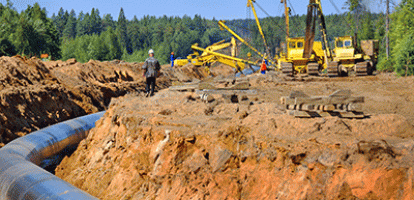 From: Benjamin Dachis To: Peter Watson, Chair of the National Energy Board Date: May 30, 2017 Re: Don’t Assess Upstream Greenhouse Gas Emissions in Energy East Review As you look ahead to reviewing TransCanada’s Energy East pipeline proposal to ship eastward Western Canadian oil, you’ve asked for the public’s advice on whether the National Energy […]