



How should Canada see the TPP? Depends on how we see the world: Globe and Mail Op-Ed
As International Trade Minister Chrystia Freeland embarks on her cross-country consultations on the Trans-Pacific Partnership trade agreement, her opening question should be a fundamental one. It comes down to how Canadians choose to view the world.
Do we view the world mostly as users of goods and services produced by others? Or do we see ourselves as makers, innovators and providers of goods and services to the global marketplace? Do we see the world as confined mostly to our own backyard? Or as an increasingly open market with vast opportunities on a global scale?
In may seem simplistic, but this is the first question Ms. Freeland should be asking Canadians.
The question is pertinent in the intellectual property…
Getting More Buildings for our Bucks: Canadian Infrastructure Policy in 2016
 Canadian governments need to spend wisely in order to maximize their infrastructure dollars, according to a new C.D. Howe Institute report. In “Getting More Buildings for our Bucks: Canadian Infrastructure Policy in 2016,” author Benjamin Dachis provides Canada’s federal, provincial and municipal governments with a blueprint for sound infrastructure investment.
 Coming Infrastructure Boom Requires Discipline In Order To Succeed
Canadian governments need to spend wisely in order to maximize their infrastructure dollars, according to a new C.D. Howe Institute report. In “Getting More Buildings for our Bucks: Canadian Infrastructure Policy in 2016,” author Benjamin Dachis provides Canada’s federal,…Bill Robson on the Exchange: Should Taxpayers be bailing out Bombardier?

Institute President and CEO, Bill Robson, joins his Big Picture co-panelists, Goldy Hyder and Armine Yalnizyan, to discuss the Canadian aerospace company’s woes and whether public money should fund a private enterprise.
More Angst Than Mystery In The Loonie’s Decline: Globe And Mail Op-ed
The ongoing decline of the Canadian dollar is generating many headlines and lots of angst. Of all the questions I receive from journalists and students, the cause of our currency’s fluctuations is surely the most common. But there really isn’t much of a mystery here – or at least there shouldn’t be.
Let’s start with the facts. Our dollar was worth 73 U.S. cents in 1995 and dropped to 63 cents by 2002. It then rose steadily to 93 cents by 2008 and kept rising to be above par in 2011. Over the past four years, the Canadian dollar has fallen again; it is now just above 70 cents.
Economists have long been studying the causes of exchange-rate fluctuations, especially after the collapse of the Bretton Woods agreement in the…
John Helliwell Re-appointed As A Research Fellow
William Robson, President and CEO of the C.D. Howe Institute, announces the re-appointment of John Helliwell, Professor Emeritus of Economics at the University of British Columbia, as a Research Fellow. “John is an…On growth, Stephen Poloz could use a little help: Globe and Mail Op-Ed
Bank of Canada Governor Stephen Poloz’s speech in Ottawa on Thursday got lots of attention. As usual, analysts and traders parsed it for clues about short-term interest rates. Economists noted the Governor’s compelling arguments for letting the Canadian dollar’s external value move as circumstances change. Less happy, however, is the intense focus on Mr. Poloz – and other central bankers – as masters of economic growth. Engineering sustainable increases in living standards is a task for which he and his counterparts around the world could really use some help.
On interest rates, the Governor’s speech highlighted the divergence between the U.S. Federal Reserve Board, responding to economic expansion by tightening, and other…
The Future of Canadian Energy Policy
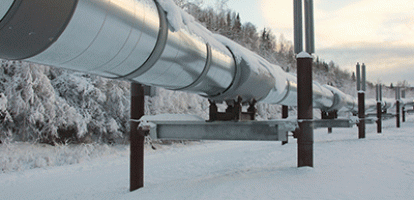 Canada’s energy sector will need to think about more than just low oil prices in 2016. There are numerous structural issues facing the sector that will need to be overcome, according to a new report from the C.D. Howe Institute. In “The Future of Canadian Energy Policy,” the second edition of the Institute’s National Priorities […]
 Four Priorities For Reviving Canada’s Energy Sector In 2016
Canada’s energy sector will need to think about more than just low oil prices in 2016. There are numerous structural issues facing the sector that will need to be overcome, according to a new report from the C.D. Howe Institute. In “The Future of Canadian Energy Policy,” the…Claude Forget Re-appointed As C.D. Howe Institute Senior Fellow
William Robson, President and CEO of the C.D. Howe Institute, announces the appointment of Claude Forget, former Quebec Minister of Social Affairs, as a Senior Fellow. “Claude is an outstanding public policy practitioner and scholar,” stated Robson. “His…Canada needs policies that encourage business investment: Globe and Mail Op-Ed
What’s the bad-news Canadian economic story of 2015? The collapse in oil prices is hammering activity in the West. Even worse is how retrenchment in the oil patch, which had boosted national business investment after the 2008-09 slump, is revealing woefully weak capital spending elsewhere in the country.
In a modern economy, prosperity depends vitally on capital spending by businesses. When Canadian businesses invest in plants and equipment, they equip workers with technology that makes them more productive, and, ultimately, better paid. The bad news is that even outside the oil patch – including in Central Canada, which we need to lead the way in this lower-energy-price environment – investment per worker is anemic and has been…
Emissions policy should focus on carbon pricing, not carbon targets: Globe and Mail Op-Ed
Now that Canadian policy-makers are back from the climate summit in Paris, there will be lots of talk about targets for reducing greenhouse-gas emissions. The federal government has indicated that the previous government’s target – reducing emissions by 30 per cent from 2005 levels by 2030 – is a lower bound for ambition. And the impending federal-provincial meetings could easily get hung up on how any national target might be divided up among the provinces. But a far more useful conversation would focus on the importance of carbon pricing.
Emissions-reduction targets and carbon pricing are closely related. A broadly based carbon price creates powerful incentives for businesses and households to reduce their GHG emissions. And…