





The Study In Brief
Debates about the relative merits of defined-benefit (DB) and defined-contribution (DC) pension plans have been a prominent part of pension discourse over the past forty years. The intensity of the debate has ebbed and flowed over the years but has been more intense in recent years as there has been a shift from DB to DC plans in Canada. This shift has left the remaining members of DB plans feeling threatened and, for many, the sense of threat has been compounded by the emergence of target-benefit (TB) plans.
Discussions of DB, TB and DC in the abstract tend to obscure basic issues related to the similarities and differences among these plans that should be taken into account. My hope is to provoke an examination of some of these issues free from the hyperbole that is widely invoked in partisan debates about DB and DC. In both the private and public sectors, I hope this would lead to the exploration of ways to limit the financial risks of a workplace pension plan (WPP) without going to pure DC. I will also note some measures that will help make DB plans more transparent.
Basically, I will argue that:
- There is so much diversity in the design of DB and DC plans that generalizing about the merits of DB versus DC has little precise meaning.
- While DB plans generally go further than DC plans in achieving a predictable gross replacement rate (the ratio of retirement income to pre-retirement earnings), they will give rise to a variety of net replacement rates (taking into account factors like taxes and mortgage payments) and may push pre-retirement living standards below post-retirement levels. Net replacement rates come closer to defining living standards than do gross rates.
- The financial and economic circumstances of the early 21st century have been difficult for all types of pension and retirement savings plans and I will focus on the impacts on DB plans that explain the changes noted above.
- The relative advantage of DB plans in providing predictable benefits stems from cross-subsidies among the members. These are not inherently problematic but transparency problems may arise because cross-subsidies are not identified and measured.
- There are measures that plan governors can adopt that can help reconcile the (un)predictability of contributions and benefits and make DB plans more transparent.
Finally, I argue that regulatory and tax policy can be adapted to facilitate more flexibility in plan designs.
Introduction
Over the forty years that I have served as a pension specialist, both inside the trade union movement and outside of it since 2005, debates about the relative merits of defined-benefit (DB) and defined-contribution (DC) pension plans have been a prominent part of pension discourse.11 I have kept this text at a conceptual level. Supporting data on key points are found in the appendices and footnotes. I have also tried to limit technical arguments. Two C.D. Howe Institute papers that provide more technical support for key arguments are Landon and Smith 2019, and Young 2012.
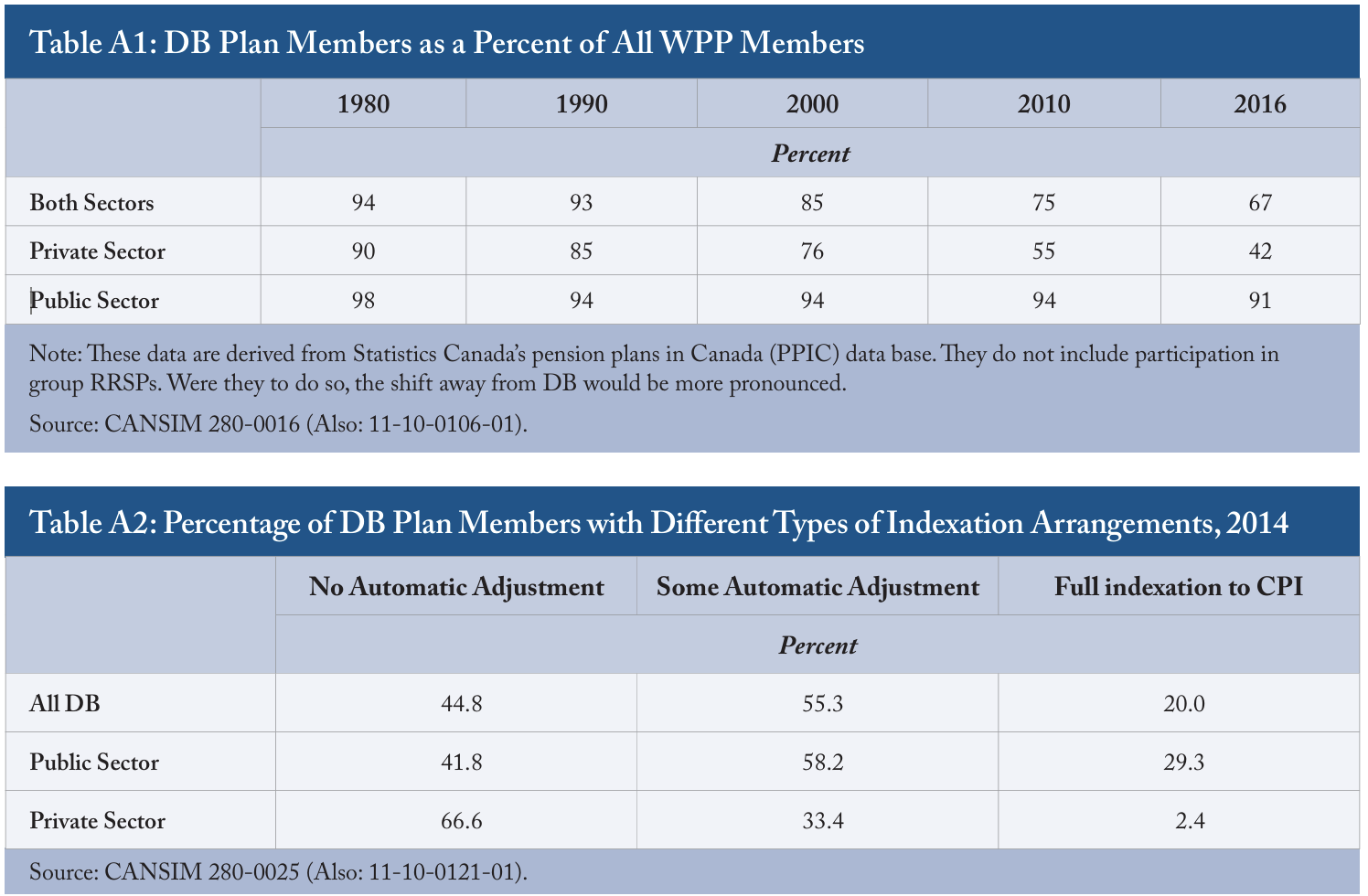
The intensity of the debate has ebbed and flowed over the years but has been more intense in recent years as there has been a shift from DB to DC plans in Canada. This shift has been much stronger in the private sector compared to the public sector and includes a shift from registered DC plans to group RRSPs (see Appendix 1 and Baldwin 2015). This shift has left the remaining members of DB plans feeling threatened and, for many, the sense of threat has been compounded by the emergence of target-benefit (TB) plans, which they see as an inferior alternative to DB22 Workplace pension plans have always been more widely available in large workplaces than in small ones, as have DB plans. Indeed, most small workplaces cannot achieve the scale or governance skills required to be a viable organizational platform for a WPP. In recent years, large DB WPPs are increasingly public-sector plans. (see CLC 2016, and the website of the Ottawa Coalition for Pension Security). The driving forces behind these changes are set out in Section 4.
As happens in many intense debates, participants tend to become advocates for particular points of view and confirmation bias sets in. People take in information that seems to confirm their opening, big picture view of what is best, and find reasons to dismiss non-conforming evidence. Recent discussions of DB, TB and DC provide ample evidence of confirmation bias at work.
DB plans are often revered by their supporters – commonly plan members and their union representatives – on the grounds that they can provide benefits that are more predictable than DC plans and they are capable of providing “adequate” retirement incomes. Adequacy in this context refers to the ability of pension plans to partially replace pre-retirement earnings. More technically, it refers to the ratio of retirement income to pre-retirement earnings, also known as the gross replacement rate (GRR).33 Limitations of the GRR as a measure of retirement income needs are noted below.
Moreover, if things go wrong financially, the employer will pay to right the financial ship. There are important elements of truth in this characterization of DB plans. But this popular characterization also obscures features of DB plans that are less flattering. Discussions of DB, TB and DC in the abstract tend to obscure basic issues related to the similarities and differences among these plans that should be taken into account. The abstract discussions also provide little or no guidance on how to address pension design issues where the economic, financial and demographic context has created difficulties for all forms of pension plan. Unfortunately, plan sponsors – especially in the private sector – often react to current circumstances by reflexively turning to pure DC without considering the full range of alternatives, and plan members dig in in defence of DB plans where they still exist – unwittingly exposing young plan members to considerable risks by doing so.44 As is noted below, when things go wrong in a pure DB plan, the only corrective measures that are permitted are increased contributions or lower benefit accruals in the future. These measures have no impact on retirees and maximum impact on new members of the plan.
My hope is to provoke an examination of some of these issues free from the hyperbole that is widely invoked in partisan debates about DB and DC. In both the private and public sectors I hope this would lead to the exploration of ways to limit the financial risks of a workplace pension plan (WPP) without going to pure DC. I will also note some measures that will help make DB plans more transparent. My thoughts are directed primarily at people with governance responsibilities for WPPs but I will suggest some public policy measures that would help improve the world of WPPs.
Basically I will argue that:
- There is so much diversity in the design of DB and DC plans that generalizing about the merits of DB versus DC has little precise meaning. (Section 2)
- While DB plans generally go further than DC plans in achieving a predictable gross replacement rate, they will give rise to a variety of net replacement rates and may push preretirement living standards below post-retirement levels. Net replacement rates come closer to defining living standards than do gross rates. (Section 3)
- The financial and economic circumstances of the early 21st century have been difficult for all types of pension and retirement savings plans and I will focus on the impacts on DB plans that explain the changes noted above. (Section 4)
- The relative advantage of DB plans in providing predictable benefits stems from cross-subsidies among the members. These are not inherently problematic but transparency problems may arise because cross-subsidies are not identified and measured. (Sections 5 and 6)
- There are measures that plan governors can adopt that can help reconcile the (un)predictability of contributions and benefits and make DB plans more transparent. (Sections 7 and 8)
- Regulatory and tax policy can be adapted to facilitate more flexibility in plan designs. (Section 8)
Section 2: Diversity under each of the DB and DC Umbrellas
In debates about the general merits of DB and DC, proponents of DB plans tend to have a particular type of DB and DC plan in mind. The DB plan implied in much of the commentary is a “Best or Final Average Earnings” (BAE or FAE) plan with benefits that are indexed to inflation once they are being paid. Generous early retirement benefits are often assumed to be part of these plans. On the DC side, it is implied that we are dealing with a plan in which investments are “self-managed”55 Self-management in the pre-retirement period refers to a situation where plan members have to choose their investment option – usually from a catalogue of options offered by the sponsor of the plan. during the pre-retirement period as well as during the run down of assets post-retirement.66 Self-management during the post-retirement period refers to a situation where a retiree manages the conversion of their assets into income on their own (i.e., they do not buy an annuity). If these types of DB and DC plans were the only types that existed, the preferential views for DB noted above would be easy to accept more or less at face value.
But the reality is that DB and DC plans come in quite a variety of shapes and sizes and not all of the DB plans include the virtues commonly ascribed to the DB model.77 In the public sector more than 90 percent of DB plan members belong to best average earnings plans. In the private sector roughly one in four belong to best average earnings plans.
The world of DB includes plan designs that may fall quite short on income adequacy and to a lesser degree, on predictability. A member of a career average earnings (CAE) plan88 CAE plans provide benefits based on average earnings over the entire period of participation in the plan. Unless the earnings records are adjusted upwards to reflect wage growth over time, it is likely that the earnings base used to calculate benefits will be quite low compared to final or best earnings. that includes no upgrade in the earnings base used to calculate benefits will likely provide inadequate benefits in periods of strong wage growth and benefits that will not be predictable until close to retirement. The same problem can arise with flat-benefit (FB) plans.99 FB plans provide a uniform number of dollars per month per year of service without reference to prior earnings. These DB plans can be managed so that benefits are predictable and adequate. But there is nothing inherent in the plan design that makes them so. But note: these are DB plans.1010 As of 2017, just under half of WPPs in Canada were of the FAE or BAE type but they included about three-quarters of all plan members thanks to the large public employee plans in Canada, which are overwhelmingly FAE or BAE. In the private sector, about 40 percent of plans and just over one-quarter of plan members are in BAE plans as of 2017. Data on FAE plans are suppressed (sCANSIM 280-0017; 11-10-0111-01).
In an era when retirement periods commonly span 20 or more years, post-retirement adjustments to reflect price or wage increases become increasingly important. Over a 20-year time span, annual inflation at the 2 percent rate targeted by the Bank of Canada will reduce the purchasing power of a pension that provides no protection against inflation by one-third. About one-third of Canadian DB plans with just under half of DB plan members provide no automatic adjustments in the post-retirement period. In these plans, benefits may be predictable at the date of retirement, but their purchasing power after retirement is not predictable (see Appendix 2). Only one in five DB plan members gets full protection from inflation as measured by the Consumer Price Index (CPI). The remainder get some form of partial protection against inflation.1111 I take the protection of purchasing power over the retirement period as an important aspect of pension plan design. However, I should acknowledge that there are knowledgeable commentators who place less emphasis on this feature of plan design on the grounds that retirees decrease their consumer spending through time (see for example Vettese 2016). Also, because life expectancy is greater for high earners compared to low earners, indexation may involve a cross-subsidy from the latter to the former.
On the DC side, a similar problem arises. The self-managed plans not only involve a high degree of uncertainty with respect to the benefits they will provide, but their contribution levels may be inadequate to provide sufficient retirement income in low-return environments like the current one.1212 A more thorough discussion of DC designs is available in Baldwin 2015. Self-managed DC plans also impose decisionmaking responsibilities on people who have little time to do the work required to make good choices and who don’t have appropriate investment expertise.1313 Baldwin (2017) finds that DB plans are more consistent with the retirement income wishes of Canadians than are DC plans.
Over long time frames, the adequacy problem can be addressed through higher contribution rates. The predictability problem can also be addressed, by degree, through choice of a specific plan design that does not rely on self-management.
Prior to the early 1980s, most DC pension plans in Canada provided benefits based on the purchase of deferred annuities. DC plans organized in this way provide much greater predictability than self-managed plans but less than BAE or FAE DB plans. Whether they produce adequate benefits conceived of in GRR terms will depend on a variety of factors including the contribution rate, the interest rates embedded in the annuities and the earnings trajectory of the plan members.
There are also a number of Canadian DC plans that provided DB guarantees before 1990 – the time of our last major reform to the tax rules governing pensions and RRSPs. The plans of this sort that were in existence at the time were allowed to keep operating but new plans of this sort could not be registered with the Canada Revenue Agency.1414 Plans of this sort were deemed incompatible with the clear distinction between DB and DC plans required by the tax rules governing WPPs and RRSPs that were introduced in 1990. These plans provide the same downside protection as DB plans while offering the upside investment risk associated with DC plans that offered plan members the same if not greater opportunity to provide adequate incomes.
Looking beyond the Canadian border, there are many examples of DC plans that provide minimum rate-of-return guarantees. The downside protection offered by these plans is similar to a career average adjusted plan like the Canada Pension Plan (CPP) but they also offer upside investment opportunities.
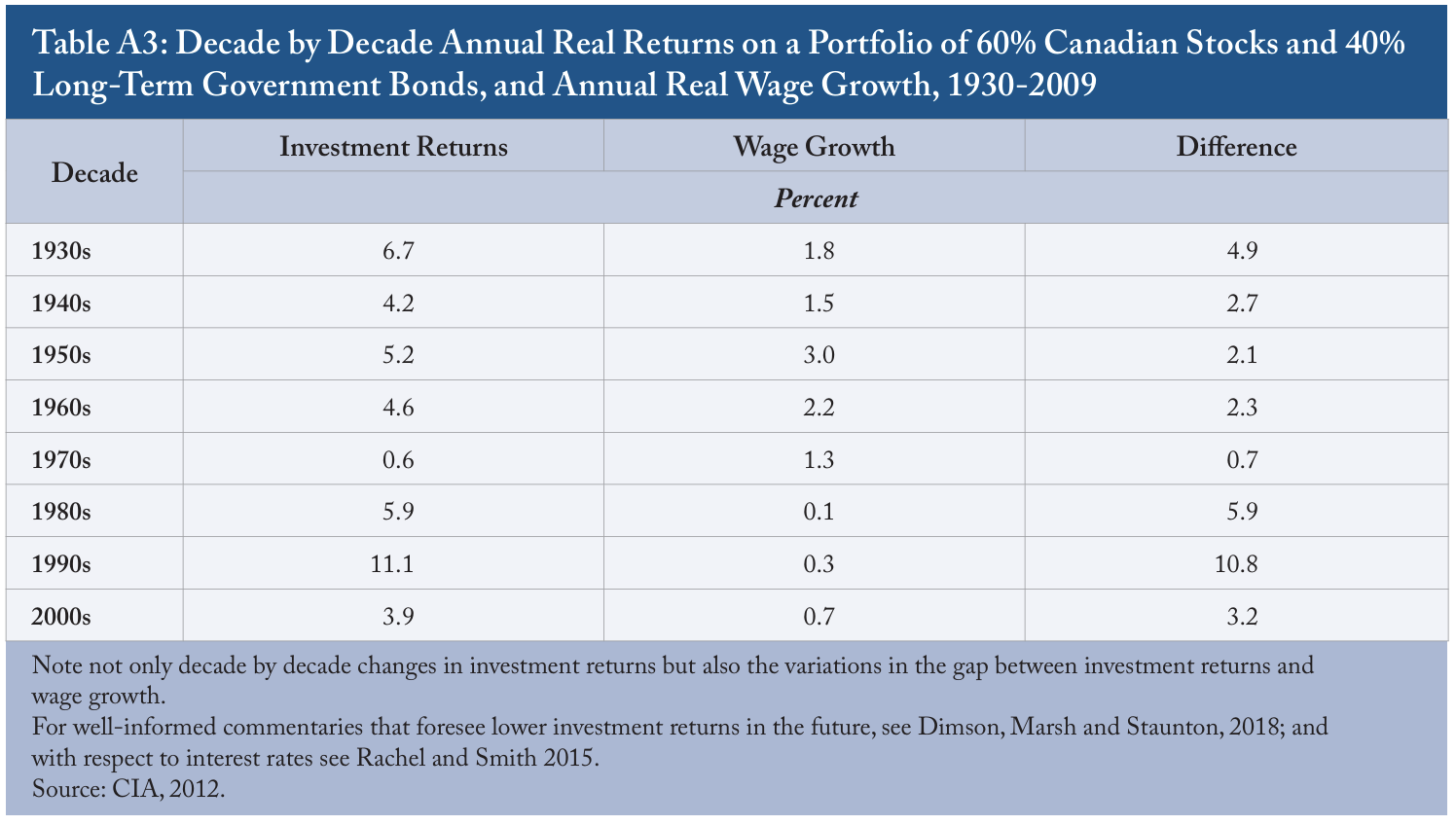
It is worth noting, too, that plans aren’t always administered in the way their basic benefit design might suggest. In the 1980s and 1990s, real returns on both stocks and bonds were high and it was common for DB plans to be in a surplus position (i.e., plan assets exceeded plan liabilities). In many cases where DB surpluses existed, the surpluses were used in whole or in part to finance benefit improvements.1515 During that era, surpluses were also quite widely used to finance contribution holidays. The contribution holidays are more consistent with the basic features of pure DB than are benefit improvements. To the extent that plans were managed in this way, they were managed as if they were collective DC plans with strong minimum DB guarantees. The DB formulas were guaranteeing a minimum level of benefits, while surpluses driven by strong investment returns were paying for enhancements.
The main point to be made here is that abstract debates about the virtues of DB and DC plans are of limited value. There is too much variation in the specifics of plan design under each heading. WPP design is more like a spectrum of choice rather than a binary choice between DB and DC. The most important priority is to assess the retirement income needs and risks faced by the plan members and make sure they are addressed in a way that is fair among plan members and is reasonable in terms of the level and volatility of required contributions. Some of the issues related to fairness and required contributions are addressed below.
I should acknowledge here that it is not easy to make the language of pensions correspond exactly with the reality of pension designs. Reality is more subtle than language. I will use the terms “pure DB” at times to refer to plans where literally all of the financial risk falls on variable contributions. There is a clear tension between the predictability of benefits and contributions; a key question in pension design is how much of the risk will fall on each side of the plan. Finding language that correctly describes the balance can be difficult.
Section 3: What are We Trying to Achieve?
Generally, workplace pension plans are designed to allow people to maintain their standard of living after they leave paid employment. As was noted above, this post-employment period can be a long one. Recent annual reports of the Ontario Teachers’ Pension Plan draw attention to the fact that the average retirement period under that plan is greater than the average period of employment as a teacher.1616 See: Ontario Teachers’ Pension Plan (OTPP) (2018).
Discussions of pension plans’ adequacy often focus exclusively on what plans produce in the retirement period. The consideration of adequacy is usually cast in terms of the GRRs they will produce. This perspective is too limited.
Pension plans affect living standards in both the pre-retirement period and the post-retirement period. In the post-retirement period we will be interested in the extent to which the pension replaces pre-retirement earnings. But in the preretirement period we have to be concerned with the extent to which the pension plan is depressing the ability of plan members to buy goods and services.
Ideally, the pre-retirement sacrifice will combine with post-retirement benefits so that living standards will be the same in both periods. If too little is given up prior to retirement, living standards will drop in retirement. If too much is given up, living standards in the pre-retirement period will be depressed below their post-retirement level. (It is possible to have too much pension!) Neither over contributing/saving nor under contributing/saving is inherently desirable. Unfortunately, for reasons that will become clear below, it is impossible to get the balance of pre-retirement sacrifice and postretirement benefits exactly right for all members of a DB plan.1717 It is also true in other types of plans that a given gross replacement rate will translate into a variety of net replacement rates.
In thinking about the balance between preretirement sacrifice and post-retirement benefits, three additional things need to be considered.
First, in describing the objective of maintaining living standards in retirement, so far I have referred exclusively to the role of WPPs in achieving this goal. In most high-income countries, publicly administered pension plans will also contribute to meeting this objective. Given the structure of Canada’s publicly administered pension plans (OAS, GIS and CPP), the objective of maintaining living standards in retirement will be met for Canadians with lower earnings – generally Canadians earning half of the average wages and salaries and below – by the publicly administered plans alone. But above that level of earnings, income from privately administered sources will be needed in order to maintain living standards in retirement and the need will grow quite rapidly through the middle and upper-middle earnings ranges.1818 Compared to other high-income countries, the public components of Canada’s retirement income system tend to produce high replacement rates at low levels of earnings and more modest replacement rates at higher levels of earnings (OECD, 2017).
Second, it has been a tradition in both publicpolicy discourse and retirement planning to argue that a retirement income amounting to 70 percent of pre-retirement earnings is a reasonable benchmark for being able to maintain living standards in retirement.1919 For low earners, this replacement rate target does not guarantee an adequate income on an absolute basis. Low earnings before retirement still mean low income in retirement. Recently, this approach to assessing retirement income adequacy has been subject to two types of challenge.
It has been argued that this benchmark is too high for the middle earners who are of key policy interest (Mintz 2009). GRRs in the range of 50 to 60 percent are becoming more common benchmarks among pension experts in Canada.
It has also been argued that gross pre-retirement earnings and retirement income are weak indicators of living standards in the pre- and post-retirement periods, respectively (MacDonald, Osberg and Moore 2014, and Wolfson 2011). In the preretirement period, a significant wedge between gross earnings and the consumption possibilities of a pension plan member can be created by the need to support children, make mortgage payments, pay taxes and, of course, make pension contributions. In the post-retirement period many of the factors that are relevant in the pre-retirement period will cease to be so for most pension plan beneficiaries (e.g., mortgage payments, transfers to children, etc.). But taxes will still be relevant for most. Also, in the post-retirement period, many homeowners will have paid off their mortgages and can live rent free. This has a very real economic value for the homeowner. Thus, some adjustment to income to account for the value of home equity is appropriate. The adjustment could take the form of imputed rent or annuitization. The presence and economic situation of a spouse is also important.2020 Baldwin (2016) provides discusses the adjustments made to incomes before and after retirement to assess net replacement rates in a number of prominent Canadian studies of retirement income adequacy.
Adjusting earnings in the pre-retirement period and income in the post-retirement period to take account of these factors gives rise to a net replacement rate (NRR). The NRR comes much closer to defining the actual standard of living enjoyed in the pre- and post-retirement periods than does a GRR. An appropriate target NRR would be close to 100 percent.
A given gross replacement rate may translate into a range of net replacement rates. Within a DB plan that is designed to generate a given gross replacement rate (e.g., 70 percent after 35 years of service) there will be a wide range of net replacement rates after 35 years of service reflecting differences among the members in terms of their family situations and whether they own their own home. The fact that DB plans are designed to generate GRRs rather than NRRs forces us to recognize that NRRs may cover a wide range and won’t be perfect for all members. However, this reality does not allow us to ignore the importance of NRRs.
Once it is accepted that pension contributions depress pre-retirement living standards and increase NRRs, an important question arises: what contributions should be entered into the calculation of pre-retirement living standards. For plan members who have deductions made from their paychecks to support a pension plan, the most obvious contributions to take into account are the deductions from each paycheck. But should employer contributions be ignored?
There is good reason for including some portion – maybe even the full amount – of employer contributions in the calculation of what plan members give up in order to get their pension benefits. In most situations, it is fair to surmise that an employer is most worried about total labour costs not the component parts of the cost. To the extent this is true, a rational employer will discount other elements in the compensation package of employees to take account of the contributions to the pension plan that are predictable. Thus, the economic burden of employer contributions will be shifted from employers to employees – rather like sales taxes being shifted from vendors to consumers. In DC plans the required contributions will usually be predictable but this will be less often the case in DB plans.
In DB plans contributions are unpredictable (more on this below). There may be situations where an employer is confronted with an unexpected need to make special contributions to a DB plan based on an actuarial deficit showing up in an actuarial valuation report. The employer may find it impossible to shift the burden of the special payments to employees in the short term due to labour market conditions and/or contractual obligations to employees.
All things considered, it would be a mistake to totally ignore employer contributions in considering what plan members give up in order to earn DB benefits.2121 A good discussion of this issue, including the difficulty of measuring the extent to which employer contributions reduce other elements in employee compensation, is found in Pesando 2008.
Section 4: Some Changes that have Affected Retirement Savings Plans
It is a basic axiom of all types of pension plans that the effects of the plan will depend not only on the benefit and financing rules in the plan but also on the way the rules interact with an ever- changing labour market, demographic, financial and economic environment. An unchanging set of plan rules does make the plan stable in terms of the benefits it will provide or the cost of providing the benefits. Some of the variables that affect the outcomes of pension plans are quite unpredictable over short and even longer time frames. This is especially true of investment returns, which play a central role in the financing of pre-funded pension plans.
Any number of changes in the labour market, demographic, financial and economic environment have affected the operation of workplace pension plans in recent years. But three merit particular attention: investment returns, life expectancy and entry and exit ages from the labour force.
As was noted above, nominal and real returns on both stocks and bonds were very strong in the 1980s and 1990s. Since 2000, returns have been weaker. The high returns of the 1980s and 1990s were important in their own right and their contribution to pension finance was accentuated by slow growth in wages and salaries. Slow wage and salary growth meant that earnings replacement targets were growing relatively slowly. In DB plans, plan liabilities were growing more slowly than would have been the case with rapid wage growth. At that time, providing retirement incomes proved quite inexpensive. Changes in the financial environment have made retirement incomes more expensive and less predictable.2222 As revisions to the paper are being made in March 2020, the stock market is taking its third deep dive in the past 20 years. (More on this below; also, see Appendix 3.)
Regarding life expectancy, in the 14th Actuarial Report on the Old Age Security (OAS) program, the Office of the Chief Actuary (OCA) points out that the average life expectancy of a 65-year-old Canadian increased by roughly six years between 1966 and 2016. By 2060, average life expectancy at 65 is likely to increase by another four years (OCA 2017). This is, of course, a very welcome development. But to state the obvious, it also means that if people keep starting their pensions at the same age, the pensions will be paid out over longer periods of time and will be more expensive.
Low returns in general – and lower interest rates in particular – have combined with increasing life expectancy to raise the cost of providing a dollar of annual retirement income. Thus, in establishing a lump sum value of a dollar of DB benefits in workplace pension plans, Statistics Canada estimates that the cost of an indexed benefit has increased over the relatively short period from 1999 to 2016 by 60 percent.2323 This estimate was provided to the author in private email correspondence. It reflects the increase in annuity factors calculated on a termination basis. On a going concern basis, the increase was 40 percent.
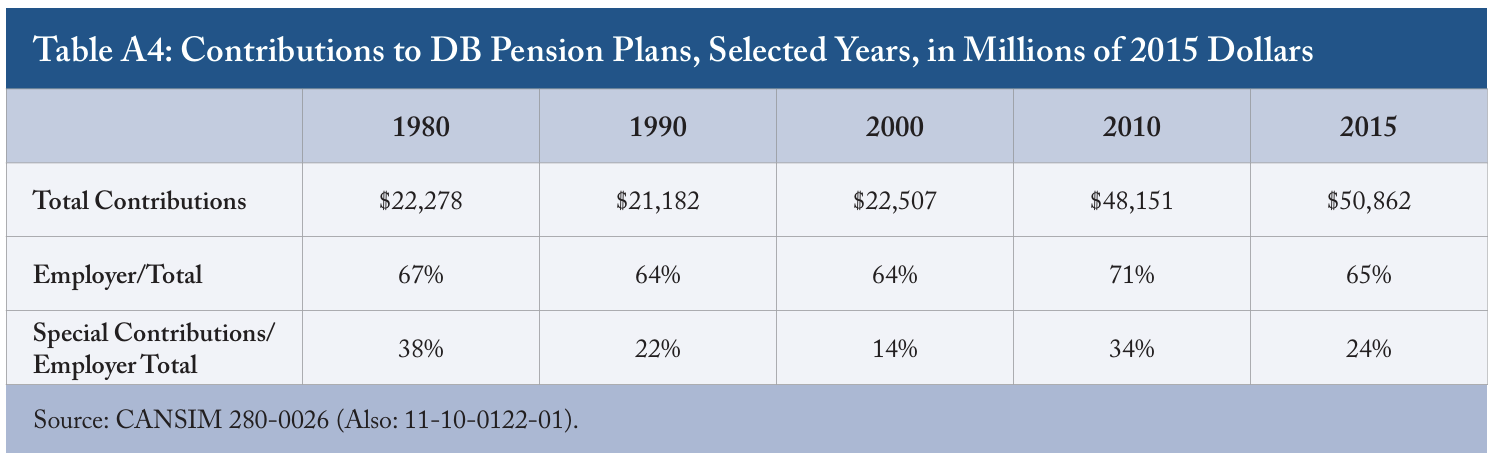
These developments have put upward pressure on DB contribution rates (see Appendix 4).2424 In order to keep this discussion relatively simple, I have avoided a discussion of the funding requirements in Canadian pension legislation. Suffice it to say here that the special payments noted in Appendix 4 stem largely from the requirement in drawing up solvency balance sheets to use market sensitive measures in assessing DB pension liabilities and the related requirement to close any gap between assets and liabilities over a relatively short period of time through special contributions. It should be noted, too, that in recent years accounting rules that apply to the treatment of pension plans in corporate financial statements have also incorporated market sensitive measures and in the current low interest rate environment have had an adverse effect on financial statements. Some have argued that the accounting rules have been more important than the funding requirements in explaining the corporate shift away from DB plans. They have also contributed to the shift from DB to DC forms of workplace pension plan – especially in the private sector. In the public sector they have contributed to a shift from pure DB to plans that are largely DB but place some financial risk on the benefit side of the plan by making the indexation of benefits in pay contingent on the funded status of the plan. Target-benefit plans have also been introduced in the public sector in response to the financial difficulties of pure DB plans. Shifts in benefit design in the public sector have typically been combined with joint governance and costsharing. These have been constructive responses to financial difficulties but the plans are no longer purely DB.
Another development meriting comment: changes in the ages of entry and exit from the labour force. There has been a general trend in recent years for the average age of both entry and exit to go up – with the increased age of exit being more clear than the entry age in the aggregate data.2525 These trends are also clearer for men than women. Women’s employment rates at all ages have been increasing though the rate of increase is much lower at younger (under 25) versus old ages. On the general trend to later retirement, see Hicks (2012). At the same time that the average age has been going up, entry and exit ages for the society/ economy as a whole have been becoming more diverse. For public pension plans like OAS and C/ QPP, these developments raise important questions about the appropriate age of eligibility for pensions and whether the role of specific chronological ages should continue to be the dominant criterion for eligibility. Should a person who enters the labour force at 18 qualify for benefits at the same age as someone who enters at age 30?2626 Internationally, a number of public plans are linking the amount of periodic benefit payments to changes in life expectancy. The entry and exit ages for specific workplace pension plans are likely to vary from the society/ economy wide norms – in some cases quite significantly.
The entry and exit ages in each plan need their own study and analysis. One question worth asking in the context of plans with special early retirement provisions is what portion of new entrants will qualify for them under the conditions when they first become available. In the case of the federal public service superannuation plan, between the 1980s and early 2000s there was a significant decline in the portion of new plan members who would qualify for special early retirement benefits when they first become available (Baldwin 2012).
Section 5: What Allows DB Benefits to be Predictable?
There is an accounting formula that applies to all types of pension plans:
- Benefits = contributions + investment returns – expenses.
Given that the basic building blocks of all types of pension plans are the same, an obvious question arises: what allows a DB plan to provide more predictable benefits than a DC plan? The answer lies in two related but distinct features of DB plans.
First, the contributions to DB plans are adjusted on a regular basis so that retirement income objectives that are embedded in the DB benefit formulae can be met. In the Canadian context these adjustments will be made based on actuarial valuation reports that must be prepared with a frequency no greater than three years.
The second feature of DB plans that allows them to provide predictable benefits is crosssubsidies within and between various cohorts of plan members. The regular adjustments to DB contribution rates mean that different cohorts of plan members get different effective rates of return on their pension contributions – hence the overlap between the cross-subsidies issue and the adjustments to the contribution rate.
There is also a wide range of cross-subsidies within cohorts. Those with short periods of retirement subsidize those with long periods of retirement, early entrants to the plan subsidize late entrants and so on.
There has been some interest in, and measurement of, cross-subsidies across cohorts among pension analysts (see, for example, Cui, deJong and Ponds 201127 and Kortleve and Ponds 2010). Less interest has been shown in crosssubsidies within cohorts. An exception is provided by Young (2012) who identifies a limited number of cross-subsidies and provides a measure of their impact. Blommestein et al. (2009) identify a number of cross-subsidies within cohorts but don’t provide a measure of their impact.
The level of contribution rates to a pension plan is important in determining both post-retirement benefit levels and the pre-retirement loss in consumption possibilities. But investment returns commonly account for two-thirds to three-quarters of benefit payments. By their nature, investment returns are unpredictable and the way that the returns are shared within and between cohorts in a DB plan is important in determining who is subsidizing whom.
In context, it is worth noting that both plan members and employers who sponsor DB plans face parallel dilemmas in terms of the degree of financial risk that should be accepted in order to get higher investment returns. Plan members would like to maximize the benefits they get from their contributions, which would tend to push them to seek higher returns which, in turn, would mean higher levels of risk. But they also want benefit security, which would push them in the opposite direction. Employer plan sponsors would like to minimize required contributions for promised benefits, which would tend to push them toward higher risk investments. But they would also like predictable contributions, which would push them in the opposite direction.
Section 6: Some Related Transparency Problems in DB
The reality of cross-subsidies within DB plans is not a problem in and of itself. Cross-subsidies are inherent in any form of insurance and people do place positive value on insurance – even when they know that they may get less of a “return” on their insurance premiums than other purchasers of the same insurance. (People seldom complain when they don’t claim fire insurance on their home or when their beneficiary claims life insurance.) Unfortunately, the cross-subsidies in DB plans are not always recognized and seldom if ever measured. As a result, it is very difficult for plan members to assess their impact and make an informed decision on whether they are “worth it.”
It is conjecture on my part, but my sense is that plan members have a dim sense of some crosssubsidies in DB plans and accept them, within limits, without having a clear sense of their financial impact. Other cross-subsidies are less clearly perceived and may not be as welcome if they were clearly perceived. An example of the former would be the cross-subsidy from members with short retirement periods due to early death to those with long lives and hence long retirement periods. This is an interesting cross-subsidy because it is constrained in many DB plans by the presence of a guaranteed minimum period of payments. The presence of minimum guarantee periods raises a question about the willingness of plan members to be an open-ended source of subsidization.2728 People approaching retirement often express fears about running out of money before life’s end (Baldwin 2017) and DB plans address this issue directly. Yet members of DC plans who are offered the choice of buying a life annuity seldom do so. Not wishing to be a source of cross-subsidy may be part of the reason for this. A thorough discussion of why people don’t but life annuities is found in Cannon and Tonks (2008).
A source of cross-subsidy in final and best average earnings plans that is less clearly perceived is the cross-subsidy from plan members whose earnings are flat or declining as they approach the age of pension receipt to those whose earnings are increasing rapidly.2829 This particular cross-subsidy can be accentuated in plans that include overtime pay in the calculation of pension benefits. It is unlikely that this particular cross-subsidy would garner substantial plan member support if it was perceived and its financial effect was known.
The point here is not to argue that crosssubsidies are wrong. But, as far as possible, they should be identified and measured so that plan members and plan governors can have some sense of whether they are “worth it.”
DB plans have a key premise and that is that the sponsor of the plan (and/or the plan members) has (have) an unlimited willingness and ability to contribute more to the plan. This is an implausible premise. As long as labour market, demographic and financial circumstances remain within limited and favourable boundaries, the implausibility of the premise will not be clearly visible. But in circumstances like those of the early 21st century, the difficulty with the premise becomes clear. Unexpected increases in contributions have contributed to the closure of DB plans and the shift to DC. Within surviving DB plans they have led to shifting some risk to the benefits provided by the plans. But even where DB plans have survived, there are transparency problems: plan governors do not articulate the outer limit of acceptable levels of contribution and don’t explain to plan members what happens if that limit is reached. This becomes a growing problem as increases in the contribution rate run the risk of pushing pre-retirement living standards below post-retirement levels.
Lurking beneath the surface of much of the discussion in this Commentary is a reflection on the extraordinary range and degree of risks in trying to provide an adequate and predictable retirement income. It seems simple enough to promise a 30-year-old that for each year of service they put in under a DB plan, they will get payments amounting to 2 percent of their best five years earnings for their retirement period and a smaller payment to a surviving spouse during their lifetime, with both benefit streams being protected against inflation. In fact, this is a promise that is full of uncertainties: the best five years’ earnings are unknown, the start date of payments is unknown, the end date of payments to the plan member and their spouse are unknown and the size of any post-retirement adjustments to reflect inflation are unknown. Moreover, we don’t know the rate of return that any money set aside today to help make the payments will earn. Money set aside today may or may not be sufficient to pay future benefits. The pervasiveness of these uncertainties dictates the need for regular financial assessments of DB plans.
These key sources of uncertainty are addressed in traditional financial reporting but in ways that tend to divert attention from the uncertainties associated with the variables. Traditional financial analysis of pension plans relies on the projection of key variables at fixed rates through time. In other words, they rely on fixed rates of wage growth, fixed rates of return and so on through time. This form of modelling of the financial future of pension plans is known as deterministic modelling. Modelling in this form can answer basic “yes/no” questions such as: are the “normal” contributions high enough to cover the cost of the newly emerging benefits? or are the assets in the plan sufficient to cover the cost of the benefits that have accrued to date?2930 Two things need to be acknowledged here. First, what I describe as the traditional approach did include sensitivity testing in which the effect of varying initial assumptions are tested. In many cases the value of the “sensitivity tests” is limited by the fact that no probability is attached to the alternative assumptions that are being tested and they are tested one-by-one and not in combination. Second, in recent years, large plans have begun to undertake their own risk analyses that are far more helpful in identifying key financial risks. The development of funding policies by these plans goes some distance in explaining to plan members what will happen if things go wrong. The advantage of large plans in the investment realm has been noted for years by for example Ambachtsheer (2007). Their advantage in terms of internal analytical capacity seldom gets the recognition it deserves.
The problem with this traditional approach is that it fails to capture all of the uncertainties that arise through time with the full range of variables. It may be true on the basis of single-valued assumptions about the future that are chosen for the purposes of analysis that a plan’s assets are sufficient to pay benefits promised to date. But it may also be true that there is a reasonable chance that shortfalls will arise in the future and prompt the need for contribution rate increases or benefit reductions. These possible consequences of uncertainties are accentuated in plans that have risky investment portfolios and in mature plans.3031 Plans become more mature as the plan membership ages and the ratio of retired lives to active lives in the plan membership increases. Also, in DB plans, pension liabilities tend to increase compared to pension payroll. Thus, every dollar of pension liability that needs to be amortized grows in relation to payroll. The potential need for these types of adjustments is not clearly brought into focus in traditional analysis.
In DB plans, the assumptions about the future that underpin the financing of a plan are made clear in actuarial valuation reports. In DC plans, the assumptions about the future that underpin the plan may not be formalized but may be implicit in claims that contributing to the plan at a certain rate will generate a retirement income amounting to some percent of pre-retirement earnings. In the case of both types of plan, there is a possibility – indeed a likelihood – that the future will be mis-estimated. In the case of a pure DB plan, the mis-estimations are corrected entirely through changes to the contribution rate and in a pure DC plan through changes in the benefits.
Section 7: DB and TB
So far I have focussed attention on the historical debate about the virtues of DB and DC. More recently, debates have also emerged about the virtues and vices of target-benefit (TB) plans compared to DB.
TB and DB plans have a logic that has a common point of departure. Unlike DC plans, both DB and TB plans promise plan members a benefit that will be paid for each year of service in the plan. Key risks are pooled in both types of plans so that there is a reasonable expectation that promised benefits will be paid. Using broadly similar actuarial methods, both types of plans establish a contribution rate required to pay the benefits promised by the plan. (In many if not most cases, the benefit level that is promised will reflect a limit that the plan sponsor or tax law will impose on maximum contributions. To the extent this happens, it introduces a DC element into the logic of DB and TB).
The main thing that distinguishes DB from TB plans is what happens when financial problems arise.
In pure DB plans, when things go wrong financially, there are two options under Canadian regulatory law for correcting the problem:
- Increase contributions;
- Reduce benefits that will accrue in the future. In TB plans these two options are available as is one more:
- Reduce benefits that have already accrued.
Option 3 is generally not available for DB plans because pension benefits law in all Canadian jurisdictions other than the federal jurisdiction prohibit the reduction in accrued DB benefits.3132 In the federal jurisdiction, permission to reduce accrued benefits requires the permission of the pension regulator. In practice, permission has only been given to multi-employer plans. Also, PEI does not have pension benefits legislation.
It is important to note that the difference between DB and TB has different implications for different cohorts of plan members. The options open to DB plans create no risk for retired members and little risk for members close to retirement age. (Retiree benefits are fully accrued and retirees don’t make contributions. Near retirees are close to this situation.) But they expose the young and future plan members to most of the financial risk of DB plans. (Most of their benefits will accrue in the future and they have many years of potentially higher contributions ahead of them.) The TB options expose all cohorts to financial risk that will vary depending on the specifics of the plan.
As is the case with DB and DC plans, there can be a range of specific designs of TB plans. Two variables in the design of TB plans are crucial:
- Is there any room for variability in the contribution rate? (The more variability there can be in the contribution rate, the more TB will perform like DB.)
- To what extent is positive experience used to recoup benefit losses in earlier time periods? (The higher the priority that is given to this use of surplus, the more TB will perform like DB.)
TB plans have been operating in Canada for many years. Many of these plans have been created at union initiative to provide pensions to workers in industries with large numbers of small employers in which it would not be practical to establish DB plans at each workplace. These plans are generally known as multi-employer plans (MEPPs).
The union-initiated MEPPs have several characteristics that are worth noting:
- Contributions to them are fixed during the term of collective agreements that require employers to contribute to them.
- Regulatory law includes specific provisions that apply to MEPPs and allows accrued benefits to be reduced.
- Regulatory law requires that half of the governing body of a MEPP be made up of plan member representatives.
Until recently, TB plans have been restricted to the MEPP context. Several provincial jurisdictions have adopted or are considering legislation to permit single employers to adopt TB plans.
Regulatory changes to permit single-employer TB plans have become particularly controversial in the federal jurisdiction. The federal government introduced legislation (Bill C-27) in the last Parliament to permit the registration of singleemployer TB plans. The Bill was vociferously opposed by some unions and retiree groups that would potentially be affected by the legislation. There are important respects in which Bill C-27 needs to be altered to protect plan member rights. Most importantly, accrued benefits should only be allowed to be reduced if joint governance is in place. But the Bill’s general direction is consistent with the shared theme of the Ontario Expert Commission on Pensions and the Joint Expert Panel on Pensions in Alberta and BC that Canada’s regulatory and tax law needs to be amended to accommodate plans that embody elements of DB and DC.
Section 8: Concluding Thoughts
I want to conclude this paper by summarizing what I see as key points made above. But I also think it would be helpful to put the foregoing discussion on WPPs in context.
Canada’s retirement income system is structured in a way that middle and upper earners have to obtain retirement income from either WPPs or individual savings plans in order to achieve a standard of living in retirement that is comparable to what they had beforehand. Based on evidence of a variety of types, this basically means participation in a WPP – preferably one with a DB element to it. While the success of WPPs is of primary importance to the well-being of people coming to retirement age, it has wider importance too. With a growing portion of the population being made up of retirees, the success of WPPs will also be important to maintain robust domestic demand for goods and services and success will also have a positive effect on fiscal balances in the future (Baldwin and Moore 2015, Baldwin 2017, and Baldwin and Shillington 2017).
The declining participation in WPPs and the shift away from plans with DB elements are discouraging with respect to the potential role of WPPs in providing retirement income. Looking beyond these recent developments, another longer term reality needs attention. WPPs have never been widely available in the small employer context. Indeed, most small employers lack the scale and expertise to serve as an adequate platform for administering a pension plan.3233 The Ontario Colleges pension plan and the OPSEU Pension Trust now offer their organizational platform to small unrelated employers. These initiatives are potentially important and deserve close scrutiny. Bearing in mind that the financial services industry has not come up with adequate solutions to this problem, finding an effective organizational platform for small employers is an important challenge. It is unlikely though, that plans that satisfy this need will be of a pure DB type. Hence, there is a further need to keep exploring the space between pure DB and pure DC.
The need to keep exploring plan designs coupled with the need to adapt plans to a changing environment raises another issue. The regulatory law that governs WPPs was crafted at a point in time when most members of WPPs in both the public and private sector belonged to DB plans. The objective of the law was to protect DB plan members from errors and/or abuse by employers. The need for the regulatory law to be more flexible with respect to plan design was an important theme of the Ontario Expert Commission on Pensions and the Joint Expert Pension Panel created by the governments of Alberta and British Columbia. I would strongly endorse this theme and argue that it needs to be complemented by more flexibility to adapt to changing circumstances. But this latter adaptability needs to be made safe for plan members by encouraging joint plan member/ employer governance as in the Jointly Sponsored Pension Plans in Ontario.
In previous sections of this paper I have argued a few key points:
- There is enough variation in specific plan designs under each of the headings of DB, DC, and TB that there is little value in arguing the virtues and vices of plan design at that abstract level.
- Too little attention has been paid to:
- the impact of plan design on pre-retirement living standards;
- the impact of changes in the socio-economic environment on pension plan benefits and costs; and
- the impact of financial risk in DB plans both in the aggregate and for specific cohorts of plan members.
- DB plans have transparency problems in not identifying what happens when things go wrong, what cross-subsidies are embedded in the plans and what financial risks are embedded in the plans.
These shortcomings in the way plans have been governed and managed provide mirror image positive directions for plan governors. It is important for plan governors, with the help of internal or external professional expertise, to:
- Establish a clear appreciation of current and future plan members’ financial needs throughout the retirement period.
- Balance retirement income needs with impacts on pre-retirement living standards with a view to achieving continuity of living standards.
- Be aware and sensitive to differences within the membership group (working from averages and medians is never adequate).
- Understand the risks in providing the benefit promises and who gets the rewards and burdens associated with the risks.
- Be as clear as possible about cross-subsidies within and between cohorts of plan members.
- Be clear about what will happen if things go wrong.
As noted above, pension plan design is more like a spectrum of choice rather than a binary choice between clearly defined DB and DC plans. The position of plans on the spectrum will be established by the way that financial risk is allocated between contribution and benefit rate variability, and between and within cohorts of plan members and employers – to the extent that the latter bear financial risk. Plan governors have to decide where they will fit on the spectrum. Pure DB is not likely to be an option for mature plans but there is clearly a wide range of alternatives to pure DC.
The prescriptive content of this paper is directed primarily at people with governance responsibilities for DB WPPs and their advisors. But there are also public policy implications in the arguments made in the paper. As noted above, it is important that regulatory law be reviewed to make sure that it does not throw up a barrier to innovations in plan designs that would incorporate elements of DB and DC. Tax rules relating to WPPs need a similar review.3334 Baldwin (2019) argues for the need for a regular review of the tax rules relating to WPPs as the impact of the rules changes through time as conditions in financial markets and demography change. See Gros et al. (2015) for concrete suggestions.
The foregoing arguments suggest two other areas where regulatory law might be changed. First, the measures identified above as good practice for plans with DB elements could become requirements of regulatory law. Plans could be required to identify an outer limit of acceptable contributions and what happens when the limit is reached. Plans could also be required to assess and disclose the probability of the limit being reached.
The second area where the regulatory law might change relates to plan governance and the form of the regulatory law. A general implication of the arguments in this paper is that more flexibility in plan benefit and financing rules is required. It is difficult to reconcile more flexibility with a strongly rules-based body of law like our current one. It is also difficult to reconcile flexibility with WPP governance structures that are dominated by employer representatives. Plans that incorporate flexibility with respect to benefit and financing rules will function best in a joint governance context. The regulatory law could be revised so the jointly governed plans face a more principlesbased or objectives-based regulation and plans with governance that is employer dominated will continue to be rules-based.
Appendix
References
Ambachtsheer, Keith, 2007. Pension Revolution: A Solution to the Pension Crisis. Hoboken, NJ: John Wiley and Sons.
Baldwin, Bob. 2019. Canada’s Retirement Income System: An Agenda for Reform. Ottawa: Council on Aging.
__________. 2017. The Pensions Canadians Want: The Results of a National Survey. Toronto: Canadian Public Pension Leadership Council.
__________. 2016. Assessing the Retirement Income Prospects of Canada’s Future Elderly: A Review of Five Studies. Commentary. Toronto: CD Howe Institute.
__________. 2015. “The Economic Impact on Plan Members of the Shift from Defined Benefit to Defined Contribution Pension Plans” in Canadian Labour and Employment Law Journal 19 (I). Toronto: Lancaster House.
__________. 2012. The Federal Public Service Superannuation Plan: An Agenda for Reform. Montreal: Institute for Research on Public Policy.
Blommestein, Hans, Pascal Janssen, Niels Kortleve and Juan Yermo. 2009. Evaluating the Design of Private Pension Plans: Costs and Benefits of Risk-Sharing. Paris: Organization for Economic Cooperation and Development.
Canadian Institute of Actuaries (CIA). 2012. Report on Canadian Economic Statistics 1924-2011. Ottawa: CIA.
Canadian Labour Congress (CLC). 2016. Letter to Finance Minister Bill Morneau re Bill C-27. Accessed on the CLC website (canadianlabour.ca) January 10, 2020.
Cannon, Edmund, and Ian Tonks. 2008. Annuity Markets. Oxford and New York: Oxford University Press.
Cui, Jiajia, Frank deJong, and Eduard Ponds, “Intergenerational Risk Sharing within funded pension schemes.” Journal of Pension Economics and Finance 10 (1). Cambridge: Cambridge University Press.
Dimson, Elroy, Paul Marsh, and Mike Staunton. 2018. Credit Suisse Global Investment Returns Yearbook 2018: Summary Edition. Credit Suisse Research Institute.
Gros, Barry, Karen Hall, Ian McSweeney, and Jana Steele. 2015. “The Taxation of Single-Employer Target Benefit Plans – Where We Are and Where We Ought to Be.” E-Brief. Toronto: C.D. Howe Institute. March.
Hicks, Peter. 2012. Later Retirement: The Win-Win Solution. Commentary. Toronto: C.D. Howe Institute.
Kortleve, Niels, and Eduard Ponds. 2010. How to Close the Funding Gap in Dutch Pension Plans? Impact on Generations. Boston, Center for Retirement Research.
Landon, Stuart, and Constance Smith. 2019. Managing Uncertainty: The Search for a Golden Discount-Rate Rule for Defined-Benefit Pensions. Commentary. Toronto: CD Howe Institute.
MacDonald, Bonnie-Jeanne, Lars Osberg, and Kevin Moore. 2014. How Accurately does 70% Final Earnings Replacement Measure Retirement Income (In)Adequacy? Toronto: International Centre for Pension Management.
Milligan, Kevin, and Tammy Schirle. 2018. “Rich Man, Poor Man: The Policy implications of Canadians Living Longer.” E-Brief. Toronto: CD Howe Institute.
Mintz, Jack. 2009. Summary Report on Retirement Income Adequacy Research. Ottawa: Department of Finance.
Office of the Chief Actuary (OCA). 2017. 14th Actuarial Report on the Old Age Security Program as at 31 December, 2015. Ottawa: Office of the Chief Actuary.
Ontario Teachers’ Pension Plan (OTPP). 2018. Plan Sustainability: Annual Report for 2017. Toronto: OTPP.
Organisation for Economic Cooperation and Development. 2017. Pensions at a Glance 2017: OECD and G-20 Indicators. Paris: OECD.
Pesando, Jim, 2008. Risky Assumptions: A Closer Look at the Bearing of Investment Risk in Defined Benefit Pension Plans. Commentary. Toronto: CD Howe Institute.
Rachel, Lukasz, and Thomas D. Smith, 2015. Secular drivers of the global real interest rate. Staff Working Paper No. 571. London: Bank of England.
Vettese, Fred. 2016. How Spending Declines with Age, and the Implications for Workplace Pension Plans. E-Brief. Toronto: CD Howe Institute.
Wolfson, M. 2011. “Projecting the Adequacy of Canadians’ Retirement Incomes: Current Prospects and Possible Reform Options.” Montreal: Institute for Research on Public Policy.
Young, Geoffrey. Winners and Losers: The Inequities within Government-Sector, Defined- Benefit Pension Plans. Commentary. Toronto: CD Howe Institute.