






To: Canadian financial institution customers
From: Peter MacKenzie, Thorsten Koeppl and Jeremy M. Kronick
Date: September 3, 2026
Re: The Further Dynamic Gains from the RTR
This is the second of two Memos looking at the importance of adopting the Real-Time Rail for retail payments in Canada.
Yesterday, we made the economic case for Canada’s Real-Time Rail (RTR) and outlined its immediate benefits. We estimated that economic gains – where the RTR saves costs through the replacement of cheques, and where it reduces float to unlock idle funds for consumers and businesses – ranging from $5.3 billion to $14.5 billion over the first 10 years. Because those estimates reflect only the RTR’s functionality at launch, there are likely to be additional gains as the rail’s performance and capabilities evolve, as well as further economy-wide, dynamic secondary effects.
This Memo gives an estimate of the dynamic gains as the RTR adapts and evolves. Beyond resource-cost savings, when payments settle instantly, households and firms can hold smaller precautionary balances and put idle money to work. This frees working capital that can be productively invested in the economy. Richer ISO 20022 standards, where payment data travel with the payment to the recipient, promise additional efficiency gains. Importantly, competition will be introduced due to the open-access nature of the RTR, enabling existing providers and new entrants to offer new value-creating products.
Research by Payments Canada documents the channels of dynamic gains for India, Brazil, the United Kingdom, and the United States. Similarly, a Bank for International Settlements (BIS) study covering 101 economies between 2014 and 2019 finds that a 1-percentage-point increase in the use of digital payments raises the level of GDP per capita by roughly 0.1 percent overall. And a Centre for Economics and Business Research (CEBR) study puts the annual additional gains in GDP coming from the United Kingdom’s fast payment system at roughly 0.1 percent.
We employ the standard (neoclassical) economic growth model to calculate the impacts for the Canadian economy. Resource-based cost savings in the payment system and reduced float act like a permanent productivity improvement. These productivity gains spur additional investment, gradually increasing the economy’s stock of productive capital until it settles on a new path. Using the standard share of capital used in modeling production (about one-third), each percentage point of productivity gain leads to a total increase in GDP of roughly 1.5 percent in the long run. Because the model is silent on how productivity gains occur – and might leave out important factors such as gains from competition among payment providers, efficiency gains for businesses from better payments functionality, or new payment innovation – we rely on the upper end of our static case ($14.5 billion) to calculate the dynamic gains.
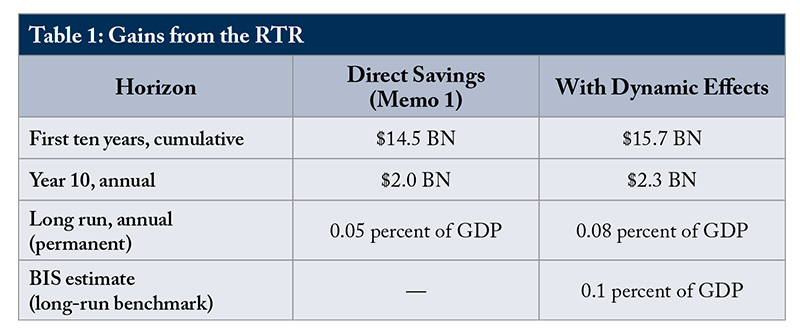
Rather than treating the RTR as a one-time shock, we feed productivity gains along the adoption path from our first Memo into the model year by year. Over the first 10 years, the gains add up to $15.7 billion, compared with $14.5 billion from direct savings alone, meaning the dynamic effects add an additional benefit of about 10 percent to the original estimate. By Year 10, the annual gain is equivalent to $2.3 billion, compared with our original direct savings estimate of $2 billion. The gain continues to build after adoption is complete, with a permanent annual gain of 0.08 percent of GDP, which sits just below the total gains estimated by the BIS study (0.1 percent). Table 1 reports the cumulative gains over 10 years and thereafter.
The permanent gain of 0.08 percent annually may still underestimate the total gains, considering that the RTR may foster additional payments innovation in Canada. For example, the RTR will evolve its functionality and system capabilities in the future, from Request to Pay (a digital request the payer can approve for instant payment), to debit pull (payments drawn with the payer’s standing authorization, as with pre-authorized debits today), to higher transaction value limits, to better cross-border connectivity. This may lead to higher cost savings and additional efficiency gains in the use cases that anchor yesterdays Memo.
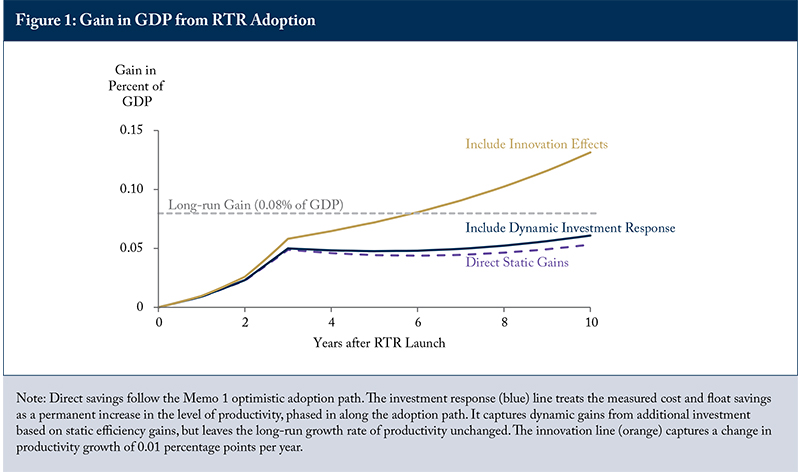
To give an impression of these potential additional gains without explicitly modeling specific new functionalities and capabilities, we let productivity growth increase by a one-hundredth of a percentage point each year for the first 10 years when the RTR is adopted. This almost doubles the cumulative 10-year gain from about $16 billion to $27 billion as shown in Figure 1. These additional productivity gains compound beyond the first decade as the economy responds to additional investment.
The gains we have highlighted in these Memos arise from a straightforward infrastructure investment. The resource-based cost savings and float reduction we discussed in the first Memo already made a strong case for introducing the RTR. But the potential dynamic effects we identify in this Memo make the RTR an essential building block for a more efficient and innovative Canadian economy.
Peter MacKenzie is a senior policy analyst at the C.D. Howe Institute, where Thorsten Koeppl, professor of economics and Robert McIntosh Fellow at Queen’s University, is a fellow-in-residence; and Jeremy M. Kronick is CEO.
To send a comment or leave feedback, email us at blog@cdhowe.org.
The views expressed here are those of the authors. The C.D. Howe Institute does not take corporate positions on policy matters.