




The Study In Brief
In response to the COVID-19 pandemic, the Bank of Canada has cut the overnight rate to 0.25 percent, the threshold it sees as the lower bound for its main policy instrument. At the lower bound, the Bank can no longer use its most direct tool to influence economic activity. The federal government has simultaneously engaged in unprecedented fiscal policy action, running record deficits to bridge households and businesses through the crisis. These deficits have added greatly to public debt, leading to questions as to the limits of future fiscal policy. As a result, the question of whether central banks should have a more direct way of delivering economic stimulus arises.
Broadly speaking, the Bank of Canada can go direct in two ways. One way is to transfer extra funds directly to the general public – often described as a “helicopter drop”: “cash” is printed and dropped onto people as transfers – a one-for-one, dollar-for-dollar combination of monetary policy and fiscal transfer.
Another option is through a standing facility at the Bank of Canada. In this case, the government could still make transfers to people, but their delivery would be called for and facilitated by the Bank, which would promise to accept any newly issued debt from the government to temporarily finance these transfers. The end result, however, theoretically would be the same as the “helicopter drop”: an increase in the money supply through direct transfers initiated and facilitated by the Bank. This would foster aggregate demand and, thus, inflation at the right time.
In our view, “going direct” would open the door to political interference with monetary policy, even under a well-designed system. Furthermore, it is not clear what the benefits would be relative to other monetary policy options, such as forward guidance, that promises to keep interest rates low for long, or quantitative easing that flattens the yield curve across different assets.
Inflation control is one of the biggest achievements of economic policy in Canada over the past quartercentury. The general public understands the job of the Bank of Canada. That might change fundamentally, however, if people receive a cheque in the mail from the government that they know has been enabled solely by the Bank of Canada’s balance sheet magic. In Canada, we have grabbed the tiger by the tail. Why involve politics once again if doing so risks the tail slipping away.
Introduction
In the wake of the COVID-19 pandemic, the Bank of Canada has cut the overnight rate to 0.25 percent, the threshold it sees as the lower bound for its main policy instrument. At this lower bound, the Bank is deprived of its most direct tool to influence economic activity.
At the same time, the federal government has engaged in unprecedented fiscal policy action, running record deficits to support private households and businesses. This has added greatly to public debt, with questions remaining as to whether this will limit future fiscal policy. These developments also raise the question of whether central banks should have a more direct way of delivering economic stimulus.
It is important, however, to distinguish between the two different lines of reasoning behind central banks’ engaging in direct stimulus. One line is that, as governments accumulate large debts, instead of having them sell that debt in markets, central banks can “print money” to finance them – an especially attractive option at the moment. Money, after all, is simply a cheap form of government debt, as it does not pay any interest, while central banks absorb the transfers on their balance sheets, theoretically easing restrictions on government finances.11 This argument also forms the primitive for the advocates of so-called Modern Monetary Theory. From traditional monetary theory, we know, however, that issuing money is not a free lunch. With a permanently increased money supply, inflation is likely to increase, which imposes an implicit tax on people who hold money. The argument might be thought of as printing money to pay off – or, better, inflate away – existing debt to gain more room for future debt. Proponents see this monetary financing as a way to relax solvency concerns for governments.
An entirely different line of reasoning focuses on the need for central banks to look at different policy instruments to achieve their mandated targets when they have no more room to stimulate economic activity with conventional interest rate policy. In this context, “printing money” and handing it to consumers is a fast and direct way – we refer to it in this Commentary as “going direct,” a term coined by Bartsch et. al. (2019) – to stimulate the economy temporarily in order to achieve the Bank of Canada’s traditional policy goal: the inflation target. This line of reasoning is the focus of this paper.
Broadly speaking, the Bank of Canada can go direct in two ways. One way is to transfer extra funds directly to the general public – often described as a “helicopter drop.”22 Milton Friedman (1969) first used this analogy; it was used again by Ben Bernanke when a member of the Board of Governors of the Federal Reserve System (see Bernanke 2016). The analogy is not too far fetched: in the near future, central banks might issue digital currency directly to people in the form of an account entry. The second way to go direct is through a standing facility, where the government issues debt directly to the central bank against funds that are then disbursed to the public. The reality is that, from an operational perspective, even in normal times the Bank of Canada is already involved in similar transactions. For example, it issues banknotes to financial institutions, which then distribute them to the general public on demand. It also acts as the government’s financial agent, making transfers on its behalf. And it purchases government debt through its regular open market operations. Hence, going direct can be thought of simply as a framework that formalizes the use of direct transfers by the central bank when interest rates have hit their lower bound.
Our assessment of this new policy tool is sobering. First, the Bank of Canada has other tools available, such as forward guidance and quantitative easing, that are likely to be deployed in the same scenarios as these direct transfers. While at the lower bound the trade-offs between output and inflation are muted, and direct transfers may offer some additional power to achieve the inflation target, the existing tools can mimic the effect of such transfers. Second, some advocates sell the tool as a way to fix fiscal policy that is either unwilling or too slow to employ transfers in crisis times. The recent experience from the pandemic, however, does not support such an argument. Third, even if the tool were to offer unique benefits and could be put into a well-designed framework of the kind we outline in this Commentary, it cannot overcome an old, well-known pitfall: good monetary policy is impossible if exposed to political influence.
The Idea
Central bankers have several tools with which to react to business cycle fluctuations. Traditionally, monetary policy controls short-term interest rates to influence aggregate demand. When demand and, consequently, inflation is too low, the Bank of Canada lowers the overnight rate to spur demand; symmetrically, when inflation is too high, it raises the rate to curb demand. Using textbook-like arguments, these changes in demand result in changes in inflation expectations and ultimately in stabilizing inflation, as required by the inflation-targeting framework. The effectiveness of this interest rate channel, however, might have diminished over the past decade. The principal reason is that the symmetry in conducting monetary policy is no longer a given when the overnight rate is close to its lower bound.33 This problem has been commonly labelled the “zero lower bound problem,” as nominal interest rates cannot theoretically fall below 0 percent, otherwise it would be cheaper to hold cash, which earns 0 percent interest. Due to other factors such as the convenience of non-cash holdings, the Bank of Canada has estimated the lower bound to be around –50 bps, where a bps is 1/100 of a percent (see Witmer and Yang 2016). Officially, however, the Bank has announced 0.25 percent as a floor for its interest policy. The new normal for the Canadian overnight rate since the Great Recession has been in the range of 1–2 percent,44 Carter, Chen, and Dorich (2019) estimate the nominal neutral rate – the long-run real rate plus inflation expectations (2 percent) – to be between 2.25 and 3.25 percent. The nominal neutral rate has fallen over the past couple of decades, partly because real interest rates have fallen over this time period (see, for example, Beaudry and Bergevin 2013). which might leave too little room for the Bank of Canada to cut interest rates in the face of a significant economic downturn, such as we have experienced with the COVID-19 pandemic.
Other instruments central banks can rely on to increase monetary policy’s firepower include forward guidance, quantitative easing, negative interest rates, and raising the inflation target.55 For an excellent overview of alternative monetary policy tools, see Gagnon and Collins (2019). Bernanke (2020) gives a wideranging overview of the effectiveness of such tools. Interestingly, he does not discuss or mention “going direct” as an option. All of these tools rely on the interest rate channel, but they have important limitations. Negative interest rates are intended to spur spending, but are hard to implement against the backlash of households facing a tax on savings. Quantitative easing aims to lower rates through purchases of debt – both sovereign and non-sovereign – or other financial assets on the secondary market.66 This interest rate channel of quantitative easing is but one channel through which this tool provides monetary stimulus. See the July 2020 Monetary Policy Report for more (Bank of Canada 2020). Such interventions, however, necessarily involve credit and operational risk. And raising the inflation target comes at the cost of higher average inflation and possibly destabilizing inflation expectations.
Enter “going direct.” At the heart of the proposal is that the central bank “prints money” that is put directly into the pockets of households via transfers. One option is to use the aforementioned “helicopter drop”: “cash” is printed and dropped onto people as transfers – a one-for-one, dollar-for-dollar combination of monetary policy and fiscal transfer. Of course, it is not the case that the central bank literally delivers cash to households. As we outline below, one option is for the bank to deposit money into household bank accounts at financial institutions.
Another option for “going direct” is through a standing facility at the Bank of Canada. In this case, the government could still make transfers to people, but their delivery would be called for and facilitated by the Bank, which would promise to accept any newly issued debt from the government to temporarily finance these transfers. The end result, however, theoretically would be the same as the “helicopter drop”: an increase in the money supply through direct transfers initiated and facilitated by the Bank. This would foster aggregate demand and, thus, inflation at the right time.
How “Going Direct” Would Work
The analogy of a helicopter drop formalizes the idea that a central bank can create “money” out of thin air. Cash issued by the Bank of Canada is ultimately a liability issued by the Government of Canada. As legal tender, it can be used in principle to pay one’s taxes. Although the Bank could simply print more cash and distribute it, it operates – like other financial institutions – under a balance sheet (see Box 1). Hence, any transaction by the Bank, including “going direct,” involves an operation linked to its balance sheet.77 Consider, for example, a commercial bank that borrows from the Bank of Canada. This typically involves a repurchase agreement (repo) transaction, where the Bank temporarily purchases a security from the commercial bank (an asset) and credits the amount paid to the commercial bank’s account (a liability).
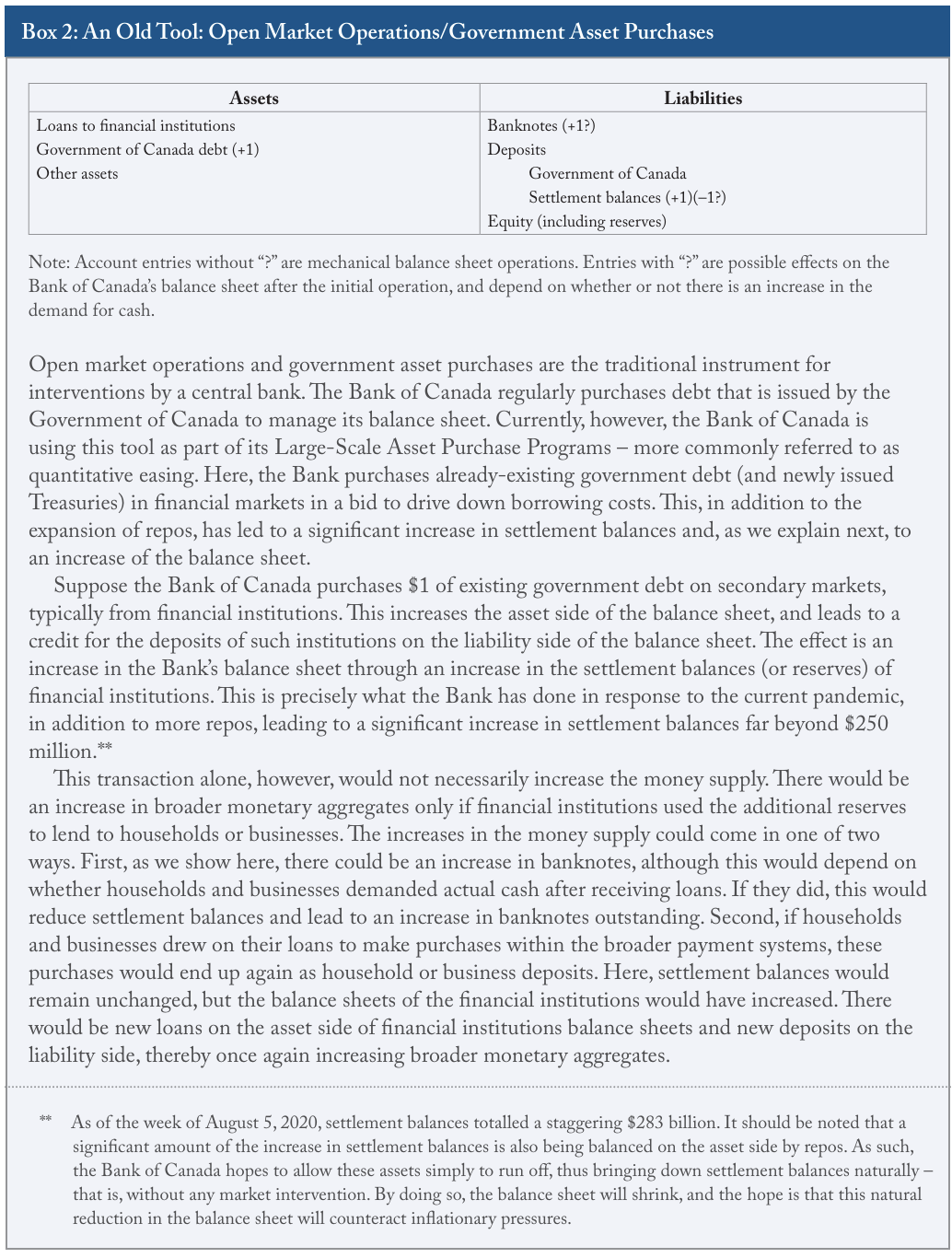
Consider two alternatives for “going direct” (see Boxes 3 and 4, with Box 2 describing standard open market operations). One has the Bank of Canada issuing transfers directly to households.88 Coincidentally, this would be operationally feasible if the Bank of Canada were to introduce central bank digital currency in the form of “accounts for all,” possibly implemented as segregated accounts at private financial institutions; see Box 3. What is new here is that such transfers would not involve any interaction with the federal government or with financial markets, as the Bank does currently with, for example, quantitative easing. The transfers would entail issuing a liability against the Bank’s equity,99 Historically, before the establishment of the Bank of Canada, private banks did precisely this when issuing banknotes. but a look at the Bank’s current balance sheet suggests that issuing such transfers would push its equity into negative territory. This would not really be a problem for the Bank, as its shares are fully owned by the Government of Canada. A negative equity position simply implies that the government has an implicit liability against the Bank.1010 For an excellent discussion, see Buiter (2008). As a Crown corporation, the Bank does not necessarily need a capital buffer, but a negative equity position might have ramifications for its independence, an important point we return to later.
The second alternative would see the Bank of Canada accept government debt directly from the federal government, and credit the government’s account on the liability side with extra balances. These balances can then be disbursed as transfers to households. What is new here is that – irrespective of who decides and how these transfers were made – the government would explicitly issue debt to the Bank of Canada, unlike quantitative easing, in which the Bank buys this debt in secondary markets.1111 Hence, the analogy of a helicopter drop of “money” is important here. The Bank of Canada would put “money” directly into people’s hands either against an explicit (debt) or implicit (reduced equity) claim against the government.

Here, Bartsch et al. (2019) have proposed setting up a standing facility on the asset side of the central bank’s balance sheet, under which the Bank could then decide to draw new debt from the government. Interestingly, the central bank would require the government to issue new debt outside financial markets when using the facility. The crucial difference is that the Bank, not households, would hold this debt. Hence, it would not be an asset swap on households’ balance sheet, but a net increase in their current wealth once transfers have been made.
Guiding Principles for Employing the Tool
We now look at guiding principles for implementing “going direct” in Canada in the context of the Bank of Canada’s inflation-targeting framework. We start by noting that the framework has been an unequivocal success story – see, for example, Parkin (2016). This is due to the independence of the Bank in making decisions and to the clear goal associated with monetary policy. Hence, any implementation of “going direct” should be seen in this context. We view three principles as being of first-order importance.
First, the Bank of Canada should be put in charge of “going direct” to minimize any influence from the government. As such, the decision to use the tool, which would have to be recognized as an option in the Bank of Canada Act, should be a decision solely taken by the Bank’s Governing Council. Any influence by the government would threaten the Bank’s independence. Of course, the Bank is not truly independent, in the sense that (i) its mandate can be revoked by the government per directive; (ii) the governor and the senior deputy governor are appointed formally by the government; and (iii) there is coordination between fiscal and monetary policy in difficult economic circumstances. In our view, however, far-ranging independence is critical to the long-run success of central bank policy; we return to this pivotal issue below.
Second, the threshold to employ “going direct” should be high, as it is meant to be a last resort when there is no more room for lowering interest rates. The onus should be on the Bank of Canada to argue that (i) more stimulus is required to meet the inflation target; (ii) using the tool is likely to help achieve the target; and (iii) using the tool is advantageous relative to other central bank tools that might still be available. Importantly, without a change in the Bank’s mandate, this would imply that the stimulus must help to bring inflation back within the range of the inflation target within the medium term. In our assessment of the tool, this is a key point to consider.
Third, the measure should be deployed in a transparent and accountable way. One way to do so is for the governor of the Bank of Canada to issue a formal letter to the minister of finance to initiate the move. The letter should specify why the Bank needs to use the tool, to what degree it will use it and what the circumstances are for exiting the measure. This would be significantly different from the Bank communicating an ordinary interest rate decision, and would commit the Bank to a significant degree to future policy actions.

The Design of “Going Direct”
Our proposed guidelines for “going direct” are meant to minimize political interference, but they leave open a wide range of design options for the Bank of Canada concerning the types of transfers and their size and duration.
Transfers could either be universal and uniform or they could target households with specific characteristics. The former is closer to the tradition of monetary policy in that the Bank of Canada has a clear objective – price stability – that affects the asset values of all Canadians, and has complex non-trivial implications for the distribution of income and wealth. In the case of “going direct,” a universal and uniform transfer would deliver a fixed payment into the hands of all households. The idea is that such a transfer would increase aggregate spending, although not all people might increase their spending equally, with some instead saving the transfer or using it to reduce their debt level.1212 This savings increase was a prominent feature of the 2001 tax rebates by the Bush administration in the United States (see, for example, Shapiro and Slemrod 2003). But ultimately, such transfers would be in the spirit of the traditional tool of changing the overnight interest rate and letting the monetary transmission mechanism – an increase in lending, that leads to an increase in spending – take its course.

To the contrary, a targeted payment for certain households would be more in the spirit of fiscal policy, and would deliver more bang for the buck. For example, the impact of a transfer could be higher for households that are constrained in their spending and, thus, have a higher propensity to consume additional income.1313 See, for example, Kaplan, Moll, and Violante (2018) for a model that has this prominent feature. Such targeted transfers, however, are problematic in this context. The Bank of Canada would be financing or even making direct transfers to specific subgroups of households, putting the Bank directly in the crossfire of political discussions.
Consequently, universal transfers would seem to be the better option to protect the Bank of Canada from politics.1414 An alternative would be to ask for coordination – on the measure and its size – between the Bank and the Department of Finance on how to deploy the funds (of course, outside the regular budget). The problem with this solution is that deployment decisions can be slow, and are often guided by political considerations rather than their economic impact – the exact thing “going direct” would aim to solve. And to shield the Bank further from political influence, the use of the facility should be defined under clear rules. First, the overall amount drawn from the facility by the Bank should depend on the circumstances (for example, how long and how far inflation is expected to miss its target) and should be calibrated to achieve the Bank’s objective of moving inflation back to target. Here, a basic principle stands out. In line with basic monetary theory, to affect inflation, the stimulus needs to involve a permanent increase in the growth of the money supply (see Ambler 2017). This implies that a one-time stimulus is unlikely to be sufficient, as rational households would be induced simply to save the additional funds received.
Second, the Bank of Canada should specify when access to the facility will stop. This should be linked to the Bank’s specific goal of achieving 2 percent inflation over the medium term. Hence, it would be reasonable to link exit from the use of the facility to moving inflation firmly back into the 1–3 percent range. Further, when exiting, it should be clear that any direct transfers that households received could not simply be undone by the Bank if the inflation-targeting mandate required a shrinking of the balance sheet. One option would be for the government to retire the standing facility – in other words, pay back the debt – by raising tax revenue or selling additional debt to households. Similarly, to reduce any negative equity position for the Bank, the government would have to inject capital, most likely in the form of newly issued debt.1515 As well, the Bank could, with agreement from the government, retain more seigniorage to reduce its negative equity position.
Third, the Bank of Canada should be required to review the need for the facility on a regular, relatively short-term basis – say, 6 or 12 months. Such a period would take into account any lags when employing the tool, and would allow the gathering of data on its effect on achieving the target, also in the context of other measures taken simultaneously by the Bank or the government.
Should “Going Direct” Be Part of the Bank of Canada’s Toolbox?
“Going direct” is meant as a monetary policy tool of last resort at the lower bound for the overnight rate. It likely would be employed only in extraordinary circumstances – such as the financial crisis of 2007–09 or the current COVID-19 pandemic. In such circumstances, once the lower bound has been hit, monetary policy will always resort first to emergency measures such as liquidity provision and asset purchases, through, for example, quantitative easing. Hence, “going direct” is unlikely to be used in the context of dealing with the immediate impact of a crisis or severe recession, but only during the stage when recovery is slow and inflation remains “too low” – in other words, if the Bank of Canada were unable to achieve its inflation target. The question remains: would “going direct’ be effective in stimulating a recovery?
Any argument in favour of this policy tool relies on the exploitation by these monetary transfers of the basic Phillips curve trade-off: monetized fiscal policy (through helicopter money or the standing facility) increases inflation, with the potential benefit of higher demand, larger output and lower unemployment. It is far from clear, however, how strong this relationship is, especially when we are at the zero lower bound (see Ng, Wessel, and Sheiner 2018). Current and past experience with larger central bank balance sheets shows that reserves – or settlement balances in the Canadian context – increase with little or no effect on broader monetary aggregates or demand – as was the case in the United States with the Federal Reserve after the financial crisis.
Some “going direct” advocates (see, for example, Bartsch et al. 2019) see the tool as a replacement for fiscal stimulus in the form of government spending or tax cuts. This argument is based on the idea that the main challenge of discretionary fiscal stimulus is that the political process prevents or slows down its delivery, and it is often not clear where and how it is best placed. In the current pandemic, however, many governments have resorted to significant and swift actions.1616 Automatic stabilizers are another way to deliver fast and direct stimulus in case of a severe and prolonged downturn. Hence, an alternative to “going direct” would be to employ more and better designed stabilizers. Examples are unemployment insurance and the use of wage subsidies along the German model of Kurzarbeit (see also footnote 18). Furthermore, Carter and Mendes (2020) have shown that a combination of quantitative easing and forward guidance can approximate the effects of direct transfers to households. If so, one can rely on the existing toolkit.
A subtler argument is that “going direct” through the standing facility would provide an indirect wealth effect. Financing government transfers through increased settlement balances can lower interest rates for governments, which thus reduces increases in future taxes. But current yield curves are so flat that the effect on government budget constraints is very small. Furthermore, quantitative easing already provides a channel to deliver cheaper interest rates for all economic actors – private and public households alike – across the yield curve.
The biggest problem for the tool, however, is that it could put the Bank of Canada in a nowin situation once it has been deployed. What if inflation stayed stubbornly low? There would be pressure from the government and the general public to keep the facility open and even expand it. Although some might argue that this is exactly what would be necessary to achieve the inflation target, it would feel like the situation in Japan or Europe, where monetary policy pushes indefinitely on a string: the balance sheet expands, at least in the case of the standing facility, with little or no effect on real activity.
What about the opposite situation, where inflation took off? Think about stagnant demand and a negative supply side shock, from, for example, broken supply chains that disrupt productivity. The Bank of Canada would be required under inflation targeting eventually to normalize its policy. This would mean a stop to the program, but possibly also to a normalization of its balance sheet. As discussed earlier, that ultimately would mean a sell-off of government debt to households combined with an increase in interest rates. This would raise the possibility of panic, as was the experience in the United States with the Fed’s efforts to normalize its balance sheet during the so-called Taper Tantrum in 2013. Interest rates rose sharply, stirred by fears that prices on debt would fall significantly when the Fed started to shrink its balance sheet. For the Bank of Canada, this could lead to significant losses as the prices on debt fell, leaving the Bank with a sizable negative equity position and endangering its operational independence.1717 The government could also force a write-down of the facility, once again leading to losses and negative equity for the Bank.
In either direction, there likely would be immense pressure on the Bank of Canada to continue the policy. Although pressure from government might be controlled through a welldesigned framework, one cannot be sure that the general public would accept putting a stop to “going direct.” After all, was the Bank not able to make or facilitate direct transfers to people? Why could it not continue with this magic permanently? Controlling interest rates is one thing, putting money directly into people’s pockets is another.
It is, therefore, not clear to us how such an exit strategy would be best designed, although, at a minimum, it would need to be tied to certain performance measures – the inflation target, certainly, and perhaps some measure of real activity. Along with the plan would come the additional challenge for the Bank of Canada to communicate its strategy clearly. Moreover, the challenge would go far beyond the traditional strategy of issuing a statement, holding a press conference or issuing a monetary policy report to accompany any regular interest rate decision. It would endanger the reputation of the Bank unless it commits clearly and unequivocally to its policy actions. At its core, then, “going direct” would expose the Bank to more pressure from public opinion and financial markets than other, conventional or unconventional, tools in its toolbox.
The Tale of a Tiger
In our view, “going direct” would open the door to political interference with monetary policy, even under a well-designed system. Furthermore, it is not clear what the benefits would be relative to other monetary policy options, such as forward guidance, that promises to keep interest rates low for long, or quantitative easing that flattens the yield curve across different assets.
A better approach would be to unleash the potential power of fiscal policy through, for example, the design of better automatic stabilizers1818 Automatic stabilizers are adjustments to taxes and government transfers that occur without explicit government action. They are meant to stabilize fluctuations in GDP. For example, most countries have progressive income taxes, and as such, when household incomes fall in recessions, people pay lower taxes. (see, for example, McKay and Reis 2016). The COVID-19 pandemic has shown that countries with such stabilizers and sufficient fiscal room can move very quickly, with large stimulus packages and in a more direct way than they can with monetary policy.
Inflation control is one of the biggest achievements of economic policy in Canada over the past quarter-century. The general public understands the job of the Bank of Canada. That might change fundamentally, however, if people receive a cheque in the mail from the government that they know has been enabled solely by the Bank of Canada’s balance sheet magic. In Canada, we have grabbed the tiger by the tail. Why involve politics once again if doing so risks the tail slipping away.
References
Ambler, S. 2017. “How to Make Monetary Policy More Effective.” Mimeo.
Bank of Canada. 2020. “Monetary Policy Report.” Bank of Canada. July.
Bartsch, E., J. Boivin, P. Hildebrand, and S. Fischer. 2019. “Dealing with the Next Downturn: From Unconventional Monetary Policy to Unprecedented Policy Coordination.” SUERF Policy Note 105. Vienna: Société Universitaire Européenne de Recherches Financières.
Beaudry, P., and P. Bergevin. 2013. “The New ‘Normal’ for Interest Rates in Canada: The Implications of Long-Term Shifts in Global Saving and Investment.” E-Brief 156. Toronto: C.D. Howe Institute.
Bernanke, B. 2016. “What tools does the Fed have left? Part 3: Helicopter Money.” Brookings Blog, April 11, 2016. Online at https://www.brookings.edu/blog/ben-bernanke/2016/04/11/what-tools-doesthe-fed-have-left-part-3-helicopter-money/.
__________. 2020. “The New Tools of Monetary Policy.” American Economic Review 110 (4): 943–83.
Buiter, W. 2008. “Can Central Banks Go Broke?” CEPR Policy Insight 24. Washington, DC: Center for Economic Policy Research.
Carter, T., X. Chen, and J. Dorich. 2019. “The Neutral Rate in Canada: 2019 Update.” Staff Analytical Note 2019-11. Ottawa: Bank of Canada.
Carter, T. And Mendes, R. (2020), “The Power of Helicopter Money Revisited: A New Keynesian Perspective”, Staff Discussion Paper 2020-01, Bank of Canada.
Friedman, M. 1969. The Optimum Quantity of Money and Other Essays. Chicago: Aldine.
Gagnon, J., and C. Collins. 2019. “Are Central Banks Out of Ammunition to Fight a Recession? Not Quite.” Policy Brief 19-18, Washington, DC: Peterson Institute for International Economics.
Jakab, Z., and M. Kumhof. 2015. “Banks Are Not Intermediaries of Loanable Funds – and Why This Matters.” Staff Working Paper 529. London: Bank of England.
__________. 2018. “Banks Are Not Intermediaries of Loanable Funds – Facts, Theory and Evidence.” Staff Working Paper 761. London: Bank of England.
Kaplan, G., B. Moll, and G. Violante. 2018. “Monetary Policy According to HANK.” American Economic Review 108 (3): 697–743.
McKay, A., and R. Reis. 2016. “Optimal Automatic Stabilizers.” NBER Working Paper 22359. Cambridge, MA: National Bureau of Economic Research.
Ng, M., D. Wessel, and L. Sheiner. 2018. “What is the Phillips Curve?” Brookings Blog, August 21. Online at https://www.brookings.edu/blog/upfront/2018/08/21/the-hutchins-center-explainsthe-phillips-curve/.
Parkin, M. 2016. “Mounting Evidence: Findings from Natural Experiments in Inflation Targeting.” E-Brief. Toronto: C.D. Howe Institute. March 31.
Shapiro, M.D., and J. Slemrod. 2003. “Did the 2001 Tax Rebate Stimulate Spending? Evidence from Taxpayer Surveys.” Tax Policy and the Economy 17: 83–109.
Witmer, J., and J. Yang. 2016. “Estimating Canada’s Effective Lower Bound.” Bank of Canada Review (Spring): 3–14