





From: Don Drummond
Re: The Ontario Labour Market is Faring Poorly Under Trump Tariffs
While there have been many twists and turns since, the tariffs are largely against manufacturing exports with steel, aluminum and automobiles hit particularly hard.
As steel, automobiles and manufacturing more broadly are all concentrated in Ontario it would be expected that its economy would underperform national totals.
And in fact, with the release last week of the January Labour Force Survey from Statistics Canada, we can now see how it’s going.
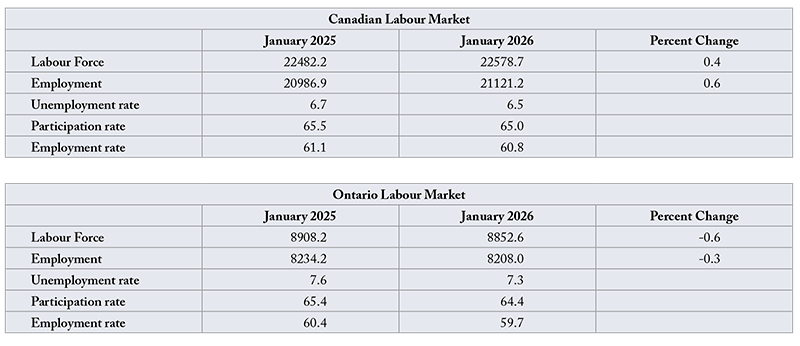
Over the past 12 months the Canadian labour market recorded a modest 0.6 percent employment increase. An even smaller percentage gain in the labour force edged the unemployment rate down from 6.7 to 6.5 percent.
The Ontario labour market fared much worse: A 0.3 percent decline in employment, a loss of 26,200 jobs. An even larger drop in the labour force at 0.6 percent brought the unemployment rate down slightly from 7.6 to 7.3 percent. (The unemployment rate is a misleading indicator since it falls as people stop looking for work, which masks actual job losses.)
Labour force results are also weak due to slower growth in the population, mostly due to lower immigration, and declines in the labour force participation rate, particularly in Ontario where it declined one percentage point, double the drop across Canada. This is likely due to workers dropping out over discouragement about job prospects.
Ontario’s underperformance relative to the Canadian labour market from January 2025 to January 2026 perpetuates a pattern building since 2023.
As shown in the table below, in 2023 Ontario’s employment rate was slightly lower than the national number and the unemployment rate was higher. Since then, Ontario has significantly underperformed the rest of the country in both measures.

The result leaves the province with the second highest unemployment rate in the country, behind only Newfoundland & Labrador.
In conclusion, Ontario’s labour market has been hit particularly hard by Mr. Trump’s tariffs, but its relative underperformance since then only perpetuates a four-year trend.
Don Drummond is a Fellow-in-Residence at the C.D. Howe Institute and Stauffer-Dunning Fellow at Queen’s University.
To send a comment or leave feedback, email us at blog@cdhowe.org.
The views expressed here are those of the author. The C.D. Howe Institute does not take corporate positions on policy matters.