


From: Tammy Schirle
To: Old Age Security watchers
Date: October 23, 2026
Re: Rethinking the First Pillar of Canada's Retirement Income System
For several decades, Canadians have failed to advance discussions on how to improve the Old Age Security Act, which defines policy for monthly pensions (Old Age Security) and supplements (including the Guaranteed Income Supplement) for older Canadians. It represents the first pillar of our retirement system, and one of Ottawa’s largest spending items; $88 billion this year. Why are we failing to make meaningful progress? Is there a better way to approach this conversation?
We can start by acknowledging there are really two distinct objectives Canadians hope to achieve with OAS Act. First, they want to recognize the past and current contributions of seniors to society. Second, Canadians want to alleviate poverty among seniors and ensure they are able to achieve a reasonable standard of living. With two distinct policy objectives in hand, it is often considered wise to have two distinct policy instruments to work with. Our first pillar, however, is really designed to function as one large program, with several interdependent components.
Some background is useful. Canada introduced our first Old Age Pension in 1927. As a means-tested benefit available to individuals age 70 or older, with much shorter lifespans in those years, only a few were eligible. The benefits were also quite modest, up to $240 annually (or $4,481 in today’s dollars). In 1952, Canada introduced Old Age Security (OAS), and since 1967 is has extended the near-universal OAS and the income-tested Guaranteed Income Supplement (GIS) to people age 65 or older. In 1975, the program expanded further, creating an allowance for some married people age 60-64 (with the older spouse 65 and older) and again in 1985 to widows and widowers age 60-64. Over time benefit generosity also increased. By the summer of 2026, an unmarried 65-year-old could expect to receive up to $22,508 in OAS and GIS benefits.
This expansion of benefit eligibility and generosity has driven remarkable reductions in senior poverty rates (which I discuss here). At only 5.5 percent (in 2023, based on our official poverty measure), this is clearly a Canadian success story. Our senior poverty rates are very low, by historical and international standards.
But it is costly. In 2026, we are spending roughly $88.8 billion on the OAS suite of programs. We also spend several billion dollars on various tax expenditures with similar goals: $5.6 billion on the age credit, $1.4 billion on the pension income credit, and another $2.1 billion on pension income splitting. I have the impression that most Canadians want our low-senior-poverty success story to continue, but as younger people find today's labour and housing markets incredibly challenging, we'd also like to make sure we are using our available tax dollars effectively.
To think about what we might do differently, we should review what we do. On the surface, OAS and GIS seem simple – we offer a lump sum benefit to most people age 65 and over, and add in a supplement to support those who are low income. But how much do people actually get? It gets complicated fairly quickly, with eligibility depending on marital status, age, individual and family incomes, the sources of income, the length of time one has lived in Canada, and more. For the purpose of illustrating some basic features affecting most older Canadians, I'm going to focus on an example of a 65-year-old unmarried individual.
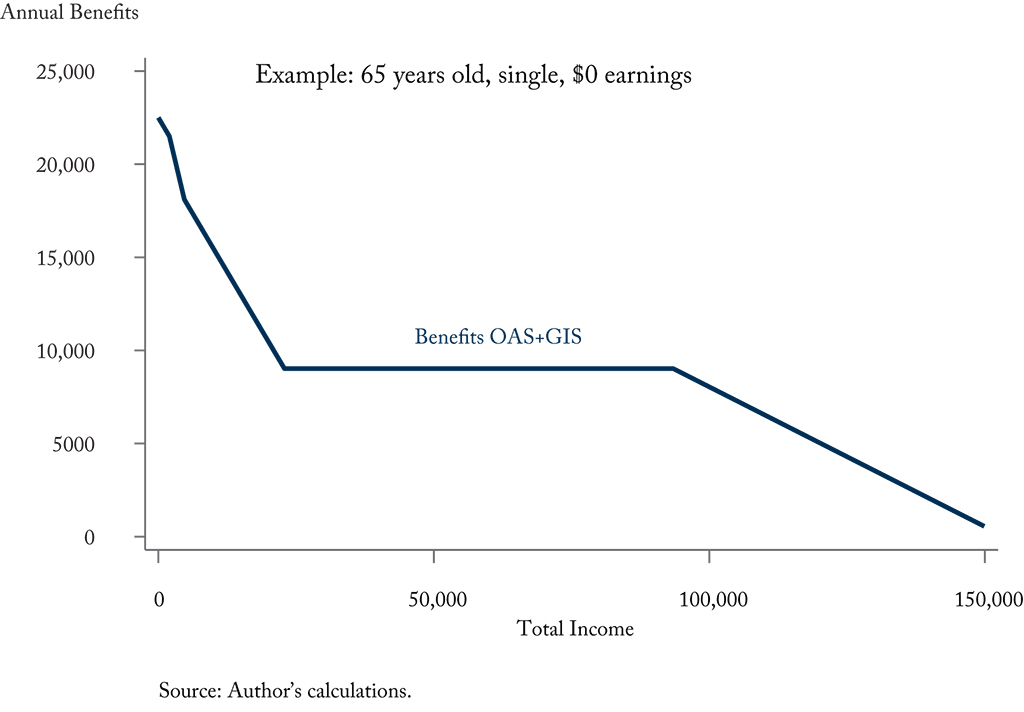
In this figure, I show the maximum annual benefit for which a 65-year-old single person could be eligible. If they have no taxable income, they can receive nearly $23,000 from OAS and GIS. This is made up of three parts – the OAS flat benefit, the main GIS, and a top-up GIS available to the lowest-income seniors. The line shows how benefits fall as total income increases
The steepness of the line shows the programs’ contributions to marginal effective tax rates; how much gets taxed back via benefit reductions for every extra dollar earned. For the lowest-income seniors, the GIS (top-up and regular benefit combined) is quickly reduced by 75 cents for every dollar of income received. Regular GIS benefits are reduced by 50 cents for every dollar of income. (Note that GIS allows seniors to earn some employment income before clawing back benefits.)
This single 65-year-old is completely phased out of the GIS when their income reaches $22,800. They receive the full OAS pension, however, until their income is over $93,454. Above that, benefits are reduced by 15 cents for every dollar of income.
There are many ways we could more effectively use the billions of dollars spent on our first pillar programs. For several decades I have seen proposals to take the resources we currently use to build a single program that better targets low-income seniors. This typically involves eliminating the near-universal component (OAS) and using those funds to create a more generous supplement – by increasing the maximum benefit and by decreasing the benefit reduction rate, so that more people receive the benefits as a supplement.
This seems sensible to many people, so why are proposals like this rejected?
First, I think people are incredibly resistant to change because nearly everyone knows someone who relies on this system. I expect any suggestion to simply eliminate OAS will be met with fierce opposition.
Second, I contend that poverty alleviation is not the only goal. So too is ensuring the sustainability of our social contract across generations with a recognition of everyone's contributions to society. OAS/GIS are part of our social contract, whereby younger people agree to support those who are older, with an expectation the next generation will do the same for them. Older individuals often want their past and current contributions – in their jobs, their family, and with their community – to be recognized. To me, this means we can’t eliminate the near-universal component of the program.
But perhaps we can change how we do things. Perhaps we can recognize there exist two distinct goals, and formulate two distinct programs to address them.
Tammy Schirle is a Professor of Economics at Wilfrid Laurier University, and is a C.D. Howe Institute Research Fellow.
To send a comment or leave feedback, email us at blog@cdhowe.org.
The views expressed here are those of the author. The C.D. Howe Institute does not take corporate positions on policy matters.