


From: Tingting Zhang
To: Healthcare observers
Date: November 11, 2026
Re: More Doctors; Higher Attachment Rate: Is that enough?
In 2025, Canada achieved something remarkable: The highest annual growth in the number of family physicians since 2019. Excluding Ontario, for which data were not available in the recent release, the provinces added 993 family physicians, up from 924 in 2024. The share of Canadians with a regular health provider also increased by 0.8 percentage points. Nationally, this represents a step in the right direction and we should celebrate.
However, three important caveats merit attention: National averages mask significant provincial differences; higher patient attachment rates do not necessarily translate into patient access to care; and an increase in the number of family physicians does not automatically mean greater primary care capacity.
First, not all provinces are seeing growth in physician supply or improvements in attachment rates. Saskatchewan and New Brunswick, for example, experienced declines in the number of family physicians (see the Figure). As a result, Saskatchewan’s attachment rate remained unchanged, while New Brunswick’s fell. Quebec also saw a declining attachment rate because its population grew faster than the number of family physicians, which grew only marginally at 0.3 percent. That’s the lowest growth, compared with 2.7 percent to 7.6 percent in other provinces.
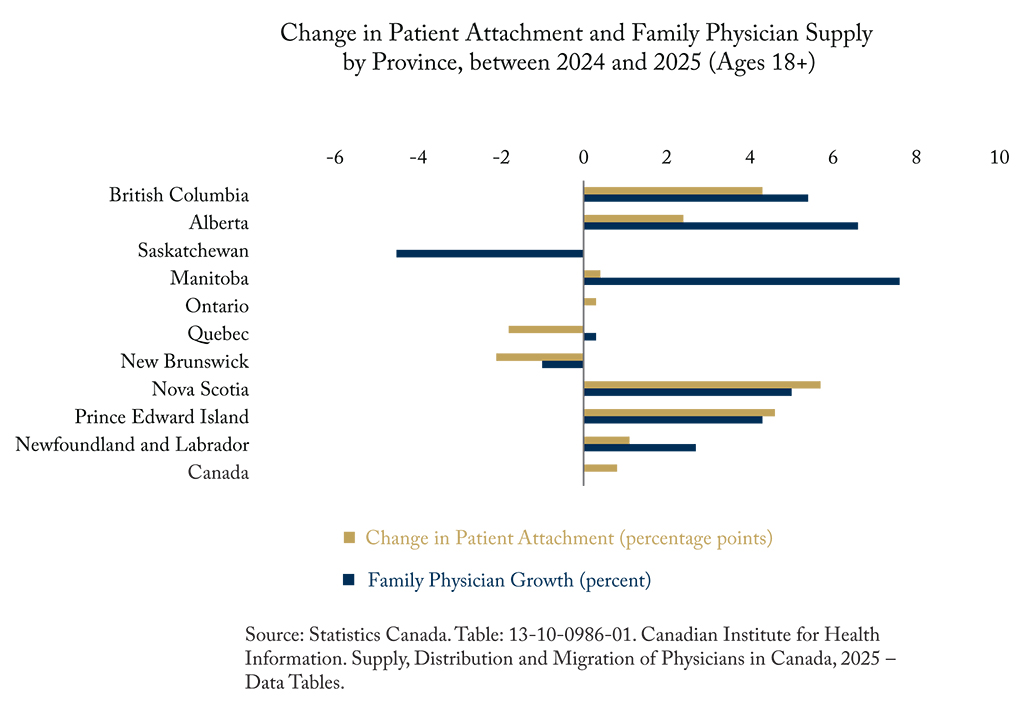
Second, attachment doesn’t guarantee access to care, and a larger workforce doesn’t translate into more care. Roughly three in four Canadians still cannot see their health provider the same day or the next. As a result, too many go to the emergency room instead. In 2024-2025, 14 percent of emergency visits were for conditions that could be managed in primary care. Having a doctor on paper isn’t the same as getting care when you’re sick.
Third, headcount doesn’t equate to capacity. In 2013, the average family physician saw 1,746 patients per year, and by 2021 that number had dropped to 1,353, a 22-percent decline. New doctors tend to work fewer hours, maintain smaller patient pools, and prioritize work-life balance, unlike earlier generations. Therefore, even when physician headcount grows, effective clinical capacity may stagnate or shrink. This is especially concerning in Quebec and New Brunswick, where physicians aged 60 and older outnumber those under 40.
Moreover, many of the new family doctors are not practising family medicine at all. Nearly 30 percent of family physicians now practise in specialty care such as psychiatry rather than in full-scope family medicine. A recent analysis found that nearly 40 percent of family physician workforce growth over the last two decades was concentrated in focused practice areas: Emergency care, hospitalist medicine, and addiction services. These physicians count in workforce statistics but don’t improve primary care access. They staff emergency departments and hospitals rather than accepting patients and providing longitudinal care.
Why are doctors doing less and leaving the profession? The 2025 Commonwealth Fund survey of primary care physicians in 10 countries found that two in five Canadian family doctors reported burnout, second only to the United States. Nearly half cited administrative work, including documenting visits. Only 14 percent of burned-out Canadian doctors attributed their distress to having too many patients or managing complex conditions – the lowest rate among comparator countries. Our family doctors aren’t drowning in patients. They’re drowning in paperwork. This is what makes family medicine increasingly unattractive to young graduates and pushes experienced physicians toward focused practice or early retirement.
What to do?
Provinces should focus on three priorities: Reducing administrative burdens, strengthening team-based care, and improving accountability and transparency.
First, they need to support family practices in adopting AI-powered clinical scribes and help clinics still using paper records or outdated systems modernize their technology. They also need to simplify processes, including insurance forms and billing procedures, to further reduce administrative burdens and free physicians’ time for patient care.
Second, strengthen team-based care by adopting compensation models that better support team-based care delivery, clearly defining the roles of nurse practitioners and pharmacists, and addressing governance and accountability barriers. Teams should be designed to ease physicians’ workloads rather than add additional coordination responsibilities. Their performance should also be evaluated based on patient-reported outcomes, including timely access to care, care coordination, prevention and health promotion, and support for managing chronic conditions.
Ontario demonstrates the risks of expanding team capacity without adequately measuring improvements in access. The province has committed a four-year investment of $3.4 billion to primary care, supporting 130 new and expanded primary care teams, more than any other province. Yet the share of Ontarians with a regular healthcare provider rose by only 0.3 percentage points between 2024 and 2025, seventh among the provinces. Where did the money go? Taxpayers need greater transparency about how the funds were used, what results they achieved, and whether the investment has meaningfully improved access to care.
Third, measure what matters. Provincial governments need to establish clear performance measurement frameworks with accountability metrics, ensure that providers and health organizations meet their commitments, and implement corrective measures when results fall short of expectations. In addition to tracking how many people are attached to a regular healthcare provider, provinces should publicly report on how quickly patients can access care and whether avoidable emergency department visits are declining.
Adding nearly 1,000 new family doctors is worth celebrating. But if they spend their evenings on paperwork and increasingly move away from longitudinal family practice, Canada will have bought itself a bigger workforce and the same waiting room. Hiring more doctors into a broken system only produces more frustrated doctors serving fewer patients. Fix the system first.
Tingting Zhang is a policy analyst at the C.D. Howe Institute.
To send a comment or leave feedback, email us at blog@cdhowe.org.
The views expressed here are those of the author. The C.D. Howe Institute does not take corporate positions on policy matters.