



C.D. Howe Institute Monetary Policy Council Says Bank of Canada Should Hold Overnight Rate at 0.50 for Next 12 Months
July 7, 2016 — The C.D. Howe Institute’s Monetary Policy Council (MPC) today called for the Bank of Canada to keep its target for the overnight rate, the very short-term interest rate it targets for monetary policy purposes, at 0.50 percent at its next announcement on July 13, 2016. Looking ahead, the Council said the Bank should hold the target at 0.50 percent over the next 12 months.
The MPC provides an independent assessment of monetary stance consistent with the Bank of Canada’s 2 percent inflation target. William Robson, the Institute’s President and CEO, chairs the Council.
Council members make recommendations for the Bank of Canada’s upcoming interest-rate announcement, the subsequent…
Peter Jarrett – The OECD’s Economic Survey of Canada: Boosting Productivity and Inclusiveness
 From: Peter Jarrett To: All Canadians Date: June 15, 2016 Re: The OECD’s Economic Survey of Canada: Boosting Productivity and Inclusiveness In its latest Economic Survey, the Organisation for Economic Cooperation and Development (OECD) is optimistic about the short-term outlook for sustained economic growth with low inflation in Canada but is concerned about the financial […]
 C.D. Howe Institute Monetary Policy Council Calls for Bank of Canada to Hold Overnight Rate at 0.50 for the next year
May 19, 2016 — The C.D. Howe Institute’s Monetary Policy Council (MPC) today recommended that the Bank of Canada keep its target for the overnight rate, the very short-term interest rate it targets for monetary policy purposes, at 0.50 percent at its next announcement on May 25, 2016. Looking ahead, the Council called for the Bank to hold the target at 0.50 percent over the next 12 months.
The MPC provides an independent assessment of monetary stance consistent with the Bank of Canada’s 2 percent inflation target. William Robson, the Institute’s President and CEO, chairs the Council.
Council members make recommendations for the Bank of Canada’s upcoming interest-rate announcement, the subsequent…
The long-term growth challenge- Many questions, few easy answers: Globe and Mail Op-Ed
The Canadian economy faces serious growth headwinds over the next few decades, and policy makers across the country should be thinking hard about how to improve growth. Many policy options will likely be considered, but finance ministers will soon find that there are no quick fixes. Economic growth is a complex process.
The broadest measure of average income is per capita gross domestic product (GDP), which is simply the overall national income divided by the number of people. Over long periods of time, this measure grows for two reasons: improvements in labour productivity and increases in the labour force participation rate.
Since 1970, per capita GDP in Canada has increased at an average rate of 1.3 per cent a year –…
C.D. Howe Institute Monetary Policy Council Calls for Bank of Canada to Hold Overnight Rate at 0.50 through 2016; Looks for 0.75 Percent by April 2017
April 7, 2016 — The C.D. Howe Institute’s Monetary Policy Council (MPC) today recommended that the Bank of Canada keep its target for the overnight rate, the very short-term interest rate it targets for monetary policy purposes, at 0.50 percent at its next announcement on April 13, 2016. Looking ahead, the Council called for the Bank to hold the target at 0.50 percent through the end of the year, raising it to 0.75 percent by April 2017.
The MPC provides an independent assessment of monetary stance consistent with the Bank of Canada’s 2 percent inflation target. William Robson, the Institute’s President and CEO, chairs the Council.
Council members make recommendations for the Bank of Canada’s upcoming…
C.D. Howe Institute Monetary Policy Council Calls for Bank of Canada to Hold Overnight Rate at 0.50 Percent until mid-2016; Hike to 0.75 Percent by next November
November 26, 2015 — The C.D. Howe Institute’s Monetary Policy Council (MPC) today recommended that the Bank of Canada keep its target for the overnight rate, the very short-term interest rate it targets for monetary policy purposes, at 0.50 percent at its next announcement on December 2, 2015. Looking ahead, the Council called for the Bank to hold the target at 0.50 percent until May 2016 and hike it to 0.75 percent by November 2016.
The MPC provides an independent assessment of the monetary stance appropriate for the Bank of Canada as it pursues its 2 percent inflation target. William Robson, the Institute’s President and Chief Executive Officer, chairs the Council.
Council members make recommendations for…
C.D. Howe Institute Monetary Policy Council Calls for Bank of Canada to Hold Overnight Rate at 0.50 Percent through Mid-Year; Hike to 0.75 Percent by October 2016
October 15, 2015 — The C.D. Howe Institute’s Monetary Policy Council (MPC) today recommended that the Bank of Canada keep its target for the overnight rate, the very short-term interest rate it targets for monetary policy purposes, at 0.50 percent at its next announcement on October 21, 2015. Looking ahead, the Council called for the Bank to hold the target at 0.50 percent through to April of 2016 and hike it to 0.75 percent by October of 2016.
The MPC provides an independent assessment of the monetary stance appropriate for the Bank of Canada as it pursues its 2 percent inflation target. William Robson, the Institute’s President and Chief Executive Officer, chairs the Council.
Council members make…
Drop in loonie poses threat to productivity: Globe and Mail Op-Ed
By Craig Alexander
The precipitous decline in the Canadian dollar has come as a shock to many businesses. Only a few years ago, forecasters were telling them to come to terms with a currency at par for the foreseeable future. Now, the Canadian dollar is worth close to 75 cents (U.S.) and could fall further. This is welcome news for the near-term economic outlook – the benefits to exporters will exceed the cost to importers, boosting economic growth. This demonstrates the value of Canada’s flexible exchange rate regime that acts as a buffer when economic shocks occur, such as the recent tumble in commodity prices. However, there is a potential dark side to a sustained low-valued loonie, as it can erode productivity and dampen…
C.D. Howe Institute Monetary Policy Council Calls for Bank of Canada to Hold Overnight Rate at 0.50 Percent through Mid-Year; Hike to 0.75 Percent by September 2016
September 3, 2015 — The C.D. Howe Institute’s Monetary Policy Council (MPC) today recommended that the Bank of Canada keep its target for the overnight rate, the very short-term interest rate it targets for monetary policy purposes, at 0.50 percent at its next announcement on September 9, 2015. Looking ahead, the Council called for the Bank to hold the target at 0.50 percent through to March of 2016 and hike it to 0.75 percent by September of 2016.
The MPC provides an independent assessment of the monetary stance appropriate for the Bank of Canada as it pursues its 2 percent inflation target. William Robson, the Institute’s President and Chief Executive Officer, chairs the Council.
Council members make…
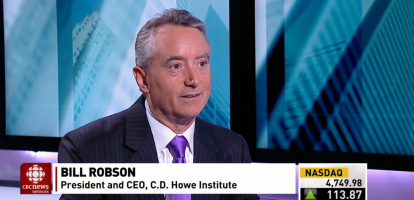
Bill Robson: Best Policy Response to the Recession?
Stephen Gordon: Canada Is Not In A Recession, And That’s A Bad Thing: National Post Op-ed
By Stephen Gordon
Most people probably think of the debate over whether Canada is in a recession as one of those glass-half-full versus glass-half-empty things. Pessimists look at five months of declining GDP and call it a “recession,” while optimists look at increasing employment and say that we’re not in a recession. Yet, the real pessimists are the ones saying we’re not in recession.
Making the case that we’re in a recession is basically optimistic: the problems we’re currently experiencing in the economy will be over soon (if it’s not already) and all that is needed it for policymakers to employ the usual array of countercyclical policies. The “no recession” camp is the home of the pessimists: saying that we’re not in…
Is Canada in recession? These numbers suggest not: Globe and Mail Op-Ed
By Steve Ambler and Jeremy Kronick
Statistics Canada’s release of preliminary merchandise trade figures for June may provide some closure to the debate on Canada’s so-called recession. After a 4-per-cent fall in export volumes over the first five months of 2015, Canada’s sales to foreigners came roaring back, with a 4.8-per-cent increase in June alone. Imports also decreased in volume by 0.9 per cent from May to June.
Overall Canadian economic growth in the first quarter of 2015, as well as the first two months of the second quarter, was negative. The decline in the value of the Canadian dollar in the wake of falling world oil prices had been expected to boost the growth of most other exports, but until June, the…