



Graph of the Week: Rising Unemployment Challenges Newcomers in a Changing Canadian Economy
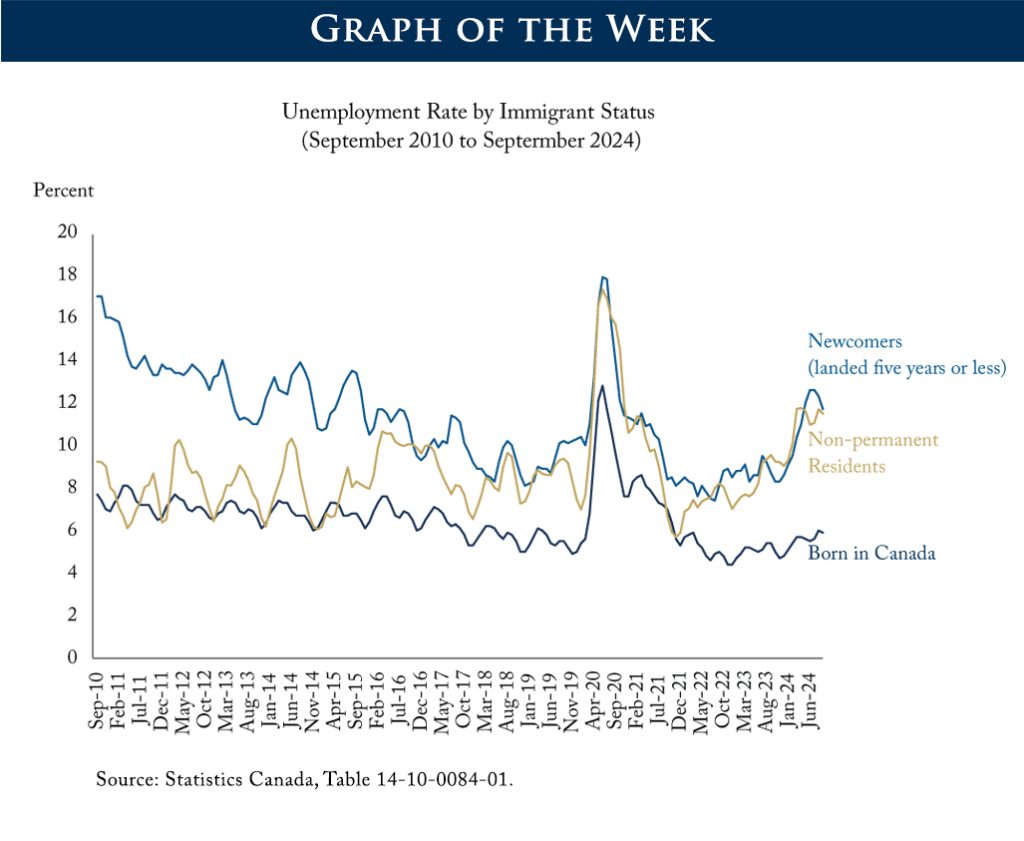 During the 2010s, the unemployment rate gap between newcomers and Canadian-born individuals narrowed, largely due to changes in immigration policies, such as the introduction of the Express Entry system. This trend continued in 2021 and 2022 as labour market conditions tightened. However, newcomers and non-permanent residents are now experiencing a sharp rise in unemployment, bearing […]
Daniel Hiebert – Immigration and a Population Strategy for Canada (Part 2, The Regions)
 From: Daniel Hiebert To: Immigration observers Date: October 25, 2024 Re: Immigration and a Population Strategy for Canada (Part 2, The Regions) Canada’s population is growing, but unevenly. Broadly speaking, we can divide the country into fast- and slow-growing regions. Ontario, Alberta, British Columbia, and the Territories make up ‘fast’ Canada, while the other Prairie provinces, Québec, and Atlantic […]
Daniel Hiebert – Immigration and a Population Strategy for Canada (Part 1)
 From: Daniel Hiebert To: Concerned Canadians Date: October 24, 2024 Re: Immigration and a Population Strategy for Canada (Part 1) Canada established one of the world’s first managed migration systems more than half a century ago when it invented points-based economic selection. Since then, legislation has mandated that immigration policy be designed to facilitate a number […]
Mahboubi, Robson – Demography is Destiny, and Canada’s Picture Isn’t Pretty
 From: Parisa Mahboubi and William B.P. RobsonTo: Canadians, young and oldDate: September 26, 2024Re: Demography is Destiny, and Canada’s Picture Isn’t Pretty Canada is facing a demographic shift that will put immense strain on our healthcare system and public finances. We currently have about three working-age (18-64) adults for every senior (65+). By 2067, we […]
Another Day Older and Deeper in Debt: The Fiscal Implications of Demographic Change for Ottawa and the Provinces
Canada’s changing demographics matter for public finances. Canada’s baby boom from the late 1940s through the mid-1960s was large. The subsequent decline in the national fertility rate was steep. As a result, some 65 years after the baby boom’s peak, Canada’s population is aging fast. Rapid population aging creates challenges for public finances. Departures from […] Parisa Mahboubi – Faster, Please, on Fixing the Temporary Foreign Worker Problem
 From: Parisa MahboubiTo: Immigration observersDate: August 23, 2024Re: Faster, Please, on Fixing the Temporary Foreign Worker Problem The government has committed to reducing the non-permanent resident population to 5 percent of the overall population within three years, current trends in issuing work permits reveal a troubling disconnect between policy goals and on-the-ground realities. Despite efforts to curb the influx […]
Ari Van Assche – Canada’s Electric Vehicle De-Risking Trilemma
 To: Canadian trade watchers From: Ari Van Assche Date: August 21, 2024Re: Canada’s Electric Vehicle De-Risking Trilemma With the recent wrap-up of Ottawa’s month-long public consultation on levying tariffs on electrical vehicles (EVs) made in China, let’s paraphrase a story Nobel Prize-winner Paul Krugman once used to explain the often under-appreciated benefits of free trade: Consider a Canadian entrepreneur who starts a new […]
Optimizing Immigration for Economic Growth
 While Canada’s skilled immigration system has been the envy of the world for decades, the post-pandemic years have seen policy prioritize plugging “holes” in lower-skilled labour markets, which is consistent with popular notions that some types of labour are “essential” to production. Instead, Canada’s economic-class immigration system should return to its successful roots by prioritizing […]
Oreopoulous, Skuterud – Once the envy of the world, Canada’s immigration system now lies dismantled
Published in the Globe and Mail
At the crux of economic immigration policy is the question of whether immigrant selection should prioritize current labour market needs or the human capital of applicants. Does Canada need more farmhands and delivery riders, or do we want more scientists and tech workers?
For economists, the answer is simple.
Governments should rely on competitive markets to allocate labour to where it is most productive and focus immigration on raising the average skill level of the population.
Where there are genuine labour shortages, governments can help job seekers identify opportunities but should allow competition for scarce labour to incentivize businesses to increase wages to attract…
The Law of Supply and Demand in Seniors Care
 The law of supply and demand plays out in senior care across Canada. This Graphic Intelligence illustrates the price and supply of senior housing spaces in the provinces – plotting rents against supply in standard care and heavy care. Looking at Quebec, more supply of adult living spaces leads to the lowest rents. Meanwhile, others […]
Skuterud, Mahboubi – Shrinking Canada’s NPR Population: How Best to Do It
 To: The Honourable Marc Miller, Minister of Immigration, Refugees and Citizenship Canada From: Mikal Skuterud and Parisa Mahboubi Date: April 17, 2024 Re: Shrinking Canada’s NPR Population: How Best to Do It Canada has in recent years witnessed an unprecedented and unsustainable surge in its non-permanent resident (NPR) population. In response, Minister of Immigration Marc […]
Parisa Mahboubi – How to Improve Our Skilled Migrant Programs
 From: Parisa Mahboubi To: The Honourable Marc Miller, Minister of Immigration, Refugees and Citizenship Canada Date: April 11, 2024 Re: How to Improve Our Skilled Migrant Programs Canada’s immigration point system is designed to select skilled individuals who have the potential to contribute to our country’s economic growth and meet its evolving labour needs. Since the mid-2010s, it has […]