



Learning from Mistakes: Improving Governance in the Ontario Electricity Sector
 The government of Ontario should move away from controlling electricity planning, according to a new C.D. Howe Institute Report. In “Learning from Mistakes: Improving Governance in the Ontario Electricity Sector,” author George Vegh argues that the government should face more checks and balances when spending electricity ratepayer money. The government should only set broad policy […]
 The National Energy Board’s Limits in Assessing Upstream Greenhouse Gas Emissions
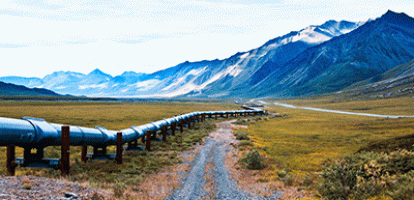 Mandating the National Energy Board (NEB) to weigh upstream greenhouse gas emissions in its pipeline approval process could stretch the federal government’s constitutional authority, according to a new report from the C.D. Howe Institute. In “The National Energy Board’s Limits in Assessing Upstream Greenhouse Gas Emissions,” authors Benjamin Dachis and Grant Bishop assert that Ottawa’s […]
 Two Blessings And A Curse Facing Alberta’s Oil Industry: Globe And Mail Op-ed
With the low price of oil today, many Albertans have long faces. Some believe we’re witnessing the beginning of the end of the oil patch, but I disagree – Alberta’s oil industry still has a promising future. However, it won’t happen automatically. Serious effort and good policy will both be required.
There are two blessings and one curse related to the future of the industry.
The first blessing is the oil itself. Alberta has a fabulous endowment of something the world desperately needs and will continue needing for many years. With the current low oil price, one might conclude that the world isn’tthat interested in Alberta’s oil any more. But don’t be blinded by the short term. As the world economy continues to grow…
True test of Alberta royalty review will be its real world application: Edmonton Journal Op-Ed
The much-anticipated Royalty Review Advisory Panel report has received wide acclaim – and deservedly so. It put forward solid principles to shape a modern royalty system. But the real test will be in the design details that emerge in the next two months. Much could go wrong.
The panel recommended no major changes to the oil sands regime.
But it suggested modernizing royalties on conventional oil and gas wells. The key principle that the panel recommended was that a modern royalty emulate a “revenue minus cost” approach. Under the modern royalty framework, starting in 2017, companies will pay only a minimal, flat royalty rate until their total revenues equal their costs. Companies receive a drilling and completion cost…
The Future of Canadian Energy Policy
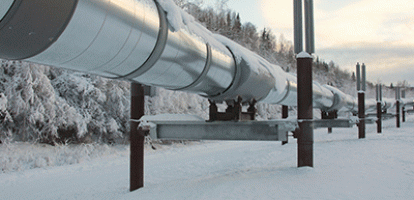 Canada’s energy sector will need to think about more than just low oil prices in 2016. There are numerous structural issues facing the sector that will need to be overcome, according to a new report from the C.D. Howe Institute. In “The Future of Canadian Energy Policy,” the second edition of the Institute’s National Priorities […]
 Emissions policy should focus on carbon pricing, not carbon targets: Globe and Mail Op-Ed
Now that Canadian policy-makers are back from the climate summit in Paris, there will be lots of talk about targets for reducing greenhouse-gas emissions. The federal government has indicated that the previous government’s target – reducing emissions by 30 per cent from 2005 levels by 2030 – is a lower bound for ambition. And the impending federal-provincial meetings could easily get hung up on how any national target might be divided up among the provinces. But a far more useful conversation would focus on the importance of carbon pricing.
Emissions-reduction targets and carbon pricing are closely related. A broadly based carbon price creates powerful incentives for businesses and households to reduce their GHG emissions. And…
Bill Robson on the Exchange: What can be accomplished at COP 21
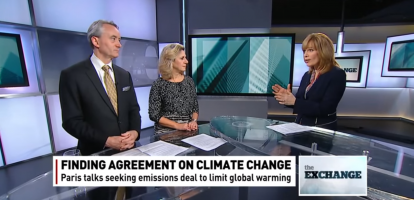
Bill Robson joins his co-panelist ArmineYalnizyan and Goldy Hyder to discuss what they think the likely outcome will be of the UN’s climate change summit in Paris.
From “Social Licence” to “Social Partnership”: Promoting Shared Interests for Resource and Infrastructure Development
 With the new federal government committed to reviewing the approval process for major resource projects, a key focus should be on encouraging stronger social partnerships between stakeholders, according to a new C.D. Howe Institute report. In “From ‘Social Licence’ to ‘Social Partnership’: Promoting Shared Interests for Resource and Infrastructure Development,” authors Geoffrey Hale and Yale […]
 Carbon pricing can balance emissions reduction and competitiveness: Globe and Mail Op-Ed
In the run-up to the Paris climate meetings, several Canadian provinces are developing or improving their carbon-pricing policies. They should be applauded for using market-based approaches to reducing greenhouse gas emissions. But businesses are nonetheless worried about how they will be affected, and this is too important an issue for governments to sweep under the carpet.
First, let’s be clear about what business “competitiveness” really means. For any Canadian business, its ability to compete successfully against its domestic and foreign rivals depends on many things. Wages, regulations, corporate taxes, the quality of workers, access to efficient supply chains, proximity to markets and foreign-exchange rates are just a few…
Bill Robson on the Exchange: Canada’s Pipeline Future

Bill Robson, joins his Big Picture co-panelists, ArmineYalnizyan and Goldy Hyder to talk about Canada’s pipeline future now that Keystone XL has been rejected by the U.S. and there is a new federal government in Canada.
Bill Robson on The Exchange: Canada’s Climate Change Initiative
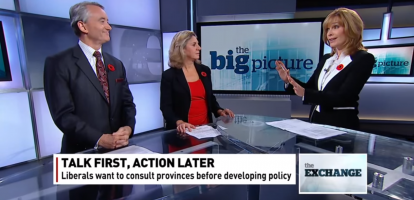
Institute President and CEO, Bill Robson, joins his Big Picture co-panelists, ArmineYalnizyan and Goldy Hyder to talk about Canada’s climate change initiative.
The Effect of First Nations Modern Treaties on Local Income
 Modern treaties have boosted incomes in First Nation communities and have led to more resource development, according to a new C.D. Howe Institute Report. In “The Effect of First Nations Modern Treaties on Local Income,” author Fernando M. Aragón shows that, beyond bettering First Nations economically, there are material benefits for resource companies and neighbouring […]