



November 15, 2023: Domestic Stability Buffer Council Recommends Holding Buffer at 3.5 Percent at Inaugural Meeting
At its inaugural meeting, the C.D. Howe Institute’s Domestic Stability Buffer Council (DSBC) recommended that the Office of the Superintendent of Financial Institutions (OSFI) maintain its Domestic Stability Buffer (DSB) at 3.5 percent at its next setting in December.
The DSBC provides OSFI, industry participants, and key economic policy voices with an independent assessment of the appropriate size of the buffer in pursuit of OSFI’s mandate of contributing to public confidence in the Canadian financial system. The Council consists of Vivian Abdelmessih, Cathy Cranston, Jamey Hubbs, Peter Levitt, Duncan Munn, Mark Zelmer, and Jeremy Kronick who is Chair. Council members make recommendations for OSFI’s upcoming DSB…
Supply Side Factors are Driving Remaining Inflation in Canada
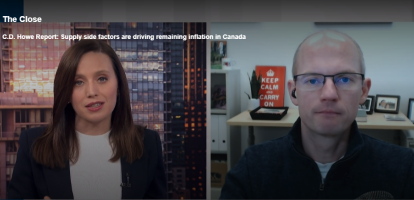
November 15 – Trevor Tombe, professor of economics at the University of Calgary, and a co-author of a new C.D. Howe Institute report on key drivers of inflation in Canada, tells BNN Bloomberg that the drop in inflation over the past year was driven by falling energy prices. He says persisting inflation is being led by supply side factors such as pricing strategies, production costs and supply chain problems, and that the Bank of Canada may have to continue its tight monetary stance to counter the upward push of these factors against the downward push on demand created by its interest rate hikes. He also says wages and labour costs have not been significant contributors to either inflation’s rise or fall.
Duncan Munn – The Evil of Short-Termism Bedevils Canada’s Future
 From: Duncan Munn To: Concerned Canadians Date: October 30, 2023 Re: The Evil of Short-Termism Bedevils Canada’s Future Canada has long been celebrated for its political stability, economic resilience, and social cohesion. Beneath this seemingly idyllic surface, however, lies a pervasive and destructive force: Short-termism. It has infiltrated the public and private sector, jeopardizing living standards. As we […]
 Napas Thein – Canada Needs its Own AI Regulatory Framework
 This week, we present the three top finishers in the C.D. Howe Institute Intelligence Memo competition, which was open to graduate students across the country. Today, our first runner-up. From: Napas Thein To: The Honourable François-Philippe Champagne, Minister of Innovation, Science and Economic Development Date: October 26, 2023 Re: Canada Needs its Own AI Regulatory […]
 Beyond tightening, where is the end point of the Bank of Canada’s monetary policy? – Globe and Mail
The Bank of Canada once again held its policy rate at 5 per cent on Wednesday, as expected.
After two months of disappointment, with the annual change in the Consumer Price Index ticking up in July and August, inflation resumed its descent in September, falling to 3.8 per cent from 4 per cent. That, plus weak economic numbers, made it practically certain – confirmed by the expectations of financial markets – that the central bank would hold.
The real questions concern the bank’s end point for monetary policy in the medium term and what that means for Canadians.
The bank is probably at the end of its tightening cycle. But this doesn’t mean interest rates are coming back down to where they were before…
Balance of data shows rate hikes are starting to work: C.D. Howe’s Jeremy Kronick
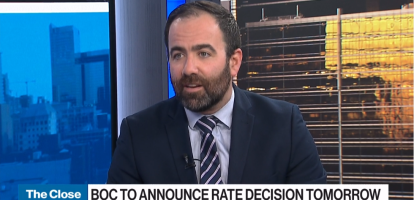 Jeremy Kronick, Associate Vice President and Director of the Centre on Financial and Monetary Policy at the C.D. Howe Institute, tells BNN Bloomberg that the Bank of Canada should hold rates at their current level tomorrow, but there’s also a chance they might hike again in this tightening cycle. He points to the job market and wage growth as areas of concern.
 Colin Busby – RRSP or TFSA? Canadians Need Help to Make the Call
 From: Colin Busby To: Retirement savings observers Date: September 25, 2023 Re: RRSP or TFSA? Canadians Need Help to Make the Call A successful savings plan is the product of both how much is saved and the returns on those savings, which one could call saving efficiency. This second aspect of savings decisions is often […]
 Kronick, Robson – Easy Populist Targets Lead to Bad Policy
 From: Jeremy M. Kronick and William B.P. Robson To: Finance Ministers and Critics Date: September 19, 2023 Re: Easy Populist Targets Lead to Bad Policy In public policy, as in life generally, we often recognize mistakes by others more easily than we recognize mistakes we make ourselves. Italy just goofed big-time with a windfall tax on its banks, and […]
 Glen Hodgson – Fires and Floods: It’s Time for Some Insurance Plans
 From: Glen Hodgson To: Canadian Climate Watchers Date: September 11, 2023 Re: Fires and Floods: It’s Time for Some Insurance Plans Fires, floods and severe storms have hit across the country, with climate change the probable cause. These severe events have destroyed housing, commercial property and infrastructure with a lengthy recovery period ahead. Insured and uninsured losses will […]
 Italy’s bank tax fiasco: Canada must learn lessons on the evils of populist tax policy – Globe and Mail
In public policy, as in life generally, we often recognize mistakes by others more easily than we recognize mistakes we make ourselves. Italy just goofed big-time with a windfall tax on its banks, and Canadians should take notice.
Last month, the coalition government of Italian Prime Minister Giorgia Meloni announced a surtax of 40 per cent on the profits of the country’s banks. The announcement triggered a crash in bank stocks – a loss of €10-billion in a single day – and a storm of criticism from investors, economists and elected representatives, including members of the coalition.
Ms. Meloni’s government has since backtracked, capping the amount at 1 per cent of bank assets, and exempting smaller banks. But the…
Tiff Macklem reads the tea leaves: Bank of Canada was right to hit pause on interest rates – Globe and Mail
The Bank of Canada held its policy rate at 5 per cent Wednesday – a smart move.
Although the central bank’s governing council may have made its decision ahead of the weak GDP numbers released last week, those numbers underlined the reasons to hold. Real GDP contracted at an annualized rate of 0.2 per cent in the second quarter of 2023 and fell 0.2 per cent month-over-month in June (annualized as well). Looking ahead, Statistics Canada’s advanced estimate for July was flat. The household consumption the bank has been battling finally seems to be flagging. Data on bank deposits and job vacancies also testify to an economy losing steam.
Monetary policy works with a lag, and these latest figures suggest…
Charles Plant – Marketing and Sales are Canada’s Missing Productivity Link
 From: Charles Plant To: Productivity observers Date: September 5, 2023 Re: Marketing and Sales are Canada’s Missing Productivity Link Our national productivity gap has spurred analyses, reports and media articles for decades. While public debate in Canada has focused on productivity improvement for more than 50 years, we have made limited progress. Fresh thinking is required. While innovation through […]