



Federal tax hikes on banks and insurers risk causing broader economic damage – Globe and Mail Op-Ed
Taxes are a necessary evil. Necessary, because we must fund government services. Evil, because they do damage beyond the cost to those who pay them – discouraging work and saving, misallocating where our scarce resources go, and encouraging underground activity. The federal government’s coming levies on banks and insurers – a corporate income surtax and the “Canada Recovery Dividend” – don’t even qualify as “necessary.”
These taxes were part of the Liberal campaign platform for last year’s federal election. The platform committed to raising the corporate income tax rate on bank and insurer profits above $1-billion from the 15 per cent other businesses pay to 18 per cent. It also proposed the Canada Recovery Dividend: a…
Laurin, Robson – Inflation Pain Includes Tax Creep and Benefit Erosion
 From: Alexandre Laurin and William B.P. Robson To: Canada’s Tax Collectors Date: September 27, 2022 Re: Inflation Pain Includes Tax Creep and Benefit Erosion Inflation of 7 percent or more is something many Canadians had never experienced until this summer. As a country, we are rediscovering how much inflation hurts. The shrinking value of our dollars is […]
 Taxes can amplify the pain of inflation – Globe and Mail Op-Ed
Inflation around 8 per cent is something many Canadians had never experienced until this summer. As a country, we are rediscovering how much inflation hurts. The shrinking value of our dollars is bad enough on its own, but inflation harms us in more subtle ways, including through its interactions with taxes and government benefits. Now would be a good time for some changes to lessen the pain.
Below are several examples.
When personal income tax thresholds and benefits are fixed in dollar terms, inflation pushes workers into higher tax brackets even when their real incomes do not rise. Some tax thresholds are indexed to inflation, but others are not.
Alberta, for instance, has just announced it will resume indexation…
The Right to Know: Grading the Fiscal Transparency of Canada’s Senior Governments, 2022
 Canada’s senior governments raise and spend huge amounts, and have legally unlimited capacity to borrow when their expenses exceed their revenues. Holding public officials accountable for their spending, taxing and borrowing is a foundational task in a system of representative government. Citizens have the right to know, and elected representatives have duties to them. […]
 Miville Tremblay – Tax Cut Promises on Quebec’s Campaign Trail Seem Unwise
 From: Miville Tremblay To: Quebec Election Watchers Date: September 7, 2022 Re: Tax Cut Promises on Quebec’s Campaign Trail Seem Unwise A post-pandemic euphoria grips our politicians on the campaign trail. We would like to join in, but the tax cuts promised by both the Coalition avenir Québec (CAQ) and the Liberals are problematic. They may have broad […]
 Duval, Allard – Canada’s New Interest and Financing Expense Deductibility Rules
 From: Marc André Gaudreau Duval and Marc Pietro Allard To: The Hon. Chrystia Freeland, Minister of Finance and Éric Girard, Quebec Finance Minister Date: August 26, 2022 Re: Canada’s New Interest and Financing Expense Deductibility Rules New rules limiting the deduction of “interest and financing expenses” to a percentage of earnings before interest, taxes, depreciation and […]
 Tax Support for R&D and Intellectual Property: Time for Some Bold Moves
 Ottawa’s Review of the SR&ED Credit Needs Bolder Thinking Ottawa’s review of the Scientific Research and Experimental Development (SR&ED) program is welcome news, but bolder thinking is needed to substantially improve the effectiveness of the tax credit, according to a new report from the C.D. Howe Institute. In “Tax Support for R&D and Intellectual Property: […]
 Angelo Nikolakakis – Global Tax Deal: Who Wins and Who Loses?
 From: Angelo Nikolakakis To: Finance Minister Chrystia Freeland Date: July 13, 2022 Re: Global Tax Deal: Who Wins and Who Loses? The 2022 federal budget launched consultations on the implementation of a Global Minimum Tax of 15 percent, which was endorsed in principle by members of the OECD and G20 in 2021. In simple terms, the “Pillar Two” tax rules […]
 S4 E9: Inflation and a Recession with Bill Robson and Jeremy Kronick

Raising interest rates to cool inflation is only part of the solution. But as the C.D. Howe Institute’s Bill Robson and Jeremy Kronick tell host Michael Hainsworth, fiscal policy that increases corporate Canada’s productive capacity to meet demand isn’t likely, leaving the central bank with the task of dousing the inflationary fire from 2 years of COVID-19 spending.
Ed Devlin on BNN – Canadian interest rates alone won’t solve the global inflation problem
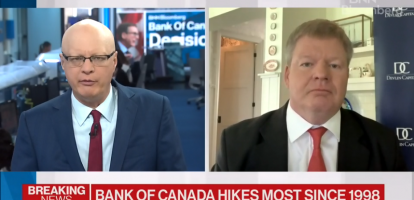
Ed Devlin, Founder of Devlin Capital and Senior Fellow at the C.D. Howe Institute (also former Head of Canadian Portfolio Management, PIMCO), joins BNN Bloomberg for reaction to Bank of Canada’s largest rate hike since 1998. He says the central bank is frontloading rate hikes today instead of indicating a faster tightening cycle.
Give seniors more saving room – Financial Post Op-Ed
Prices are rising and stock markets are falling — a toxic combination, especially for older Canadians who rely on savings in registered retirement saving plans (RRSPs) and defined-contribution pension plans, and who are drawing down savings in registered retirement income funds (RRIFs) and Life Income Funds (LIFs).
Many will now want to save more, to alleviate their risk of running out of money before they die. At the very least, Canadians over 71 should not face tax rules that force them to sell when the market is down, permanently lowering their prospects for retirement.
Instead of exacerbating their problems the federal government should help solve them.
To begin with, retirees need a break on mandatory RRIF…
Ça ne devait pas se passer comme ça – La Presse Op-Ed
Ça, étant une inflation persistante et généralisée, que les banques centrales doivent écraser par une hausse accélérée des taux d’intérêt, au risque élevé de récession ! Ça, expliquant l’humeur massacrante en Bourse.
« We fought the last war. » On s’est battu comme si on livrait la guerre précédente, explique Jason Furman, professeur à Harvard et ex-conseiller économique du président Obama. Erreur classique des généraux obnubilés par le dernier conflit, en l’occurrence celui de la grande crise financière de 2007-2008.
La grande récession qu’elle a engendrée fut des plus longues, car il a fallu désendetter le secteur privé et recapitaliser le système bancaire. On a aussi blâmé les gouvernements pour la…