



Les Dogmes Budgétaires Remis En Question – La Presse Opinion
Ils ne vont pas jusqu’à contester la loi de l’offre et de la demande, mais aux États-Unis, plusieurs économistes de renom révisent certaines « vérités » sur l’endettement public et le rôle de la politique budgétaire.
Chercheurs émérites et même Nobel d’économie, ils ont été président de la Réserve fédérale, économistes en chef du Fonds monétaire international, conseillers des présidents des États-Unis, directeurs du budget et secrétaire au Trésor. Ils se nomment Joseph Stiglitz, Paul Krugman, Ben Bernanke, Olivier Blanchard, Kenneth Rogoff, Larry Summers, Jason Furman et Robert Rubin, pour ne citer que les plus connus.
Ils ne sont pas d’accord sur tout. Certains penchent à gauche, d’autres à droite, mais…
John Manley on BNN – Ottawa should think carefully on providing additional stimulus
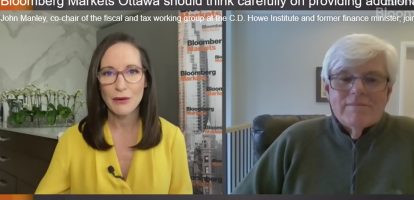
John Manley, co-chair of the Fiscal and Tax Working Group at the C.D. Howe Institute and former finance minister, joins BNN Bloomberg to discuss key recommendations for the federal government ahead of the expected budget. He notes Canada should focus on tracing and rapid testing in order to get the economy through the pandemic.
It is time for a Canadian Equitable Growth Institute – Globe and Mail Op-Ed
Canada’s weak economic growth prospects threaten the well-being of Canadians and preclude the introduction of the Liberal government’s spending initiatives without undue fiscal risk or much higher tax rates.
The fall fiscal statement estimated Canada’s potential growth rate to be just 1.4 per cent from 2020 to 2025, down from the still modest pace of 1.8 per cent calculated before the pandemic. Growth could be worse still as, in research done for the Council of the Federation in 2015, I estimated the growth potential to be just slightly more than 1½ per cent, without pandemic effects.
The main reasons for such low growth are the aging population, slowing labour force growth and a continuation of a long trend of…
From Here to Full Inoculation: How an Epidemiological-Economic Model Can Help as We Rollout Vaccines
 This working paper uses an epidemiological-economic model to determine the optimal intervention strategy in order to achieve desired health outcomes while minimizing economic damage. The results show that, compared to a uniform lockdown in which everyone is locked down the same, a targeted approach to lockdowns by age or industry over the period until a […]
 Gagné-dubé, Godbout, St-cerny – L’histoire Sans Fin De La Pcu
 De: Tommy Gagné-Dubé, Luc Godbout et Suzie St-Cerny À: Carla Qualtrough, ministre de l’emploi, et Chrystia Freeland, ministre des finances Date: 12 février 2021 Sujet: L’histoire sans fin de la PCU Les critères d’admissibilité pour avoir droit à la PCU étaient relativement simples; avoir gagné plus de 5000$ de revenu de travail l’année précédente (ou dans les […]
 Gagné-dubé, Godbout, St-cerny – Cerb’s Never Ending Story
 From: Tommy Gagné-Dubé, Luc Godbout and Suzie St-Cerny To: Carla Qualtrough, Minister of Employment and Chrystia Freeland, Minister of Finance Date: February 12, 2021 Subject: CERB’s Never Ending Story Eligibility criteria for the Canada Emergency Relief Benefit were relatively simple: Earn more than $5,000 in employment income in the previous year (or in the 12 months […]
 James Pierlot – Ontario’s Pension Benefits Guarantee Fund: A Practical Way Forward
 From: James Pierlot To: Ontario Ministry of Finance Date: February 11, 2021 Re: Ontario’s Pension Benefits Guarantee Fund: A Practical Way Forward The only sub-national pension guarantee fund in the world, Ontario’s Pension Benefits Guarantee Fund (PBGF) has survived 40 years, providing a limited guarantee for Ontario members of some underfunded defined benefit […]
 Von Finckenstein, Mitchell – Making Bill C-10 Work
 From: Konrad von Finckenstein and James Mitchell To: Ministers of Innovation, Science and Economic Development and Canadian Heritage Date: February 8, 2021 Re: Making Bill C-10 Work The government has introduced Bill C-10, an Act to Amend the Broadcasting Act with the main aim of regulating online over-the-top digital services commonly called streamers; Netflix, Amazon Prime and their proliferating, […]
 Lynch, Deegan – Five Steps To Sustainable Fiscal Management
 From: Kevin Lynch and Paul Deegan To: Finance Minister Chrystia Freeland Date: February 3, 2021 Re: Five Steps to Sustainable Fiscal Management The federal government launched pre-budget consultations last week. Let us hope these lead to a clear and predictable approach to sustainable fiscal management that can be summed up as: Set, Shift, Stop, Switch […]
 Debt danger ahead if interest rates outpace growth – Financial Post Op-Ed
A couple of weeks back, Jack Mintz warned Financial Post readers that governments that think low interest rates will let them keep borrowing big are on a dangerous path. As he pointed out, the presumption that deficits are sustainable depends on the rate of growth of the economy exceeding the interest rate. Drilling down, if a government borrows to pay all its interest, its debt will grow at the interest rate. If the economy grows faster than that, the government’s debt-to-GDP ratio can fall even if it also borrows to pay for some of its program spending. But if the interest rate is greater than the rate of economic growth, the government must cover all its program spending with taxes, and then some. Otherwise, its debt grows…
The Rock in a Hard Place: The Difficult Fiscal Challenges Facing Newfoundland and Labrador
 Economists Outline Causes and Cures for Newfoundland and Labrador’s Fiscal Woes Leading economists Don Drummond and Louis Lévesque turn a spotlight on the root causes of the province’s current fiscal predicament – and prescribe solutions to help safeguard the province’s financial future. The authors track the province’s current fiscal problems back to 2012/13 when the […]
 Robson, Wu – It’s the End of January. Do You Know Where Your City’s Budget Is?
 From: William B.P. Robson and Miles Wu To: Municipal Councillors and Ratepayers Date: February 1, 2021 Re: It’s the End of January – Do You Know Where Your City’s Budget Is? Municipal budgets produce some of the most frustrating failures of accountability among Canadian governments. Municipalities are the level of government that matters most in […]