



Decision Time: The Alberta Shadow Budget 2019
 Alberta has a once-in-a-generation opportunity to correct its economic and fiscal direction, says a new report from the C.D. Howe Institute. In “Decision Time: The Alberta Shadow Budget 2019,” Calgary-based author Grant Bishop demonstrates how Alberta could return to a budget balance by 2022-23 and achieve a sustainable path for balanced budgets over the long […]
 Canada knows what smart fiscal policy looks like. We should not be doubling down on dumb – National Post Op-Ed
For Canadians concerned about national finances, the 2019 federal election campaign has been a double whammy. Personal smears and social-media mobbing have mostly eclipsed substance. And the discussions of budgetary policy that have cut through the noise have been discouraging. Especially the commitments for more and bigger deficits: even more red ink in the next four years than was spilled in the past four.
Economists are divided about how much that matters. If the ratio of federal debt to GDP is stable, some say, we are good. Others, like me, don’t like how deficits burn up savings, heralding a future with less infrastructure, housing, machinery and technology than we otherwise would have enjoyed. If there’s no consensus on…
Bill Robson on BNN – Leaders should be thinking about long-term spending
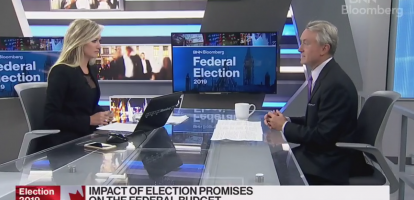
Bill Robson, president and CEO of the C.D. Howe Institute, joins BNN Bloomberg’s Catherine Murray to discuss how candidates are making many election promises without thinking about the impact it will have on the federal budget.
Alesina, Favero, Giavazzi – Austerity and the Economy: Spending Cuts Versus Tax Increases
 To: Canadian Governments From: Alberto Alesina, Carlo Favero and Francesco Giavazzi Date: September 12, 2019 Re: Austerity and the Economy: Spending Cuts Versus Tax Increases Alberta and Ontario are now in the midst of fiscal austerity programs. Austerity indicates a policy of sizeable reduction of government deficits aimed at stabilization of government debt, achieved by […]
 Is giving parents money directly the best approach to child-care funding? – Toronto Star Op-Ed
There can be many reasons for society to subsidize parents for the cost of child care. The financial hurdle for a parent considering the merits of working versus staying at home to care for young children can be extremely high — especially at lower levels of family income, where incremental work hours are taxed heavily.
Mothers, in particular, are hard-hit by absence from the workforce and face larger wage penalties the longer they are away from paid work.
For economists, the main motivation for subsidizing child care is to encourage parents to participate in the workforce, thus boosting the economy through higher household incomes. As an added bonus, the extra income generates increased tax revenues, substantially offsetting…Alexandre Laurin – The Ugly Arithmetic of All-Inclusive Tax Rates, Part II
 From: Alexandre Laurin To: Canada’s ministers of finance Date: August 28, 2019 Re: The Ugly Arithmetic of All-Inclusive Tax Rates, Part II In my new C.D. Howe Institute E-Brief, I examined the effects of “all-inclusive” tax rates through separate lenses, the marginal effective tax rate (METR) and the participation tax rate (PTR). These all-inclusive tax rates take into consideration […]
 Alexandre Laurin – The Ugly Arithmetic of All-Inclusive Tax Rates, Part I
 From: Alexandre Laurin To: Canada’s ministers of finance Date: August 27, 2019 Re: The Ugly Arithmetic of All-Inclusive Tax Rates, Part I In my new C.D. Howe Institute E-Brief, I examined the effects of “all-inclusive” tax rates through separate lenses, the marginal effective tax rate (METR) and the participation tax rate (PTR). These all-inclusive tax rates take into consideration […]
 The Paycheck Blues: Why Extra Work is often Not Worth the Effort for Lower-income Families
 Low-income Canadian families with children encounter high “all-inclusive” tax rates that could discourage parents from working more or entering the workforce, argues a new C.D. Howe Institute report. In “The Paycheck Blues: Why Extra Work is often Not Worth the Effort for Lower-income Families,” author Alexandre Laurin finds that parents with children may lose a […]
 Alexandre Laurin on BNN – Costs of returning to work could exceed the benefits

Alexandre Laurin, director of research at the C.D. Howe Institute, joins BNN Bloomberg to discuss how the costs associated with returning to work could exceed the benefits for some Canadian families with children.
Nick Pantaleo – Improving Ottawa’s Changes To The Tax Treatment Of Employee Stock Options
 From: Nick Pantaleo To: The Hon. Bill Morneau, Minister of Finance Date: August 1, 2019 Re: Improving Ottawa’s Changes to the Tax Treatment of Employee Stock Options In Budget 2019, the federal government announced its intention to correct a significant inequity of the Canadian personal tax system relating to the employee stock option deduction, which effectively allows employment income […]
 Robson, Omran – Fiscal Stabilization – The Gap Between Theory And Reality
 To: Students of macroeconomics – and policymakers too! From: William B.P. Robson and Farah Omran Date: July 22, 2019 Re: Fiscal stabilization – the gap between theory and reality All students of macroeconomics encounter governments’ practice of using fiscal policy to stabilize the business cycle from the outset of their coursework. In slumps, tax revenues […]
 William B.P. Robson and Farah Omran – A Bad Budget Habit Afflicts Most Senior Governments
 From: William B.P. Robson and Farah Omran To: Canada’s finance ministers Date: July 12, 2019 Re: A Bad Budget Habit Afflicts Most Senior Governments Canada’s federal, provincial and territorial governments have spent a combined total of $91 billion more than they said they would since 2000. In our new C.D. Howe Institute Commentary we compare the budgets of Canada’s […]