



Ambler, Kronick – Thanks, We Needed That. Why the Bank Move Was the Right One
 From: Steve Ambler and Jeremy M. Kronick To: Bank of Canada Governing Council Date: July 20, 2022 Re: Thanks, We Needed That. Why the Bank Move Was the Right One Last week, the Bank of Canada increased the scope of its interest rate increases, raising its overnight rate target by 100 basis points to 2.5 per cent. We […]
 Why these interest rate hikes are so necessary – Globe and Mail Op-Ed
On Wednesday, the Bank of Canada increased the scope of its interest rate increases, raising its overnight rate target by 100 basis points to 2.5 per cent. We haven’t seen a hike that big in recent memory, and the target rate is now higher than at any time since before the financial crisis in 2008.
With mortgage and other market interest rates increasing with the overnight rate, fears of a recession are mounting. There are two big questions. First, are there alternatives to the blunt overnight rate for fighting inflation? Second, how bad will the recession need to be to bring inflation back down? Unfortunately, the answer to the first question is no, there aren’t any viable alternatives. However, the recession…
S4 E9: Inflation and a Recession with Bill Robson and Jeremy Kronick

Raising interest rates to cool inflation is only part of the solution. But as the C.D. Howe Institute’s Bill Robson and Jeremy Kronick tell host Michael Hainsworth, fiscal policy that increases corporate Canada’s productive capacity to meet demand isn’t likely, leaving the central bank with the task of dousing the inflationary fire from 2 years of COVID-19 spending.
Ed Devlin on BNN – Canadian interest rates alone won’t solve the global inflation problem
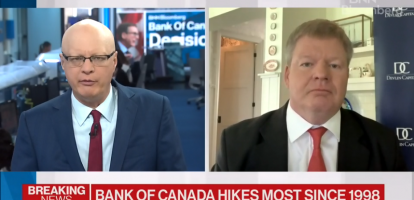
Ed Devlin, Founder of Devlin Capital and Senior Fellow at the C.D. Howe Institute (also former Head of Canadian Portfolio Management, PIMCO), joins BNN Bloomberg for reaction to Bank of Canada’s largest rate hike since 1998. He says the central bank is frontloading rate hikes today instead of indicating a faster tightening cycle.
C.D. Howe Institute Monetary Policy Council Calls for Bank of Canada to Raise Overnight Rate to 2.25 Percent Next Week and 3.25 Percent by 2023
July 7, 2022 – The C.D. Howe Institute’s Monetary Policy Council (MPC) recommends that the Bank of Canada raise its target for the overnight rate, its benchmark policy interest rate, by 75 basis points to 2.25 percent on July 13th. The MPC recommends further increases over the coming year: to 2.75 percent in September and 3.25 percent by January 2023. Its call for the overnight rate in a year’s time was also 3.25 percent. The MPC also recommends that the Bank maintain the current pace of reduction in its holdings of Government of Canada bonds between now and September.
The MPC provides an independent assessment of the monetary stance consistent with the Bank of Canada’s 2 percent inflation target. William Robson,…
William B.P. Robson – Higher Productivity Would Help Fight Inflation
 From: William B.P. Robson To: Federal Economic Ministers Date: July 6, 2022 Re: Higher Productivity Would Help Fight Inflation Canadians are beset by economic problems. Inflation is hammering their purchasing power. Forecasters are predicting weak, if any, rise in living standards. And now it seems that tighter monetary policy may cause a recession. The list of challenges seems […]
 Ambler, Kronick – Reintegrate Money into Monetary Policy Analysis
 From: Steve Ambler and Jeremy M. Kronick To: Bank of Canada Governing Council Date: July 5, 2022 Re: Reintegrate Money into Monetary Policy Analysis Headline inflation, which has reached 7.7 percent, has become decidedly unsettled. Until the 1980s, most economists believed there was a significant relationship between money and inflation in both the short and long runs. However, […]
 Money Talks: The Old, New Tool for Predicting Inflation
 With rising inflation top-of-mind for Canadians, a major question is: Can we predict its future? This Commentary shows that growth in the money supply is a useful predictor of inflation, and examines why and when. Since the early 1990s, the Bank of Canada has pursued a successful inflation-targeting strategy. With inflation, and inflation expectations, safely anchored […]
 Jeremy Kronick on BNN – BoC’s policy rate must go much farther to get inflation back down

Jeremy Kronick, Associate Director of Research at the C.D. Howe Institute, joined BNN Bloomberg to explain how stimulus spending during the pandemic has created an overhang in the economy and prices have to play catch-up with the money now sloshing around in the system. Kronick says the slowdown in the rates of money growth and in the housing market are positive signs for taming inflation.
William B.P. Robson – A Recession Lurks in our New Inflation Numbers
From: William B.P. Robson To: Canadians Concerned about the Economy Date: June 28, 2022 Re: A Recession Lurks in our New Inflation Numbers The May consumer price index was up 7.7 percent year-over-year in Statistics Canada’s inflation report last week. That’s alarming for two reasons. The obvious one: our money’s purchasing power is falling faster than at any time […]Double whammy: The latest surge in inflation means a recession is likely – Globe and Mail Op-Ed
Wednesday’s inflation report from Statistics Canada showed that the consumer price index was up 7.7 per cent year-over-year in May. That’s alarming for two reasons. The obvious one: our money’s purchasing power is falling faster than at any time since the early 1980s. The other reason will take time to sink in: We are headed for a recession.
Getting inflation back to its 2-per-cent target would inevitably have been a challenge for the Bank of Canada. The fiscal and monetary stimulus at the beginning of the COVID-19 pandemic went on too long, and now it has combined with pent-up saving by households who could not travel, eat out or enjoy in-person entertainment for two years to unleash a torrent of spending. Demand is above the…
Climate Risk and Canadian Banks: Is More Capital Required?
 As regulators generate new rules for financial institutions regarding the monitoring, disclosure and mitigation of climate-related risks, a key issue is: should banks be required to increase their capital buffers?
In “Climate Risk and Canadian…
As regulators generate new rules for financial institutions regarding the monitoring, disclosure and mitigation of climate-related risks, a key issue is: should banks be required to increase their capital buffers?
In “Climate Risk and Canadian…