



Marcel Boyer – The Pervasive Economic Error In Assessing The Cost Of Public Funds
 From: Marcel Boyer To: Canada’s Debt Watchers Date: January 7, 2021 Re: The Pervasive Economic Error in Assessing the Cost of Public Funds In the assessment of the cost of public funds, a pervasive economic fallacy is dogma in both the private and public sectors as well as in academia: since the cost of borrowing is higher for a […]
Miville Tremblay – L’infrastructure N’est Pas Simple, Mais Les Régimes De Retraite Peuvent Aider
 De la part de: Miville Tremblay A l’attention de: Observateurs d’infrastructure Date: 4 décembre, 2020 Subject: L’infrastructure n’est pas simple, mais les régimes de retraite peuvent aider Je ne cherche pas à vous vendre le pont Samuel-De Champlain, croyez-moi! Seulement à vous convaincre qu’il est opportun de considérer le financement des infrastructures publiques par les caisses de retraite, […]
Les caisses de retraite reluquent nos infrastructures – La Presse Opinion
Je ne cherche pas à vous vendre le pont Samuel-De Champlain, croyez-moi ! Seulement à vous convaincre qu’il est opportun de considérer le financement des infrastructures publiques par les caisses de retraite, qui ont besoin de ces actifs pour assurer le paiement de nos rentes.
Il y a quelques jours, Mark Machin, le patron d’Investissements RPC, qui gère les 457 milliards de dollars du Régime de pension du Canada, le grand frère du Régime des rentes du Québec, lui géré par la Caisse de dépôt, a suggéré que les gouvernements à court d’argent devraient vendre les aéroports, les routes à péage, les sociétés de services public et autres infrastructures publiques.
« Il y a tellement de capital qui court…
Glen Hodgson – How Much Investment Is Required To Reduce Ghg Emissions Without Sacrificing Growth?
 From: Glen Hodgson To: Canadians concerned about green growth Date: November 27, 2020 Re: How Much Investment is Required to Reduce GHG Emissions Without Sacrificing Growth? In the extensive debate on the policies and innovation required to reduce Canada’s GHG emissions while achieving solid economic growth, discussion on the scale and distribution of investment needed has been absent, […]
How high municipal housing charges and taxes decrease housing supply – Globe and Mail Op-Ed
Home prices have skyrocketed in places such as Vancouver and Toronto in the past decade. These cities have some of the highest charges and most restrictive rules on construction. The evidence from around the world shows that government policies that limit supply and increase the cost of construction are among the key causes of higher prices. It is time governments take more steps to reduce these costs.
Homebuyers in Canadian cities face a multitude of taxes and charges that increase the cost of buying a home. Restrictions on housing supply and extra costs hinder the efficiency of the housing market. Recent research has found a persistent gap between the cost of building new homes and their market price in major Canadian…
Cost and Use of Development Charges: Ontario and British Columbia
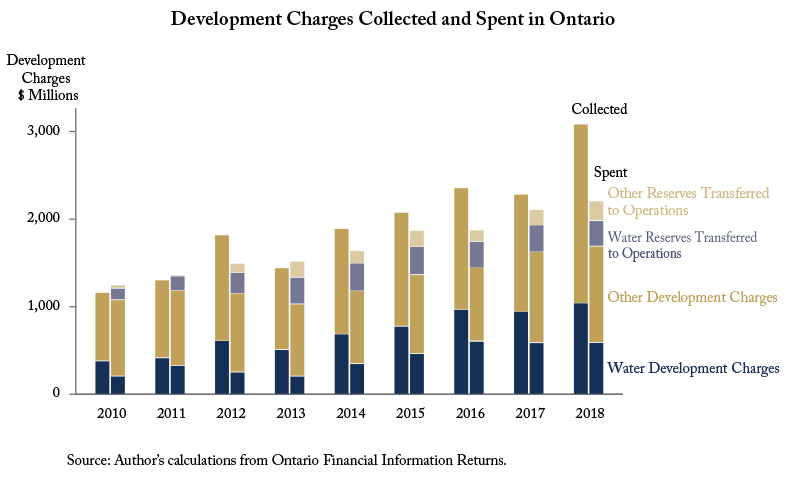 New research from Benjamin Dachis explores how homebuyers in Canadian cities face a multitude of taxes and charges that increase the cost of buying a home. These charges include development charges – charges paid by the developer to compensate the municipality for the cost of building infrastructure, such as sewers, to service new homes and […]
Gimme Shelter: How High Municipal Housing Charges and Taxes Decrease Housing Supply
 The Study In Brief Homebuyers in Canadian cities face a multitude of taxes and charges that increase the cost of buying a home. Government policies whose affect is to limit the supply of the kinds of homes people want and can afford are among the key causes of higher property prices. Restrictions on housing supply […]
Peter Hicks – The Pandemic Opportunity For Better Well-being Data
 From: Peter Hicks To: The Office of the Prime Minister Date: October 9, 2020 Subject: The Pandemic Opportunity for Better Well-being Data The federal government agenda during this parliamentary session will be focused on managing the pandemic and putting ‘new normal’ programs in place. There should also be a place for lower profile action to […]
Canada’s Recovery Plans Should Focus On Building The Infrastructure Of The Future – Globe And Mail Op-ed
In the past weeks, Canada’s economy has begun to reopen. This restart is tentative and faces great uncertainty. Nonetheless, Canada’s governments must now turn to planning for our economic recovery. The recovery plans should focus on laying foundations for Canadian prosperity in decades to come. Well-targeted infrastructure investments should be the centrepiece.
Notwithstanding the risk of a second wave for the pandemic, all indications are for a long, hard recovery rather than any “V-shaped” bounceback. Canada’s economy will likely face a period of weak demand from consumers and for our major exports, as well as depressed capital spending by private business.
Managing the crisis required unprecedented outlays by the…
Accelerate Infrastructure Projects and Adapt Restructuring Processes: Crisis Working Group on Business Continuity and Trade
June 17, 2020 – Accelerating productivity-enhancing infrastructure projects could provide much-needed stimulus and help Canada’s economy recover from the COVID-19 crisis, according to a C.D. Howe Institute Crisis Working Group.
The Crisis Working Group on Business Continuity and Trade, in its most recent meetings on May 26 and June 2, 2020, also emphasized the need for adapting Canada’s bankruptcy and restructuring process to cope with the potential for widespread insolvencies.
The group of industry experts and economists, co-chaired by Dwight Duncan, Senior Strategic Advisor at McMillan LLP and former Ontario Minister of Finance, and Jeanette Patell, Vice-President of Government Affairs and Policy for GE Canada,…
When the pandemic subsides, preserving the arts must be a top priority for governments – Globe and Mail Op-Ed
One of the tragedies of the COVID-19 crisis is its devastation of arts and culture organizations in this country. Even with emergency support by the federal government, the future for many of these groups is uncertain. As the economy slowly opens up, crowd restrictions and social distancing will mean galleries, museums and the performing arts generally (theatre, music, dance), will face tremendous challenges. Many see a dim and uncertain horizon ahead as revenues shrink or disappear.
Financial struggles were a long-standing a fact of life for the arts community well before the pandemic crisis. Notwithstanding pre-pandemic increases in public funding, including the injection of new money for the Canada Council, public financing…
Dwight Duncan on BNN – Financing bridge needed to protect at-risk sectors
Dwight Duncan, co-chair of the C.D. Howe Institute’s Crisis Working Group on Business Continuity and Trade, joins BNN Bloomberg to discuss the kind of government support needed for at-risk sectors amid the pandemic.