






by Jack M. Mintz and V. Balaji Venkatachalam
- When the federal government moves out of virus-fighting mode it will have to assess whether, when and how it will fulfil a Liberal campaign promise: the introduction of limits on interest deductibility by large corporations, which is under consideration in Ottawa.
- The US and EU countries already have their versions of such a rule, in keeping with a recommendation of the OECD, as a way to fight the advantageous shifting of taxes and profits between countries. This does not mean a similar proposal is a good idea for a cyclically based economy like Canada.
- As proposed by the Liberals in the 2019 election, the rule would cap net interest expense at no more than 30 percent of the corporation’s earnings before the deduction of interest, taxes, depreciation and amortization (EBITDA), with some exemptions.
- This E-Brief examines some different approaches to the interest limitation rule to lessen its impact, since the rule will generally raise the cost of capital and deter investment. We find, the government’s initial broad proposal based on 30 percent of EBITDA would have raised $1.45 billion in federal and provincial corporate tax revenue in 2019. This results in an increase in the average corporate income tax rate of 0.9 percentage points. To keep the effect neutral, a reduction in the corporate income tax rate by 1 point would be needed, similar to recent reforms in Europe.
- We offer several ideas to lessen the impact of the proposed rule and conclude that a broad interest limitation rule should not be applied to all domestic and multinational companies. It could lead to double taxation of bond-financed capital investments. It will be distortionary across sectors and assets as well as discourage investment.
Introduction
In the 2019 election, the Liberals promised to introduce an “earnings stripping rule” to limit interest deductions claimed by companies. The rule would cap net interest expense to be no more than 30 percent of the corporation’s earnings before the deduction of interest, taxes, depreciation and amortization (EBITDA).11 In simple terms, interest payments are a two-way street for corporations. For example, they pay interest on debt such as bonds sold to investors and earn interest on various assets like cash in the bank. The difference is the net amount. Companies with less than $250,000 in net interest expense would be exempt as well as small businesses.22 Canadian-controlled private corporations with less than $500,000 in profits or $10,000,000 in assets are exempt. The rule also allows a company as part of a corporate group to deduct interest if its debt is less than its worldwide average of the corporate group. These proposed interest limitations are quite broad, applying to all corporations including domestic companies regardless of whether or not interest is taxable in the hands of the investors in those companies.
The purpose of this E-Brief is to examine some different approaches to the interest limitation rule to lessen its impact, since the rule will generally raise the cost of capital and deter investment. We also provide our own estimate of the amount of interest expense that could be denied under alternate applications of the rule and the increase in federal and provincial corporate income tax to be paid by Canadian corporations.33 The Parliamentary Budget Office estimated a revenue gain to be $1.6 billion in 2020/21 federal corporate taxes (provincial corporate tax gains would be in addition to the federal revenue increase). For the PBO discussion of their estimate, see https://www.pbo-dpb.gc.ca/web/default/files/Documents/ElectionProposalCosting/Results/33063981_ EN.pdf?timestamp=1583271229899 (as of March 3, 2020).
We begin with a broad proposal similar to the Liberal election promise but only as a starting point. We realize any ultimate proposal would be more circumscribed. We model some of these provisions here. Any proposal would likely best be applied to corporate groups, which is an assumption related to the data we use. Some sectors might be exempt. Companies with low leverage may be excluded. Unused interest deductions in a year might be carried forward, an important provision for cyclically based economies like Canada. Past rules limiting interest deductions with respect to international tax planning such as thin capitalization, where a company holds more debt than equity in Canada, might be disbanded.
A few caveats are mentioned upfront. Our brief study will not include all the bells and whistles associated with a relatively complex set of changes, such as interactions with the tax treatment of foreign affiliate income. It is also preliminary work looking at one year of data whereas our eventual goal is to look a multi-year data set. The latter is important in order to develop estimates of marginal effective tax rates as undertaken by Chen and Mintz (2008) and Mintz (2018).
In our view, a complex earning-stripping interest limitation rule for companies including many domestic companies without international business, is ill-advised. It is distortive; favouring some industries over others. It will also be ill-timed especially once the economy begins to recover from the Covid-19 induced recession after five years of weak investment performance, as discussed in Bazel and Mintz (2020).
Why this Change?
Under the current tax system, companies are generally permitted to deduct interest incurred on borrowed money used to earn income from business or property. Canadian residents pay personal income tax on interest received from the company. Pension plans and other retirement saving plans are exempt from paying tax on interest received from the company (the exemption enables Canadians to accumulate savings more quickly for retirement). Canada applies a withholding tax on payments to non-residents although most interest is exempted (the non-resident can claim a tax credit for any withholding tax against income tax owing in their own country).44 Interest payments to non-residents are exempt from Canadian withholding tax by treaty or in certain situations such as arm’s length interest payments.
By limiting interest deductions for corporations, such income is potentially double taxed under the corporate and personal income tax systems since the Canadian corporation cannot deduct interest over the cap while the recipient remains taxable on such income. One should therefore ask a critical question: why limit interest deductions since it could discourage investment and lead to unfair double taxation?55 The Technical Committee on Business Taxation (1998) did not recommend an earning-stripping rule to limit interest deductions for a resource-based cyclical economy like Canada.
Limitations on interest deductibility have been a response to companies using international tax planning to shift profits from high to low tax rate jurisdictions. For example, by deducting interest expense in Canada at a corporate income tax rate of 26 percent with the income paid to an affiliate company in Ireland with a 12.5 percent tax rate, the company reduces its worldwide corporate tax payments by 13.5 cents on each dollar of interest.66 It is also possible for a company to attract two or more interest deductions for an investment. See Mintz and Weichenrider (2010). This encourages increased leverage in Canada and more debt-financed investment in Ireland.
After the 2008 financial crisis, the G20 countries asked the Organisation for Economic Cooperation and Development (OECD) to study base erosion and profit shifting (BEPS) by multinational companies aiming to reduce global corporate tax burdens. One recommendation was to limit interest deductions beyond the range of 10 to 30 percent of EBITDA to discourage leverage.77 See https://www.oecd.org/ctp/limiting-base-erosion-involving-interest-deductions-and-other-financial-payments-action4-2015-final-report-9789264241176-en.htm(as of March 3, 2020). The proposal was adopted by the European Union in 2016 and the United States in 2018.
In the US, companies may deduct interest up to 30 percent of EBITDA until January 1, 2022, and thereafter 30 percent of EBIT (earnings before the deduction of interest and taxes only).88 See https://www.irs.gov/newsroom/basic-questions-and-answers-about-the-limitation-on-the-deduction-for-businessinterest-expense Public utilities, agriculture, real property (e.g., estate, construction, and leasing) and businesses with less than $25 million in revenues are exempt from the interest limitation rule. Any unused interest deductions may be carried forward indefinitely.
The earnings-stripping rule would be a profound change to Canadian corporate tax policy since it goes well beyond issues related to international tax planning.99 Canada’s existing “thin capitalization” rule is targeted to restrict interest deductions when a foreign-controlled parent holds debt that is more than 1.5 times its equity investment in its Canadian subsidiary. It is therefore important to look at alternatives to limit its harshness in application, including a reduction in the corporate income tax rate as discussed below. The methodology for our estimates is provided in the appendix below as is a presentation of the data used in the study.
Canada has had various rules, including thin-capitalization and anti-dumping, to limit financial structures that lead to base erosion in Canada. Presumably, a general interest limitation rule would require other rules to be eliminated or modified.
Results
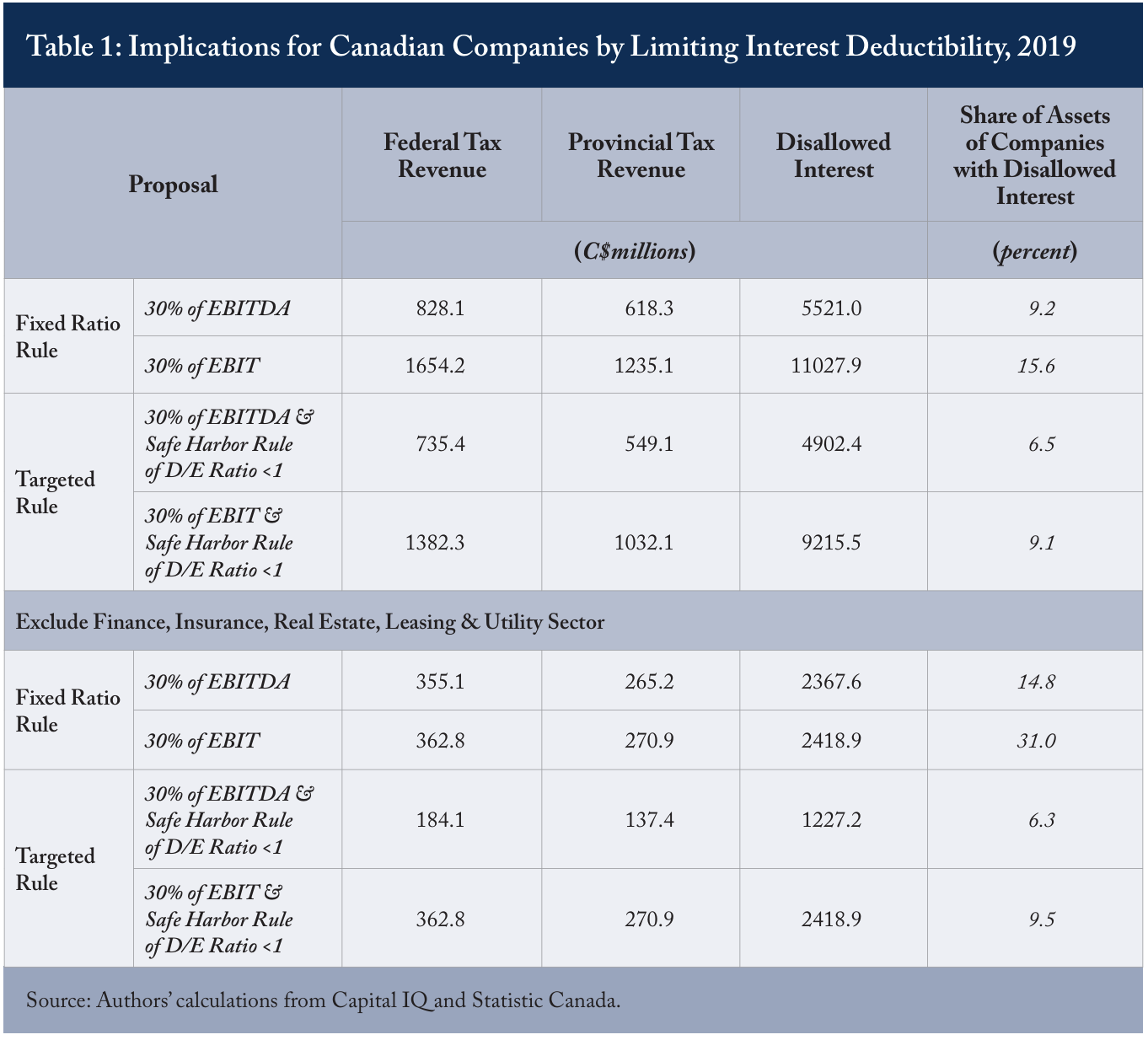
Table 1 provided the estimate of 2019 revenue and investment impacts of a broad proposal applied to all companies with net interest expense in excess of $250,000. We then make several adjustments, which include exempting low leveraged companies (with a debt/equity ratio less than 1). We also consider a limitation based on 30 percent of EBIT only. And we consider the exclusion of finance and insurance (consistent with OECD recommendations), real estate and public utility companies.
As is shown, the initial broad proposal (fixed ratio rule) based on 30 percent of EBITDA would raise $1.45 billion in federal and provincial corporate tax revenue. Disallowed interest of $5.5 billion affects companies that hold 9.2 percent of all assets.
Although not shown in the table, a sectoral analysis is briefly reported here. The biggest impact of a general limitation on net interest expense deductions would be to increase federal and provincial corporate tax payments by $612 million for financial and insurance companies (holding 4.3 percent of sector assets), $371 million for real estate, rental and leasing (73.5 percent of sector assets) and $194 million for manufacturing companies (46.1 percent of sector assets). The smallest tax impacts are on services ($3 million), transportation ($7 million) and information and services ($42 million).
A tighter rule based on 30 percent of EBIT similar to the US rule that will take force beginning in 2022 would raise $2.88 billion in corporate tax revenues as more companies would be constrained, accounting for 15.6 percent of total assets.
These additional corporate tax payments for Canadian companies would potentially result in some reduction in investment. The broad proposal is estimated to increase 2019 corporate taxes as a share of taxable income on all large companies by 0.9 percentage points (from 13.4 to 14.3 percent).1010 Using Finance Canada statistics, business taxable income of large companies was $157 billion in 2017. Indexing the value to 2019 using the GDP deflator, we estimate that taxable income would be $170 billion in 2019. See https://www. canada.ca/en/department-finance/services/publications/federal-tax-expenditures/2020/part-2.html#_Toc31637257. If the EBIT-based interest limitation rule were adopted instead, the average corporate income tax rate would rise by 1.8 percentage points.
The impact can be reduced in three ways.
The first would be adopt a safe harbour to exempt low-leveraged companies, which is used by several EU countries. As shown in Table 2, excluding companies with a debt/equity ratio of less than 1 would reduce corporate tax payments to $1.28 billion from $1.45 billion under the EBITA-based rule and to $2.41 billion from $2.88 billion for the EBIT-based rule.
A second would be to exempt certain sectors that are highly leveraged for economic reasons such as finance, real estate and public utilities. This would result in corporate tax payments of $620 million under the EBITDAbased rule and $633 million under the EBIT rule (assuming no exclusion of low-leverage companies). The case for exceptions, however, is not clear. Interest limitation rules undermine neutrality if profits paid out as interest are double taxed. The only argument for exceptions is to offset the impact of interest limitations where leverage is important for the conduct of business.
A third way would be to enable companies to carry forward or back unused interest deductions, similar to the US and certain European countries. This will require analysis of a longitudinal data set, which is our plan for future work.
Investment Impacts
As shown by Chen and Mintz (2008) and Mintz (2018), the disallowance of interest deduction would raise the cost of financing for marginal investment decisions. The reason: the loss of interest deductions for additional dollars borrowed and invested in capital assets. On the other hand, investing in more capital creates additional adjusted earnings to absorb interest deductions (see Mintz 2018 for a theoretical derivation of results for both the EBITDA and EBIT interest limitations). At the margin, therefore, the effective tax rate unambiguously increases for structures, land and inventories since the earnings effect has a smaller impact than the interest disallowance. For machinery investments, the effect of the EBITDA-based earnings-stripping rules is ambiguous. The effective tax rate can be reduced since investments in highly depreciable assets enables the company to create more room to absorb interest expenses, even though interest disallowance increases the financial cost of capital. In the case of EBIT-based interest limitation rules, the overall impact is to increase the effective tax rate on capital since the impact on the cost of finance is larger than the earnings effect
As Chen and Mintz (2008) empirically estimate for Canada, the overall effect of an EBITDA-based earnings stripping rule is to reduce the effective tax rate on marginal investments in machinery while raising it for structures, inventories and land. Mintz (2018) shows that the US earnings limitation rule has a similar impact. This analysis needs to be extended in future work.
Policy Conclusion
We conclude that a broad interest limitation rule should not be applied to all domestic and multinational companies. It could lead to double taxation of bond-financed capital investments. It will be distortionary across sectors and assets as well as discourage investment. Given that Canada has had difficulty attracting investment since 2015 (except in residential construction) even before the current medically induced economic recession, the interest limitation rule broadly applied will be inappropriate, especially in a cyclically based resource economy like Canada.
The estimated impact of the broad proposal on federal and provincial corporate tax payments is $1.45 billion in 2019 across large and medium-size Canadian corporations. This results in an increase in the average corporate income tax rate of 0.9 percentage points. To keep the effect neutral, a reduction in the corporate income tax rate by 1 point would be needed, similar to recent reforms in Europe (Bazel and Mintz 2020). It is also suggested that a safe harbour should be introduced so low-leveraged companies are exempt.
Appendix: Methodology
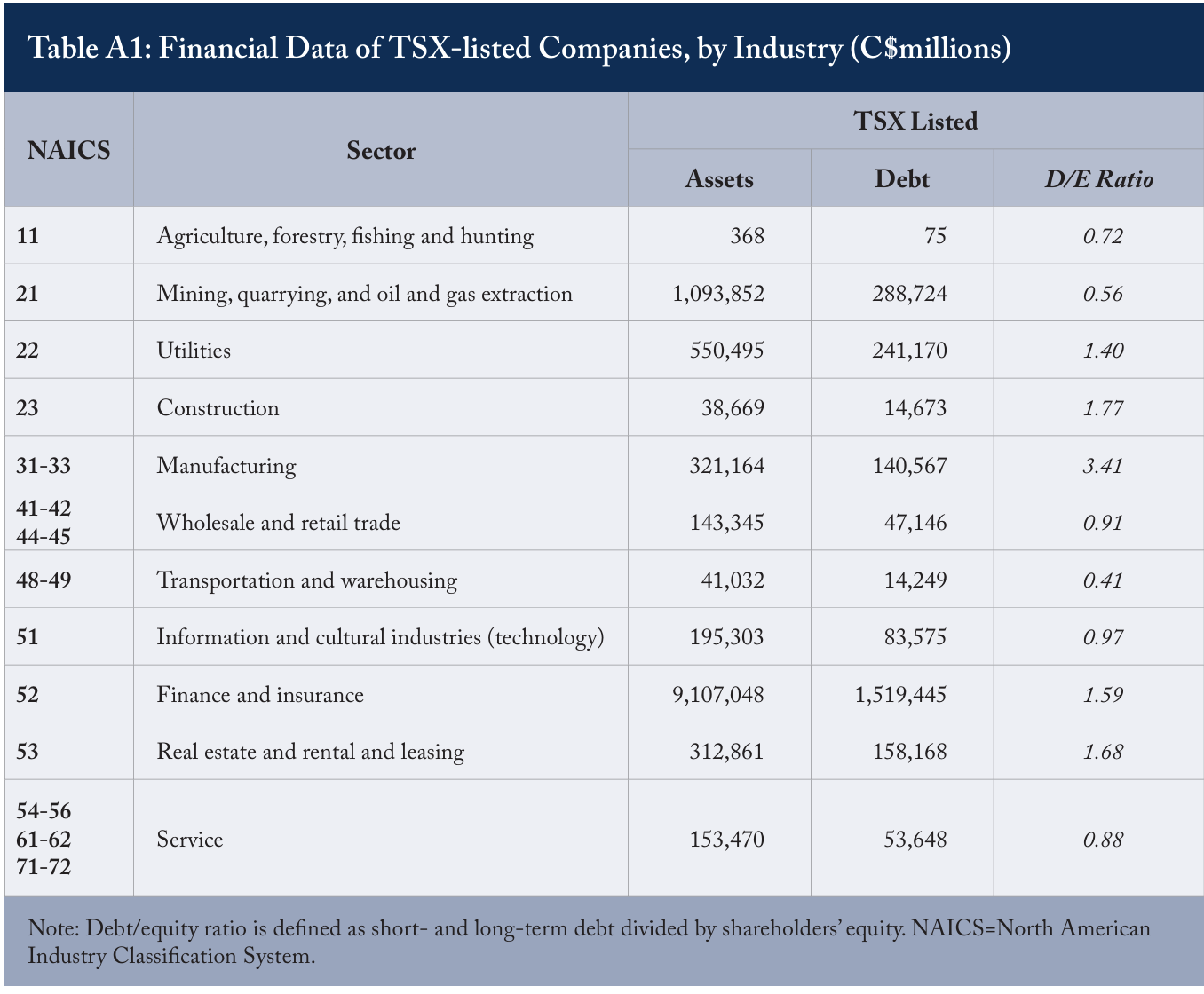
To estimate the impact of interest limitation rules, we use published accounting statements of TSX-listed consolidated companies for 2019 (Table A.1 provides summary data). For each company, we determine the amount of net interest expense in excess of 30 percent. We exclude companies if their net operating loss carry forwards are more than EBITDA. The excess amount is multiplied by the federal and the average provincial corporate income tax rate, which is then totalled for the universe of companies. Our database includes $11.92 trillion in assets. Statistics Canada reports data for Canadian enterprises regardless of size as well as including income and assets of domestic establishments ($12.9 trillion in 2017 which we index by nominal GDP growth for 2019 values). We adjust our corporate tax estimate to exclude international business (12 percent) and those claiming the small business deduction (24 percent) using the distribution of corporate taxable income as a proxy for assets (Finance Canada Tax Expenditure data 2020).
References
e-Brief Bazel, P., and J. Mintz. 2020. “The 2019 Tax Competitiveness Report: Canada’s Investment and Growth Challenge” SPP Research Paper 13:1, School of Public Policy, University of Calgary, March.
Chen, D., and J. Mintz. 2008. “Taxation of Canadian Inbound and Outbound Investment.” Advisory Panel on Canada’s System of International Taxation, Finance Canada.
Mintz, J., and Alfons Weichenrieder. 2010. The Indirect Side of Direct Investment. MIT Press, Boston, Mass.
Mintz, J. 2018. “Global Implications of U.S. Tax Reform.” Tax Notes International, 90(11): 1183-94. Also published by the European Network of Economic and Fiscal Policy Research as EconPol Working Paper 08, March 2018.
Technical Committee on Business Taxation. 1998. Report, Department of Finance, Ottawa.