




By Peter MacKenzie and Mark Zelmer
- The proposed Defence, Security, and Resilience Bank (DSRB) could strengthen allied defence capabilities, expand financing for Canadian defence suppliers, and create economic opportunities through its Canadian headquarters. But these benefits must be weighed against the financial risks of its proposed structure.
 Canada could bear a disproportionate share of the DSRB’s financial risk. Canada and Luxembourg are the only triple-A-rated sovereigns among its nine founding members, and Canada accounts for roughly 41 percent of their combined economic output. Although Canada’s liability would be capped, its credit strength could leave it carrying an outsized burden if weaker members cannot meet their obligations.
- Canada should secure stronger financial safeguards before committing to the DSRB. The authors recommend adequate capital, conservative lending limits, protections against high-risk exposures, and governance rights reflecting financial commitments. Any expansion of the DSRB should depend on attracting more highly rated members, rather than increasing Canada’s exposure.
 Canada could bear a disproportionate share of the DSRB’s financial risk. Canada and Luxembourg are the only triple-A-rated sovereigns among its nine founding members, and Canada accounts for roughly 41 percent of their combined economic output. Although Canada’s liability would be capped, its credit strength could leave it carrying an outsized burden if weaker members cannot meet their obligations.
1. Introduction
At the North Atlantic Treaty Organization (NATO) summit in Ankara, Türkiye, nine countries (Canada, Albania, Belgium, Greece, Latvia, Luxembourg, Romania, Türkiye, and Ukraine) declared their shared intention to establish the Defence, Security, and Resilience Bank (DSRB). The Bank will be headquartered in Canada.11 Canada (2026b; 2026d). This was welcome news to many Canadians; the DSRB is expected to create jobs and attract investment through military and infrastructure contracts for Canadian companies. However, given the countries participating in the DSRB, Canadian policymakers should take care to ensure that a good idea does not become a financial burden for Canada.
The case for a defence bank is stronger today than in previous years. Defence spending is rising rapidly across almost all NATO members as they adjust to a more turbulent geopolitical environment. NATO allies have pledged to raise annual defence and defence-related spending from the previous target of 2 percent of GDP, which Canada reached this year, to 5 percent by 2035.22 NATO (2025). The pledge combines 3.5 percent of GDP for core defence spending with a further 1.5 percent for defence-related investment. On Canada reaching the 2 percent benchmark, see Department of National Defence (2026). A multilateral bank can leverage its shareholders’ strong credit ratings to provide low-cost, long-term financing for members, and its guarantees can help bring private lenders back in (Murray 2024). Hosting the institution is expected to create jobs in Canada, generate demand for professional services, and give Canada a seat at the centre of allied industrial policy.
The DSRB’s promoters describe a model that works by “leveraging a strong credit rating.”33 Canada (2026c). Yet only two of the nine founding members have such ratings. Canada and Luxembourg are the group’s only triple-A sovereigns, and Luxembourg’s economy is roughly one-twenty-fifth the size of Canada’s.44 Trading Economics (2026). The United Kingdom, rated AA by S&P and Aa3 by Moody’s, considered joining in September 2026 but decided in October not to (Reuters 2026). Every other member sits somewhere between the bottom of the double-A range and the deep end of speculative grade; and one of them, Ukraine, is still working through a wartime debt restructuring. These partners are necessary to deliver the DSRB’s defence objectives. The concern is how the financing arrangements allocate risk among members with different capacities to pay.
That composition raises three questions: what exactly is Canada exposed to if weaker members cannot pay their way? Why have the world’s other top-rated sovereigns, with one small exception, not joined? And what should Ottawa insist on before Parliament ratifies the DSRB’s charter? The short answers are that Canada’s legal liability is capped, but its economic role is outsized; Canada and Luxembourg stand to gain from hosting and supplier opportunities; other top-rated sovereigns likely stayed out because of their involvement in other European defence initiatives; and Canada has the greatest leverage to influence the DSRB’s design now, before ratification.
2. Canada’s Role in the DSRB
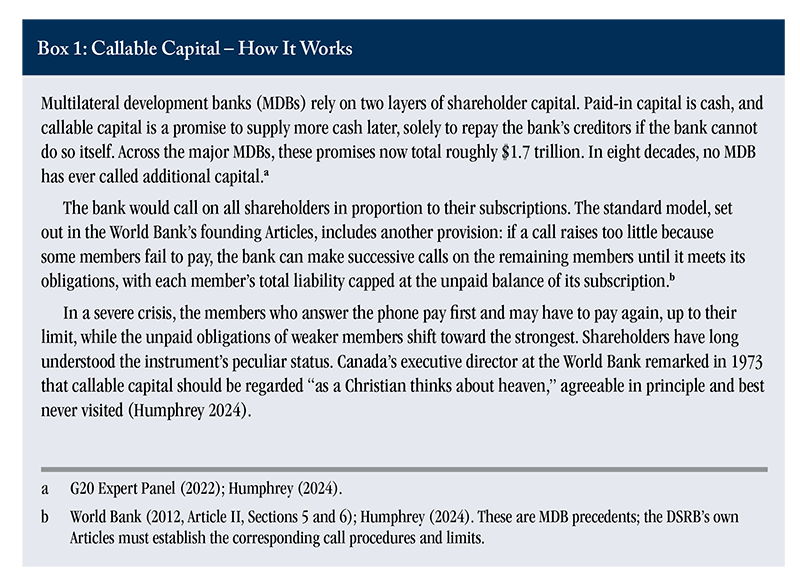
The DSRB follows the standard multilateral development bank template. Members subscribe capital roughly in proportion to the size of their economies. They pay a small share in cash and pledge the remainder as callable capital, a treaty guarantee that the DSRB can draw on only to repay its creditors if it cannot do so itself. Reporting on the negotiations points to a structure of roughly 20 percent paid-in and 80 percent callable capital, with bonds issued against that base to fund sovereign loans for procurement, guarantees for commercial lenders, and working-capital support for suppliers.55 Geopolitical Monitor (2026). Box 1 explains how callable capital works and how successive calls can require members with the capacity to pay to contribute again, up to their unpaid subscription limits.
The concept of a DSRB originated with Rob Murray, a former head of innovation at NATO. His 2024 Atlantic Council blueprint sketched a bank with roughly $11 billion of paid-in capital supporting some $90 billion in subscriptions.66 All dollar amounts are in Canadian dollars. Amounts reported in US dollars, euros, and pounds are converted at Bank of Canada exchange rates for October 20, 2026: $1.41 per US dollar, $1.58 per euro, and $1.88 per pound. It made clear that combining paid-in and callable capital would help secure a triple-A rating and the low borrowing costs that come with it (Murray 2024). A 2025 meeting in the City of London drew representatives from 37 nations, alongside the rating agencies and major global banks.77 DSRB Development Group (2025); Murray (2024). The meeting highlighted the proposed benefits: longer-term funding for governments, guarantees that ease financing constraints for suppliers, and more predictable defence procurement and production.
The DSRB has big ambitions. It envisions a balance sheet that could eventually reach $188 billion and a membership of as many as 40 countries.88 The Globe and Mail (2026a); Geopolitical Monitor (2026). Canada, the largest founding economy, would reportedly contribute up to $2.4 billion, with smaller members paying less.99 Science|Business (2026). Public reporting does not make clear whether the figure refers to Canada’s paid-in amount or to its total subscription. Twelve internationally active banks, including all six of Canada’s large banks, have endorsed the project.1010 Canada (2026c); The Globe and Mail (2026a). The six non-Canadian institutions are JPMorgan Chase, ING, Deutsche Bank, Commerzbank, Landesbank Baden-Württemberg, and Natixis.Luxembourg would host the DSRB’s European hub, and Ottawa describes the DSRB as a complement to, rather than a duplicate of, the European Union’s Security Action for Europe (SAFE) loan program, the European Investment Bank’s expanded defence lending, and Britain’s Multilateral Defence Mechanism (MDM).1111 Science|Business (2026); Canada (2026c); Council of the European Union (2025); European Investment Bank (2025).
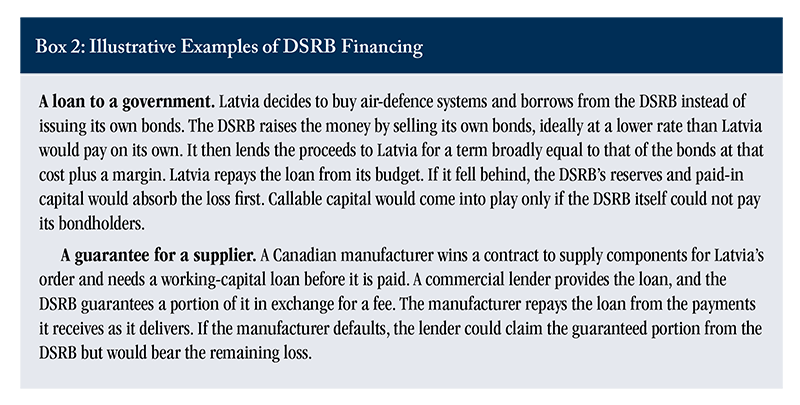
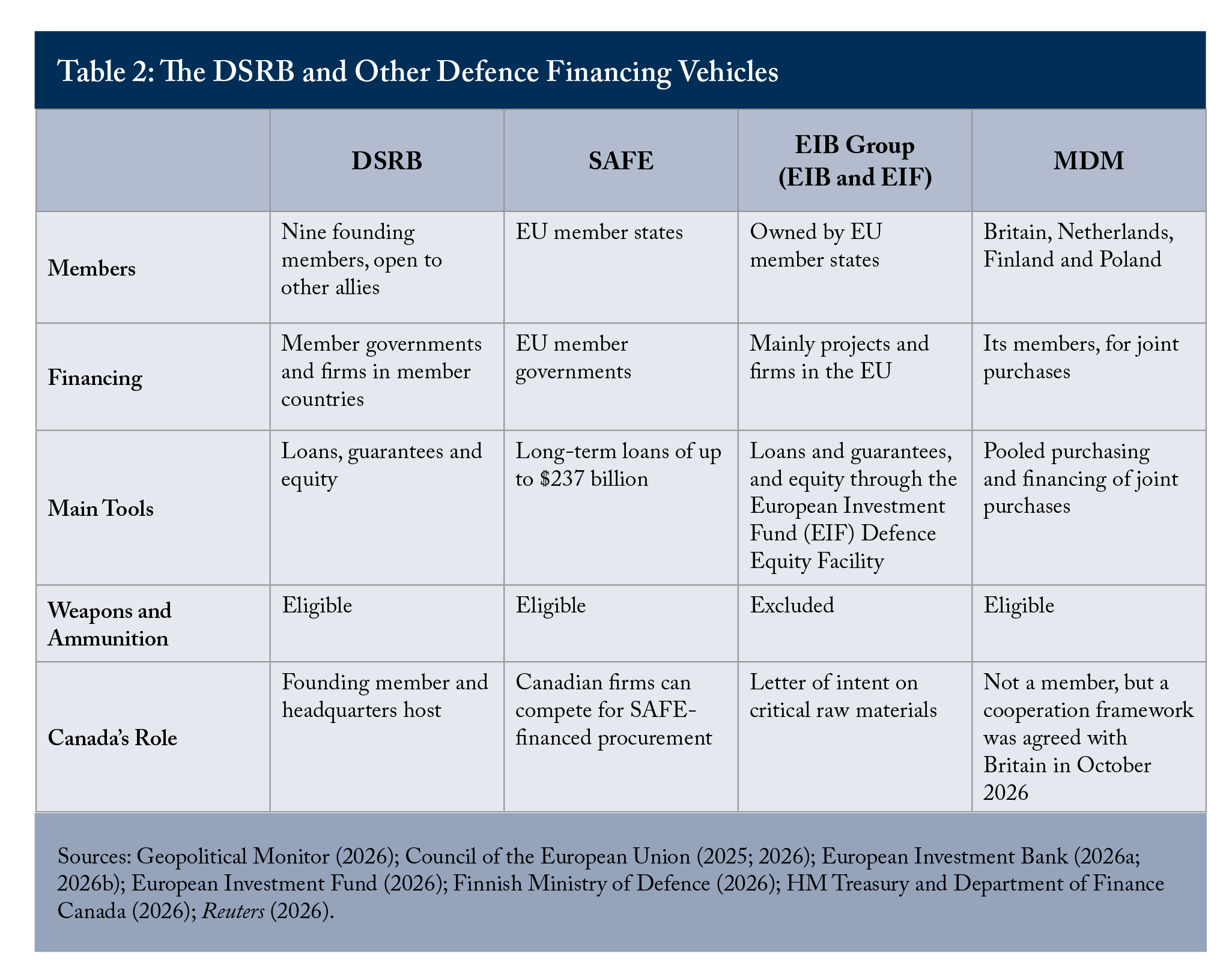
None of these existing financing mechanisms serves both Canada and allies outside the EU. SAFE lends only to EU member states, while Canada’s agreement gives Canadian firms access to SAFE procurement but not financing. The European Investment Bank lends mainly within the EU and still excludes weapons and ammunition. The MDM pools demand and finances joint purchases among its own members. The DSRB would be the only institution offering loans to individual governments and guarantees for supplier loans across a membership that spans North America, the EU, and countries such as Türkiye and Ukraine (see Box 2). But this overlap comes at a cost: each institution needs its own capital, staff, and credit rating, while the highly rated sovereigns that enable low-cost funding are spread across them. Several prospective members cited this overlap as a reason for not joining.1212 Council of the European Union (2026); European Investment Bank (2026a; 2026b); Finnish Ministry of Defence (2026); Withers, Martinuzzi, and Papadimas (2026).
The DSRB’s business model would combine lending and guarantees. It would raise funds in capital markets to finance defence procurement and eligible infrastructure projects for member governments. It would earn interest and loan fees and could charge commercial lenders or borrowers a fee for guaranteeing part of a supplier loan. Its interest margin and fees would need to cover its own funding costs, operating expenses, and expected credit losses. Bond proceeds and shareholder capital would finance the DSRB but not its operating expenses.1313 Murray (2024); World Bank (2012, Article III, Section 4, and Article IV, Sections 4 and 5). Proposed model, subject to DSRB operating rules.
Loan repayment sources differ by borrower. A government borrowing to buy military equipment would service the debt from tax revenues and other budgetary resources. The equipment itself would not need to generate tolls, electricity sales, or other receipts. Development-bank lending also relies on the borrower’s or guarantor’s capacity to pay, rather than requiring every public project to produce its own cash flow. A defence supplier, by contrast, would repay a loan from sales or procurement-contract receipts. For example, a Canadian components manufacturer could borrow to expand production for an allied order, then repay the loan as it receives payments for deliveries.
Under a guarantee arrangement, the commercial lender advances the funds, and the DSRB earns a fee for taking an agreed share of default risk. Any payment by the DSRB would depend on the guarantee’s contractual terms. A guarantee covers only part of a loan, so lenders should not base their credit decisions on the guarantee alone. Of course, governments still need fiscal capacity, and suppliers need viable contracts, since defence spending is not self-financing. A credible business plan must set out the expected income, expenses, and losses, assess borrowers’ ability to repay, and explicitly identify any subsidy or donor support.
For Canada, the financing benefit is likely to be greater for defence suppliers than for Ottawa itself, since the federal government already borrows on favourable terms. Loans and guarantees could help smaller firms finance equipment, inventory, and the period between producing components and receiving payment under a procurement contract. This could help expand Canadian production and exports that financing constraints might otherwise delay. The benefit depends on providing additional credit or better terms for useful investment, rather than replacing financing that firms could already obtain.1414 Murray (2024); Canada (2026c). Potential benefits depend on additional financing, procurement eligibility, and viable contracts.
Canada’s defence industry is relatively small, particularly compared with that of the United States. Underinvestment since the end of the Cold War has left the industry with only a few large players and relatively few small and medium-sized firms. Many new entrants struggle to raise capital because their profitability often depends on government contracts, which are not guaranteed. The DSRB could potentially help finance some of these smaller players that struggle to qualify for conventional bank credit. Lenders remain wary of the sector’s limited customer base and uneven cash flows. Canada’s large banks avoided defence lending for decades on environmental, social, and governance (ESG) grounds and have only recently begun to return.1515 BDC (2026a); Chouiekh (2026). BDC’s Defence Platform and EDC now fill part of that gap for Canadian firms and exporters, and the Canadian Commercial Corporation acts as a prime contractor for sales to foreign governments but does not lend. The DSRB could fill a remaining gap by lending to allied governments purchasing from suppliers across multiple countries using the pooled credit strength of its member governments.1616 BDC (2026b); Export Development Canada (2026); Canadian Commercial Corporation (2026).
Joining the DSRB could also help Canada strengthen allied supply chains. The DSRB could finance purchases of equipment and components from allied partners, as well as sales to them. Financing production could ease bottlenecks and improve the availability of supplies, while coordinated procurement could support longer production runs and compatible equipment. Canadian firms could gain from financed allied purchases, subject to procurement rules, competitive bids, and contract awards. Realizing these opportunities would require Canada and its partners to demonstrate that their businesses are ready for investment. Hosting the DSRB does not guarantee that procurement will flow to Canadian suppliers.
Hosting the headquarters would create professional jobs and demand for legal, accounting, and financial services, alongside opportunities to influence the institution’s governance and priorities. Luxembourg would receive similar benefits from its European hub. These hosting gains are distinct from the interest and fees earned by the DSRB, which belong to the institution rather than automatically to Canada. Together with stronger allied capabilities, they provide a case for continuing the project. They must nevertheless be weighed against hosting costs, the opportunity cost of supplying paid-in capital, and the risk of callable commitments.
2.1 A Heavy Reliance on Two Strong Credits
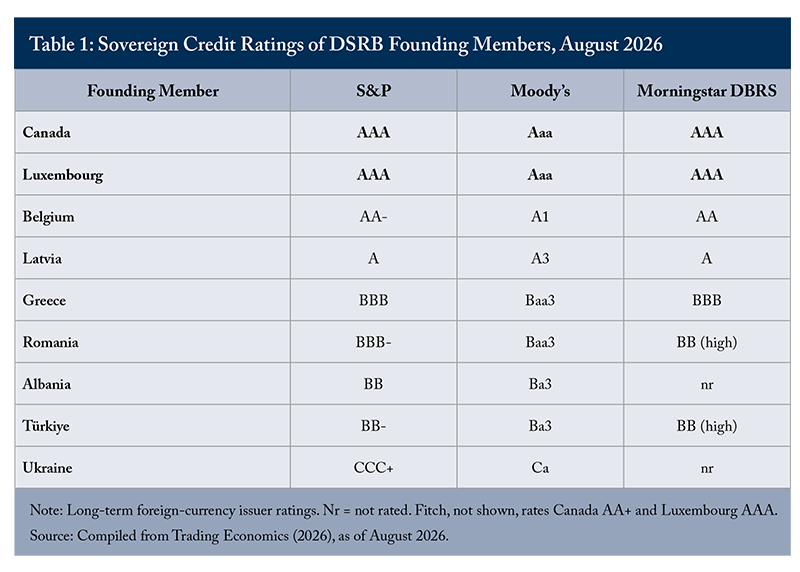
Table 1 shows the credit ratings of the nine founding members from the major rating agencies. Canada and Luxembourg hold triple-A ratings from S&P, Moody’s, and Morningstar DBRS. Belgium, which both S&P and Moody’s downgraded over the past year, ranks three notches lower. Latvia sits in the middle of the single-A range. Greece and Romania occupy the lowest rungs of investment grade, and Morningstar DBRS already rates Romania a notch below it. Albania and Türkiye have speculative-grade ratings, whatever their recent direction of travel. Ukraine, whose foreign-currency bonds were restructured in 2024, has ratings of CCC+ from S&P and Ca from Moody’s, indicating a borrower in or near default.
Even the Canadian anchor is not quite as solid as it once was. Fitch downgraded Canada from AAA to AA+ in June 2020 and reaffirmed that rating in July 2026, citing gross general government debt of roughly 92 percent of GDP, close to double the median for AA-rated sovereigns.1717 Fitch Ratings (2026); CBC News (2020). On the affirmations by S&P, Moody’s, and Morningstar DBRS that followed the November 2025 federal budget, see Financial Post (2025). Despite the Fitch downgrade, Canada remains a top-tier credit, and S&P, Moody’s, and Morningstar DBRS all affirmed their top ratings after the November 2025 federal budget. Among the founding members, only Luxembourg has a unanimous triple-A rating across all four agencies.
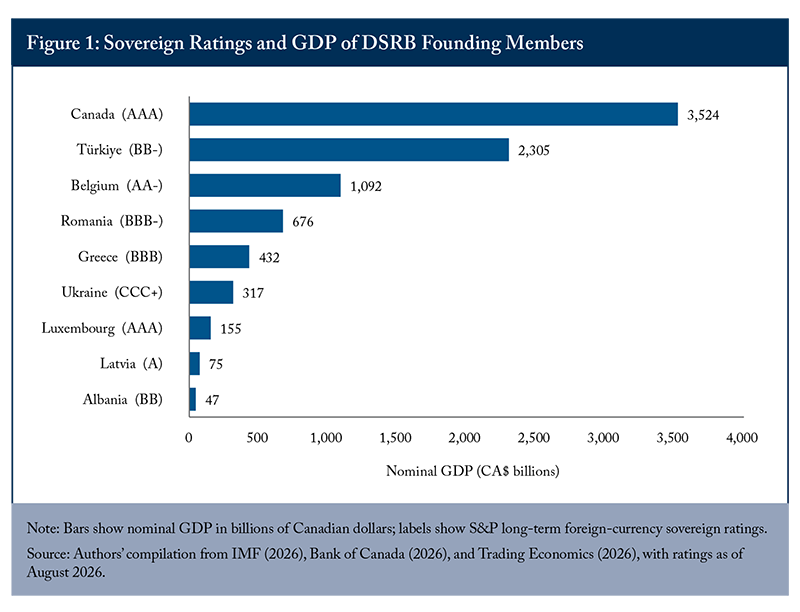
The size of Canada’s economy compounds the ratings gap and its implications for the DSRB’s operations and debt structure. According to International Monetary Fund (IMF) figures, Canada accounts for roughly two-fifths of the founding group’s combined annual economic output and Canada and Luxembourg together account for about 43 percent. The members rated below investment grade by at least one of the three agencies shown, Türkiye, Ukraine, Albania, and Romania, account for nearly another two-fifths.1818 Authors’ calculations from the nominal GDP values in Figure 1: Canada 40.87 percent; Canada and Luxembourg 42.67 percent; the four members with ratings below investment grade from at least one agency, 38.79 percent. IMF (2026). These economic weights are not agreed capital shares. Capital subscriptions (paid-in cash and callable capital) have been discussed in proportion to economic size, a principle Canada’s lead negotiator has acknowledged is a hurdle for some participants.1919 Chartier (2026). If subscriptions followed these economic weights, roughly 40 percent of the capital base would fall on Canada, while the most likely borrowers would supply much of the rest (see Figure 1). These are illustrative shares; Canada’s actual subscription and callable exposure will ultimately depend on negotiated capital allocations.
Contrast this with the founding of the last major Western multilateral bank. When the European Bank for Reconstruction and Development was founded in 1990, the G7 and other highly rated sovereigns held the dominant share of its capital, and the transition economies it was established to finance held small stakes. The DSRB inverts that pattern. Its future borrowers largely comprise its founding membership, with a single large creditor country leading the institution. A multilateral institution promising lower borrowing costs tends to attract sovereigns facing the highest funding costs in global debt markets – a form of adverse selection. The countries with the most to gain from joining have the weakest credit, while highly rated sovereigns that would enable the DSRB to borrow cheaply stand to gain the least. Each weaker member that joins therefore makes membership less attractive to stronger ones. A sovereign that already borrows at triple-A rates may gain little from using the DSRB as a borrower. Its economy could still benefit through supplier opportunities and stronger collective security, but those gains must be weighed against its capital commitments and alternative financing options.
3. Canada’s Financial Exposure
Canada faces two channels of financial exposure through the DSRB. The first is callable capital (Box 1). This contingent liability is capped at Canada’s unpaid subscription and can be called under the Articles only to meet the DSRB’s obligations to creditors if the institution cannot do so itself. The history of multilateral development banks is reassuring. No multilateral bank has ever called capital, and Canada already has $43.6 billion in callable commitments to the World Bank and the regional development banks.2020 Canada (2025). Callable share capital stood at $43,557 million as of March 31, 2025. These existing commitments provide context but do not establish whether a DSRB subscription would be modest or acceptable. Its size and risk must be assessed independently of the historical absence of capital calls at other institutions.
The second channel concerns other members’ ability to honour their callable capital commitments if needed. The DSRB’s funding costs will depend on how rating agencies assess shareholder support. Although their methodologies differ, rating agencies share one principle: callable capital carries little weight unless the shareholder backing it is highly rated. S&P, for example, recognizes callable capital in its uplift calculation only when shareholders are rated at or above the level the institution seeks to achieve. Moody’s assesses members’ capacity to pay a call through their own ratings, and Fitch anchors its support assessment on the average rating of key shareholders.2121 S&P Global Ratings (2025). For a comparison of the three agencies’ differing treatments of callable capital, see Humphrey (2024). Among the founding members, the eligible pool consists essentially of Canada and Luxembourg. Canadian support would therefore be important to the DSRB’s ability to secure favourable funding terms, alongside its own paid-in capital, liquidity, and lending policies.
So, is Canada on the hook? Legally, liability is capped at Canada’s subscription, capital calls can only service the DSRB’s debts, and several safeguards (paid-in equity, reserves, preferred creditor treatment, and conservative leverage) stand between a borrower default and a capital call. But within that cap, the successive-call mechanism described in Box 1 shifts the burden of an extreme crisis toward members with the capacity to pay. In a founding group where four of nine members carry a speculative-grade rating from at least one agency, and one is emerging from default, Canada’s central role is clear. Canada does not guarantee every DSRB bond. Nevertheless, the DSRB’s borrowing model relies heavily on Canada’s financial strength. Whether the DSRB adopts the same successive-call provisions should become clear when it publishes its Articles of Agreement.
The good news is that MDB sovereign loan portfolios have performed remarkably well over eight decades, partly because borrowers seek to preserve their access to financing. Callable capital has never come close to being needed, including during the 1980s debt crisis, the global financial crisis, and the pandemic.2222 G20 Expert Panel (2022); Humphrey (2024). However, MDBs established this record by lending to peacetime governments for projects such as dams and highways, under an unwritten convention of preferred creditor treatment. In some cases, conditions attached to emergency IMF lending have reinforced that treatment when borrowers face financial distress. The analogous repayment sources for defence lending are government budgets and suppliers’ sales or contract receipts, as explained above. A security crisis could simultaneously weaken borrowers’ revenues and member countries’ capacity to meet capital calls. The historical MDB record therefore cannot by itself establish the risk of the DSRB’s defence portfolio.
3.1 The Challenge of Securing a Triple-A Rating
The rating question matters because it affects the DSRB’s funding costs and its reliance on Canadian support. The DSRB has two main routes to obtaining a triple-A credit rating: shareholder support or standalone financial strength. The Asian Infrastructure Investment Bank (AIIB) holds triple-A ratings from all three major agencies even though its dominant shareholder, China, is rated in the single-A range. The AIIB demonstrates the second route. It achieved these ratings with roughly $27 billion in paid-in capital, about a fifth of subscriptions, alongside conservative leverage and deliberately cautious early lending.2323 AIIB (2025); Humphrey (2024). The AIIB’s 20 percent paid-in ratio was set at its founding in 2015, and the bank is rated AAA by S&P, Aaa by Moody’s, and AAA by Fitch.
The AIIB route is open to the DSRB, but it is expensive. An institution that must hold large paid-in capital relative to its loans cannot also offer members large opening cheques and a large balance sheet. With contributions on the scale of Canada’s reported $2.4 billion, the DSRB’s initial lending capacity will depend on the total paid-in capital, leverage, and proposed portfolio, rather than its stated ambition of reaching a $188 billion balance sheet. Expanding lending capacity beyond those initial constraints would require more paid-in capital from members who joined partly to avoid paying cash, more high-grade shareholders, or heavier reliance on callable capital that only Canada can meaningfully supply.
A further wrinkle is that rating agencies essentially act as de facto regulators of multilateral banks, yet assess the same institutions differently. A bank seeking top ratings from all three major agencies must meet the standards of the most conservative (Humphrey 2024). The DSRB could plausibly launch with split ratings, triple-A from one agency and a notch or two lower from the others, much as Canada itself carries. A split rating would not be fatal. It would, however, reduce the interest savings for borrowers. Canada’s objective should be a financially sustainable DSRB whose benefits justify its commitments. A unanimous triple-A rating is one possible means to that end, not a goal that warrants excessive Canadian support. A smaller DSRB or lower rating may be preferable if the alternative places too much risk on Canada.
A related design issue will likely shape who joins next. NATO’s 2035 pledge includes an allocation of up to 1.5 percent of GDP for defence-related investment; governments have signalled that they want to know whether DSRB capital subscriptions will count toward this target before committing.2424 Chartier (2026); NATO (2025), paragraphs 2 and 3. The 2035 pledge combines at least 3.5 percent of GDP for core defence and up to 1.5 percent for broader defence and security-related investment. If subscriptions count, the DSRB becomes a convenient vehicle for meeting the pledge, which might help recruitment. If they do not, the case for joining weakens. Ottawa should seek a clear answer from NATO before counting its own subscription toward any pledge. Canada could propose that subscriptions qualify and seek support from other allies. But Canada’s position would remain a negotiating proposal rather than an accepted NATO determination. Any decision must also distinguish between paid-in subscriptions and callable capital commitments.
3.2 Why Other Highly Rated Countries Have Not Joined
Eighteen countries participated in negotiations in Montréal. Nine signed. Britain and Germany attended as observers, but none of the alliance’s three largest European economies has joined.2525 The Globe and Mail (2026b); Canada (2026a). Britain is instead developing the MDM with the Netherlands, Finland, and Poland, an initiative Prime Minister Mark Carney describes as a procurement vehicle complementary to the DSRB. Former UK Chancellor of the Exchequer Rachel Reeves had publicly floated merging the two,2626 Chartier (2026); The Globe and Mail (2026b). but Britain decided in October 2026 not to join the DSRB and to keep the initiatives separate. The two could still complement each other. An MDM order placed with suppliers in DSRB member countries could qualify for financing supported by a DSRB guarantee.
The pattern among the triple-A club is starker still, as Germany, the Netherlands, Denmark, Sweden, Norway, Switzerland, Australia, and Singapore all borrow at rates a new DSRB may struggle to beat. The benefits of sovereign borrowing through the DSRB may therefore be limited, although supplier financing and collective security could still offer value. Membership would also bring capital commitments and the potential obligation to support the DSRB’s rating. European triple-A-rated countries also have alternatives closer to home. The EU’s SAFE program offers $237 billion in defence loans funded by the EU, and the European Investment Bank dropped its dual-use restriction in 2025 and expanded its security lending.2727 Council of the European Union (2025); European Investment Bank (2025). Table 2 compares these alternatives with the DSRB. Germany amended its constitutional debt brake to exempt defence spending above 1 percent of GDP and can fund rearmament at German government bond yields. The United States, which lost its unanimous triple-A status following Moody’s downgrade, also uses bilateral military-financing channels.2828 On the March 2025 constitutional amendment exempting defence spending above 1 percent of GDP from Germany’s debt brake, see CNBC (2025). On the United States, see Moody’s Ratings (2025) and Defense Security Cooperation Agency (2026).
Luxembourg is the exception, having secured the role of the DSRB’s European hub when it signed on.2929 Science|Business (2026). For a small financial centre, hosting part of an international financial institution is a tangible prize, and Luxembourg’s callable capacity, however pristine its rating, is small in absolute terms. Canada also stands to gain from hosting, in addition to the supplier and security gains discussed above. These advantages help explain why its calculation may differ from that of other highly rated countries. But those countries have alternative financing options and different industrial interests, so their absence does not necessarily mean that hosting is the only benefit of membership.
The countries that have stayed out may not be gone for good. Germany’s defence industry association has urged Berlin to join, and the DSRB Development Group notes that international financial institutions typically start with a core group and widen through later capital rounds.3030 The Globe and Mail (2026b); DSRB Development Group (2025). Additional partners are important if the DSRB is to broaden its capital base and expand safely. However, Canada cannot assume they will join and must negotiate safeguards that work with the existing founding members. If additional countries do not join, the DSRB should operate within the resources of the committed group. If a partner leaves, Canada should not automatically replace its contribution. Rather than increasing Canada’s exposure, the options should include a smaller institution, a delayed launch, or reconsideration of Canadian participation.
4. Policy Recommendations
Despite these concerns, we do not argue for walking away from the DSRB project. The potential benefits of supplier financing, export opportunities, stronger allied supply chains, and hosting provide a case for moving forward. However, they do not justify Canadian participation regardless of the terms or establish that the benefits outweigh the financial commitments. Instead, Canada should use the leverage it has right now. Canada’s proposed hosting role and credit strength give it influence over the DSRB’s design, while domestic treaty and funding processes offer an opportunity to define and authorize Canada’s obligations. The Articles of Agreement will be signed on November 30, and we hope Ottawa considers the following recommendations before then, recognizing that some may already be reflected in the Articles.3131 Canada (2026e).
We propose five conditions to make the DSRB worthwhile for Canada:
First, strengthen the DSRB’s financial position to secure attractive funding terms without relying excessively on Canadian support. The Articles should establish an AIIB-style structure, with a paid-in share of at least 20 percent; a leverage ceiling; preferred creditor treatment for sovereign lending; single-borrower concentration limits; and an arrears policy that suspends new lending to members who fall behind on any obligation, including capital calls. These safeguards would help the DSRB borrow at favourable rates based on its own financial strength, rather than relying primarily on Canada’s credit standing. The 20 percent paid-in share should be a negotiating benchmark, tested against the proposed portfolio and potential losses under stress; it does not guarantee a particular rating. These safeguards may reduce the DSRB’s initial scale or appeal to some members, as discussed above.
Second, tie the DSRB’s growth to an expanded membership. Canada should cap its subscription at ratification and make any subsequent capital increase or expansion toward the $188 billion target conditional on additional highly rated shareholders joining. With Britain keeping the MDM separate, Germany’s entry would significantly strengthen the DSRB’s credit base, while the addition of the Netherlands or Finland would help spread the burden of supporting its credit rating beyond Canada. Nevertheless, the DSRB must be viable with its existing founding members. If further partners do not join, the DSRB should remain smaller rather than increase Canada’s exposure. Any additional Canadian commitment should require new domestic authorization.
Third, keep the riskiest exposures off the DSRB’s general balance sheet. Financing Ukraine is a legitimate purpose and a likely source of early demand. Nonetheless, lending to a borrower rated CCC+ and Ca should occur through guarantee arrangements backed by donor first-loss coverage or dedicated trust funds, rather than ordinary loans supported by the common callable capital pool. Existing MDBs use similar arrangements for their highest-risk lending, distinguishing direct Canadian support for Ukraine from Canada effectively insuring other members’ support. A separate financing window or limited first-loss reserve would not automatically remove all residual risk. The legal terms must specify who bears losses and whether uncovered obligations could draw on the general callable capital pool. Canada should authorize and disclose any donor contributions separately.
Fourth, settle the NATO accounting question in advance of officially launching the DSRB. Whether paid-in capital subscriptions count toward the 2035 NATO target of 5 percent of GDP, either under the 3.5 percent core-defence component or the up-to-1.5 percent broader defence and security-related investment component, will shape countries’ incentives to join. Canada should obtain and disclose NATO’s determination before presenting its own subscription to Parliament as defence investment. Canada can advocate for subscriptions to qualify, but should distinguish its position from an agreed NATO determination and avoid counting callable promises or the same financed spending twice.
Fifth, align control over the DSRB with each member’s financial exposure. Votes on the decisions that put callable capital at risk, such as capital increases, lending limits, and the admission of new members, should reflect each member’s capital at risk, with voting thresholds that allow Canada and other highly rated shareholders to block such decisions. Because the DSRB’s credit rests largely on Canada, Canada should at a minimum have veto power over changes to these rules. The rules should also address circumstances in which a member government acts against the DSRB’s objectives, financed equipment reaches a non-member country, or a member experiences a significant credit-rating downgrade.
5. Conclusion
The DSRB is a good idea that, so far, has a risky structure. An institution advertised as multilateral currently relies on one large, highly rated economy and one much smaller one. The mechanics of callable capital could leave Canada bearing a disproportionate share of the burden in an extreme crisis – a scenario the DSRB’s proponents understandably hope to avoid. Its proposed banking model would generate interest and fees, with sovereign borrowers repaying loans from government budgets and suppliers from sales or contract revenues. This provides a plausible foundation for the institution, provided its lending and guarantee terms adequately cover costs and credit risks.
Ottawa should ratify a DSRB that discloses its financial obligations, maintains adequate paid-in capital, expands alongside its shareholder base, and appropriately prices its riskiest lending. Canada’s credit standing took decades to build and came through a pandemic with a single demotion from only one rating agency. Parliament should not put that standing at risk by agreeing to terms that could effectively make Canada the lender of last resort because of other members’ financial difficulties. Under the right conditions, the DSRB could help finance defence infrastructure in Canada and allied countries, while creating jobs and supporting Canadian suppliers. These potential benefits justify continuing negotiations, but they must be weighed against Canada’s financial commitments and the safeguards it secures. Canada must manage its exposure based on the founding membership rather than assume additional partners will join. If acceptable terms cannot be agreed, Canada should support a smaller DSRB or reconsider its participation rather than assume greater financial risk.
The authors extend gratitude to Mawakina Bafale, Colin Busby, Alex Ciappara, Dave Longworth, Aaron Meyer, and several anonymous referees for valuable comments and suggestions. The authors retain responsibility for any errors and the views expressed.
References
AIIB (Asian Infrastructure Investment Bank). 2025. 2024 AIIB Annual Report and Financials. Beijing: AIIB.
Bank of Canada. 2026. “Daily Exchange Rates.” Ottawa: Bank of Canada. Accessed October 22, 2026.
BDC (Business Development Bank of Canada). 2026a. Canada’s Defence Boom Is Creating a Three-Speed SME Divide. Study. Montréal: BDC. June.
______. 2026b. “How to Finance Your Defence Projects with BDC.” Montréal: BDC. Accessed November 17, 2026.
Canada. 2025. Annual Financial Report of the Government of Canada, Fiscal Year 2024–2025. Ottawa: Department of Finance Canada.
______. 2026a. “Canada Hosts Partners to Advance Establishment of the Defence, Security and Resilience Bank.” News release. Ottawa: Department of Finance Canada. March 23.
______. 2026b. “Canada Welcomes Progress towards the Establishment of the Defence, Security and Resilience Bank and Hosting Its Headquarters.” News release. Ottawa: Department of Finance Canada. April 29.
______. 2026c. “Eight Countries Commit to Supporting the Canada-led Defence, Security and Resilience Bank.” News release. Ottawa: Office of the Prime Minister. July 7.
______. 2026d. “Declaration on the Defence, Security and Resilience Bank.” Statement. Ankara: Office of the Prime Minister. July 7.
______. 2026e. “Joint Statement on the Establishment of the Defence, Security and Resilience Bank (DSRB).” Statement. Ottawa: Department of Finance Canada. October 29.
Canadian Commercial Corporation. 2026. “CCC Is Canada’s Government to Government Contracting Agency.” Ottawa: Canadian Commercial Corporation. Accessed November 17, 2026.
CBC News. 2020. “One of U.S.’s Big 3 Credit Agencies Downgrades Canada’s Credit Rating.” June 24.
Chartier, Noé. 2026. “Why Canada’s Push for a Defence Bank Has Limited Backing So Far.” The Epoch Times. July 9.
Chouiekh, Chaimae. 2026. “Canada’s Biggest Banks Get into Defence after Years of Avoiding Military Financing.” The Logic. March 30.
CNBC. 2025. “German Parliament Passes Historic Debt Reform, Paving the Way for Higher Defense Spend.” March 18.
Council of the European Union. 2025. Council Regulation (EU) 2025/1106 of 27 May 2025 Establishing the Security Action for Europe (SAFE) through the Reinforcement of the European Defence Industry Instrument. Official Journal of the European Union, L series. May 28.
______. 2026. Council Decision (EU) 2026/444 of 11 February 2026 on the Signing and Provisional Application of the Agreement between the European Union and Canada Laying Down the Conditions for the Participation of Canadian Legal Entities and Products Originating in Canada to Procurement under the SAFE Instrument. Official Journal of the European Union. February.
Defense Security Cooperation Agency. 2026. “Financial Policies and Procedures.” Chapter 9 of Security Assistance Management Manual. Accessed October 14, 2026.
Department of National Defence. 2026. “Canada Achieves the 2% of Gross Domestic Product Defence Spending Benchmark.” News release. Ottawa: Department of National Defence. March 26.
DSRB Development Group. 2025. “Official Statement.” Business Wire. December 10.
European Investment Bank. 2025. “EIB Steps Up Financing for European Security and Defence and Critical Raw Materials.” Press release. Luxembourg: European Investment Bank. March 21.
______. 2026a. “EIB and Canada Team Up to Strengthen Critical Raw Material Resilience.” Press release. Toronto: European Investment Bank. March 2.
______. 2026b. “Security and Defence.” Luxembourg: European Investment Bank. Accessed November 17, 2026.
European Investment Fund. 2026. “Defence Equity Facility.” Luxembourg: European Investment Fund. Accessed November 17, 2026.
Export Development Canada. 2026. “EDC Expands Its Support for Canada’s Defence and Security Sector at a Pivotal Moment.” News release. Ottawa: Export Development Canada. February 17.
Financial Post. 2025. “Mark Carney’s Federal Budget Could Turn Up Pressure on Canada’s Credit Rating, Fitch Warns.” November 13.
Finnish Ministry of Defence. 2026. “Joint Statement by Finland, the United Kingdom, the Netherlands and Poland on Developing the New Multilateral Defence Mechanism.” Press release. Helsinki: Finnish Ministry of Defence. July 6.
Fitch Ratings. 2026. “Fitch Affirms Canada at ‘AA+’; Outlook Stable.” Rating action commentary. July.
G20 Expert Panel. 2022. Boosting MDBs’ Investing Capacity: An Independent Review of Multilateral Development Banks’ Capital Adequacy Frameworks. Report to the G20. July.
Geopolitical Monitor. 2026. “Banking on NATO: Canada Takes Lead on the Alliance’s DSRB.” July.
The Globe and Mail. 2026a. “Montreal to Host 18 Countries for Defence Bank Negotiations Beginning Monday.” March 22.
______. 2026b. “Eight Countries Join Canada in Backing Defence Bank, but Major European Partners Still Absent.” July 8.
HM Treasury and Department of Finance Canada. 2026. “Joint Statement from HM Treasury and Department of Finance Canada.” Statement. London and Ottawa: HM Treasury and Department of Finance Canada. October 25.
Humphrey, Chris. 2024. The Legal Underpinnings of MDB Callable Capital: Implications and Policy Options. ODI Working Paper. London: ODI. January.
IMF (International Monetary Fund). 2026. World Economic Outlook Database. Washington, DC: IMF. April.
Moody’s Ratings. 2025. “Moody’s Ratings Downgrades United States of America Ratings to Aa1 from Aaa; Changes Outlook to Stable.” Rating action. May 16.
Murray, Rob. 2024. How a New Global Defense Bank, the “Defense, Security, and Resilience Bank,” Can Solve US and Allied Funding Problems. Issue Brief. Washington, DC: Atlantic Council. December 13.
NATO. 2025. The Hague Summit Declaration. June 25.
Reuters. 2026. “Britain Will Not Join Canada-led Defence Bank Initiative.” October 25.
Science|Business. 2026. “How a New Multilateral Defence Bank Could Boost Innovation.” July.
S&P Global Ratings. 2025. Multilateral Lending Institutions and Other Supranational Institutions Ratings Methodology. New York: S&P Global Ratings.
Trading Economics. 2026. “Credit Rating – Countries – List.” Accessed August 4, 2026.
Withers, Iain, Elisa Martinuzzi, and Lefteris Papadimas. 2026. “Insight: The Battle to Build a Global Defence Bank.” Reuters. August 30.
World Bank. 2012. IBRD Articles of Agreement. As amended June 27, 2012. Washington, DC: World Bank.