





The Study In Brief
The value in 2018 of vehicles and equipment for consumer and business customers in Canada financed by the asset-based finance (ABF) industry was an estimated $416 billion. The ABF industry supports a broad network of dealers, manufacturers, distributors, vendors and brokers, and their customers throughout the country.
ABF is offered by banks, credit unions, insurance companies, government financial institutions, manufacturer finance companies, and independent finance companies. Several of these entities are regulated with consequent access to existing Bank of Canada programs for emergency lending. This paper focuses on those entities – both regulated and unregulated – that may not have such access, and yet are critical to the functioning of the economy.
ABF entities ran into deep trouble during the 2008-2009 global financial crisis and required an emergency liquidity program from the federal government that took months to devise and implement. The primary source of funding of the ABF sector was, and is, the asset-backed commercial paper and securitization markets, often with bank back-up or standby lines, purchased by private pools of investment capital – insurance companies, pension plans, hedge funds, banks and others.
The 2008-2009 experience revealed that a complete loss of liquidity could occur within a few weeks, even days. Government was needed to step into the shoes of absent private-sector investors. Given the ABF industry’s relative success and low delinquencies, this Commentary recommends that, during periods of extraordinary financial market turmoil, the federal government activate a large-scale securitization program that would fund ABF intermediaries who finance customers based on real assets. The government would purchase asset-backed securities backed by a pool of assets and their receivables, receiving the same protection and profit that a privatesector investor would receive. Once liquidity is restored and private investor confidence returned, the commercial markets would again resume their normal functioning and government could withdraw its scaled-up temporary emergency funding program.
The 2009 Federal Budget established the Canadian Secured Credit Facility, a $12 billion fund administered by The Business Development Bank of Canada (BDC) to purchase term asset-based securities (ABS) backed by loans and leases on vehicles and equipment. Since then, under successor programs, the BDC has continued to purchase ABS albeit on a smaller scale. With more than 10 years of experience, the BDC understands the policies and rules for such funding. Existing BDC programs could, therefore, be scaled up in a severe downturn, with experienced people in place for effective, prudent and efficient funding.
In a profoundly disrupted market, the policy objective should be to restore liquidity to allow the financial services sector to continue offering financing to credit-worthy consumers and businesses in support of the Canadian economy, and that must include the ABF industry.
Introduction
Asset-based finance (ABF) entities ran into deep trouble in Canada during the 2008-2009 global financial crisis, requiring an emergency liquidity program from the federal government that took months to devise and implement.
In this paper, I argue that a retrospective of these events highlights why it is crucial for the federal government to develop and maintain a permanent plan for a facility to rapidly provide market liquidity to this sector during future episodes of intense financial market-wide stress. The 2008 financial crisis illustrated how fast liquidity can disappear. Experience drawn from that time demonstrates the invaluable role that the federal government plays in assuring liquidity and stability in the broader financial system in times of crisis, while minimizing any potential long-term negative impact on the government and taxpayers.
Asset-based financing is offered by banks, credit unions, insurance companies, government financial institutions, manufacturer finance companies, and independent finance companies. Several of these entities are regulated with consequent potential access to existing Bank of Canada standing liquidity facilities and programs for emergency lending. The focus of this paper, however, is on those entities – both regulated and unregulated – that may not have such access, and yet are critical to the functioning of the economy. How can this access gap be filled?
The argument in this paper starts from the evidence suggesting that the ABF industry is integral to the well-being of the financial system and the Canadian economy. Consequently, it would be prudent policy to maintain a comprehensive plan to support these ABF entities during periods of extraordinary financial market turmoil. Thankfully, a viable model exists in the $12 billion Canadian Secured Credit Facility (CSCF) introduced in the 2009 Federal Budget. Since then, smallerscale successor wholesale and indirect financing facilities for financial intermediaries funding small and medium-sized enterprises have been devised and continue to be administered by the Business Development Bank of Canada (BDC). These current facilities, should be maintained, and positioned to be temporarily rapidly scaled-up and enhanced in times of national economic crisis.11 The author would like to acknowledge those individuals who were essential in preparing this Commentary: John Abraham, Marcel Buerkler, Moe Danis, James Joyce, Jeremy Kronick, Phil Howell, David Longworth, Michael Rothe, Pierre Siklos, Robin Somerville, and Hugh Swandel, several anonymous reviewers and members of the Financial Services Research Initiative of the C.D. Howe Institute. The author retains responsibility for any errors and the views expressed. At the time of writing, it is the author’s understanding that some of the funds allocated by the Government of Canada to the BDC under the Business Credit Availability Program (BCAP), as announced on March 13, 2020, may potentially be available for a program of the type proposed in this Commentary. If, however, private markets remain available to fund the ABF sector, it may be decided to assign these funds to other private-sector lenders.
This paper has three essential parts: first, a description of the ABF industry and why governments should be concerned about its viability during a national financial crisis; second, lessons we can learn from the 2008-2009 crisis; and third, in the event of significant turmoil in the financial system, recommendations on the elements to be considered in designing a temporary emergency funding facility for the ABF industry.
I. The Size of the ABF Industry and why the Federal Government should Care?
The ABF industry is a major source of capital and credit for Canadian businesses and consumers. Currently, including banks engaged in ABF activities, it finances over $416 billion (in terms of stock) of vehicles and equipment in Canada, making it the largest provider of credit and capital to Canadian businesses and consumers after classic lending. (As discussed in greater detail below, this financing relies on cash-flow-based credit analysis rather than on the classic bank/credit union networth lending formula basis.) Increasingly, it has become an established and critical player in the economy, expanding the pool of available capital and offering a competitive choice to businesses and consumers.
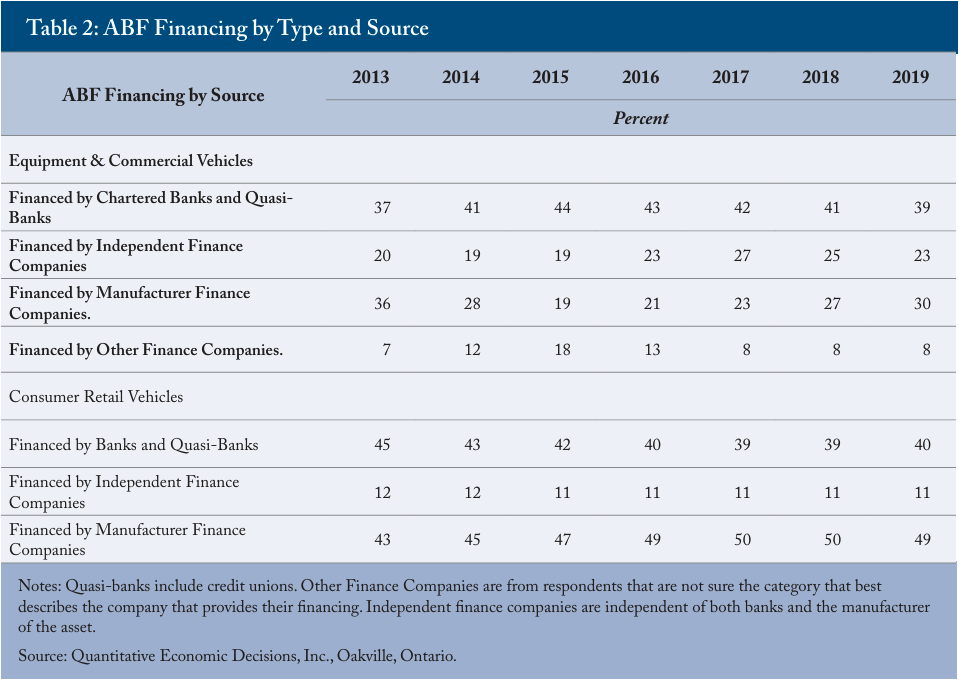
There are three main categories of assets financed by the ABF industry: consumer vehicles,22 See Table 1 below – over 70 percent of all assets financed by the ABF industry in 2018 were consumer retail vehicles. commercial vehicles and machinery & equipment (M&E).33 Note that factoring, i.e., lending on security in accounts receivables, is not included in this definition. In 2019, 39 percent of equipment and commercial vehicles and 40 percent of consumer retail vehicles were financed by banks44 See Table 2 below: ABF Financing by type and source. - these numbers are included as part of the ABF industry. While there exist a number of central bank standing liquidity facilities and programs for emergency lending to regulated financial institutions during periods of intense market turmoil, there is one sector important to the financial system that is not provided for – unregulated ABF entities and some regulated smaller banks and credit unions. How can this gap can be filled?
Most of the customers of the ABF industry are consumers and small and medium-sized businesses (SMEs).55 SME customer data is derived from the 2019 Equipment Market Research study prepared for the Canadian Finance & Leasing Association by PMG Intelligence, St. Jacobs, Ontario, September 2019. The total value of assets financed by the ABF industry in Canada rose 4.6 percent in 2018 to $416 billion. Included in that number is an annual (2018) record-setting value of new assets financed of $129 billion. New business financed in 2019 is expected to have increased by 4 percent.66 Asset-based Finance in Canada – The 2018-2019 Year, Quantitative Economic Decisions, Inc., Oakville, Ontario, November 2019, at page 1. Most ABF sector financings are amortized for terms of three to five years, hence the high percentage of new financings each year. A more detailed overview of the ABF market in Canada follows below.
What is Asset-based Finance?
The ABF industry finances the acquisition of equipment, machinery and vehicles by business and non-business entities, and retail vehicles by households. All the capital obtained by the industry is deployed to carry out that single purpose.
ABF is not the same as classic lending. The industry complements the work of conventional lenders but stands alone as an alternative way of financing. As its name suggests, asset-based finance is the financing of a specific asset: a vehicle or piece of equipment, commonly by way of a lease, loan, conditional sales contract or by a line of credit.
The specific assets financed secure the borrower’s unconditional obligation to make payments over the term of the agreement. In this way, users of equipment and vehicles can use the value of the asset as security to finance its acquisition. The financing company retains legal ownership of, or a priority claim to, the asset until the customer pays for it in full or returns it. This form of financing relies on cash-flow-based credit analysis rather than on a net-worth based lending formula. The credit decision is, therefore, heavily based on customer cash flow. Financing approval depends on whether a business will generate sufficient cash flow using the equipment financed to make the payments, or whether a consumer has sufficient cash flow to make the payments.
Vendor or point-of-sale financing is probably the most direct way for businesses and consumers to access this financing. That is, manufacturer finance companies, independent finance companies or banks provide financing through vendors/dealers at the point of sale. By way of example, both auto and equipment dealers may offer financing to customers by one or more banks and by the manufacturer’s finance company.
Asset-based financing comes in many forms and is marketed as having alternative features to traditional net-worth borrowing. For example, it is possible to arrange 100 percent financing of equipment or vehicles with no down payment. Moreover, there is flexibility in a variety of ABF products available that allow the customer to customize transactions to meet specific needs – cash flow, budget, deal structure, cyclical fluctuations, etc. Credit decisions typically are quickly made, often in minutes at the point-of-sale. In addition, certain financing programs allow the customer to keep up with technology by upgrading or adding equipment to meet ever-changing needs or to roll up to a new vehicle. In the case of a true lease, since the financing company owns the asset, it bears the risk of obsolescence.77 True lease, here, refers to an operating lease, or a closed-end auto lease. For capital leases or open-end auto leases, the lessee bears the risk of the residual value of the asset at the end of the lease term. Many financing companies provide asset management services that track the condition/status of the asset, its location, and know when to upgrade, update or dispose of it. They also provide services relating to installation, use, maintenance, de-installation and disposal.
The ABF industry supports a broad network of dealers, manufacturers, distributors, vendors and brokers, and their customers throughout Canada. The auto manufacturer finance companies and banks finance dealers and their customers for the acquisition of vehicles. Commercial fleet lessors use networks of auto dealers to acquire, maintain and dispose of fleets of vehicles for customers in every province and territory. Equipment manufacturer financing companies and independent financing companies have relationships with manufacturers, vendors and distributors of all sizes to provide financing to their customers to acquire machinery and equipment. Many equipment financing companies work with local independent brokers to source customers, particularly in smaller communities.
Four Catalysts that Jumpstarted the ABF Industry
Prior to the 1960s, the ABF industry was small in size and limited in scope. A confluence of four global developments set the industry on its significant growth course: disintermediation and disaggregation; the proliferation of funding sources; the diversification of funding techniques; and the introduction of new communications and information technologies.
Disintermediation and disaggregation. The displacement of classic bank financing by nontraditional financing, and the rise of a broader array of non-bank financial providers, has been labelled “disintermediation.”
In the traditional model, financing was an integrated process comprising five component parts – origination, credit adjudication, funding, administration and collection – all performed through one institution. This model shaped the current regulatory framework and regulatory culture.
But in financial services, this is no longer the only model. Today, there are a growing number of specialized providers dedicated to only one or two of these functions. This “thin-slicing,” unbundling or disaggregation of financial functions works when it is more cost-efficient to share responsibilities. New, as well as existing, financial institutions are choosing to concentrate on just a few of the traditional components of financing by joint venturing, out-sourcing or partnering on other services, or creating alliances of service companies. It was this combination of disintermediation and the disaggregation of financial functions that opened the doors to new financial providers.
The proliferation of funding sources. The second catalyst was the unprecedented availability of huge pools of private capital seeking global investment opportunities (e.g., pension funds, hedge funds, insurance companies and others). This phenomenon was merely a subset of the trend toward marketplace globalization. These pools of capital have proliferated the number of potential providers of funding. This has, in turn, engendered a dramatic increase in competition in a sector, which, for the last 50 to 100 years, was limited to a small number of participants. This dramatic increase in competition continues to generate a growing choice of new financial products and services, spawning new organizational models for the delivery of those products and services.
Without these pools of available capital, disintermediated and disaggregated financing entities would have had great difficulty in funding themselves to compete against traditional bank lending.
Diversification of funding techniques. The third catalyst flows from the proliferation of funding sources; it is the diversification of funding techniques, such as “securitization” (the pooling of receivables and then financing them through the sale of securities to investors88 Securitization is a well-established funding method where a pool of assets such as receivables are packaged, underwritten and sold in the capital markets in the form of asset-backed securities (ABS). A company (sometimes called the originator) sells its receivables to a securitization vehicle, a special purpose entity (SPE). An SPE can take several forms, but is generally a trust, a corporation, or a limited partnership which becomes the issuer of the ABS backed by the pool of receivables. The ABS, either in the form of an ABS term note issuance or in the form of asset-backed commercial paper (ABCP) issued by an ABCP conduit (typically sponsored by a bank or other financial entity), is then sold to investors in the private or public securities markets. After the initial sale to the SPE, the SPE uses the collections received on the receivables (which it now owns) to pay the interest and principal on the ABS debt obligations that it has issued. Once the obligations of the SPE have been satisfied, all remaining collections on the receivables are then returned to the seller/originator. Certain credit enhancement techniques can be structured into the securitization transaction to lower the ABS investors’ exposure to default risk (such as “over-collateralization,” i.e., requiring more collateral than the corresponding amount of ABS issued, or increasing the seller/originator’s “first loss” responsibility, i.e.. the seller/originator’s obligation to assume a higher percentage of initial losses should they arise.) As a consequence of (i) the sale of the receivables by the seller/originator to the SPE, which creates a separation of the receivables from an insolvency of the seller/originator, and (ii) the addition of credit enhancements structured into the securitization transaction, the ABS issued by the SPE will typically attract a lower cost of funds than the seller/originator would otherwise be able to receive if they issued securities or borrowed funds directly. The seller/originator continues to service the securitized pool of receivables so the transaction is seamless to the end customer, the seller/ originator’s client. A securitization transaction is not a loan from the SPE to the seller/originator. While securitization may be compared to a financing for discussion purposes, in law it is a sale of assets by the seller/originator to the SPE. Sources: adapted from Securitization of Lease Receivables, Securcor Financial Group, Burlington, Ontario, 2004, and from Receivables Securitization and the Non-Financial Firm, Korgaonkar, Sanket, Wharton Research Scholars. 65, Wharton Business School, University of Pennsylvania, 4th Quarter 2009, with input from James Joyce and John Abraham, TAO Asset Management.) and the growth in manufacturer financing companies, referred to frequently in the industry as “captives.” As subsidiaries of manufacturing companies, their role is to offer customer financing of their parents’ products.
Securitization is an alternative funding source for non-bank financing companies. The combination of investors with large pools of capital seeking to invest in pools of cash-generating assets has transformed the ability of non-bank financing companies to raise cost-competitive funds.
While not new, another phenomenon generating capital growth of significance in the ABF industry concerns well-capitalized manufacturing and servicing companies with substantial earnings deciding to leverage their own equity base and core competencies rather than those of third parties. This has led to many manufacturers establishing their own financing arms or partnering with those who can do it for them; many of which also rely on securitization to raise cost-competitive funds. General Electric is widely credited with being the first manufacturer to establish its own financing subsidiary, GE Capital. That model was followed by most other major vehicle and equipment manufacturers setting up their own financing subsidiaries to facilitate customer acquisition of the manufacturers’ products. Where manufacturers chose not to create financing subsidiaries, they partnered with independent financing companies to provide financing to their customers.
New technologies. The fourth catalyst was the introduction of new communications and information technologies. Increasingly in financial services, you are only as good as your technology. Communications technologies continue to create new distribution channels for financial services that allow newcomers to leap-frog the traditional, more cumbersome distribution systems at a fraction of the set-up and operating costs.
The speed and reach of new technology to capture information and to rapidly analyze that information on an unprecedented scale has made possible the identification and exploitation of many different markets in several time zones at once. New technology has revolutionized the capacity of a much broader range of professionals, often relatively few in number, to manage risk.
Sources of Funding
The ABF industry has typically operated with a minimum of bank funding. It is difficult to borrow at bank rates and then offer a competitive financing product against the same bank in the same lending market.
The primary source of funding has been the assetbacked commercial paper and securitization markets, often with bank back-up or standby lines. Private pools of investment capital – primarily insurance companies, pension plans, hedge funds, and when necessary, banks - have provided the funding over the years to help grow the industry. ABF entities originate financing transactions with their customers. Funding of these transactions is provided by assetbacked commercial paper and structured financings where private-sector investors essentially purchase the income flow (and often title to the financed assets) of a pool of leases and/or loans.
The 2008-2009 financial crisis pulled most of these private-sector funders away from the ABF industry. If the pattern demonstrated by the 20082009 experience is repeated when the next financial crisis hits, the concern is that the traditional ABF industry funders and the banks will again pull back, creating a significant funding gap, putting an avoidable dent in economic growth. That is why a temporary government-supported plan, rapidly deployable is so critical.
The Growth of the Asset-based Finance Market in Canada
According to research by Quantitative Economic Decisions Inc. (QED), the total value of all assetbased finance assets in Canada was estimated to be $416 billion in 2018, up from $138 billion in 1990, representing over 300 percent growth (in nominal terms). Table 1 breaks down the growth of the industry by its component parts since 1998.
Since 1990, the ABF industry has experienced an average annual growth of 5.1 percent (Figure 1). In 2018, the consumer retail vehicle market accounted for 72 percent of total assets financed, up from 58 percent in 1990. The business fleet vehicle market accounted for 10 percent in 2018, down from 14 percent in 1990. The M&E market accounted for 18 percent in 2018, down from 28 percent in 1990.99 Asset-based Finance in Canada – The 2018-2019 Year, Quantitative Economic Decisions, Inc., Oakville, Ontario, November 2019, at page 12. As a comparison, the value of loans outstanding by chartered banks and quasi-banks in Canada has grown by 6.3 percent a year on average since 1990. This growth has been fueled by residential and commercial mortgages and drops to 5.2 percent a year on average when these are excluded, which is comparable to the growth in finance assets over this period. Assets financed by the ABF industry are equivalent to 22 percent of non-mortgage loans made by the total private banking sector in 2018 (see Statistics Canada National Balance Sheet Accounts).
Banks, credit unions, manufacturer finance companies and independent finance companies are all involved in financing new and used asset acquisitions for their consumer and business customers. Table 2 below shows the breakdown of asset financing by source of financing over the last seven years.
By 2019, banks at 39 percent were the largest source of financing for equipment and commercial vehicles and the second largest source of financing for consumer retail vehicles (40 percent). Manufacturer finance companies accounted for 49 percent of the financing of consumer retail vehicles and are the second largest source of financing for equipment and commercial vehicles (30 percent). While the source of this data does not go back before 2013, other sources show the effect of the crisis on the composition of this market. According to The Alta Group, between 2007 and 2016, a total of 37 ABF entities left the Canadian marketplace. They either sold their portfolios or platforms (27) or were acquired by banks (10). During that same nine-year period, there were 10 new ABF entrants.1010 Understanding the State of Independent Finance in Canada 2018, The Alta Group, page 26 of a presentation to the Independent Financing Round Table, September 24-25, 2018.
Reliable Performance of ABF Assets
The ABF industry clearly plays an important role in the Canadian economy. What about on the risk side? In fact, transaction performance, that is, default rates or delinquencies, with equipment and vehicles as collateral, perform in a distinct and predictable pattern that is reliable and comparable to the performance of general consumer and business lending.
One explanation is that customers typically use asset-based financing to acquire needed equipment that generates core business income or a personal vehicle essential to daily life. Consequently, customers are motivated to make their payments on time to avoid losing access to a key business or personal asset if they default.
Consumer Asset-based Financing Experience
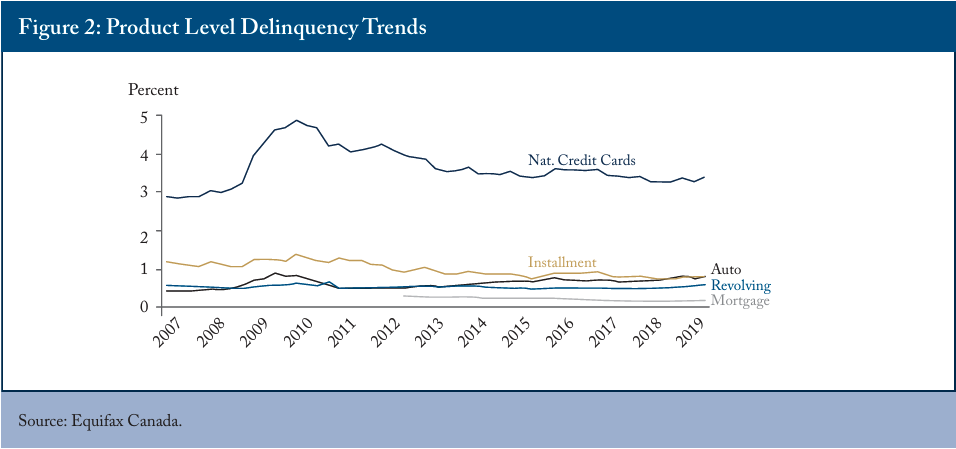
Figure 2 reports on consumer delinquency rates that are 90 days past due (90+ DPD Rates) from 2007 to the 3rd quarter of 2019. The black line (“Auto”) describes consumer defaults on non-bank ABF auto financing. The gray line (“Installment”) reveals consumer defaults on bank auto loans. Overall, Figure 2 confirms that delinquencies on consumer auto financing transactions over the last decade have been low. Interestingly, over that period, non-bank ABF auto financing defaults never exceeded 1 percent. The performance delinquencies for consumer mortgage, national credit cards and revolving loans (including lines of credit), all generally forms of financing provided by banks and credit unions, have been included for comparison purposes.
These data confirm the limited risk experienced by both non-bank ABF and bank auto financing.
Commercial Asset-based Financing Experience
As for commercial customer losses incurred by the ABF industry, again the performance is solid and predictable with the spike during the crisis consistent with the economy as a whole.
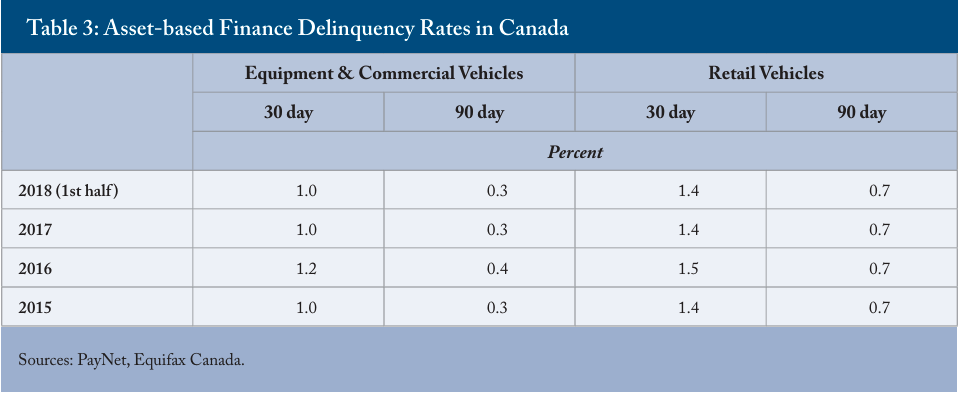
Over the last 15 years, experience has shown that 90+ day commercial vehicle and equipment financing delinquencies are in the average range between 0.25 percent and 0.5 percent. During the peak of the last crisis (2009-2010), 90+ day delinquencies never reached 1 percent (see Figure 3).
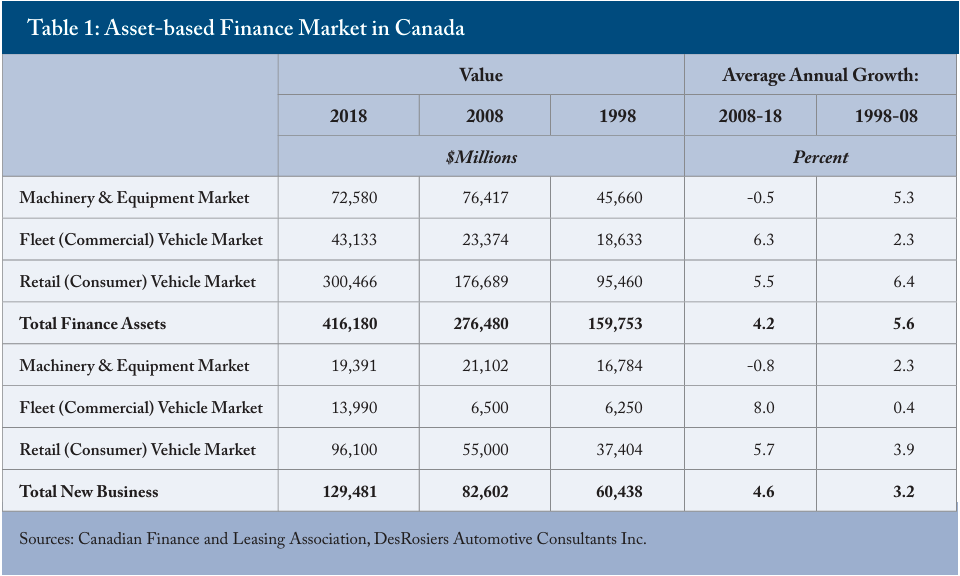
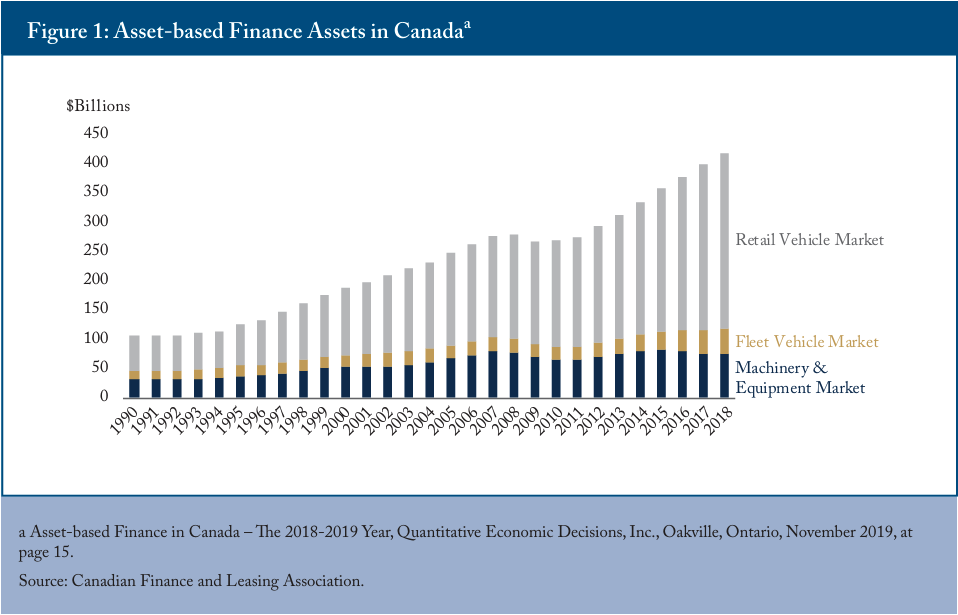
Table 3 summarizes recent year ABF delinquency rates (2015-2018) for commercial and consumer assets in percentage terms (banks and credit unions included).
These data suggest that ABF lenders have robust credit, audit and collection processes.
II. Experience During the Financial Crisis 2008-2009
In early January 2009, then federal Finance Minister Jim Flaherty “told reporters the No. 1 concern he has heard across the country is access to credit and financing.”1111 “Access to credit No. 1 concern: Flaherty. Problem being addressed, says minister,” A. McInnis, Canwest News Service, The Calgary Herald, January 7, 2009.
In reality, however, the last global financial crisis was less a credit crisis and more a crisis in liquidity. Money was still available during the crisis. Central banks, including the Bank of Canada, acted swiftly to ensure a plentiful supply of cash to keep the banking system operational. However, the channels that would have permitted these funds to be used for businesses to acquire new equipment and commercial vehicles or consumers to purchase new motor vehicles were severely constrained.
The liquidity freeze struck the non-regulated ABF industry particularly hard. Securitization conduits (see footnote #8 on securitization) and other commercial lending markets dried up. The traditional funders of the industry were unavailable. They were obliged to shore up capital, limiting what was available to borrowers.
There was a precipitous collapse in confidence across the financial sector. Investors had been unnerved by worthless sub-prime real estate mortgages passed off in the US as legitimate and even blue-chip investments.
The ABF industry also suffered the effects of the freeze in credit and liquidity.1212 Coventree Financial was the most prominent ABF entity to run into difficulty in Canada before the 2008 crisis. Like others, Coventree was financing its receivables through the short-term ABCP market, rolling over these receivables every month. It did business with several leading Canadian and international banks. In 2007, Coventree found itself in the crosshairs as rumours swirled that its securities might be tainted by toxic sub-prime real estate mortgages as seen south of the border. In fact, sub-prime mortgages made up only 4 percent of Coventree’s portfolio. But the firm’s plea to its investors fell on deaf ears and the market for its ABCP dried up. Coventree’s back-up banks were expected to provide emergency liquidity in a “market crisis.” The banks refused, arguing that the company was a victim of a ‘Coventree crisis’ rather than a ‘market crisis.’ In Back from the Brink, an analysis of the Canadian asset-backed commercial paper crisis (ABCP) prompted by Coventree, the authors identified the winners (the lawyers, the financial advisers, the hedge funds and the Canadian banks) and the losers (the investors, Coventree shareholders, the Caisse de dépôt , DBRS and Deutsche Bank). (At pages 185ff). In the end, all Canadian ABF assets in Coventree’s portfolio performed within expected tolerance levels. “Much of the restructured debt proved to be a good investment for those who bought it off of desperate sellers. It … appreciated back toward par, giving hedge funds that scooped it up a nice gain.”(Shareholders are the lucky ones as Coventree winds up, B. Erman, The Globe and Mail Report on Business, February 13, 2012). As one author put it, the ABF industry: …was caught in this turmoil along with every other [economic sector]. No one in the financial sector knew whom to trust anymore. Cash was hoarded by anyone who had it because you did not know when, where or if it would be needed to meet some unexpected financial emergency. No one knew what the future held. No one knew how, when or if the economy could be turned round —hence the unprecedented government intervention worldwide. Yes, there had been economic downturns before, but none this severe during the lifetime of those involved -- from policymakers to bankers to lessors. (Parker 2014, p. 184.)
Very few private-sector investors remained active in this funding marketplace. Those that remained, cut back substantially on their investments. As a direct consequence, liquidity shrank and non-bank ABF entities originating financing deals experienced an inability to sell these transactions to fund new ones. Less credit was available for consumers to use and businesses to spend to keep the economy growing. Capital and liquidity constraints brought the industry to a standstill. The finance company affiliates of major manufacturers of both vehicles and equipment, along with the independent (nonbank) financing companies, suffered mightily. Transactions just stopped being funded. As shown in Robson, Kronick, and Kim (2018, Figure 9) the share of capital spending on M&E financed by ABF collapsed in 2008 and 2009. By the end of 2008, the disruption in the flow of credit to businesses and consumers had pushed the global economy into recession.
As with other forms of emergency liquidity and credit, government was needed to step into the shoes of absent private-sector investors. Given the ABF industry’s relative success and low delinquencies, public investment would not only quickly reach consumers and businesses on Main Street Canada but also represent a low risk that the taxpayer would not recuperate the sums deployed.
In 2008, in weighing the possibility of federal support for the ABF sector, several fundamental questions were being asked: how can taxpayer risks be minimized? What is the government’s exit strategy? Is the ABF industry just a temporary short-lived creation existing only because of extraordinarily liquid conditions pre-crisis? For policymakers considering a future contingency program advocated in this paper, these questions are no less relevant today than they were in 2008.

How Can Risk to the Taxpayer be Minimized?
The assets financed by the ABF industry are straightforward – equipment and vehicle loans and leases. These are hard assets that are generally necessary to support core customer needs: a key piece of equipment for a business or a vehicle for essential travel.
During the 2008-2009 crisis, customer credit within the ABF industry generally did not experience problems associated with poor underwriting standards. Industry receivables continued to perform within levels that could be expected in an economic downturn and within anticipated tolerances. Nevertheless, funding to the industry dried up.
Moreover, the typical funding structures purchased by private-sector investors in the past provided protections for the continuing investors. A properly implemented securitization program funds ABF intermediaries who finance customers who originate real assets. In short, the government would receive the same protections and profits that a private-sector investor would receive.
What is the Government’s Exit Strategy?
Any additional funding that comes from government in severe downturns should be shortterm in nature. The average term of the underlying lease and loan transactions is generally no longer than 36-60 months. Each purchased asset pool has a limited term with a profit realizable in the short term. During a crisis, it might take time to restore private-sector investor confidence, requiring government purchase of commercial paper or structured financing securities, but for a limited duration, likely for no more than a year or two.
Is the ABF Industry for “Real”?
Is the ABF industry simply a temporary, short-lived business that existed because of an exceptionally liquid marketplace pre-crisis, or does it have a longterm raison d’être?
As shown above, the contention in this paper is that the ABF industry performs an important specialized role within which it has demonstrated a solid track record. The industry is embedded in the economy, expanding the pool of available capital and offering a competitive choice to businesses and consumers.
Over the last 30 plus years, the ABF industry had typically financed between 30 percent and 40 percent of annual new business investment in machinery, equipment and commercial vehicles.1313 Author’s calculations based on data from Canadian Finance and Leasing Association, Statistics Canada, and DesRosiers Automotive Consultants Inc. Commercial investment in these areas is critical to labour productivity gains since it increases the amount of productive capital available for workers to use. As numerous C.D. Howe Institute studies have demonstrated, enhanced productivity is a critical driver of long-term economic growth (see, for example, Omran and Kronick 2019). Gains in Canadian living standards rely primarily on labour productivity growth. In that sense, the industry makes a “real” contribution.
Toward a Solution
The January 27, 2009 Federal Budget described the intense financial market-wide turmoil: Dislocations in global credit markets have raised wholesale borrowing costs for Canadian financial institutions and have sharply reduced the liquidity of private sector financial assets. Parts of Canada’s credit markets have ceased to function well, and there has been a significant re-pricing of risk in financial assets, increasing the cost to business borrowers. … the disruption in financial markets has created a shortage of available financing in some areas. Chief among these is financing for vehicles and equipment for consumers and businesses, large and small. (Canada 2009, Chpt. 3)
The budget announced the Extraordinary Financing Framework (EFF). Interventions under the EFF aimed to:
- Provide financing on a commercial basis whenever possible.
- Protect the taxpayer by controlling risk.
- Encourage partnership with the private sector.
- Restore confidence and encourage private sector lending.
One of the measures included in the EFF was the Canadian Secured Credit Facility (CSCF) where the government agreed to temporarily take the role of traditional private-sector funders of the vehicle and equipment financing industry (private pools of investment capital – insurance companies, pension plans, hedge funds, banks and others – see “Sources of Funding” above). The budget announced that: the Government will create the Canadian Secured Credit Facility, with an allocation of up to $12 billion, to purchase term asset-based securities (ABS) backed by loans and leases on vehicles and equipment. The facility will be run under high standards for transparency and credit enhancement to protect the taxpayer. This facility will be priced on commercial terms, and will therefore be expected to generate a positive return for the Government. (ibid.)
One measure of the success of the CSCF was that, by November 2013, all the ABF companies that had participated in the program had fully repaid the government funding plus interest.
Several non-bank ABF entities took advantage of the program administered by the Business Development Bank of Canada (BDC). The CSCF would have attracted more borrowers had a workable program been implemented on a more timely basis. Caught with unexpected demands from the 2009 budget and tasked with funding an industry with which it was not familiar, the BDC not surprisingly took six to eight months to find the personnel with the needed expertise, to devise the essential program criteria and to determine its approval process.
Moreover, the initial application criteria, terms, conditions and costs were likely too expensive – basically, the end-customer would not or could not pay for it. It took 10 months before funds first flowed from the CSCF and then ultimately to only four entities providing significant financing to Canadians (all unregulated non-bank, multinational financing companies).1414 CNH Capital (Case New Holland), GMAC (General Motors Acceptance Corporation), Nissan Canada Finance and PHH.
While some existing business models may have been unsustainable, faced with a complex program taking time to implement, potential ABF entities, particularly the non-regulated entities, were discouraged, and liquidity-strapped companies were obliged to look elsewhere for solutions: some went out of business, Canadian subsidiaries of foreign firms left the country, others formally restructured and downsized, and some sought deeper-pocketed buyers. The Canadian chartered banks significantly increased their share of the ABF market, both directly and indirectly (through the purchase of non-bank financing companies). 1515 See The Alta Group report on loss of ABF entities in Canada 2007-2016 at page 7 of this Commentary.
In retrospect, BDC did bring a significant benefit to the marketplace, one not to be minimized. Despite the relatively low uptake of the CSCF (ultimately the four financing companies were advanced a total of $3.7 billion out of a possible $12 billion), according to Allan and Bergevin (2010), the CSCF provided a benefit to the market “that went beyond their impact upon those availing themselves of the program”:
In late 2008, in both the United States and Canada, the debt crisis had initiated an inexorable upward spiral in the credit spreads attached to all structured products. … Given time, this disorder of market psychology would have righted itself, but not before continuing unavailability of consumer and commercial credit further stalled the North American economies. A discrete policy intervention was necessary to arrest this continuing spread widening what had become unhitched from any real credit apprehension. … CSCF provided the required nudge to market dynamics … In the case of the CSCF, the method of market correction was more one of leadership than direct market stimulation. (Allan and Bergevin 2010.)
In establishing a price for securitization funding of ABF assets, the very public efforts of BDC went a long way to restoring confidence and stability resulting in encouraging sophisticated privatesector investors (mutual funds, pension funds, insurance companies) to return to fund the industry. This experience does, however, underscore the need to have a detailed workable facility/program contingency plan permanently in place.
The Canadian Secured Credit Facility ended in March 2010. That month’s Federal Budget introduced a complementary program, the $500 million Vehicle and Equipment Finance Partnership (VEFP), which was, in turn and in part, replaced by the Funding Platform for Independent Lenders (F-PIL). Through the F-PIL, BDC is able to fund small and mid-sized finance and leasing companies using term facilities backed by loans and leases on vehicles and equipment. These intermediaries are then enabled to provide financing to business customers (but generally not to consumer customers).
While F-PIL may be a helpful ongoing program for small and mid-sized finance and leasing companies, it has neither the size nor the amount of capital to respond to an extraordinary market-wide liquidity crisis such as experienced in 2008-2009.1616 There is more on Business Development Bank of Canada funding programs later in this paper.
BDC continues to be a player in the ABF industry, though at much smaller levels. With more than 10 years of experience, it is likely that BDC better understands appropriate terms and conditions should a severe economic downturn arise. Existing programs could, therefore, be scaled up in a severe downturn, with criteria in place for effective and efficient capital allocation.
III. Recommendations for designing a temporary emergency funding facility for the ABF industry
Issues of Moral Hazard and the Regulation of Currently Unregulated Entities Do not Arise
To fill the gap identified in this paper, it is not being suggested that the Bank of Canada extend emergency lending facilities to unregulated ABF sector entities as it may do to chartered banks. Rather, it is suggested that the BDC purchase equipment and vehicle loans and leases in a crisis to allow unregulated ABF entities to continue injecting credit into the marketplace for creditworthy businesses and consumers.
The BDC would be purchasing hard assets for cash. That is what the BDC is currently doing, albeit on a smaller scale. The BDC has the robust policies and processes in place to assess the quality of the loans and leases. The BDC knows what it is buying. Where there may be any questions as to quality, the BDC can either refuse to purchase the assets or apply a variety of funder risk reduction obligations such as “over-collateralization,” that is, requiring more collateral than is needed to obtain or secure funding, or increasing the seller’s “first loss” responsibility, that is, the seller’s obligation to assume a higher percentage of initial losses should they arise. These techniques are often used as a form of credit enhancement by lowering the funder’s exposure to default risk.
If an unregulated ABF entity became insolvent, it would be the shareholders that would suffer. Customers of the insolvent entity would be largely unaffected; they would be directed to pay a third party that acquires the portfolio or that takes over the administration of the payments for the funder. That is the process that happens today.
Why should these ABF entities be regulated? On this question, there is a distinction to be drawn between the unsophisticated consumer customer of an unregulated ABF financing entity and the sophisticated funder or customer of that entity.
Regulators target those activities requiring regulation for prudential or business conduct reasons. If institutions choose to source funds from an unsophisticated public (bank deposits, insurance premiums), it is appropriate for such institutions to expect certain prudential regulation and conduct regulation (consumer protection requirements) on their activities with that unsophisticated public.
Consumer financing offered by unregulated ABF entities is subject to consumer protection legislation today. That would not change. So the individual unsophisticated borrower is protected (conduct regulation).
Unregulated ABF entities choose to acquire their funds from financially sophisticated funders and many offer financing to commercial customers only.
For funders, bundled securitized portfolios of consumer auto transactions are rated by third party credit agencies, thoroughly examined by the funder and any protections deemed necessary added to the funding deal (over-collateralization, increased first loss responsibility, etc.)
In both cases, the funders and commercial customers are sophisticated parties. There would appear to be no strong public policy justification in favour of government imposing special regulations, additional restrictions or further requirements.
What Can Government Do?
In the event of a national economic crisis, the question is how quickly the government can respond with effective measures to stimulate the economy. If the principal tools available during extraordinary periods of market turmoil are to adjust interest rates and/or to use government funds to stimulate the economy, the legacy of the last crisis presents a particular challenge. With persistently low interest rates over the years since, the Bank of Canada has less room to lower interest rates. The March 2020 cut of 50 basis points to the overnight rate lowered it to ¾ percent.
With less room to stimulate the economy through traditional monetary policy, and with the positive effects of unconventional monetary policy controversial, this would imply a quicker turn to fiscal policy. One option, if automatic stabilizers are insufficient, is the creation of a contingency funding plan to be deployed rapidly when needed.1717 Dealing with the next downturn: From unconventional monetary policy to unprecedented policy coordination. 2019. Macro and Market Perspectives, Elga Bartsch, Jean Boivin, Stanley Fischer, Philipp Hildebrand, Simon Wan, BlackRock Investment Institute.
Since the last economic crisis, the possibilities for new emergency facilities have been explored, all generally involving a role for the central bank. The Bank of Canada is equipped to add liquidity in the clearing and settlement systems (mainly the Large Value Transfer System - LVTS). More liquidity for the direct clearers, who are “regulated financial institutions,” fosters more liquidity for their correspondents, which with lags and dilution will create more liquidity in the broader economy. That leaves a gap in emergency facilities outside the regulated financial sector. In other words, the many active unregulated ABF institutions (independent finance companies, manufacturer finance companies) are all outside the purview of the central bank.
The 2008-2009 experience revealed that a complete loss of liquidity could occur within a few weeks, even days. Government response time to enact legislation, engage the necessary expertise, develop the policies and rules to apply for funding, to adjudicate applications and then release the funds can take a year, leaving a key source of business and consumer financing much diminished and unable to function.
In a profoundly disrupted market, the policy objective should be to restore liquidity to allow the financial services industry to continue offering financing to credit-worthy consumers and enterprises in support of the Canadian economy. As demonstrated in this paper, that must include the ABF industry. Once liquidity is restored and investor confidence returned, the expectation would be that the commercial markets would again resume their normal functioning and government could withdraw the scaled-up temporary emergency funding program from this marketplace and return to the more modest continuing programs administered by the BDC.
In a context where it is deemed essential to have a comprehensive plan to support regulated financial institutions during future episodes of intense market-wide stress, the federal government should develop and maintain a facility/program to provide liquidity to enhance the ability of the ABF industry to respond promptly and effectively to market-wide liquidity stress. This would help get funds directly into the hands of those most likely to spend it.
How should federal policymakers go about the creation of an emergency facility for institutions outside the regulated financial industry, in particular for ABF lenders? Prior models exist in modified versions of the Canadian Secured Credit Facility introduced in the 2009 Federal Budget, and its successor facilities, the Vehicle and Equipment Financing Partnership and the Funding Platform for Independent Lenders (F-PIL, still active), all developed and maintained by the BDC.
The federal government should maintain a detailed contingency plan, developed and updated from time to time, in consultation with the industry
This would support ABF entities during periods of extraordinary financial market turmoil. BDC currently administers a viable model for small and medium-sized ABF entities, from which a plan can be developed with the Department of Finance that is somewhat similar to a business continuity plan. It would be prudent policy during a period of relative financial calm to devise a comprehensive plan to support ABF entities during periods of extraordinary financial market turmoil. BDC currently administers a viable model for small and medium-sized ABF entities, from which a plan can be developed with the Department of Finance that is somewhat similar to a business continuity plan.
Enable BDC to Scale Up Quickly
The current BDC program is a more modest one, funding financial intermediaries to finance eligible small and medium-sized enterprises. That said, BDC has maintained, since the financial crisis, the necessary expertise, the policies and rules to apply for funding in place, and the capacity to adjudicate applications and then release funds, albeit on a smaller, more limited scale.
Based on the 2009-2010 experience, it is essential to re-visit the existing BDC facilities to assure a prompt scaling up of the funding programs to rapidly meet the needs of ABF entities of all sizes. The delays experienced in 2009, although understandable in the circumstances, did result in a significant number of ABF entities leaving the Canadian marketplace or being acquired by banks, thereby reducing the diversity of borrowers’ choice of financial service providers.1818 See The Alta Group report on loss of ABF entities in Canada 2007-2016 at page 7 of this Commentary.
Allow BDC to Fund ABF Intermediaries to Finance Consumer Customers As Well As Commercial Clients
The current BDC facilities only allow for the funding of small and medium-sized ABF entities who finance commercial clients. ABF entities that offer financing to consumer customers, notably in the auto finance sector, are generally not eligible. In a period of intense financial market-wide turmoil, ABF entities that finance consumers should be eligible to participate in any temporary emergency facility as was permitted in 2009 under the Canadian Secured Credit Facility (CSCF).
Allow BDC to Fund Smaller Regulated Financial Institutions
The current BDC facilities do not generally contemplate the funding of credit unions (provincial and federal) and the smaller Canadian banks (the latter sometimes referred to as the “challenger banks”). These ABF entities have strong links to SMEs and consumers in communities across Canada. If, during a period of intense financial market-wide turmoil, government policy targets getting capital and credit to Main Street Canada as quickly as possible, these ABF entities are channels well-positioned to hit such targets and should be eligible to participate in a temporary emergency facility.
Allow BDC to Increase Advance Rates and Reduce Need to Raise Equity
Subject to due diligence analysis on a case-bycase basis, a temporary emergency facility should contemplate funding advances greater than those offered under the current BDC facilities as well.
During a market-wide crisis, the inability of otherwise solid ABF entities to work within today’s funding advance rates will simply frustrate, or at the very least slow down, the financing of end users.
In a market-wide emergency situation, the essential challenge is a lack of available liquid funds. During a crisis, leverage and the cost of funds change rapidly with serious impairments of profitability making it virtually impossible to attract equity at a time when it is most critically needed. The requirement that ABF entities, particularly smaller ones, secure additional thirdparty equity in these circumstances is not realistic. This paper is not suggesting rushing loan approvals, as one interpretation of the success of the CSCF is the prudence undertaken. However, with the experience over time developed by BDC, they are in a better position to make use of already-existing due diligence.
Conclusion
During times of extraordinary financial market turmoil, government policy should aim to assure liquidity and stability to the financial system, while minimizing any potential long-term negative impact on taxpayers.
During such times, the lack of liquidity and the inability of companies to sell transactions to fund new transactions lead to there being less credit available for consumers to use and businesses to invest, in otherwise perfectly sound assets, to maintain a healthy and vibrant economy. The cost and availability of funds during a period of economic crisis does not accurately reflect the risk that industries or businesses represent, and this includes those in and supported by ABF lenders. Rather, it reflects a financial system wide “capital rationing.”
This paper shows that continuing funding to the ABF industry is an effective way to stimulate the economy, getting credit back to Main Street, enabling credit-worthy Canadians – businesses and consumers – to obtain financing to spend responsibly as before on the equipment, machinery and vehicles that meet their – and the overall economy’s – longer term needs.
Whatever the structure of any eventual solution, the result is the same: the government exchanges one asset (cash) for another (hard equipment and vehicle assets). In doing so, the government cash will then be used by the originators to fund new transactions, enhancing the credit available for consumers to deploy and businesses to invest in a growing economy. As noted above, viable models exist in modified scaled-up versions of programs that the BDC has managed.
It would be everyone’s expectation that once liquidity was restored and investor confidence returned, the commercial markets would again resume their normal functioning and government could withdraw from this marketplace, including scaling back BDC’s temporary extraordinary programs.
History has shown that if liquidity is not supported, many non-bank financing entities and service providers will disappear from the Canadian marketplace. Once these alternative entities are gone, their financing products, services and expertise cannot be easily replaced. Canadian consumers and businesses will bear the loss because there will be fewer financial providers and fewer financial product alternatives available.
Federal policy over the last three decades, regardless of the government’s political stripes, has sought to expand and diversify the number of financial service providers in the Canadian marketplace. This policy has been based on the understanding that users of financial services, both individuals and businesses, stand to benefit most if the financial services marketplace:
- Assures an expanding diversity of choice of providers;
- Increases the pool of credit and capital;
- Improves access to credit and capital;
- Ensures access to innovative services and products; and,
- Increases available specialized technical expertise.
The ABF industry plays a significant role in Canada’s financing sector as part of a diverse set of financial providers that exist to offer Canadian consumers and businesses a range of alternative financing solutions.
References
Allan, David C., and Bergevin, Philippe, 2010. The Canadian ABS Market: Where Do We From Here? Commentary 315. Toronto: C.D. Howe Institute. November.
Bank of Canada. 2019. “Bank of Canada’s Intention to Introduce a Standing Term Liquidity Facility.” Ottawa, Ontario. November.
Bartsch, Elga, Jean Boivin, Stanley Fischer, Philipp Hildebrand, and Simon Wan. 2019. Dealing with the next downturn: From unconventional monetary policy to unprecedented policy coordination, Macro and Market Perspectives, BlackRock Investment Institute. New York, NY, August.
Bordo, Michael D., and Pierre L. Siklos. 2019. The Bank of Canada and Financial Stability: A New Mandate? Commentary 557. Toronto: C.D. Howe Institute. November
Bryan, Lowell, and Diana Farrell. 1996. Market Unbound: Unleashing Global Capitalism. Wiley, Hoboken, N.J., April.
Business Development Bank of Canada. 2009. Consultation on the Canadian Secured Credit Facility. Montréal, Québec. February.
Canada, Government of Canada. 2009. Budget – Canada’s Economic Action Plan, Ottawa, Ontario, January.
Canadian Finance & Leasing Association. 2008. Getting credit to Main Street Canada for SMEs and Consumers. Direct Swift Efficient Effective. Submission to the federal Department of Finance. Toronto, Ontario. December.
__________. 2015. Comments on the First Consultative Document on Proposed Revisions to the Standardised Approach for Credit Risk. Submission to the Basel Committee on Banking Supervision. March
__________. 2015b. Consultation on Changes to the Bank of Canada’s Framework for Financial Market Operations. Submission to the Bank of Canada. July.
__________. 2016. Comments on the Second Consultative Document on Proposed Revisions to the Standardised Approach for Credit Risk. Submission to the Basel Committee on Banking Supervision. March.
__________. 2017. Waiting for Basel? Next steps for Canada’s bank capital regime. Submission to the Superintendent of Financial Institutions. May.
Chamber of Commerce, The. 2008. Economic and Fiscal Statement – Where’s the Plan? Ottawa, Ontario. November.
Engert, Walter, Jack Selody, and Carolyn Wilkins. 2008. Financial Market Turmoil and Central Bank Intervention. Financial System Review. Bank of Canada. Ottawa, Ontario. June.
Equifax Canada Automotive. 2019. 2019 Auto Finance Market Overview. CFLA Annual National Conference. September.
Erman, Boyd. 2012. Shareholders are the lucky ones as Coventree winds up. The Globe and Mail Report on Business, February13, 2012.
Halpern, P., C. Cakebread, C.C. Nicholls and P. Puri. 2016. Back from the Brink – Lessons from the Canadian Asset-Backed Commercial Paper Crisis, University of Toronto Press, Toronto, Ontario.
Globe and Mail Editorial, The. 2019. We need to talk about the next recession. Toronto, Ontario. October 12, 2019.
Korgaonkar, Sanket, 2009. “Receivables Securitization and the Non-Financial Firm.” Wharton Research Scholars. 65, Wharton Business School, University of Pennsylvania, 4th Quarter 2009.
Kronick, Jeremy. 2016. Looking for Liquidity: Banking and Emergency Liquidity Facilities. Commentary 445. Toronto: C.D. Howe Institute. February.
Laurin, Alexandre. 2009. A Balancing Act: Making the Canadian Secured Credit Facility Work. E-Brief. Toronto: C.D. Howe Institute. March.
McInnes, Allen. 2009. Access to credit No. 1 concern: Flaherty. Problem being addressed, says minister. Canwest News Service, The Calgary Herald, January 7, 2009.
Omran, Farah, and Jeremy Kronick. 2019. Productivity and the Financial Services Sector – How to Achieve New Heights? Commentary No. 555. Toronto: C.D. Howe Institute. October.
Parker, Beth. 2014. Unstoppable – The story of assetbased finance and leasing in Canada. Barlow Book Publishing Inc., Toronto, Ontario.
PayNet. 2019. Commercial Equipment Trends. CFLA Annual National Conference. September.
PMG Intelligence. 2019. Equipment Market Research. St. Jacobs, Ontario. September.
Quantitative Economic Decisions, Inc. 2018. Asset-based Finance in Canada – The 2017-2018 Year. Oakville, Ontario. October.
__________. 2019. Asset-based Finance in Canada – The 2018-2019 Year. Oakville, Ontario. November.
Robson, William B.P., Jeremy Kronick and Jacob Kim. 2018. Tooling Up: Canada Needs More Robust Capital Investment. Commentary 520. Toronto: C.D. Howe Institute. September.
Securcor Financial Group, 2004. Securitization of Lease Receivables, Burlington, Ontario.
Somerville, Robin. 2004. Asset-based Financing, Investment and Economic Growth In Canada. The Centre for Spatial Economics. Milton, Ontario. December.
__________. 2017. Asset-based Financing, Investment and Economic Growth in Canada. Centre for Spatial Economics, Milton, Ontario, January.
__________. 2018. Asset-based Finance in Canada – The 2017-2018 Year. Quantitative Economic Decisions, Inc., Oakville, Ontario. October.
__________. 2019. Asset-based Finance in Canada – The 2018-2019 Year. Quantitative Economic Decisions, Inc., Oakville, Ontario. November.
Swandel, Hugh. 2009. Funding. What our industry needs for a sustainable recovery. Presentation to Capacity for Economic Recovery, Ottawa, Ontario. The Alta Group. September
__________. 2018. Understanding the State of Independent Finance in Canada 2018. The Alta Group, a presentation to the Independent Financing Round Table. September.
Swandel, Hugh, and Murray Derraugh,. 2009. Implementing a Private Securitization Funding Model. Canadian Secured Credit Facility. The Alta Group. Winnipeg, Manitoba. October.
The Centre for Spatial Economics. 2004. Asset-based Financing, Investment and Economic Growth In Canada. Milton, Ontario. December.
__________. 2017. Asset-based Financing, Investment and Economic Growth in Canada, Milton, Ontario, January.
Yakabuski, Konrad. 2019. Former Bank of Canada deputy has a radical plan to fight the next recession. The Globe and Mail Report on Business. Montréal, Québec. September 12, 2019.
Young, Rebekah, and Nikita Perealov. 2019. Keeping the Powder Dry But the System Primed: Fiscal Policy in a Recession. Scotiabank, Global Economics – Fiscal Pulse. Toronto, Ontario. October.