






by Paul C. Bourque, K.C. and Douglas M. Hyndman
- Parliament discontinued funding for the Canadian Securities Transition Office in 2021, bringing an end to Canada’s most ambitious effort to establish a national securities commission, create a national framework for managing capital markets systemic risk, and strengthen the regime for the criminal enforcement of securities laws. The decision left important elements of the country’s financial stability architecture unfinished.
- Canada remains an outlier among major advanced economies in lacking a statutory authority responsible for the comprehensive management of systemic risk in capital markets. Following the 2008 Global Financial Crisis, peer jurisdictions established dedicated frameworks for managing systemic risk, while Canada’s reform effort was never completed.
- Canada should revive key elements of the unfinished reform agenda. Establishing a national capability to identify and manage systemic risks in capital markets would improve financial stability. Stronger investigation and prosecution of serious securities offences would also enhance investor confidence and support economic resilience.
Introduction
When the Parliament of Canada voted to discontinue funding for the Canadian Securities Transition Office (CSTO) in June 2021, Canada missed an opportunity to substantially improve financial system risk management and criminal enforcement of securities offences.
The quiet termination of Canada’s most ambitious effort to launch a single national securities regulator, implement financial market systemic risk management, and improve criminal enforcement of securities laws contrasted sharply with its confident public launch in 2009. The initiative held more promise than any attempt pursued over the previous five decades (Johnston et al. 2014). The federal government of the day had provided the policy rationale, funding, expertise, and political support needed to implement the project successfully.
This Commentary outlines how that opportunity was missed and how Canada can still strengthen financial system risk management and improve criminal enforcement outcomes.
It is now more important to do so than ever. Canada’s relatively small, open economy has been significantly impacted by disruptions to world trade caused by US tariff policies and conflicts in Ukraine and the Middle East. In response, the federal government is looking to make the economy more resilient and less reliant on the United States. A key element of that objective is attracting and retaining investment in Canada’s capital markets.
Comprehensive management of systemic risk, together with stronger capacity to identify, prosecute, and penalize serious securities offences, would complete an important piece of Canada’s financial market infrastructure.
Capital Markets System Risk Management
Capital markets are inherently complex and interdependent. Competition, driven by the need to meet investor demands, avoid commoditization, or increase profitability, generates ever more complexity. Financial innovation and demands for additional information and liquidity create critical interdependence among market participants. This complex and tightly wound interdependence (often called “tight coupling,” a term from engineering) makes it more likely that mistakes will be made. Those mistakes cascade quickly through the system, in unpredictable directions, magnifying the harm and leaving the relevant authorities little or no time to intervene and mitigate the damage.
The complexity of capital markets and the interconnections among market participants mean that systemic risk11 Systemic risk refers to the potential that an event, action, or series of events or actions will have a widespread adverse effect on the financial system and, in consequence, on the economy. See: IOSCO. 2014. “Risk Identification and Assessment Methodologies for Securities Regulators.” June. can emerge from ordinary capital markets activity, and that risk may go unnoticed by regulatory authorities and even by the market participants themselves.22 See Ford and Gill (2012) for a non-exhaustive list of capital markets activities that connect in opaque ways domestic and international market participants and products, create opportunities for regulatory arbitrage, and magnify liquidity mismatches.
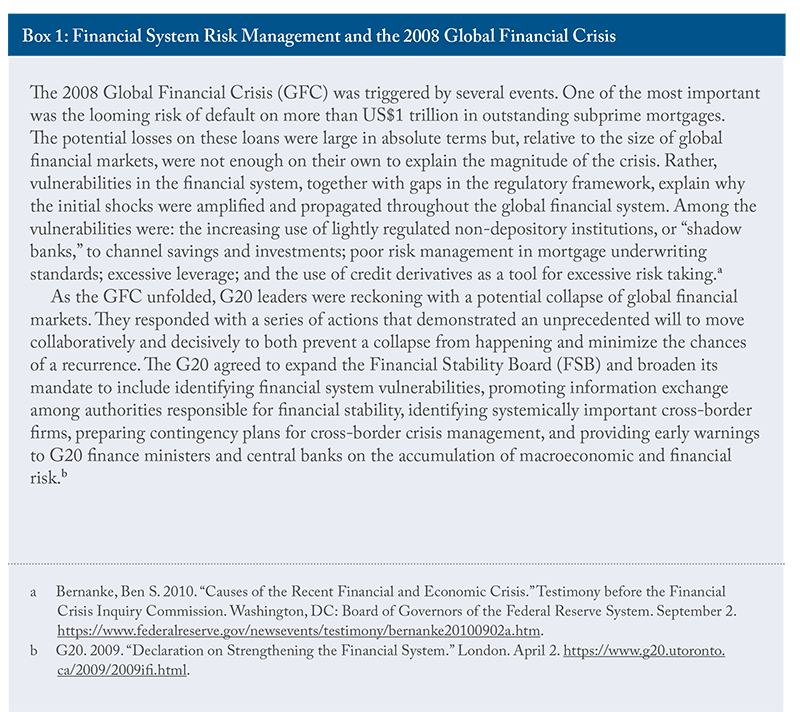
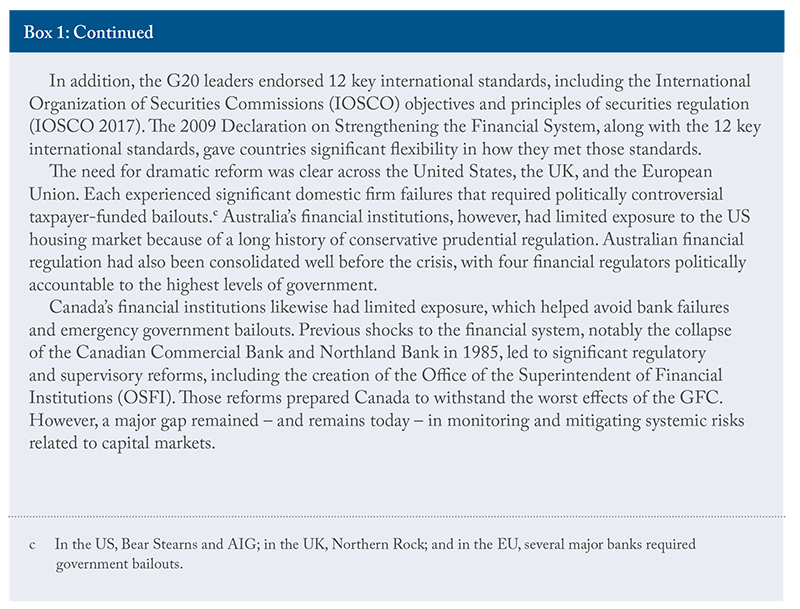
The Canadian Asset Backed Commercial Paper (ABCP) crisis of 2007 demonstrated how capital markets could transmit systemic risk. The ABCP product was developed to provide investors with a somewhat higher return than other short-term investments, like Treasury bills and money market mutual funds, with supposedly little additional risk. Demand for the product was strong, and the volume outstanding grew rapidly during the years leading up to the crisis. Purchasers included institutional investors, non-financial firms, and ultimately some retail investors.
The underlying investments of the ABCP issuers (known as conduits) were less liquid financial instruments. In August 2007, investors became concerned about the underlying assets and most declined to roll over their investments. The conduits were unable to redeem $35 billion in non-bank-sponsored or third-party-sponsored ABCP on maturity, and the market froze. A complex, multi-year legal process and a financial backstop from both the federal government and several provinces were required to resolve the situation.
OSFI did not have the authority to regulate the non-bank-sponsored conduits, the issuers were exempt from securities law disclosure obligations,33 Sponsors typically provided an information memorandum describing the basic elements of ABCP. In most cases, the general asset classes were the only information publicly disclosed; there was no disclosure of the specific assets held in the conduits or the terms of the liquidity agreements supporting the ABCP. and the paper received a high credit rating from a Canadian rating agency. Together, these factors allowed the emerging risk of ABCP exposure toUS subprime mortgage assets to go unnoticed, and a product intended for sophisticated investors began to move into the accounts of thousands of retail investors.
In addition to the structural risks that contributed to the ABCP crisis, capital markets are vulnerable to reckless risk taking that can generate outsized returns in the short run but imperil the financial well-being of not only the direct participants but also many other, often less sophisticated, investors. In extreme cases, the losses caused by risky activities, when transmitted through financial interconnections,44 A good example of this interconnectedness was the role played by AIG Financial Products, a largely unregulated dealer in OTC credit derivatives. AIGFP wrote CDS credit protection on hundreds of billions of mortgage-related securities and was an important risk transmission channel in the GFC. can threaten the stability of the entire financial system and adversely affect overall economic activity.55 For an analysis of reckless risk taking enabled by the capital markets, see: Posner, Eric A., and E. Glen Weyl. 2013. “Against Casino Finance.” National Affairs 14: 58–77. The authors describe how the growth of collateralized debt obligations (CDO) produced market-based gambling opportunities.
Governments usually respond to a financial crisis in two ways: (i) short-term fiscal, monetary, and regulatory actions to stabilize the financial system by preventing or containing business failures and bolstering public confidence, followed by (ii) longer-term regulatory changes intended to prevent the problem from recurring.
The immediate crisis response is necessarily hurried and based on incomplete information, but much of it is usually unwound once the crisis has passed.66 For example, the Bank of Canada’s initial response combined targeted and extraordinary liquidity support to funding markets with a conditional commitment to lower interest rates. The Bank wound down liquidity facilities commencing in June 2010. The CSA temporarily restricted short sales in certain financial issuers. Post-crisis regulatory changes are also often made in a rush, both responding to and taking advantage of the public call to “do something” (Dagher 2018). Post-crisis rulemaking, intended to reduce the risk of recurrence, may actually increase system complexity and create new risks:
Regulators and institutions can’t stand idly by in the face of potential crisis: something must be done. They may not know the mechanics behind the crises and they certainly cannot know where or how the next crisis will arise, but they learn from their mistakes and develop new or revised regulations and safeguards. And in a world of increasing complexity those safeguards add yet more complexity (Bookstaber 2007, p. 146).
This reflexive post-crisis rulemaking adds complexity, increases the risk of mistakes, and makes it likely that the next crisis will be caused by different mistakes than the last. Many of the changes adopted in the wake of the GFC to shield banks from risks have driven those risks into the capital markets, where they are even harder to track (FSB 2025). In recent remarks to the Global Risk Institute, Bank of Canada Governor Tiff Macklem noted that riskier activities that have migrated from banks to non-bank financial intermediaries have not disappeared, but have become harder to track. The gap posed by lower reporting and monitoring requirements continues to challenge global standard setters, national regulators, and central banks.77 Macklem, Tiff. 2026. “New Players, Old Risks: Financial Stability in a Changing Landscape.” Speech to the Global Risk Institute. March 6.
The continued occurrence of novel mistakes in fast-moving, interconnected, and interdependent financial markets requires the attention of dedicated, specialized experts able to anticipate and model mistakes that have the potential to create and propagate risk through the capital markets and the financial system generally.
How the US, the UK, the EU, Australia, and Canada responded to the GFC
United States
In the United States, the Dodd-Frank Wall Street Reform and Consumer Protection Act (2010) established the Financial Stability Oversight Council (FSOC) to close gaps in financial oversight and constrain risk taking.88 Geithner, Timothy. 2009. “Introducing the Financial Stability Plan.” Remarks by the Treasury Secretary. February 10. https://www.treasury.gov/press-center/press-releases/Pages/tg18.aspx. FSOC’s mandate is to identify risks to financial stability, promote market discipline, and respond to emerging threats to the stability of the US financial system. It brings together the expertise of federal financial regulators as well as state securities and insurance regulators, and reports annually to the US House of Representatives and Senate.99 The voting members of FSOC are: the Secretary of the Treasury, (Chairperson); the Chair of the Board of Governors of the Federal Reserve System; the Comptroller of the Currency; the Director of the Consumer Financial Protection Bureau; the Chairman of the SEC; the Chairman of the Federal Deposit Insurance Corporation; the Chairman of the CFTC; the Director of the Federal Housing Finance Agency; the Chairman of the National Credit Union Administration; and an independent member having insurance expertise. The non-voting members are the Director of the OFR; the Director of the Federal Insurance Office; a state insurance commissioner; a state banking supervisor; and a state securities commissioner. See: FSOC. 2020 Annual Report. Washington, DC: US Department of the Treasury. https://home.treasury.gov/system/files/261/FSOC2020AnnualReport.pdf.
A critical element of US financial reform was the establishment of the Office of Financial Research (OFR) to support the FSOC. Bringing together expertise in financial data, research, and analysis, the OFR looks across the financial system to identify and measure risk and collect and standardize financial data.
In the past year, FSOC has shifted its focus toward reducing regulatory burden and promoting economic growth, while OFR is undergoing a significant reduction in staffing. The jury is out on how these changes affect the US capacity to monitor and mitigate systemic risk.
The United Kingdom
The UK also moved quickly to reform its financial system risk management framework in response to the GFC. The Financial Policy Committee (FPC), a statutory committee within the Bank of England, is responsible for identifying, monitoring, and taking action to remove or reduce systemic risks to financial stability, with the aim of ensuring that regulators take a holistic approach to safeguarding financial stability.
The Financial Services Act (2012) replaced the Financial Services Authority with two agencies: the Financial Conduct Authority (FCA), to oversee market conduct and consumer protection; and the Prudential Regulation Authority (PRA)1010 The Prudential Regulation Authority operates as part of the Bank of England. to ensure banks hold sufficient capital and liquidity and promote the stability of the financial system.
The FPC has authority to issue binding directions to the FCA and PRA concerning minimum standards. These reforms were laid out in a speech by the Chancellor of the Exchequer in June of 2010 and implemented by 2012.1111 Osborne, George. 2013. “Speech by the Chancellor of the Exchequer at the Lord Mayor’s Dinner for Bankers and Merchants of the City of London, Mansion House.” London: HM Treasury. June 19. https://www.gov.uk/government/speeches/speech-by-the-chancellor-of-the-exchequer-rt-hon-george-osborne-mp-at-mansion-house.
The European Union
The European Systemic Risk Board (ESRB) was established within the European Central Bank (ECB) by EU regulation in 2010. It analyzes interconnected risks across markets and financial institutions, collecting information, running stress tests, and monitoring developments to act proactively. It is responsible for macroprudential oversight, aiming to monitor and mitigate systemic risks. In addition, three sector-focused European Supervisory Authorities (ESAs) were established:
- The European Banking Authority (EBA).
- The European Securities and Markets Authority (ESMA).
- The European Insurance and Occupational Pensions Authority (EIOPA).
The ESRB’s decision-making body is the General Board. It is composed of the central bank governors of the 27 EU member states and is chaired by the President of the European Central Bank.1212 The work of the General Board is supported by a Steering Committee, an Advisory Technical Committee, and an Advisory Scientific Committee. Representatives from national financial regulators, the European Commission, and heads of the EBA, ESMA, and EIOPA also participate in its deliberations. The ESRB may issue recommendations publicly. Implementation by EU member-state regulators is monitored on an “act or explain” basis, promoting transparency and fostering compliance. Among its first recommendations was the establishment of an authority responsible for macroprudential supervision at the national level (ESRB 2011).
These reforms resulted in a more integrated, resilient, and transparent EU financial system and established strong supranational oversight and crisis management procedures. Importantly, the EU reforms also focused on enhanced data collection necessary to oversee increasingly complex and interconnected financial firms and markets.
Australia
Australia did not experience a large economic downturn or a financial crisis during the GFC. Like Canadian banks, Australian banks had very limited exposure to subprime and other high-risk loans because domestic lending was very profitable and because of the historic focus on lending standards by the Australian Prudential Regulation Authority (APRA).1313 Reserve Bank of Australia. “The Global Financial Crisis.” Website. https://www.rba.gov.au/education/resources/explainers/pdf/the-global-financial-crisis.pdf?v=2025-08-07-14-56-22.
The Council of Financial Regulators (CFR) provided a small but comprehensive central authority to oversee the financial markets.1414 The CFR is comprised of the Australian Treasury Department (ATD), Reserve Bank of Australia, Australian Prudential Regulation Authority, and Australian Securities and Investment Commission. As the financial crisis unfolded, the CFR signed a memorandum of understanding on financial distress management. It established the principles for decision-making, assigned responsibilities to each of the four regulators, developed strategies for detecting financial stress, and committed to a coordination of responses, including communications.
The CFR reported directly to the highest level of government through the Australian Treasury Department’s Strategic Priorities and Budget Committee,1515 The Strategic Priorities and Budget Committee is comprised of the prime minister, deputy prime minister, finance minister, and the treasurer. providing political accountability for its decisions.
Canada
Like Australia, Canada’s economic response to the 2008 GFC1616 See the discussion in Lindquist, Evert A. 2022. “Canada’s Response to the Global Financial Crisis.” In Policy Success in Canada. Oxford: Oxford University Press. benefited from a prudently regulated banking and financial sector, a relatively strong balance sheet, and a well-managed budget process. Post-crisis regulatory reforms for federally regulated financial institutions included enhanced recovery and resolution plans for systemically important banks, strengthened bank liquidity standards, and expanded supervisory practices, including stress testing, risk disclosures, and prudential oversight.
Unlike its peers, Canada has no national regulatory agency responsible for capital markets. As a result, implementing internationally agreed regulatory reforms on a comprehensive basis has been more difficult. Capital markets now play a bigger role in transmitting systemic risk than in past crises, making this gap in Canada’s oversight of financial stability more evident. The federal government used this fact to promote its decades-long objective to create a national securities commission, which had been reactivated by a new government in 2006.1717 The initiative was described in the Budget Plan 2006: Focusing on Priorities as follows: “A common regulator would foster more responsive policy making, improve market efficiency, eliminate duplication, provide common standards of investor protection, and strengthen Canada’s voice in international discussions on regulatory standards. It would also significantly enhance capacity for effective, integrated enforcement in capital markets across Canada” (141).
Canadian Securities Regulator Project
In 2009, the federal government established the Canadian Securities Transition Office (CSTO) to lead and manage the transition from the provincial system of capital markets regulation to a proposed new federal system. CSTO began work on a transition plan to establish a Canadian Securities Regulatory Authority (CSRA), as well as a draft Canadian Securities Act (CSA). The CSRA would take over frontline capital markets regulation from the provinces, and the draft CSA would replace the provincial and territorial securities acts.1818 Although the federal government claimed to have comprehensive jurisdiction to regulate the activities of the securities markets, the draft CSA would have permitted each provincial government to “opt in” to the national regulatory system or maintain its provincial regulation. The theory seemed to be that, sooner or later, all the provinces would join the national system.
The draft CSA – alongside the traditional dual mandate of securities legislation to protect investors and foster efficient and competitive capital markets – would contribute, “as part of the Canadian financial regulatory framework, to the stability of the financial system.”1919 Subsequently, a number of provincial securities acts have included this mandate to manage financial system risk.
Less commented on but just as important were the draft CSA provisions related to the enforcement of criminal law. Like the provincial securities acts, the draft CSA provided administrative enforcement powers and created prosecutable offences for contraventions of the regulatory requirements and prohibitions. Unlike its provincial counterparts, the CSA also contained securities-related criminal prohibitions and provisions to strengthen criminal investigations, prosecutions, and penalties. These, of course, are matters of exclusive federal jurisdiction.
The promise of the CSRA, if it had survived constitutional challenge, was to consolidate under federal jurisdiction (albeit in more than one agency) the supervision of banking and securities, financial system risk management, and criminal enforcement of securities laws.2020 The federal Public Prosecution Service of Canada (PPSC) is responsible for prosecuting federal criminal statutes for which prosecution is not delegated to provincial attorneys general. It is also responsible for prosecuting Criminal Code of Canada offences in Nunavut, the Northwest Territories, and the Yukon. Unfortunately, this objective was not achieved.
In Reference re Securities Act,2121 2011 SCC 66 (Securities Reference). the Supreme Court of Canada held that the draft Canadian Securities Act was unconstitutional to the extent it sought to regulate the day-to-day activities of the securities markets.2222 In the Reference case, the governments of Canada and Ontario argued that the CSA was constitutional. The governments of Quebec, Alberta, Manitoba, and New Brunswick argued that the proposed legislation was unconstitutional. The governments of British Columbia and Saskatchewan also argued that the proposed legislation was unconstitutional, but argued that a national regulator could be established cooperatively by a combination of federal and provincial legislation. The Court rejected the arguments of Canada and Ontario that the general trade and commerce power provided a basis for exclusive federal jurisdiction to regulate the capital markets. The court did, however, find that the general trade and commerce power gives the federal government responsibility for national capital markets data collection and systemic risk management.
The Court also noted that the federal government would have jurisdiction over the interprovincial and international aspects of securities markets, but declined to give an opinion on the extent of that jurisdiction because the federal government did not raise that question in the reference.
Finally, the Court noted that governments could establish a national regulator through “a cooperative approach that permits a scheme that recognizes the essentially provincial nature of securities regulation while allowing Parliament to deal with genuinely national concerns.”2323 Reference re Securities Act 2011 SCC 66 at para 130.
After the 2011 Supreme Court of Canada Reference decision, the federal government was left with several options:
- abandon the project entirely;
- proceed on its own with federal legislation dealing solely with systemic risk and criminal matters;
- proceed with broader federal legislation that would deal with systemic risk and criminal matters, and regulate the interprovincial and international aspects of securities markets;
- negotiate with willing provinces to establish a cooperative regulatory system.
The government chose the fourth option, while indicating the second option would be a fallback if negotiations were unsuccessful.
After nearly two years of negotiations, work began on implementing a national securities regulatory agency through the Cooperative Capital Markets Regulatory System (CCMR), a project of the federal and participating provincial governments.2424 Ultimately, the CCMR provincial participating jurisdictions were Ontario, BC, Saskatchewan, New Brunswick, PEI, Yukon, Nova Scotia, and Newfoundland and Labrador. The concept was to establish a single Capital Markets Regulatory Authority (CMRA), overseen by a Council of Ministers representing all participating governments. It would administer a uniform provincial Capital Markets Act (CMA), which would replace provincial securities acts in participating provinces and territories, and a federal Capital Markets Stability Act (CMSA), which would apply throughout Canada and cover systemic risk and criminal matters.
The original aim was to have all the required legislation drafted and adopted in all participating jurisdictions in time to launch the CMRA in mid-2015. It quickly became apparent that this target was too ambitious and, as time went on, the provincial governments discovered that developing common legislation was far more complex than they had anticipated. The launch date was moved back several times until, in 2019, governments announced that the target was “under review.”
In 2015, the government of Québec challenged the constitutionality of both the CCMR and the CMSA. The challenge ultimately reached the Supreme Court of Canada, which determined in 2018 that both the CCMR and the CMSA would be constitutionally valid.2525 Reference re Pan-Canadian Securities Regulation, 2018 SCC 48, https://canlii.ca/t/hvs5f.
One might have expected this positive outcome to revitalize the project. But work on the provincial legislation bogged down and essentially came to a halt during the COVID-19 pandemic. The CSTO continued to work on the CMSA and to plan for its implementation. Those efforts gradually shifted toward having the federal government adopt the CMSA without waiting for the provincial legislation. The thinking was that a new or existing federal agency could administer the Act and later transfer it to the CMRA if and when that body came into existence. However, that plan came to an end in 2021, when Parliament voted down proposed funding to continue the CSTO’s operations.
Current Status – Financial System Risk Management
With the delay and ultimate demise of the CMSA project, Canada has been left to deal with systemic risk related to capital markets through existing institutions and legislation.
Canadian securities regulators have adopted and largely implemented the IOSCO recommendations for the management of capital markets systemic risk (IOSCO 2011). Several provincial legislatures have incorporated capital markets systemic risk management in the legislative mandates of their securities commissions. In addition, the CSA established a Systemic Risk Committee to monitor and report on capital markets systemic risk.2626 Established in October 2009, the CSA Systemic Risk Committee’s mandate is to identify potential systemic risks in the area of their regulatory responsibility and to determine whether those risks are being properly monitored.
The federal Financial Institutions Supervisory Committee (FISC) and the Senior Advisory Committee (SAC) provide forums for the federal financial regulators2727 Members of FISC are the Department of Finance, OSFI, the Canadian Deposit Insurance Corporation (CDIC), the Bank of Canada, and the Financial Consumer Agency of Canada (FCAC). to share information on potential systemic risks. The Heads of Agencies (HoA), a committee of federal financial regulators and provincial securities regulators,2828 The HoA includes the four largest securities commissions (Ontario, Quebec, Alberta, and British Columbia), the Bank, OSFI, and senior officials from the Department of Finance. established the Systemic Risk Surveillance Committee (SRSC)2929 The SRSC is chaired by the Bank of Canada with representatives from the federal Department of Finance, OSFI, CDIC, CMHC, BC Securities Commission (BCSC), Alberta Securities Commission (ASC), Ontario Securities Commission (OSC), Quebec’s Autorité des marchés financiers (AMF), BC Financial Services Authority, and Financial Services Regulatory Authority of Ontario. in 2020 to monitor financial system risk.
The Bank of Canada Financial Stability Report provides an annual assessment of vulnerabilities and risk in the Canadian financial system, including banks, insurers, non-bank financial intermediation, debt and equity market liquidity, and the payment, clearing, and settlement systems (Bank of Canada 2025). The CSA Systemic Risk Committee publishes an annual report on recent financial market trends and key vulnerabilities in Canadian capital markets.3030 See the Canadian Securities Administrators Systemic Risk Committee. 2023. Annual Report on Capital Markets. https://www.securities-administrators.ca/csa-activities/csa-systemic-risk-committee/. The report was made public for the first time in 2023. These committees bring together financial markets expertise and provide venues for information sharing and coordination.
What they do not provide, however, is national legislative authority or administrative capacity to collect data and set national minimum standards. Nor do they provide a single point of political accountability for monitoring and managing overall financial system risk. In both respects, the Canadian framework for overseeing financial system risk falls short of the level of legislative authority and accountability adopted in the United States, the UK, and the EU – most notably the UK model, under which a single committee within the Bank of England can direct policy across regulators.
From a practical perspective, the consistent collection of comprehensive financial markets data is a significant challenge for a group of federal and provincial agencies with differing powers, mandates, priorities, and capabilities. For example, one of the key recommendations following the GFC was that each country require over-the-counter derivatives contracts to be reported to trade repositories. The CSA adopted trade reporting requirements, but they differ among provinces and do not collect comprehensive data at the national level. Fifteen years after work began on this issue, the CSA might finally be close to having a more consistent national approach, but it has still not adopted a common rule.
Other critical gaps include the lack of comprehensive data collection on repurchase agreements, securities lending, and the growing volume of securities trading occurring outside the transparent public markets through vehicles like private equity and private debt.3131 The Financial Stability Board has flagged data gaps in Canada’s private credit exposures and the growing links with insurers and private equity firms that can transmit stress beyond the private credit sector. See: Financial Stability Board. 2026. Report on Vulnerabilities in Private Credit. May 6.
The current structure is also ill-suited to deal with large external risks that can amplify and propagate shocks through capital markets at an accelerated pace and are harder for supervisors to detect and control. Examples include risks arising from leveraged trading in sovereign debt, cyber-attacks, climate change, artificial intelligence (Baxendale 2026), and cryptocurrency and securities markets tokenization (Augur et al. 2025), for which mitigation strategies at a subnational level are unlikely to be effective.
The recent International Monetary Fund assessment of Canada’s financial system stability (IMF 2025) highlighted vulnerabilities and recommended enhanced cooperation and information sharing between federal and provincial authorities, better data collection and oversight of Non-Bank Financial Institution (NBFI) credit risk, and clearer supervisory mandates. These recommendations are consistent with the objective of the draft CMSA to provide a legislative framework for federal-provincial information sharing and data collection.
All of these outcomes could be achieved more directly and effectively with the implementation of the CMSA. Monitoring and managing systemic risk should not be left to committees or to staff whose primary responsibilities lie elsewhere. Instead of leaving this difficult task to people working off the sides of their desks, Canada should establish a dedicated team focused on systemic risk and give it the legal and administrative tools needed to do the job.
Current Status of Criminal Enforcement
Fair, firm, and swift enforcement of securities law is essential to support markets and market participants who voluntarily comply and to deter those who, through negligence or deliberate dishonesty, commit theft and fraud.
The imposition of criminal penalties, including jail time, is an essential element of deterrence. In the words of Samuel Johnson, attributed by his biographer James Boswell, “depend upon it sir, when a man knows he is to be hanged in a fortnight, it concentrates his mind wonderfully.” That aptly describes how the realistic prospect of criminal prosecution captures the attention of planned and deliberate theft and fraud by white collar criminals
Unfortunately, Canada is particularly weak in combating criminal activity in the capital markets. Criticisms include a lack of high-profile criminal prosecutions, delay, inadequate penalties, failure to compensate investors’ losses, and duplication of enforcement responsibility (Cory and Pilkington 2006). The available research suggests that Canada applies significantly less investigative and prosecutorial intensity to securities fraud than does the traditional enforcement program in the United States.3232 See, for example, Cory and Pilkington (2006) and Jackson (2008). Money laundering is frequently associated with serious investment fraud, and Canada has also been criticized for its weakness in combating money laundering.3333 Indeed, it is difficult to imagine the commission of a serious investment fraud offence that did not also involve the “use, transfer the possession of, send or deliver to any person or place, transport, transmit, alter, dispose of or otherwise deal with, in any manner and by any means, any property or any proceeds of any property.” Criminal Code, RSC 1985, c C-46, s. 462.31. To be clear, the criticism is not directed at Canada’s anti-money laundering regulations or the Financial Transactions and Reports Analysis Centre of Canada’s (FINTRAC) monitoring of financial institutions’ compliance with them. Rather, it concerns the lack of criminal convictions for significant money laundering offences.
The investigation of Criminal Code of Canada market offences3434 The Criminal Code stock market offences include fraud (s. 380[1]), fraud affecting the public market (s. 380[2]), stock market manipulation (s. 382), insider trading (s. 382.1[1]), tipping (s. 382.1[2]), and gaming in stocks (s. 383). is the responsibility of local police and the RCMP. In recognition of the limited capacity and low priority assigned by local police departments to these investigations, the RCMP launched the Integrated Market Enforcement Teams (IMET) in 2003. The IMET mission is to “deter perpetrators of criminal capital market fraud by ensuring that there is a genuine risk of being discovered, investigated, prosecuted and incarcerated” (IMET 2008). Despite repeated attempts to strengthen this function,3535 IMET performance has been evaluated three times: the Le Pan Report 2008, the 2010 IMET Program Evaluation by Public Safety, and the 2013 Expert Panel Report. These reviews called for better specialized expertise, enhanced leadership, improved management oversight, and stronger collaboration with prosecutorial and regulatory bodies. These evaluations were followed by the 2018 Performance Improvement Action Plan. In January 2025, an Expert Panel was convened to advise IMET on ongoing investigations. IMET has obtained convictions in only 12 cases since 2008 (one every 18 months): two in Montreal, three in Toronto, five in Calgary, and two in Vancouver.3636 The 2008 start date was chosen because the RCMP discontinued reporting consolidated IMET results in 2008. These results for 2008-26 are from available public material, including RCMP, ASC and BCSC news releases and available court material. Clearly, the results have been disappointing.3737 In particular, IMET struggles to bring cases involving serious stock market fraud that cross geographic and language barriers. Investigations concerning the two largest Canadian securities frauds, Bre-X Minerals and Sino-Forest, were closed without charges, suggesting a lack of resources and expertise. On the other hand, IMET can count some successes with domestic cases, including Sorenson/Brost (Alberta ponzi scheme 2005), Norbourg Financial Group (Lacroix 2005), Livent (Drabinsky/Gottlieb 2009), and Fortress Real Developments Inc. (Rathore and Petrozza 2026).
Provincial securities regulators, primarily responsible for imposing administrative fines and suspensions, are often unfairly blamed by the news media for these poor criminal prosecution results.3838 For example, The Globe and Mail ’s year-long investigation published in December 2017, which found that regulators had allowed thousands of repeat offenders to continue to operate in the capital markets, failed to collect hundreds of millions of dollars in unpaid fines and penalties, and resulted in a small number of offenders receiving jail sentences. See: Robertson, Grant, and Tom Cardoso. 2017. “Investigation: How a Simple Name Change Can Deceive Regulators and Allow Offenders to Escape Prosecution.” The Globe and Mail. December 18; Ibid. 2017. “CSA Is Being ‘Willfully Blind’ to Problems in Capital Markets: Investor Advocates.” The Globe and Mail. December 25; Ibid. 2017. “$1,101,583,984.44: That’s the Amount of Unpaid Securities Fines in Canada.” The Globe and Mail. December 22. In recent years, some provincial securities regulators have devoted resources and attention to criminal investigations, either on their own or in cooperation with police.3939 A good example is the BCSC Criminal Investigations Branch’s investigation of My Mortgage Auction Corp, an investment Ponzi scheme that promised high rates of return that so far has resulted in investor losses of $270 million. This type of criminal case falls directly within IMET’s mandate. See: Larsen, Karin. 2024. “Victoria Mortgage Broker Ran Ponzi Scheme, Trustee Finds.” CBC News. May 28. https://www.cbc.ca/news/canada/british-columbia/victoria-b-c-mortgage-broker-ran-ponzi-scheme-trustee-finds-1.7217273. This has yielded some charges and convictions, but not enough to alter the overall fact that Canada lacks an effective deterrent to criminal conduct in its capital markets.
Next Steps
Although the federal capital markets regulation project has now been dormant for four years, the government should consider what aspects should be revived and pursued as federal priorities.
General Securities Regulation
Proponents have dreamed for decades of replacing the 13 provincial and territorial regulators with a single national regulator. The 2011 Supreme Court Reference opinion made clear that a single regulator could be achieved only through a cooperative federal-provincial arrangement. The experience of the CCMR project demonstrated that establishing such an arrangement is extremely complex and difficult. For the foreseeable future, there is no advantage in trying again to create a single national securities regulator.
As an alternative, the federal government could assert its jurisdiction over interprovincial and international securities activity to create its own federal regulator. But that would overlap with provincial securities regulation and increase the complexity of the regulatory system. Given the uncertain scope of federal jurisdiction, it would also invite prolonged, expensive, and disruptive legal challenges by both provinces and market participants.
Another federal initiative on general securities regulation might be warranted if the provincial system were clearly inadequate and could be substantially improved by federal involvement. But that is not the case (Lortie 2011).
Through the CSA, provincial regulators have established a sophisticated system of interjurisdictional cooperation. It includes a Secretariat that provides policy and project coordination, substantially harmonized national rules, a passport system that allows registrants and issuers to deal with only one regulator for most regulatory approvals,4040 Ontario continues to be the outlier, refusing to join the passport system, claiming a national regulator, as unlikely as that now seems, is a preferable objective. the CSA National Systems,4141 The CSA National Systems consist of the System for Electronic Document Analysis and Retrieval (SEDAR), the System for Electronic Disclosure by Insiders (SEDI), the National Registration Database (NRD), and the National Registration Search. and a national, self-regulatory organization.4242 The Canadian Investment Regulatory Organization (CIRO) directly regulates all investment dealers and mutual fund dealers, as well as all major stock exchanges, alternative trading systems, and government and corporate bond trading.
Systemic Risk Related to Capital Markets
Financial system risk management is the area most in need of federal oversight. The 2011 Reference decision and the 2018 Reference re Pan-Canadian Securities Regulation both confirmed clear federal authority to enact legislation and regulate for the purpose of financial market systemic risk management and data collection. In Reference, the Court identified systemic risk management and national data collection as matters of genuine national importance.4343 Reference re Securities Act, 2011 SCC 66, at para. 102-105.
These two areas of responsibility provide the necessary authority for a federal agency to obtain market data from and impose common standards on federally and provincially regulated market participants relating to capital markets system risk management (Ford et al. 2012).
As noted above, Canada is attempting to deal with this issue through various committees and makeshift arrangements. Canada does not have an agency with the legal authority and a single point of accountability to identify and act on national capital markets systemic risks in a coordinated manner. The federal government has the jurisdiction and the responsibility to move ahead, and the cost of doing so (probably no more than $50 million per year) would be minuscule compared to the enormous costs of cleaning up after a systemic event.
Capital Markets Criminal Enforcement
Currently, the Criminal Code contains a set of offences for capital markets misconduct like fraud, market manipulation, and insider trading. Some of the offences use archaic language that makes them difficult to apply in today’s markets. Federal and provincial agencies share responsibility for investigating and prosecuting these offences. Despite notorious instances of serious misconduct in Canadian markets, however, there have been few charges and even fewer convictions.4444 The most notorious example was TSE-listed Bre-X Minerals. Bre-X was the centre of massive gold fraud at Busang, Indonesia, but after years of RCMP investigation, no criminal charges were ever laid in Canada, and the only person prosecuted anywhere was Bre-X’s chief geologist, John Felderhof, who was prosecuted by the OSC on quasi-criminal securities charges but ultimately acquitted. Another example was the TSE-listed Sino-Forest. Sino-Forest became the subject of extensive criminal and regulatory scrutiny after a 2011 short-seller report alleged it was a multibillion-dollar fraud. While the RCMP opened a criminal probe, no criminal charges were ever laid; instead, the main findings and sanctions came through securities enforcement and civil proceedings. Canada’s criminal deterrent against capital markets fraud and abuse is universally regarded as weak.
The abortive federal and cooperative projects anticipated that capital markets criminal offences would be modernized and moved from the Criminal Code to capital markets legislation, and that a division of the national securities regulator would be empowered to investigate potential violations of the offences. The 2016 draft of the CMSA (the most recent published draft) included improved versions of offences now in the Criminal Code, some proposed new offences, and two proposed new investigative tools.
The new and improved offences would include fraud relating to securities or derivatives, deceitfully affecting a market price, market manipulation, benchmark manipulation, insider trading, misrepresentation, criminal breach of trust by a dealer or investment fund manager, forgery of securities or derivatives-related documents, threats or retaliation against an employee who complies with the Act or reports non-compliance to authorities, and conspiracy to commit an indictable offence under the Act. New powers to obtain court-ordered production orders would better enable investigators to obtain information needed at an early stage to build a case for a search warrant or lay a charge.
Despite the failure of both the CSRA and the CCMR projects, the federal government retains the authority and responsibility to rectify Canada’s dismal record on capital markets criminal enforcement by adopting the criminal provisions of the draft CMSA and empowering a federal agency with a national mandate to investigate and prosecute securities offences.
The agency responsible for prosecuting serious and complex capital market offences must also have the government support necessary to prioritize these cases, as well as sufficient resources and expertise. Individual provinces have different priorities and resources. Most provincial attorneys general do not have the resources to take on complex capital markets fraud cases against high-profile and well-funded defendants; those that do are constrained by their provincial jurisdiction. Sustained, national enforcement of securities law can only be achieved through a federal agency with dedicated investigative and prosecution resources.
Canada’s Budget 2025 signals a welcome renewed focus on combating serious and complex financial crime and announces plans to establish the previously proposed Canada Financial Crimes Agency.4545 The Canadian Financial Crimes Agency, announced in Budget 2022 and further supported by Budget 2024, is being designed as a national body dedicated to investigating and enforcing federal laws against complex financial crimes such as money laundering, fraud, corruption, terrorist financing, and sanctions evasion. The CFCA will integrate resources from the RCMP, the intelligence assets of FINTRAC, and the expertise of the Canada Revenue Agency. Its core objective is to address long-standing criticisms about fragmented enforcement and to unify efforts under a specialized, single agency. More recently, the government has appointed a deputy minister to lead the creation of the new agency.4646 Prime Minister of Canada. 2026. “Prime Minister Carney Announces Changes in the Senior Ranks of the Public Service.” Government of Canada. March 4. https://www.pm.gc.ca/en/news/news-releases/2026/03/04/prime-minister-carney-announces-changes-senior-ranks-public-service. However, the nature of the proposed agency is vague, and its focus appears to be on money laundering, organized crime, and online scams, rather than capital markets crime.
Recommendations
The federal government should:
- Review and revise the CMSA as a standalone federal act establishing authority to:
- Manage capital markets systemic risk, collect data, and set and enforce related minimum data standards for all federally and provincially regulated financial market participants.4747 This would include all federally and provincially regulated financial institutions as well as stock exchanges, trading platforms, and financial industry utilities such as Fundserv Inc., the Canadian Investor Protection Fund, the Ombudsman for Banking and Investments, and CIRO.
- Investigate and prosecute criminal capital markets offences and regulatory offences under the CMSA.
- Complete consultations on a revised CMSA.
- Introduce the CMSA in the next session of parliament.
- Establish a new federal agency to manage capital markets systemic risk.
- Enforce the CMSA by establishing a federal agency with:
- a national mandate;
- experienced and qualified investigators and prosecutors;4848 Whatever organization design model is chosen to implement this capability at the federal level, it would seem sensible to utilize the criminal investigation and prosecutorial resources of the provincial securities commissions on a part-time or full-time basis. and,
- access to specialized data and technology.
Conclusion
There was no principled reason for discontinuing the funding for the CSTO in 2021. It was the victim of minority parliament dynamics. Aside from the questions of priorities and funding, there is no reason why work to implement a national capability for monitoring and managing capital markets risk should not be resumed.
The potential threat of a disruption originating in, or transmitted through, capital markets to threaten financial system stability and Canada’s economy is clear. The Asset Backed Commercial Paper freeze in 2007 illustrated how unmonitored activity in the capital markets can transmit risk to the broader financial system. In light of this, it is concerning that, 18 years after the GFC, Canada has not established or designated a statutory agency responsible for the comprehensive management of risks to financial system stability.
The goal of consolidating financial system risk management under a single authority is now within reach. The constitutional questions have been settled, and the implementation work has begun.
The absence of a credible criminal deterrent to reckless risk taking and deliberate dishonesty has led to criticism of Canada’s ability to combat investment fraud and associated money laundering. The cost of capital, investor confidence, and market liquidity are all adversely affected by the country’s lacklustre criminal enforcement efforts.4949 See the discussion in: Puri (2007) and Christensen et al. (2011).
A federal agency with a national mandate, staffed by experienced and qualified investigators and prosecutors with access to specialized data and technology, would give Canada the capacity to tackle high-profile, complex, cross-jurisdictional criminal conduct in its capital markets. The federal Financial Crime Initiative provides an opportunity to consider the most effective organizational design for criminal enforcement. This function could be located within a capital markets systemic risk regulator, the proposed new Financial Crimes Agency, or a separate agency within the federal public service.
Canada’s economy is facing new and unexpected challenges from its most important trading partner. The federal government is looking to make the economy stronger and less reliant on the United States. That includes retaining and attracting investment in Canada’s capital markets. Implementing consolidated federal oversight of financial system risk and improving Canada’s ability to identify, prosecute, and impose appropriate penalties for serious securities offences would complete an important piece of the country’s financial market infrastructure. Work on managing capital markets systemic risk was well underway with the draft Capital Markets Stability Act. Building on that work would significantly advance the creation of a federal systemic risk regulator. It is time to finish the job.
The authors extend gratitude to Mawakina Bafale, Kate Koplovich, Peter MacKenzie, Grant Vingoe, Mark Zelmer, and several anonymous referees for valuable comments and suggestions. The authors retain responsibility for any errors and the views expressed.
References
Anand, Anita I. 2010. “Is Systemic Risk Relevant to Securities Regulation?” University of Toronto Law Journal 60: 941–70.
Augur, I., G. Bauer, T. Mancini-Griffoli, M. Peria, and B. Tan. 2025. “Tokenization and Financial Market Inefficiencies.” International Monetary Fund, January 29.
Bank of Canada. 2025. Financial Stability Report – 2025. May.
Baxendale, Sonia. 2026. “Strategic Actions for AI-Enabled Financial System Resilience.” Toronto: Global Risk Institute. May.
Bookstaber, Richard. 2007. A Demon of Our Own Design: Markets, Hedge Funds and the Perils of Financial Innovation. Hoboken: John Wiley and Sons.
Canadian Securities Administrators Systemic Risk Committee. 2023. “Annual Report on Capital Markets.”
Christensen, Hans B., Luzi Hail, and Christian Leuz. 2011. “Capital Market Effects of Securities Regulation: The Role of Implementation and Enforcement.” NBER Working Paper. January.
Comeau, Kevin. 2019. “Why We Fail to Catch Money Launderers 99.9 Percent of the Time.” E-Brief 291. Toronto: C.D. Howe Institute. May 7.
Cory, Peter de C., and Marilyn L. Pilkington. 2006. Critical Issues in Enforcement. Task Force to Modernize Securities Legislation in Canada. September.
Dagher, Jihad. 2018. “Regulatory Cycles: Revisiting the Political Economy of Financial Crises.” IMF Working Paper 18/8.
European Systemic Risk Board. 2011. Recommendation on the Macro-Prudential Mandate of National Authorities (ESRB/2011/3). December 22. Frankfurt: European Systemic Risk Board.
Financial Stability Board. 2025. Leverage in Nonbank Financial Intermediation. Final Report. July 9.
_____________. 2026. Report on Vulnerabilities in Private Credit. May 6.
Ford, Cristie, and Hardeep S. Gill. 2012. “A National Systemic Risk Clearinghouse?” In What Next for Canada? Securities Regulation After the Reference, edited by Anita I. Anand. Toronto: Irwin Law.
Integrated Market Enforcement Teams (IMET). 2008. Integrated Market Enforcement Teams Program Report 2007/2008.
International Monetary Fund. 2025. Canada Financial System Stability Assessment. July.
IOSCO. 2011. Mitigating Systemic Risk: A Role for Securities Regulators. Discussion Paper. February.
______. 2017. Objectives and Principles of Securities Regulation. May.
Jackson, Howell E. 2006. “Regulatory Intensity in the Regulation of Capital Markets: A Preliminary Comparison of Canadian and US Approaches.” In Canada Steps Up: Critical Issues in Enforcement. Task Force to Modernize Securities Legislation in Canada. September.
Johnston, David, Kathleen Rockwell, and Cristie Ford. 2014. “National and Coordinated Approaches to Securities Regulation.” In Canadian Securities Regulation, 5th ed. Markham: LexisNexis.
Leuprecht, Christian, and Jamie Ferril, eds. 2023. Dirty Money: Financial Crime in Canada. Montreal: McGill-Queen's University Press.
Lindquist, Evert A. 2022. “Canada’s Response to the Global Financial Crisis.” In Policy Success in Canada. Oxford: Oxford University Press.
Lortie, Pierre. 2011. “Securities Regulation in Canada: The Case for Effectiveness.” IRPP Study No. 19. October.
Posner, Eric A., and E. Glen Weyl. 2013. “Against Casino Finance.” National Affairs 14: 58–77.
Puri, Poonam. 2007. “Will Canada Step Up? Improving Enforcement in the Canadian Capital Markets.” Canadian Investment Review 20(1): 53–54.