



Inaccurate Budgets Are A Big Problem
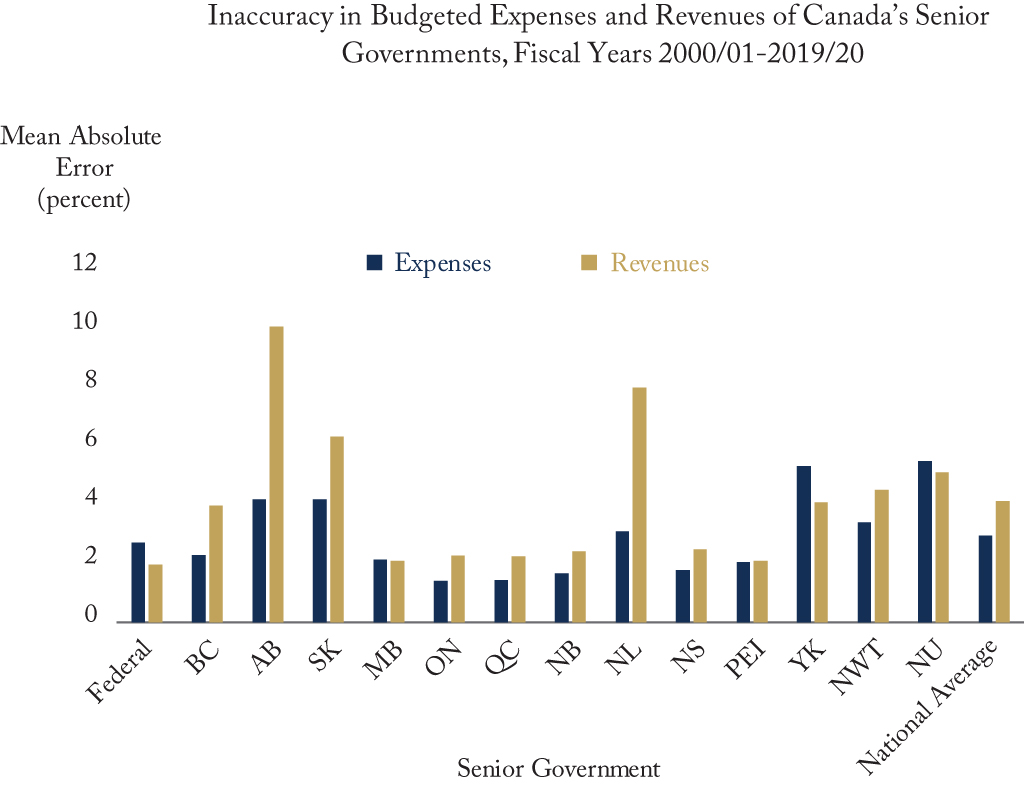 Canada’s federal, provincial and territorial governments routinely miss their budget projections. Although their projections for both expenses and revenues tend to be lower than what actually happens, the absolute size of misses in either direction also matters for accountability. Voters and legislators can have more confidence in budget projections if measures such as the absolute […]
 ‘Transitory’ inflation does lasting harm – Globe & Mail Op-Ed
Wednesday’s inflation report from Statistics Canada showed October’s consumer price index up 4.7 per cent from a year earlier. We are still hearing about “transitory” inflation from many forecasters and central bankers. Canadians dismayed by recent higher prices for food, energy, appliances and much else should not take much reassurance from this term.
Many transitory events – storms, pandemics, recessions – leave lasting effects. With the benefit of hindsight, the inflation from the mid-1960s to the early 1990s was transitory. It came and went. Two-per-cent inflation was common until 1965 and became an official Bank of Canada target after 1995. But between those two dates, the consumer price index more than quintupled. The…
Parisa Mahboubi – Canada’s Skills Development Challenges
 From: Parisa Mahboubi To: Canada’s Ministers of Employment Date: November 16, 2021 Re: Canada’s Skills Development Challenges The job market is in constant flux. Automation, digital innovation, globalization and demographic trends are reshaping the market, causing structural changes and shifting the skill requirements for a productive workforce – and now COVID. COVID-19 related restrictions have resulted in high unemployment […]
 Benjamin Dachis – Ontario Government Shutting Down the Electricity Price Casino
 To: Ontario Electricity Watchers From: Benjamin Dachis Date: November 15, 2021 Re: Ontario Government Shutting Down the Electricity Price Casino Early this month, the Ontario government quietly announced plans to create a pilot “interruptible rate” for large industrial electricity customers. This is good news for customers and for a system that needs to rationalize its pricing regime. The […]
 Le marché pétrolier dicte le prix du carbone – La Presse Opinion
Alors que les gouvernements craignent de taxer davantage le carbone pour en décourager l’usage dans l’économie, le marché du pétrole en augmente brutalement le prix, se fichant éperdument de la colère des électeurs.
Nous nageons en plein paradoxe. Depuis longtemps, les économistes s’époumonent à demander aux gouvernements de hausser le prix du carbone, par une taxe ou une bourse, pour favoriser la transition vers les énergies propres, mais les politiques n’osent souvent que des pas timides.
Or, c’est le marché qui fonce présentement. Depuis le creux de la pandémie, le prix nord-américain du pétrole a bondi de 145 %, au-dessus des 80 $ US le baril, et celui du gaz naturel a triplé. Si on remonte à peu avant…
The world’s heating up and so are boardrooms – Toronto Star Op-Ed
Climate change considerations are looming large in corporate boardrooms as directors grapple with emerging reporting rules.
The latest development came last week with Mark Carney’s announcement at the COP26 summit in Glasgow of the Global Finance Alliance for Net Zero (GFANZ), whose signatories, including major Canadian banks, have committed to achieving net-zero carbon emissions across their assets by 2050. That means clients seeking investments or loans from banks (not to mention insurance companies, pension funds, etc.) will also have to have their reporting ducks in a row.
Most of Canada’s big banks have begun setting their own net-zero goals earlier. For them, as for all corporations, effective climate governance…
Jon Johnson – Section 232 Tariffs – Pathway to Climate Protection or Managed Trade?
 From: Jon Johnson To: US Trade Policy Observers Date: November 11, 2021 Re: Section 232 Tariffs – Pathway to Climate Protection or Managed Trade? On October 30, the US and the EU announced a deal that replaces Trump-era US tariffs on EU steel and aluminum under Section 232 of the Trade Expansion Act of 1962 […]
 Hey, Big Spenders!
 Canada’s senior governments tend to spend more than they budget. From the 2000/01 fiscal year to 2019/20, only Newfoundland and Labrador spent less, on average, than it budgeted. Over those 20 years, all senior governments together overshot budgeted expenses by a cumulative $119 billion. That means they went into the COVID-19 crisis spending $3,100 more […]
 Trouble on the Bottom Line: Canada’s Governments Must Produce More Reliable Budgets
 Bottom Line: Canadian Governments’ Budget Overshoots Mean Higher Spending and Taxes Over the course of 20 fiscal years, Canada’s federal, provincial and territorial governments routinely overshot their annual budget targets, says a new report from the C.D. Howe Institute. Authors William B.P. Robson and Miles Wu find that since 2000/01, Canada’s senior governments have overshot […]
 Bottom Line: Canadian Governments’ Budget Overshoots Mean Higher Spending And Taxes
Over the course of 20 fiscal years, Canada’s federal, provincial and territorial governments routinely overshot their annual budget targets, says a new report from the C.D. Howe Institute. In “Trouble on the Bottom Line: Canada’s Governments Must Produce More Reliable…Dillon, Gullo – Canada Needs to Get Serious on Carbon Capture
 From: John Dillon and Michael Gullo To: Department of Finance Date: November 10, 2021 Re: Canada Needs to Get Serious on Carbon Capture COP 26 has challenged all countries to deliver ambitious plans to achieve net zero greenhouse gas emissions by 2050. In Canada, businesses, public institutions and consumers all have a role. Canada’s public […]