



Eloise Duncan – Financial Resilience Index: a New Tool to Refine Income Support
 From: Eloise Duncan To: Finance Minister Chrystia Freeland Date: October 28, 2021 Re: Financial Resilience Index: a New Tool to Refine Income Support Governments were generous and broad in their financial support during the COVID-19 pandemic, but as the economy returns to a normal state – and fiscal positions remain under strain – it is […]
 Quinn, Isenberg, Downar – End of Life: How to Improve Care and Save (Much) Money
 From: Kieran Quinn, Sarina Isenberg and James Downar To: Canadians Concerned about Healthcare Costs Date: October 27, 2021 Re: End of Life: How to Improve Care and Save (Much) Money Canadians spend more on end-of-life care than other high-income countries, including the United States, yet we achieve poor results compared to most. There are structural factors and inefficiencies within […]
 Steer clear of EI for gig workers – Financial Post Op-Ed
It all seems so straightforward and evident: why not cover vulnerable “gig” workers, an often-marginalized group in the economy, who were hit so hard by the pandemic, under EI? In June, a parliamentary committee recommended that Employment and Social Development Canada conduct consultations on ways to provide self-employed persons, including those in the gig economy, with access to regular Employment Insurance benefits. ESDC has responded and formal consultations along these lines are forthcoming. They need to include a sober, detailed analysis of the problems involved.
The first item on the agenda ought to be a clear and agreed definition of gig work, which is critical to insuring potential income losses. A recent survey…
The Skills Imperative: Workforce Development Strategies Post-COVID
 Canada Lags Peers in Upskilling Workers, Needs to Plug Gaps Canada stands below the top-performing countries in skills development, and has no comprehensive approach toward lifelong learning, according to a new report from the C.D. Howe Institute. Authors Parisa Mahboubi and Momanyi Mokaya find that long-term unemployed and low-income, low-educated workers are slipping between the […]
 Canada Lags Peers in Upskilling Workers, Needs to Plug Gaps
Canada stands below the top-performing countries in skills development, and has no comprehensive approach toward lifelong learning, according to a new report from the C.D. Howe Institute. In “…Lawrence Herman – On the Persistence of Trade Sanctions
From: Lawrence Herman To: Canadians concerned about the trading system Date: October 25, 2021 Re: On the Persistence of Trade Sanctions While governments struggle to find consensus in the lead-up to the World Trade Organization’s (WTO) critical ministerial conference (MC12) at the end of November, there is a highly significant global development that won’t even be touched on at […]S3 E20: The Gig Economy and EI with David Gray
 The gig economy worker has been doing much of the heavy lifting during COVID-19, delivering everything from shopping packages to dinner. But when a gig worker loses their job, they fall through Employment Insurance holes in Canada’s social safety net. Author David Gray asks: should gig workers be covered by the EI regime? The answer, not surprisingly, […]
 David Gray – Gig Workers and Employment Insurance: No Easy Answers
 From: David Gray To: Employment Minister Carla Qualtrough Date: October 22, 2021 Re: Gig Workers and Employment Insurance: No Easy Answers COVID-19 has laid bare the important shortfalls of Canada’s rigid 1970s-vintage Employment Insurance system and the pressing need for substantive reforms. EI was originally designed in the late 1940s to cover full-year, full-time workers from the risk of cyclical […]
 There’s a more practical way to regulate Big Tech – Globe and Mail Op-Ed
As the refreshed Trudeau minority government pushes forward with what we presume will be revised versions of Heritage Minister Steven Guilbeault’s controversial bills C-10 and C-36, we suggest it pause, breathe and consider a more poised approach.
The problems with online harms legislation (C-36) are being revealed through the responses of numerous civil and human-rights organizations. The issues connected to C-10 are more firmly embedded within the public memory because of the controversy that ensued last spring when Mr. Guilbeault sought to grant the Canadian Radio-television and Telecommunications Commission (CRTC) authority over the internet, including personal social-media posts. Its stated intent, while lacking in…
Fourth wave highlights health system’s fragility – The Daily Gleaner Op-Ed
New Brunswick hospitals are on “red alert,” reducing or suspending services to increase capacity for COVID-19 patients as the fourth wave continues. There are 57 patients hospitalized for COVID-19 and 18 in intensive care, at the time of writing – a number that will continue to fluctuate in the days and weeks to come.
New Brunswickers might reasonably ask if the hospital system is truly threatened by fewer than 20 critical cases after 18 months of a global pandemic. Unfortunately, the province-wide red alert shows that it is.
Why and how is this possible? To this, there is no simple answer.
In less than a month, the number of people hospitalized for COVID-19 has nearly doubled, and the number in ICU has…
C.D. Howe Institute Monetary Policy Council Calls for Bank of Canada to Hold Overnight Rate Target at 0.25 Percent Next Week, Hike to 1.00 Percent Next Year, Cut Bond Purchases
October 21, 2021 – The C.D. Howe Institute’s Monetary Policy Council (MPC) recommends that the Bank of Canada keep its target for the overnight rate, its benchmark policy interest rate, at 0.25 percent through December, before raising it to 0.50 percent by April of 2022, and to 1.00 percent by October of 2022. It also recommends that the Bank reduce its quantitative-easing purchases of Government of Canada bonds from the current pace of $2 billion per week.
The MPC provides an independent assessment of the monetary stance consistent with the Bank of Canada’s 2 percent inflation target. William Robson, the Institute’s CEO, chairs the Council. Council members make recommendations for the Bank…
Nowhere to Go at the End
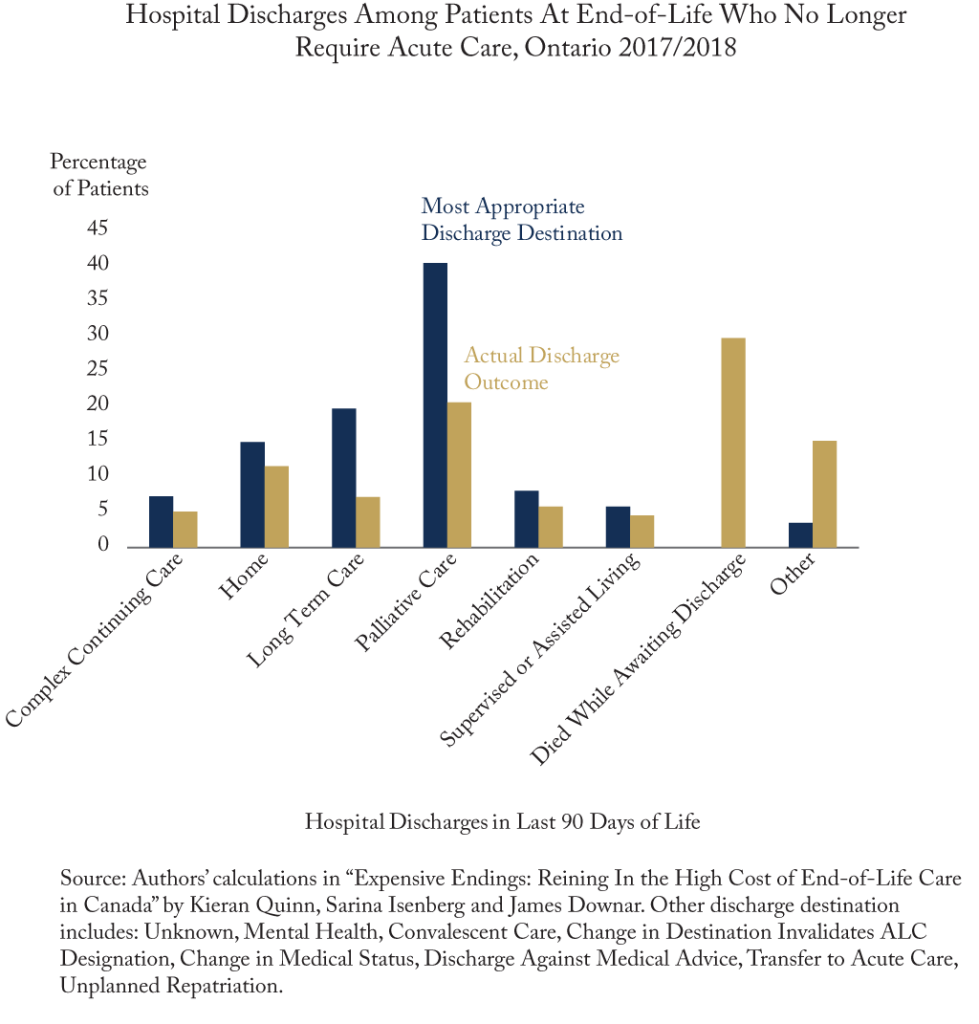 People approaching the end of life often require an intensification of healthcare services, and the majority could benefit from palliative care prior to death. With its focus on improving comfort and quality of life, palliative care tends to avoid hospital-based, invasive, costly and potentially inappropriate care. Palliative care is preferably (but not always) delivered outside […]