



Budget 2021 rolls all the dice – iPolitics Op-Ed
In 1990, then-prime minister Brian Mulroney infamously quipped that a first ministers’ meeting about the Meech Lake Accord was “the day I’m going to roll all the dice.”
The 2021 federal budget rolls Canada’s dice again, by burdening a generation with more debt. One hopes the result is more positive than what befell the accord and the Mulroney government.
Some of us were hoping the budget would introduce a fiscal anchor to return us to the pre-pandemic net debt-to-GDP ratio of around 30 per cent. And it’s there — in 2055.
In the intervening 34 years, Canadians will shoulder a higher debt burden — around 50 per cent until 2025-26. A graph depicts it declining ever so slowly after that.
The projection presumably…
Taxer les netflix et autres multinationales – La Presse Opinion
Même si le fardeau des impôts payés par les entreprises est ultimement porté par des personnes – actionnaires, employés et consommateurs –, le sens commun exige que les compagnies fassent leur part et on s’insurge lorsque les plus grandes profitent des paradis fiscaux pour se défiler.
L’administration Biden a ravivé l’espoir d’un accord international sur un taux d’imposition minimal et sur la capacité des pays à taxer les ventes faites à distance par les FANG (Facebook, Amazon, Netflix, Google) sur leur territoire national.
Selon l’Organisation de coopération et de développement économiques (OCDE), les stratégies fiscales qui exploitent les différentes règles des pays pour faire disparaître des profits ou les déplacer…
Reshoring initiative targets behaviours, not laws – Globe and Mail Op-Ed
Even before the COVID-19 pandemic, there was talk in Western countries about supply-chain vulnerability and the need for reshoring, as it’s called. The issue arose not only in Canada, but in the United States – especially when Donald Trump was president – and in European countries.
It was therefore interesting to read recently about some former Canadian politicians and several key industry associations launching an advocacy group called Reshoring Canada, formed to promote the return of critical manufacturing to Canada and rebuilding supply chains in this country.
The group styles itself as non-partisan and a “repository and advocate of ideas” aimed at promoting reshoring by educating the business sector, rather…
Ed Devlin on BNN – Bank of Canada Policy Rate Decision
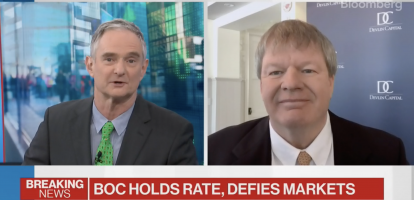
The Bank of Canada is keeping its overnight lending rate unchanged at 0.25 percent. The central bank is signaling a 2022 rate hike, and reducing its weekly asset purchases to $3B per week. Ed Devlin, founder of Devlin Capital, senior fellow at C.D. Howe Institute, and former head of Canadian portfolio management at PIMCO, joins BNN Bloomberg to weigh in.
Bill Robson on BNN – Ottawa needs to send a sign that they’re taking the future seriously
 Bill Robson, CEO, C.D. Howe Institute, joins BNN Bloomberg to discuss what he’s looking for in the upcoming federal budget. He calls for the managing of spending to debt, and recommends policies to balance the budget.
 Benjamin Dachis – Reducing Permit Costs In The Canadian Economy
 From: Benjamin Dachis To: House of Commons Standing Committee on Industry, Science and Technology Date: April 16, 2021 Re: Reducing Permit Costs in the Canadian Economy From water hookup fees to interminable waits for approval from city hall, excess permit costs and delays are harming Canadian homebuyers and small businesses. For homebuyers, restrictions on housing supply and extra […]
 Trains, Lanes and Automobiles: The Effect of COVID-19 on the Future of Public Transit
 Troubled Transit: Working from Home Has Wider, “Overlooked” Economic Costs for Cities The massive shift to working from home is causing Canada’s major urban centres to lose out on the wider, often overlooked, economic benefits of public transit. Fast public transit enables riders to have access to a wider set of job opportunities, higher wages, […]
 Troubled Transit: Working From Home Has Wider, “overlooked” Economic Costs For Cities
The massive shift to working from home is causing Canada’s major urban centres to lose out on the wider, often overlooked, economic benefits of public transit, says a new report from the C.D. Howe Institute. In “Trains, Lanes and Automobiles: The Effect of COVID-19 on the…Bank of Canada Should Hold Overnight Rate at 0.25 Percent, Reduce Government Bond Purchases: C.D. Howe Institute Monetary Policy Council
April 15, 2021 – The C.D. Howe Institute’s Monetary Policy Council (MPC) recommends that the Bank of Canada keep its target for the overnight rate, its benchmark policy interest rate, at 0.25 percent at its next policy rate announcement on April 21st, but reduce its purchases of Government of Canada bonds below $4 billion per week.
The MPC provides an independent assessment of the monetary stance consistent with the Bank of Canada’s 2 percent inflation target. William Robson, the Institute’s CEO, chairs the Council. Council members make recommendations for the Bank of Canada’s upcoming interest-rate announcement, the subsequent announcement, and the announcements six months and one year ahead. The Council’s formal…
Transit tripped up: the effect of COVID-19 and the future of public transit – Hill Times Op-Ed
COVID-19 has fundamentally changed lives across Canada. This change may be most pronounced in Canada’s major cities. Many of the things that make life in our cities so vibrant—great restaurants, entertainment, or going to the office to learn from great colleagues—have vanished. Post-pandemic, as more Canadians work from home, transit operators will face the challenge of bringing us back together to enjoy urban life while facing a gloomy financial outlook.
There are many benefits of urban living, such as tapping a large job and employee market, having access to a wide range of services and infrastructure, and learning from others face-to-face. Public transit is the essential component that enables the benefits of people coming…
William White – Build Back Better May Not Be Sufficient
 From: William White To: Canada’s Policymakers Date: April 14, 2021 Re: Build Back Better May Not Be Sufficient There seems general agreement that global policymakers must “build back better” in fostering recovery from the global pandemic. While laudable, the phrase hints at a degree of incrementalism that might be inadequate to overcome the challenges that humanity currently faces. […]
 Rosalie Wyonch – Drug Shortages And Domestic Manufacturing
 From: Rosalie Wyonch To: Canadians Concerned about Healthcare Date: April 13, 2021 Subject: Drug Shortages and Domestic Manufacturing Lost in Canada’s lamentations about vaccine shortages and domestic manufacturing of medicines is the bigger picture of drug shortages in Canada. In 2020, there were 4,980 new drug shortages reported (excluding “anticipated shortages”) in Canada covering 313 Anatomical Therapeutic Chemical […]