



Le Québec Peut Montrer Au Canada La Voie à Suivre En Matière De Garde D’enfants
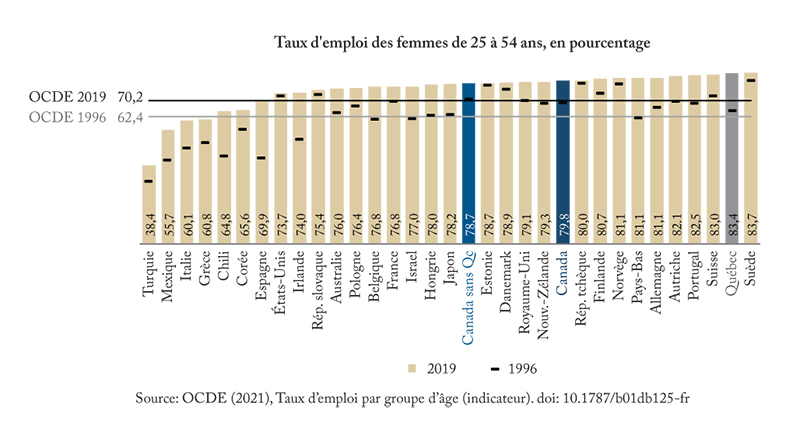 À partir des données de l’Enquête sur la population active que mène Statistique Canada adaptée par l’Institut de la statistique du Québec, les taux d’emploi des mères âgées de 25 à 54 ans qui ont un enfant de moins de 6 ans est analysé. Ce groupe est ciblé car il s’agit de celui qui est le plus […]
 Governments need to ensure the unemployed have the right skills for the postpandemic economy – Globe and Mail Op-Ed
A key to economic recovery after the COVID-19 pandemic will be targeted measures to address the possible long-term effects of this crisis on the labour market.
Bouncing back to employment from lockdown layoffs is becoming more challenging for many unemployed people as there is no job to return to, at least in the short term, or they lack sufficient or relevant skills to find employment. This has led to exceptionally high long-term unemployment rates that will need to be mitigated with labour market and skills development strategies.
Long-term unemployment (the number of unemployed people for six months or more) increased by 207 per cent to 462,100 Canadians between March, 2020, and February, 2021. This has boosted the…
Ed Devlin on BNN – Housing market response should be targeted to increase mortgage rates

Ed Devlin, founder of Devlin Capital, senior fellow at C.D. Howe Institute and former head of Canadian Portfolio Management at PIMCO offers his views on Canadian housing and why he doesn’t feel it’s in bubble territory yet.
S3 E7: Modern Monetary Theory with Farah Omran and Mark Zelmer
 Times of crisis open the door to new economic theories. As governments inflate debt to address them, talk about Modern Monetary Theory has grown into a chorus in some circles – particularly as the Americans discuss the “Green New Deal.” But as report authors Farah Omran and Mark Zelmer tell host Michael Hainsworth, Modern Monetary […]
 Why A Capital Gains Tax On Principal Residences Won’t Help To Cool The Housing Market – Globe And Mail Op-ed
The housing market is hot, and has been for several years, especially in Canada’s largest cities. Many policy attempts and proposals have been made to slow it down, with the focus almost always on trying to reduce demand. The most recent proposal along these lines is a capital gains tax on principal residences.
The argument for taxing capital gains on the sale of owner-occupied principal residences is twofold. First, the argument goes, the tax will decrease demand for houses and condos, putting a stopper on illogical price appreciations. Second, governments are starved for tax revenues, and taxing these gains would help fill that gap.
In practice, however, neither of these is likely to play out as expected.
In some…
Mending the Safety Net: Social Assistance Reform in Alberta
 Alberta’s Path to Social Assistance Reform Alberta’s social assistance programs have been the fastest growing among provincial income support programs with caseloads doubling between 2008 and 2019. High clawback rates and low earnings exemptions decrease the likelihood of recipients bouncing out of the social safety net and back into the labour market. “Rather than improving […]
 John Stackhouse Re-appointed as C.D. Howe Institute Senior Fellow
William Robson, CEO of the C.D. Howe Institute, announces the re-appointment of John Stackhouse as a Senior Fellow. “John is both broad and deep when it comes to the economic and policy challenges facing…Jon Johnson Re-appointed as C.D. Howe Institute Senior Fellow
William Robson, CEO of the C.D. Howe Institute, announces the re-appointment of Jon Johnson as a Senior Fellow. “Jon is one of Canada’s most respected minds in trade law and policy,” said Robson. “The C.D. Howe…Alberta’s Path To Social Assistance Reform
The government of Alberta should undertake a review of its social assistance programs to reduce long-term dependency of recipients and ensure overall program sustainability, according to a report by the C.D. Howe Institute. In “Mending the Safety Net: Social…Benjamin Dachis – Better Data Would Yield Better Telecom Decisions
 From: Benjamin Dachis To: Canadian Telecommunication Watchers Date: April 1, 2021 Re: Better Data Would Yield Better Telecom Decisions Cellular service prices have fallen 25 percent over the past five years, a decline that aligns with Ottawa’s promised wireless rate cut. This is important and surprising news for both Canadian consumers and the government. The Prime Minister’s 2019 Mandate […]
 Don’t be alarmed as the Bank of Canada begins its COVID withdrawal – Financial Post Op-Ed
On March 23, the Bank of Canada announced the upcoming suspension of some of its major asset-purchase programs. This is good news. Financial stresses at the beginning of the pandemic a year ago led the bank to buy the debt of provincial governments and private companies. Those stresses are now in the past and Canadians should welcome the bank’s retreat from a role fraught with economic and political risks.
The programs covered by the announcement include the Commercial Paper Purchase Program, the Provincial Bond Purchase Program, and the Corporate Bond Purchase Program. The Bank established these programs when liquidity in the markets for these securities dried up a year ago. The programs were very successful:…
Godbout, St-cerny – Service De Garde à Faible Coût : Favoriser La Participation Des Femmes Aux Marchés Du Travail
 De: Luc Godbout et Suzie St-Cerny À: Ministres du travail canadien Date: 31 mars 2021 Re: Service de garde à faible coût : Favoriser la participation des femmes aux marchés du travail Récemment, l’OCDE publiait une étude économique sur le Canada (mars 2021). Un constat sévère y apparait : « l’offre de services de garde d’enfants abordables et de qualité […]