



Pension Rules Stifle Innovation For Target-benefit Plans
Current pension rules, designed from a defined-benefit perspective, are a bad fit for target-benefit pension plans, says a new report from the C.D. Howe Institute. In “Room to Thrive: Why Principles-based Standards Make Sense for Regulating Contingent Pension Plans,”…Kronick, Ambler – The Bank Of Canada’s Next Trick? Balancing The Balance Sheet
 From: Jeremy M. Kronick and Steve Ambler To: Monetary policy watchers Date: June 11, 2020 Re: The Bank of Canada’s next trick? Balancing the balance sheet Even before the Bank of Canada’s interest rate announcement last week, the eyes of monetary policy watchers had shifted elsewhere – to the Bank’s expanding balance sheet. There was little surprise when the […]
 Jon Johnson – Cusma Uniform Regulations: Better Late Than Never
 From: Jon Johnson To: Global Affairs Canada and the Canadian Automotive Industry Date: June 10, 2020 Re: CUSMA Uniform Regulations – Better Late Than Never On June 3, the United States Trade Representative published a draft of the Uniform Regulations (Draft URs) for the Canada-United States-Mexico Agreement (CUSMA). These are of critical importance to the […]
 Mahboubi, Ragab – Restructuring Social Assistance In Ontario
 From: Parisa Mahboubi and Mariam Ragab To: Canadian Businesses and Governments Date: June 9, 2020 Re: Restructuring social assistance in Ontario Social assistance systems, and how they interact with individuals’ participation in the labour force, are an integral component of healthy and financially stable communities. In Canada, nearly 50 percent of all social assistance recipients reside in Ontario […]
 Data Needed for Income Support Transition Planning: Crisis Working Group on Household Income and Credit Support
June 8, 2020 – Better data is required to make informed decisions about an income support transition model, says the C.D. Howe Institute’s Crisis Working Group on Household Income and Credit Support.
At their recent meeting, working group members discussed options for providing continued income support to Canada Emergency Response Benefit (CERB) recipients who, after exhausting their maximum eligibility period, may remain unemployed and without access to Employment Insurance (EI). The group also explored a solution for getting real-time pay information to tackle the administrative challenge of using income-tested support programs, and discussed the potential impact of working from home on young employees and the gender wage…
A Glimmer of Hope in Dismal Job Numbers
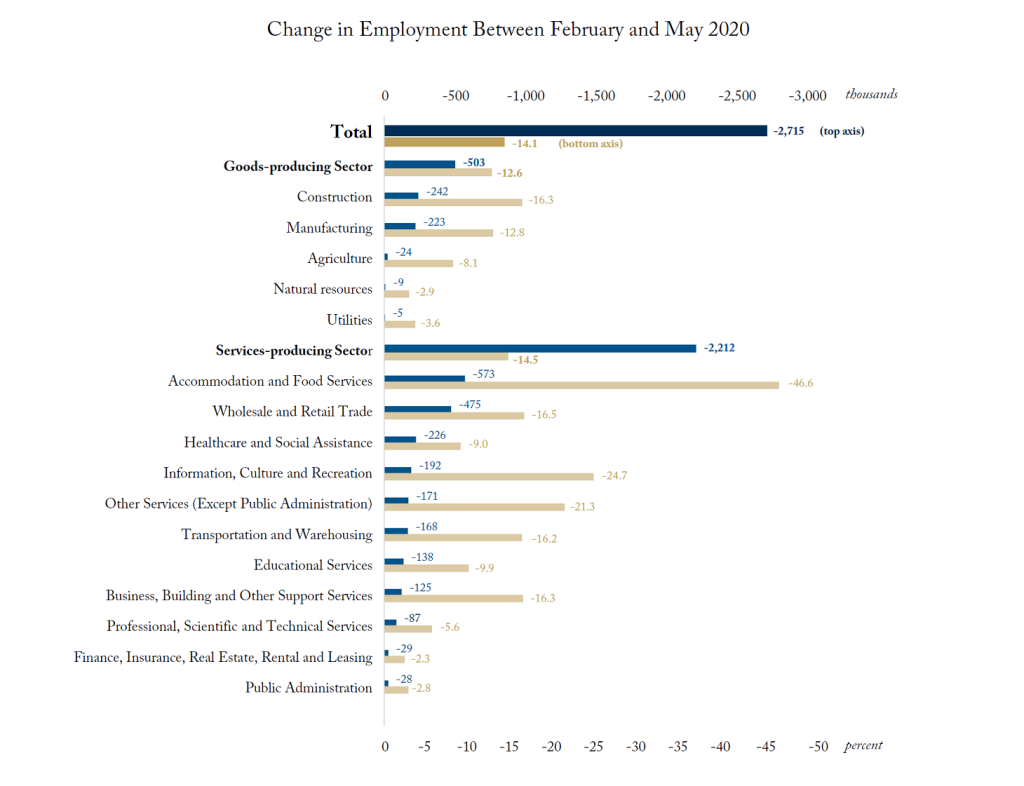 The latest release of the Labour Force Survey from Statistics Canada gives a glimmer of good news for the Canadian economy. Although Canada saw a 14.1 percent drop in employment between February and May, employment numbers showed a promising 1.8 percent gain in May over April. While the unemployment rate is at a record high, […]
 Tim Brennan – Could Covid-19 Justify Competitor Cooperation?
 From: Tim Brennan To: Competition policy watchers Date: June 8, 2020 Re: Could COVID-19 Justify Competitor Cooperation? As nations around the world try to cope with COVID-19, one hears calls to encourage cooperation among manufacturers and suppliers that normally compete with another. Cooperation, of course, is good if not necessary in so many aspects of our […]
 Without The Clarity They Need, Alberta’s Oil Sands Producers Are Being Set Up To Fail – Globe And Mail Op-ed
May was a bad month for Canada’s beleaguered oil producers. First, the Norges Bank, which manages Norway’s sovereign wealth fund, announced its divestment from four oil sands producers, citing their “unacceptable greenhouse gas emissions.” Then, presumptive Democrat nominee Joe Biden announced that, if elected U.S. president, he would cancel the permits for the Keystone XL pipeline. And there was the little matter of an unprecedented plunge in global oil demand thanks to the COVID-19 pandemic.
The Norges Bank’s decision is predicated on a misrepresentation of carbon pricing in Canada. Mr. Biden’s announcement represents a diplomatic failure, and a potentially fatal setback for a vital project. But those two developments…
Mike Veall – Freezing Ei Premiums
 From: Mike Veall To: Bill Morneau, Minister of Finance Date: June 5, 2020 Re: Freezing EI premiums The federal government has, in your words, “no plan to raise taxes.” This should extend to Employment Insurance (EI) premium increases as well. When the Canada Emergency Response Benefit (CERB) and the Canada Emergency Wage Subsidy (CEWS) are […]
 Ontario Should Streamline Path Off Welfare With More Carrot, Less Stick
Ontario should trim “punitive” welfare clawbacks and hike earnings exemptions for a more effective welfare system, says a new report from the C.D. Howe Institute. In “Lifting Lives: The Problems with Ontario’s Social Assistance Programs and How to Reform Them” authors Parisa Mahboubi and…Lifting Lives: The Problems with Ontario’s Social Assistance Programs and How to Reform Them
 Ontario should streamline path off welfare with more carrot, less stick Ontario should trim “punitive” welfare clawbacks and hike earnings exemptions for a more effective welfare system, says a new report from the C.D. Howe Institute. Authors Parisa Mahboubi and Mariam Ragab provide recommendations that would reduce the cost of taking on work to social […]
 Don’t Force Canadian Banks To Cut Dividends – Financial Post Op-ed
Banks are often in the political and regulatory crosshairs during times of economic stress, and COVID-19 is no different. Support for the payments system and credit markets can look like support for banks themselves. And supports for businesses are controversial. Few people want to prop up firms with no future and nobody wants government credit or transfer payments to fund executive bonuses or flow to shareholders through share buybacks or unsustainable dividends. Canada’s banks have just reported weak second-quarter earnings. Laurentian Bank just cut its dividend. Should the Office of the Superintendent of Financial Institutions (OSFI) ask other Canadian banks to do the same?
If they did, they would be following a trend. The…