



Lori Sterling – The Next Phase Of Economic Recovery, Part One: Transitioning Pandemic-related Relief Programs For Individuals
 From: Lori Sterling To: Canadian Businesses and Governments Date: June 4, 2020 Re: The Next Phase of Economic Recovery, Part One: Transitioning Pandemic-Related Relief Programs for Individuals As we move from lockdown to a more open economy, the existing government pandemic-related programs will have to evolve. The Canada Emergency Response Benefit (CERB) achieved its goal of an immediate […]
 Don’t Force Canadian Banks To Cut Dividends – Financial Post Op-ed
Banks are often in the political and regulatory crosshairs during times of economic stress, and COVID-19 is no different. Support for the payments system and credit markets can look like support for banks themselves. And supports for businesses are controversial. Few people want to prop up firms with no future and nobody wants government credit or transfer payments to fund executive bonuses or flow to shareholders through share buybacks or unsustainable dividends. Canada’s banks have just reported weak second-quarter earnings. Laurentian Bank just cut its dividend. Should the Office of the Superintendent of Financial Institutions (OSFI) ask other Canadian banks to do the same?
If they did, they would be following a trend. The…
Bank Of Canada’s Next Trick Involves A Delicate Three-way Balancing Act – Globe And Mail Op-ed
Even before the Bank of Canada’s interest rate announcement on Wednesday, the eyes of monetary policy watchers had shifted elsewhere – to the bank’s expanding balance sheet.
There was little surprise when the central bank left its target for the overnight rate at 25 basis points, with the deposit rate paid to banks also remaining at 25 basis points.
In fact, the target overnight rate is expected to remain where it is – a level at which the bank considers further cuts to be counterproductive – until at least well into 2021.
It is clear that the overnight rate will not be the centrepiece of the bank’s monetary policy for the foreseeable future.
Instead, the bank’s balance sheet and how it stickhandles it will…
Randy Bauslaugh – Esg Investing Will Get A Boost From The Pandemic
 From: Randy Bauslaugh To: Businesses and institutional investors Date: June 3, 2020 Re: ESG Investing Will Get a Boost from the Pandemic Pension fund fiduciaries and other institutional investors in Canada are increasingly using environmental, social and governance (ESG) considerations to better understand and predict financial risks and opportunities. They have become, in recent years, […]
 Nursing Home Fatalities Expose Weakness in Long-Term Care Provision: Crisis Working Group on Public Health and Emergency Measures
June 2, 2020 — While Canada has invested in residential long-term care at similar levels to other countries, it has drastically under-invested in home and community-based care, according to the C.D. Howe Institute’s Crisis Working Group on Public Health and Emergency Measures. Long-term care and retirement homes are the center of the epidemic in Canada, with about 80 percent of COVID deaths having occurred in residential care facilities — a death rate much higher than most other nations.
Because a high proportion of seniors in Canada live in an institutional care setting, they are at a much higher risk of exposure, infection and death from COVID-19 than seniors living in the community or in the home. While there is…
Mariam Ragab – Our Tracker Shows Emerging Signs Of Recovery, But We Are Not In The Clear
 From: Mariam Ragab To: Canadian Businesses and Governments Date: June 2, 2020 Re: Our tracker shows emerging signs of recovery, but we are not in the clear Statistics Canada’s March GDP numbers showed a 7.2 percent overall fall and projected another 11 percent for April. It contained detailed sectoral breakdowns: arts and entertainment and air transportation down more than […]
 Green, Simard-duplain, Siu – A Covid Assessment Tool To Guide The Opening And Closing Of Sectors
 From: David A. Green, Gaëlle Simard-Duplain, and Henry E. Siu To: Policymakers across Canada Date: June 2, 2020 Re: A COVID Assessment Tool to Guide the Opening and Closing of Sectors Since early May, the number of new Canadian COVID cases and – importantly – the number of COVID-related deaths, is on a downward trajectory. Now, public attention […]
 Jon Johnson – The Cusma Cultural Exemption: Minuses And Pluses
 From: Jon Johnson To: Global Affairs Canada Date: June 1, 2020 Re: The CUSMA Cultural Exemption – Minuses and Pluses Canadian trade negotiators have always bargained hard to preserve Canada’s ability to protect and encourage Canadian culture through ownership or content requirements by exempting cultural industries from the non-discrimination provisions in trade agreements. Canada secured […]
 Distress Signals: Canada’s GDP Contraction in March 2020
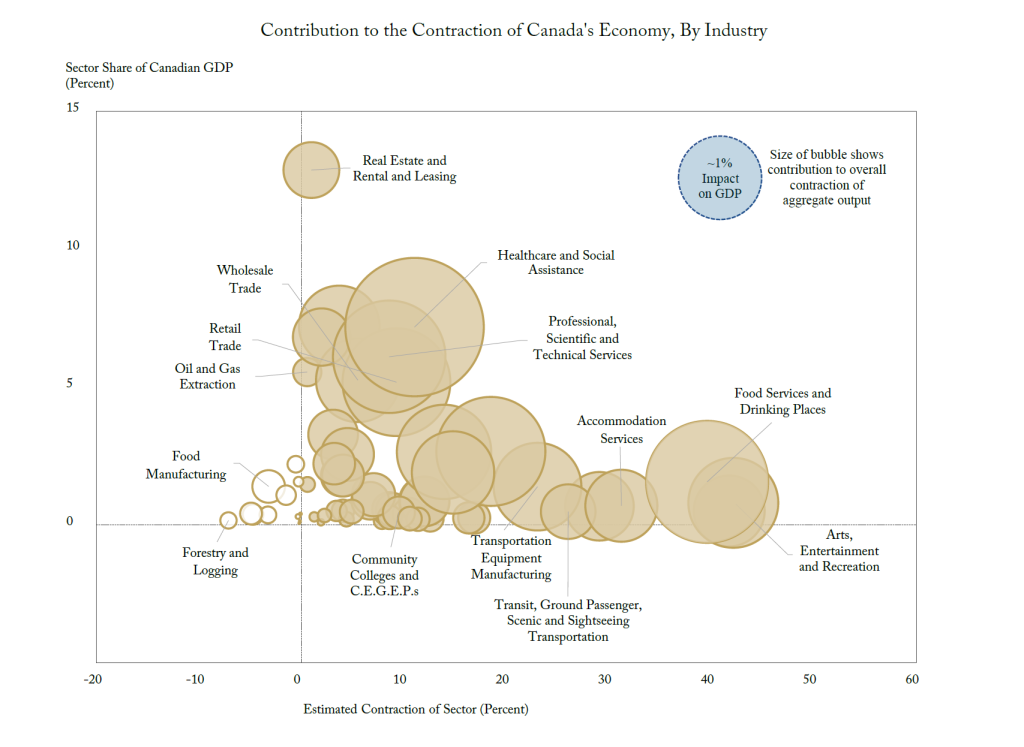 In this edition of Graphic Intelligence, we examine the earliest available GDP numbers by industry amid the COVID-19 crisis. Overall, Canada’s GDP shrank by 7.2 percent relative to February 2020, with arts, entertainment and recreation most affected at -42.2 percent. Also severely affected were air transportation at -41.8 percent, food services and drinking places at […]
 Ken Boessenkool – Supply-side Shocks And The Covid Economic Recovery
 To: Federal and Provincial Ministers of Finance From: Ken Boessenkool Date: May 29, 2020 Re: Supply-side shocks and the COVID economic recovery How should governments help the economy emerge from the COVID recession? Conventional responses are not designed for this – no amount of monetary or broad-based fiscal stimulus will open up middle seats on […]
 Bank of Canada Should Keep Overnight Rate at 0.25 Percent, Focus on Implications of Expanded Balance Sheet: C.D. Howe Institute Monetary Policy Council
May 28, 2020 – The C.D. Howe Institute’s Monetary Policy Council (MPC) recommends that the Bank of Canada maintains its target for the overnight rate, its benchmark policy interest rate, at 0.25 percent for at least a year.
The MPC provides an independent assessment of the monetary stance consistent with the Bank of Canada’s 2 percent inflation target. Jeremy Kronick, Associate Director, Research, chaired today’s meeting, sitting in for the MPC’s usual chair, William Robson, the Institute’s President and CEO. Council members make recommendations for the Bank of Canada’s upcoming interest-rate announcement, the subsequent announcement, and the announcements six months and one year ahead.
All ten members…
Stéphanie Lluis – Lessons From Employment Insurance For The Cerb
 From: Stéphanie Lluis To: Canadians Concerned about the Labour Market Date: May 28, 2020 Re: Lessons from Employment Insurance for the CERB The Canada Emergency Response Benefit (CERB) was designed as an emergency measure to offset the income losses of millions of individuals following the COVID-19 outbreak. It has been effective in providing financial support to many individuals and […]