



Daniel Schwanen: TPP is a good deal for Canada: Financial Post Op-Ed
By Daniel Schwanen
The Trans-Pacific Partnership (TPP) has finally landed – or so it seems. The 12 countries who signed on to the deal announced yesterday in Atlanta still have to ratify it. This process will mean that lawmakers and the public at large will review and debate the pros and cons of the agreement, as they see it, in each signatory country.
Canada will, of course, undergo such a debate. Here are three things Canadians should keep in mind as we examine the TPP’s fine print.
First is what this agreement is all about from Canada’s perspective: making it easier for firms here – both big and small – to do business in other member economies. Many large firms and their employees will benefit, since they are…
Frank Milne Re-appointed As A Research Fellow
William Robson, President and CEO of the C.D. Howe Institute, announces the re-appointment of Frank Milne, BMO Professor of Economics and Finance at Queen’s University, as a Research Fellow “Frank is an accomplished economist with…Qpp Experience Raises Red Flags For Other Public Pension Plans
The experience of the Quebec Pension Plan (QPP) offers serious lessons for new public pension plan options, in particular the pending Ontario Retirement Pension Plan (ORPP) and Canada Pension Plan (CPP) enhancements, according to a new C.D. Howe Institute report. In “The…L’expérience Du Rrq Soulève Des Questions Pour Les Autres Régimes De Retraite Publics – Institut C.D. Howe
Selon une nouvelle étude de l’Institut C.D. Howe, des leçons importantes peuvent être tirées de l’expérience du Régime des rentes du Québec (RRQ) pour de nouvelles options, comme la rente longévité proposée récemment par le Comité d’experts sur l’avenir du système de…Andrew Parkin: The skills paradox: National Post Op-Ed
By Andrew Parkin
How can Canada get the skills boost it needs to stay competitive? For many, the answer lies in pressuring our colleges and universities to do more to ensure that graduates are equipped with the skills employers need. A closer look at the evidence on adult literacy in Canada shows that our most pressing skills gaps lie elsewhere.
Canadians have grown accustomed to hearing that their provincially run education systems are among the best in the world. That’s why Canada’s less-than-stellar scores in the Organization for Economic Cooperation and Development’s (OECD) 2013 study of adult literacy was so jarring. It seems logical to expect high achievement in education to translate into high performance on skills…
The Benefits of Hindsight: Lessons from the QPP for Other Pension Plans
 The experience of the Quebec Pension Plan (QPP) offers serious lessons for new public pension plan options, in particular the pending Ontario Retirement Pension Plan (ORPP) and Canada Pension Plan (CPP) enhancements, according to a new C.D. Howe Institute report. In “The Benefits of Hindsight: Lessons from the QPP for Other Pension Plans,” authors Luc Godbout, […]
 Intelligence Minute – Benjamin Dachis explains how Alberta can get more out of its resource taxes
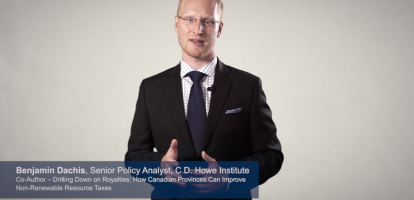
As Alberta embarks on another royalty review, this third installment of the Intelligence Minute features Institute Senior Policy Analyst, Benjamin Dachis, who discusses his recently co-authored report, “Drilling Down on Royalties: How Canadian Provinces Can Improve Non-Renewable Resource Taxes,” and how there is a better way for Alberta to both raise more revenue and encourage investment.
Adam Found Appointed Metropolitan Policy Fellow
William Robson, President and CEO of the C.D. Howe Institute, announces the appointment of Adam Found as the Institute’s Metropolitan Policy Fellow and his re-appointment as a Fellow-in-Residence. “Adam has unique expertise…Drilling Down on Royalties: How Canadian Provinces Can Improve Non-Renewable Resource Taxes
 The key problem with current resource taxes in Canada is not the tax rates, but the design of the taxes, states a new report from the C.D. Howe Institute. In “Drilling Down on Royalties: How Canadian Provinces Can Improve Non-Renewable Resource Taxes,” authors Robin Boadway and Benjamin Dachis suggest that a better design for many […]
 Time For Provinces To Replace Royalty Systems For Resource Companies
The key problem with current resource taxes in Canada is not the tax rates, but the design of the taxes, states a new report from the C.D. Howe Institute. In “Drilling Down on Royalties: How Canadian Provinces Can Improve Non-Renewable Resource Taxes,” authors Robin Boadway…William Robson: Go back into deficit? Bad idea: National Post Op-Ed
The federal government announced last week that it has balanced its budget ahead of schedule. After a deficit of $5.2 billion in fiscal year 2013-14, Ottawa posted a surplus of $1.9-billion in 2014-15.
Good news? Not everyone thinks so. Balancing the federal books has hurt Canada’s economy, said some critics. We even heard calls for a return to deficits.
If asked, some of those critics might acknowledge that deficits are dangerous. Committing to cover all spending with taxes sets a higher bar. Want another dollar in programs? Okay, justify taxing another dollar. Want tax relief? Great, just show the offset. Borrowing lowers that bar – one reason why deficits easily become chronic.
But, those critics would say, we’re…
Why Carbon Pricing Will Help To Secure Alberta’s Economic Future: Globe And Mail Op-ed
By Christopher Ragan
As Alberta’s new government assembles its troops and redesigns its policies for reducing greenhouse gas emissions, the need for greater environmental protection will be an obvious rallying cry. But Premier Rachel Notley should also be sure to make the case that pricing carbon emissions is very much in Alberta’s economic interests.
Many will wonder whether that last sentence is a mistake. How can attaching a financial penalty to carbon emissions be in the economic interests of a province so rooted in the production of fossil fuels? There are two reasons, each regarding a different kind of “market access.”
Alberta produces far more oil and natural gas than it can use at home, so getting these…