



Bill Robson on The Exchange: What’s the First Order of Business for Whoever gets Elected?
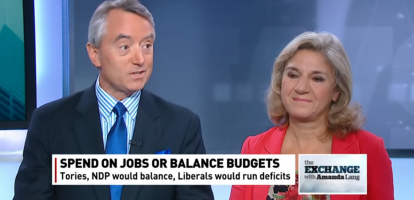
Institute President and CEO, Bill Robson, along with Goldy Hyder and ArmineYalnizyan, join host Amanda Lang for one last time, on the Big Picture Panel. Topic of discussion: First order of business for whoever gets elected on October 19.
First Nations Own-Source Revenue: How Is the Money Spent?
 Revenues from First Nations business activities have grown substantially over the last generation. In Ontario, they now comprise nearly one third of First Nation government funds. Where does the money go? A new C.D. Howe Institute report, “First Nations Own-Source Revenue: How Is the Money Spent?” makes use of new data to analyze band finances.
 What’s in Store for the Middle Class following the Election? Craig Alexander Joins CBC to Discuss
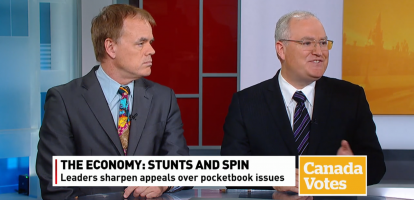
The Institute’s V.P. of Economic Analysis, Craig Alexander, joined Jim Stanford of Unifor on CBC to discuss what’s in store for Canada’s middle class following the election on October 19.
As First Nations Business Revenues Grow, Where Does The Money Go?
Revenues from First Nations business activities have grown substantially over the last generation. In Ontario, they now comprise nearly one third of First Nation government funds. Where does the money go? A new C.D. Howe Institute report, “First Nations Own-Source Revenue: How…NAFTA is not TPP: Financial Post Op-Ed
By Lawrence Herman
Canadian suppliers would not be entitled to enhanced access to the U.S. market granted to the 10 other TPP members
It’s time to answer some of the misguided arguments about Canada rejecting the TPP Agreement that are being bandied about.
I was dismayed to hear pundits and political candidates claim that, because 85 per cent of our exports are covered under the NAFTA and other trade bilateral agreements, we really don’t need to be part of the TPP anyway.
This shows a regrettable misunderstanding of international trade rules and Canada’s treaty commitments, whether under the World Trade Organization Agreement or elsewhere. So let’s review all this.
Start with the WTO Agreement. It’s a…
Bill Robson on The Exchange: Resource vs. Knowledge Based Economies
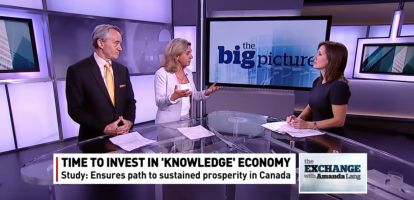
Bill Robson discusses the future of resource investment, and urban knowledge based economies on The Exchange’s Big Picture panel with co-panelist, Armine Yalnizyany.
One Percent? For Real? Insights from Modern Growth Theory about Future Investment Returns
 Pension fund savers face a future of lower investment returns, states a new report from the C.D. Howe Institute. In “One Percent? For Real? Insights from Modern Growth Theory about Future Investment Returns,” authors Steve Ambler and Craig Alexander project a 1 percent rate of real return for risk free investments like Treasury bills, forming […]
 A better way for Alberta to collect royalties: Calgary Herald Op-Ed
By Robin Boadway and Benjamin Dachis
Alberta’s much-anticipated royalty review panel has begun drilling down with expert and public consultations. It can find common ground by proposing that the province adopt a best-in-class cash-flow tax for all energy resources in the province.
The status quo needs changing. The province holds auctions in which companies purchase the rights to extract provincially owned oilsands, natural gas or conventional oil. Companies that buy conventional oil or natural gas deposits then pay the government a tax based on the amount they produce. These taxes are called gross-revenue royalties, because companies pay the province a share of their gross production revenues.
The royalty…
Un pour cent? Vraiment? Ce que la théorie économique moderne laisse présager quant au rendement futur des investissements
 Les épargnants et les caisses de retraite doivent faire face à des rendements futurs inférieurs sur leurs investissements, affirme une nouvelle étude d’Institut C.D. Howe. Dans « Un pour cent? Vraiment? Ce que la théorie économique moderne laisse présager quant au rendement futur des investissements », les auteurs Steve Ambler et Craig Alexander prédisent un rendement réel […]
 Les épargnants Et Les Caisses De Retraite Confrontés À Des Rendements Futurs Plus Bas Sur Les Investissements
Le 7 octobre 2015 — Les épargnants et les caisses de retraite doivent faire face à des rendements futurs inférieurs sur leurs investissements, affirme une nouvelle étude d’Institut C.D. Howe. Dans « Un pour cent? Vraiment? Ce que la théorie économique moderne laisse présager quant au…Pension Funds And Retirement Savers Face Future Of Lower Investment Returns
Pension funds and retirement savers face future of lower investment returns, states a new report from the C.D. Howe Institute. In “One Percent? For Real? Insights from Modern Growth Theory about Future Investment Returns,” authors Steve Ambler and Craig Alexander project a 1…A few small deficits may actually be just what Canada needs: Globe and Mail Op-Ed
By Christopher Ragan
There has been much confusion amid the discussion about budget deficits in the federal election campaign. These numbers mean almost nothing unless they are expressed relative to our national income. Once these numbers are better understood, it becomes clear that small budget deficits for the next few years, used to finance productive investments, would be good for the Canadian economy.
Let’s start with some basic facts about the federal government’s fiscal position over recent history. In 1985, the federal budget deficit was $40-billion, but that deficit was a whopping 8.1 per cent of gross domestic product (GDP), the largest in our postwar history. The accumulated net debt was then a modest 42.9 per…