



Edward Waitzer – Change Needed: Crooks Shouldn’t Get Out of Fines Through Bankruptcy
 From: Edward Waitzer To: Bankruptcy law watchers Date: August 8, 2024 Re: Change Needed: Crooks Shouldn’t Get Out of Fines Through Bankruptcy Insolvency laws in Canada (as in the United States, Britain and Australia) have long enshrined the principle that bankruptcy should not assist dishonest debtors. But the Supreme Court of Canada recently determined that fraudsters are able to […]
 Avoiding a Greek-Style Debt Crisis with Andrew Coyne and Trevor Tombe
 Federal and provincial governments in Canada are too casual about deficits and public debt, according to Globe and Mail columnist Andrew Coyne and economist Trevor Tombe of the University of Calgary. In our latest C.D. Howe Institute podcast episode, Coyne and Tombe discuss the long-term challenges to government balance sheets that we can see coming, […]
 Charles DeLand – Let Consumers Lead the Way on Green Vehicles and Heat Pumps
 To: Canadians Concerned about Climate Change From: Charles DeLand Date: August 6, 2024 Re: Let Consumers Lead the Way on Green Vehicles and Heat Pumps The federal government and many provinces are working toward reducing greenhouse gas (GHG) emissions with Ottawa committing to achieving a net-zero economy by 2050. However, governments need to proceed more cautiously with two of their […]
 Eichenbaum, Alexopoulos, Kronick – Economists must convince the public that productivity isn’t just a number
Published in The Globe and Mail.
Since 1985, U.S. labour productivity has grown by roughly 100 per cent. In sharp contrast, labour productivity in Canada grew by only 40 per cent. Canadian workers are now only 70 per cent as productive as U.S. workers. And we’re not just falling behind the U.S. – the growth rate of our productivity is well below that of the U.K., Germany and France.
Economists have long been aware of our productivity malaise, but we need a broader audience. Public support can help solve the problem, and this requires showing Canadians how productivity gains improve their lives.
To see the benefits of higher productivity, consider the following example: Suppose a firm with 100 workers produces 100…
Graph of the Week: Canadian IP Payments and Receipts
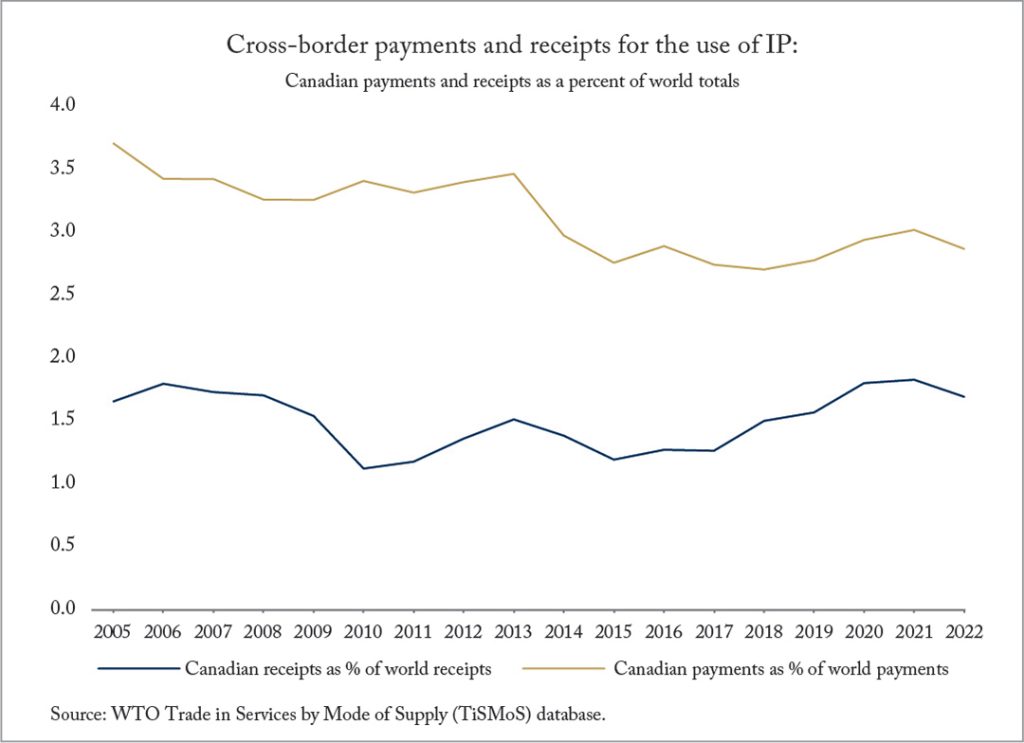 Introducing Graph of the Week, a new series from the C.D. Howe Institute’s Graphic Intelligence that presents valuable and easily digestible data. Each Monday we will unveil one new captivating chart or graph with interesting insights, explaining it in two-to-three sentences. Dive into the data with us. The gap between these two lines reflects the Canadian balance-of-payments deficit […]
 Optimizing Immigration for Economic Growth with Mikal Skuterud and Christopher Worswick
Canada needs to return to the immigration system that made us the envy of the world. Economists Mikal Skuterud and Christopher Worswick explain that choosing economic immigrants based on their likelihood of success is key to the long-term success of the country on the whole. Ripple Effects: The Impact of an Empty-Homes Tax on the Housing Market
 The Canadian housing market is experiencing an unprecedented crisis. One solution being explored is the adoption of demand-side measures like Vancouver’s 2017 empty-homes tax. This E-Brief evaluates the tax’s impact on housing affordability and availability, helping policymakers balance efficient property use with ensuring a steady supply of new homes. We use the difference-in-difference (DID) method […]
 Barry Gros – Ontario Finally Joins the Target Benefit Pension Party
 To: Ontario Pension Observers From: Barry Gros Date: August 1, 2024 Re: Ontario Finally Joins the Target Benefit Pension Party Ontario’s journey towards target benefit pension regulation is coming to a close. The Ministry of Finance recently released draft regulations for technical review with an effective date of January 1, 2025, winding up a process begun last year. […]
 The Verdict on Vacant Home Taxes
The verdict is in: Vacant home taxes can improve housing availability, but not affordability, according to a new C.D. Howe Institute report. In “Ripple Effects: The Impact of an Empty-Homes Tax on Canada’s Housing Market,” authors Gherardo Gennaro Caracciolo and Enrico…Rosalie Wyonch – Addressing Canada’s Bed-Blocker Problem
 To: Healthcare Observers From: Rosalie Wyonch Date: July 31, 2024 Re: Addressing Canada’s Bed-Blocker Problem Canadian hospitals are capacity-constrained and expensive and therefore not the best care setting for patients who no longer need acute care and the bed that comes with it. Yet these “alternate level care” (ALC) patients accounted for 17 percent of all acute-care bed days […]
 Charles DeLand – Want the best climate policy? Let the market decide
Published in The Globe and Mail.
The federal government and many provinces are working toward reducing greenhouse gas (GHG) emissions with Ottawa committing to achieving a “net-zero” GHG economy by 2050. However, governments need to proceed more cautiously with two of their key policy levers – zero-emission vehicles (ZEVs) and heat pumps – and let consumers lead the way.
Reducing emissions comes at an economic cost. The trick is to ensure Canadians still have the products and services they need while minimizing the cost of each GHG tonne not emitted. This is not an easy task in a complex, energy-intensive economy in which Canadians feel their budgets are stretched. Including upfront and continuing costs, ZEVs and heat…
The Good, the Bad and the Unnecessary: A Scorecard for Financial Regulations in Canada
 Canada’s regulatory burden has increased significantly over the past decade, resulting in higher compliance costs and decreased competitiveness. This paper evaluates whether Canadian financial regulators employ a sound approach. There is a need for a balanced approach that ensures regulations address financial stability and consumer protection while fostering innovation and market efficiency. The analysis includes […]