



Financial Sector Rules Need Careful Weeding
Canadian financial sector rules need careful weeding to safeguard the system and market stakeholders, while creating conditions for innovation and efficiency, according to a new C.D. Howe Institute report. In “The Good, the Bad and the Unnecessary: A Scorecard for…Graph of the Week: The Top 10 Diagnoses Hospitalization Rate
 Introducing Graph of the Week, a new series from the C.D. Howe Institute’s Graphic Intelligence that presents valuable and easily digestible data. Each Monday we will unveil one new captivating chart or graph with interesting insights, explaining it in two-to-three sentences. Dive into the data with us. Compared to pre-pandemic, current hospitalization rates for the […]
 Lawrence Herman – Mélanie Joly’s China visit is just the latest in a line of Canadian foreign-policy own-goals
Published in The Globe and Mail.
Canada has lost its way in the world. Its international influence and respect is in serious decline, as a result of a combination of poor political leadership and inept actions, especially during the nine years of Justin Trudeau’s government.
It is a challenge for any government to avoid foreign-policy missteps. Given the volatility in global affairs with unexpected crises beyond a country’s control, it is impossible to always get things right, as governments react and adjust to sudden events. But Canada’s errors in recent years go far beyond this, showing astonishing ineptitude – own-goals that will have long-term consequences, and are of the Liberal government’s own making.
Take…
Lewis, Dupuy – Nostalgia Should Not Drive Ontario’s Economic Development Policy
 From: Brian Lewis and Damian Dupuy To: Ontario Economy Observers Date: July 25, 2024 Re: Nostalgia Should Not Drive Ontario’s Economic Development Policy Despite bold promises and billions of dollars of support, Ontario manufacturing jobs remain around the same level as when Doug Ford’s Progressive Conservatives came to power. The province needs to move past the nostalgic view of […]
 Rosalie Wyonch – Eliminate hallway medicine by getting non-acute patients out of hospital
Published in the Financial Post.
Canadian hospitals are capacity-constrained and expensive and therefore not the best care setting for patients who no longer need acute care and the bed that comes with it. Yet these “alternate level care” (ALC) patients accounted for 17 per cent of all acute-care bed days in Canada (excluding Quebec) in 2022-23. Reducing this unnecessary use of limited acute-care capacity could help ensure hospital beds are open for Canadians when they need them.
High ALC volume is one of the most vexing and complex health system challenges, but there are ways to address it. Relatively modest improvement could help reduce the risk of hospital bed shortages. ALC occupancy, which ranges from 14.5 to 26.1…
Grant Bishop – Ottawa’s New Greenwashing Rule Infringes Freedom of Expression
 From: Grant Bishop To: Attorneys General of Provincial Governments Date: July 24, 2024 Re: Ottawa’s New Greenwashing Rule Infringes Freedom of Expression The new greenwashing rule hastily crammed into the Competition Act in last month’s omnibus budget bill has cast a chill over communications by Canadian companies – many of whom have scrubbed content from their webpages in response. The […]
 Graph of the Week: The 5-Year Fixed Interest Rate
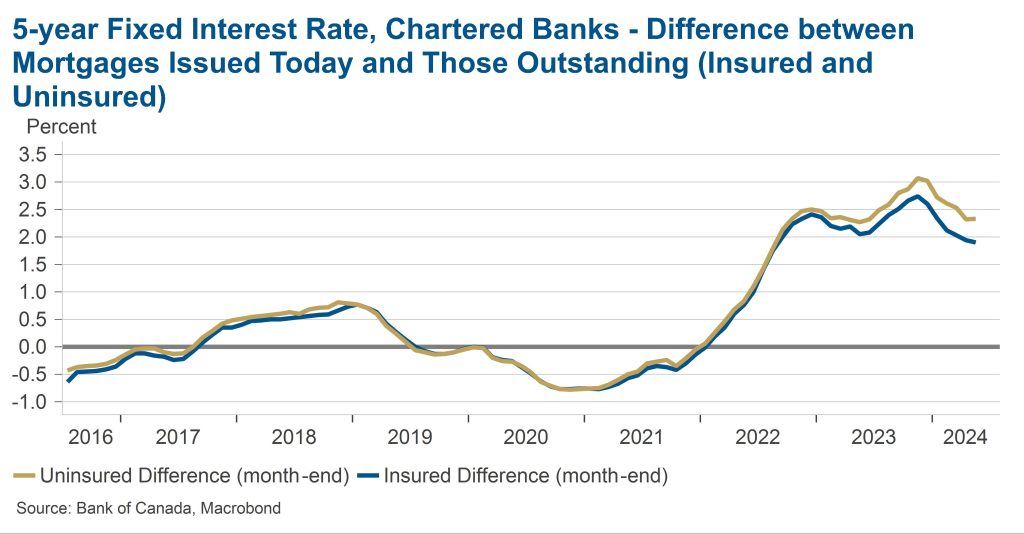 Introducing Graph of the Week, a new series from the C.D. Howe Institute’s Graphic Intelligence that presents valuable and easily digestible data. Each Monday we will unveil one new captivating chart or graph with interesting insights, explaining it in two-to-three sentences. Dive into the data with us. The 5-year fixed interest rate is the most […]
 Rosalie Wyonch – Ozempic: The Perils of Living Beside the US Elephant
 From: Rosalie Wyonch To: Healthcare observers Date: July 22, 2024 Re: Ozempic: The Perils of Living Beside the US Elephant In the last instalment of our examination of the lessons of the Ozempic moment we look at the complications of living next door to the largest and highest profit pharmaceutical market in the world and ongoing changes to […]
 C.D. Howe Institute Monetary Policy Council Calls for Bank of Canada to Lower Overnight Rate to 4.50 Percent, Cut to 3.25 Percent by July 2025
July 18, 2024 – The C.D. Howe Institute’s Monetary Policy Council (MPC) calls for the Bank of Canada to lower its target for the overnight rate, its benchmark policy interest rate, to 4.50 percent at its next announcement on July 24th. The MPC further calls for the Bank to lower the target to 4.25 at the following announcement in September, on the way to a target of 3.25 percent by July of 2025.
The MPC provides an independent assessment of the monetary stance consistent with the Bank of Canada’s 2 percent inflation target. MPC co-chair, Jeremy Kronick, the Institute’s Associate Vice President and Director of the Centre on Financial and Monetary Policy, chaired this meeting. MPC members make…
Rosalie Wyonch – Ozempic: Economic Ripple Effects, Equity and Side Effects
 From: Rosalie Wyonch To: Healthcare Observers Date: July 18, 2024 Re: Ozempic: Economic Ripple Effects, Equity and Side Effects The surge in demand for Ozempic (and other GLP-1 medications) has implications for healthcare’s future, is creating opportunities for complementary products and services and disrupting other markets. About 6 percent of US adults currently use one of the drugs, according to […]
 Plotting Progress on Primary Care Access Strategies across Provinces
 The lack of access to family physicians in Canada is a critical issue affecting millions of Canadians, and provinces are all moving to address it.This Graphic Intelligence illustrates primary care initiatives and actions taken by various provinces since 2022 in pursuit of five well-established approaches: increasing supply of family physicians; reducing administrative burdens; implementing alternative compensation […]
 Rosalie Wyonch – Ozempic: Disruption and Drama in Pharmaceutical Markets and Insurance
 From: Rosalie Wyonch To: Healthcare Observers Date: July 17, 2024 Re: Ozempic: Disruption and Drama in Pharmaceutical Markets and Insurance Ozempic (and other GLP-1 medications) are having their moment in the popular mind. And their sudden prominence illustrates how pharmaceutical companies can expand the market for existing products by finding new applications. They have been approved as safe for […]