


Overview
by John Lester and Benoît Robidoux
- Drawing on presentations and discussion at the C.D. Howe Institute’s 2026 Workshop on Strengthening the Federal Evaluation Function, this Conference Report examines why the federal evaluation function produces too little usable evidence to inform expenditure management. It combines the workshop proceedings with additional analysis and recommendations from the authors.
- The report finds that the current evaluation framework does not explicitly require value for money assessments, provides excessive flexibility in how efficiency is assessed, and is constrained by gaps in data, expertise, and institutional incentives. It recommends making assessments of relevance, effectiveness, operational efficiency, and value for money mandatory, using clearly specified methodologies.
- The report also recommends broadening evaluation coverage to include spending delivered through the tax system and new spending proposals, strengthening value for money methodologies and the use of administrative data, and creating an independent evaluator general to improve the quality and usefulness of federal program evaluations.
Rapporteurs’ Report
By John Lester and Benoît Robidoux
Introduction
This Conference Report summarizes the presentations and discussion at the C.D. Howe Institute’s Workshop on Strengthening the Federal Evaluation Function on March 11, 2026, with additional analysis and recommendations from the authors. The workshop was motivated by a growing mismatch between mounting fiscal pressures and the limited evaluation evidence available to guide federal spending decisions.
As the federal government ramps up defence and defence-related spending to 5 percent of GDP over the next decade, non-defence spending will have to be scaled back considerably to avoid tax increases or higher debt. Making sensible choices about which programs to target requires robust value for money evidence on program spending. Unfortunately, such evidence is lacking. Despite allocating substantial resources to assessing program spending, few federal evaluations can meaningfully guide spending decisions.
The main reason for this gap is that the current evaluation policy does not explicitly require value for money assessments. Programs must be evaluated for efficiency, which opens the door to value for money assessments, but evaluators have substantial flexibility in how this is done. With limited central direction, few evaluators choose to assess program efficiency through a value for money lens and, therefore, have not developed data systems and expertise to perform such assessments. Risk aversion – the reluctance to draw attention to programs that are not performing well – also plays a role. Making value for money evaluations a core evaluation requirement would provide the impetus to develop specialized talent and data over time required to build an effective evaluation framework.
Creating an evaluator general position with a mandate to help build departmental evaluation capacity, and to undertake value for money evaluations while departments are building capacity, would help the evaluation function reach its full potential more quickly. Capacity development could also be accelerated by emulating the high-quality evaluations of labour market training programs performed at Employment and Social Development Canada (ESDC), and the benefit-cost analysis of regulatory initiatives performed in several departments.
A key feature of the ESDC evaluations of active labour market programs is that they capture the social cost of raising taxes to finance program spending. Raising an extra dollar in tax revenue not only reduces private-sector disposable income but also hurts economic performance by reducing incentives to work, save, and invest. The social cost of raising taxes, usually described as the marginal cost of public funds, is certainly offset by higher spending by program beneficiaries. But there will always be a direct social cost from a “tax and spend” operation because money is transferred from taxpayers to program beneficiaries in a leaky bucket. As discussed below, on average, around 35 to 75 percent of the transfer could be lost as the tax base shrinks due to lower efficiency and tax avoidance.
Evaluators should assess value for money using benefit-cost analysis when both benefits and costs can be expressed in dollar terms, and they should use the ratio of costs to a measure of program outcome when the benefits cannot be monetized. Benefit-cost analysis allows programs to be ranked by their net social benefit measured in dollars, but when comparing programs that differ in size, it is useful to calculate benefit-cost ratios to determine benefits per dollar of costs incurred. Cost-effectiveness ratios can be used to rank programs with similar objectives or to compare them to a benchmark. When neither benefits nor all costs can be monetized, evaluators should undertake qualitative benefit-cost analyses. A qualitative analysis should also be performed if neither cost-effectiveness ratios for similar programs nor benchmarks are available for comparison purposes.
While benefit-cost ratios are typically used to compare the “bang for the buck” of programs, the denominator of the ratio is the social cost of the program instead of its fiscal cost, which is of particular interest to policymakers. Comparing a program’s net social benefit with its net fiscal cost, described as the marginal value of public funds (MVPF),1Policy Impacts. 2026. “What Is the MVPF?” https://policyimpacts.org/mvpf-explained/what-is-the-mvpf/. gives policymakers a better measure of how the marginal dollar of tax revenue should be spent. In this alternative approach, the cut-off point for a viable program occurs when the marginal value of the program equals the marginal cost of public funds.
This alternative approach should be part of all value for money evaluations of government programs. The additional information would enhance program comparability and strengthen the methodological base of evaluations.
While performing more and better value for money evaluations is important to strengthening the evaluation function, structural changes are also required. In addition to appointing an evaluator general, a stronger evaluation function would result from:
- Broadening coverage of the evaluation policy to include spending programs authorized through the Income Tax Act, which include the Canada Child Benefit and refundable tax credits, and tax measures that are functionally equivalent to program spending, such as non-refundable investment tax credits.
- Extending the evaluation framework to the program approval stage by including a simplified value for money test in the process.
- Freeing up resources by moving away from a rigid five-year cycle toward a more flexible approach when high-quality evaluations exist and programs have not materially changed.
Ottawa describes its overall expenditure management system as “designed to ensure that all programs are focused on results, provide value for taxpayers’ money and are aligned with the government’s priorities and responsibilities.” Making value for money evaluations of programs mandatory while allowing time to build capacity, appointing an evaluator general, and broadening the scope of the evaluation policy would be big steps toward making this worthy goal a reality.
Both authors presented at the workshop. In preparing this report, they refined their analysis and recommendations and added material that complements the other presentations (see Agenda).
The Federal Evaluation Policy Framework
The federal government’s Expenditure Management System is designed to ensure that all new and existing programs are focused on results, provide value for taxpayers’ money, and are aligned with the government’s priorities and responsibilities.2Treasury Board of Canada Secretariat. 2025. “Expenditure Management System.” July 21. https://www.canada.ca/en/treasury-board-secretariat/services/planned-government-spending/expenditure-management-system.html. Within that system, the Treasury Board Policy on Results (2016) and Directive on Results (2016), including the Mandatory Procedures for Evaluation and the Standards on Evaluation, are the foundation of the federal evaluation framework.
The key requirements of the evaluation policy framework are:
- Grant and contribution programs with an average yearly budget of at least $5 million must be evaluated every five years and the results made public.
- All other programs, excluding those authorized through the Income Tax Act,3These programs include the Canada Child Benefit and refundable tax credits, both of which are included in program spending. must be evaluated periodically and the results made public.
Programs must be evaluated for relevance, effectiveness, and efficiency. Depending on user needs, however, evaluations can also examine other themes and issues, including alternative interventions.
Programs are broadly defined to cover all program spending identified in budget documents, except for spending authorized under the Income Tax Act, which, as discussed later, accounts for about 10 percent of program expenditures. Selected definitions used in the evaluation policy framework are presented in Box 1.
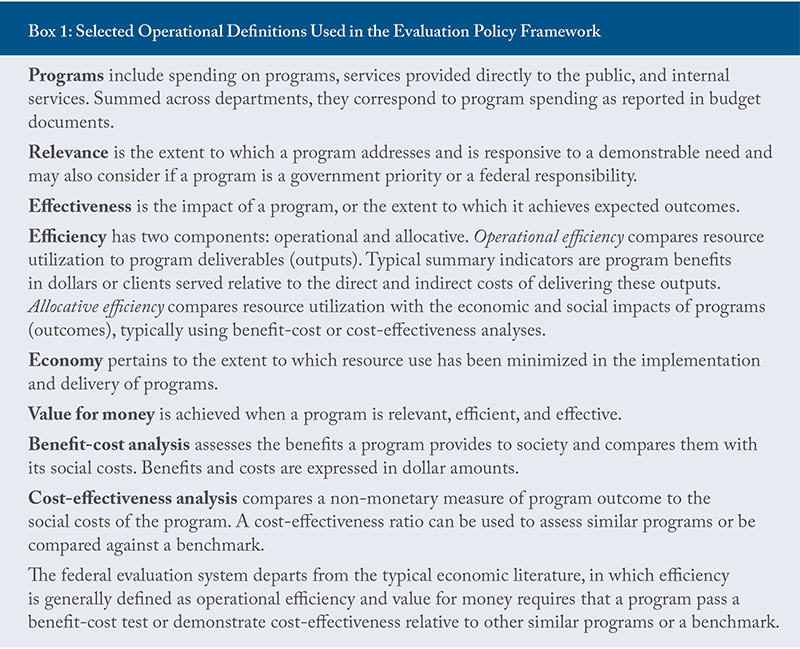
Neither the Policy nor the Directive mention value for money, which is surprising given the stated objectives of the government’s expenditure management system. However, a supporting document (Treasury Board of Canada Secretariat 2013) sets out the requirement to perform value for money assessments. Value for money is generally understood to require that the benefits of a program exceed its costs. A more nuanced interpretation is needed when program benefits cannot be expressed in dollar terms. In this case, value for money can only be assessed relatively using cost-effectiveness analysis, which compares the social costs of the program to a non-monetary measure of its outcome.
Workshop presenter Andres Velez-Guerra emphasized that achieving value for money within the federal evaluation framework means something broader. To demonstrate value for money, a program must be relevant, effective, efficient, and pass a benefit-cost test or be cost-effective. To simplify the discussion in this report, we assume that programs provide value for money when they pass a benefit-cost test or demonstrate cost-effectiveness.
A Shortage of Value for Money Evaluations
Velez-Guerra made the point that value for money has always mattered, but attention to it comes in waves. Interest in value for money assessments comes to the forefront during periods of fiscal pressure, and Canada is clearly in such a period now. Unfortunately, the supply of value for money evaluations lags demand for them.
Most evaluations address implementation rather than results or outcome issues (Nordstrom 2026). Further, most outcome-oriented evaluations focus on how program beneficiaries are affected – generally without carefully identifying the program’s contribution to these outcomes – rather than whether programs provide value for money. Lester (2024) reviews 48 evaluations prepared from 2020 to 2024 in eight departments and finds that only four went beyond assessing impacts on program beneficiaries to examine whether they provided value for taxpayers’ money. Three of these evaluations applied a formal benefit-cost analysis. About 70 percent of the programs reviewed had well-defined economic objectives, making a value for money assessment based on benefit-cost analysis feasible.
In discussing why there are so few value for money evaluations, Benoît Robidoux emphasized data limitations and the excessive flexibility of evaluation requirements. Velez-Guerra broadened concerns about data to include the availability of the talent required to perform value for money evaluations. He also drew attention to risk aversion as a contributing factor, a concern shared by John Lester.
Effective evaluation to inform expenditure management decisions requires clear program objectives and the availability of high-quality, usable administrative and economic data. While the Directive on Results requires departments and agencies to identify output (deliverables) and outcome (results or impact) indicators for their programs, Robidoux explained that these are not always coherent and standardized, and data collection to support program performance measurement and evaluation remains a challenge in many departments.4Bourgeois and Maltais (2023) review 41 reports of neutral assessment of evaluation functions from 28 federal organizations published between 2013 and 2020 and conclude that “the integration of performance measurement in evaluation activities is an ongoing challenge” (365). According to the Directive, program managers are responsible for ensuring appropriate data are available to evaluate programs. A better approach would be to make data development a joint responsibility of program managers and evaluators, and to require deputy heads to ensure this responsibility has been fulfilled.
Further, collecting administrative data on program participants is necessary but not usually sufficient (Frenette et al. 2025). Information on non-participants is required to assess the contribution of the program to changes in outcomes for participants and to determine whether the program was well-targeted. In addition, a sound evaluation may require following program participants before program implementation and after the program has ended.
Velez-Guerra noted that, in addition to having the right data, performing strong efficiency evaluations requires the right set of skills. Evaluators need analytical judgment combined with the ability to translate technical information into clear, actionable insights for non-technical audiences. Evaluators do not need to be experts in everything, but evaluation teams need the right mix of competencies. They should have complementary expertise in costing, efficiency, impact analysis, cultural competency, and partner engagement.
Robidoux highlighted the excessive flexibility of the evaluation policy as a key obstacle to performing more value for money evaluations. While programs must be assessed for relevance, efficiency, and effectiveness, departments may “go around” these requirements given the plethora of options for meeting them. The evaluation policy framework proposes 16 approaches to measure efficiency or economy – many qualitative – and notes “that these represent only a small sample of approaches that evaluators may wish to adopt in assessing efficiency or economy.”5These 16 approaches include three allocative efficiency evaluations: cost-effectiveness, cost-benefit analysis, and cost-utility analysis. They also include seven operational efficiency evaluations (benchmarking, planned to actual cost comparison and analysis/expenditure tracking and analysis, business process mapping and analysis, fidelity assessment/testing theory of implementation, optimization analysis/expert opinion, participatory appraisal, and comparison with alternative program models/comparative cost per output), and four economic analysis evaluations (benchmarking, planned to actual input cost comparison, comparative cost per input, and optimization analysis/expert opinion). Cost-feasibility analysis and cost-minimization analysis are also noted as other possible approaches to assess efficiency. See Treasury Board of Canada Secretariat (2013) for more details.
Value for money evaluations fall under the allocative efficiency category, which can be assessed using benefit-cost, cost-effectiveness, and cost-utility analysis. However, cost-utility analysis may be applied in ways that do not provide value for money information. Cost-utility analysis is a special form of cost-effectiveness analysis that “compares the utility of a program (i.e., the worth, value, merit of, or degree of satisfaction with program outcomes, usually as defined from the perspective of beneficiaries) in light of the costs” (Treasury Board of Canada Secretariat 2013). This definition allows the use of utility measures based on program outputs (deliverables) rather than program outcomes (results). Consider a business subsidy with the expected outcome of improving economic performance. A necessary but not sufficient condition for this to occur is a positive response of the beneficiaries to the subsidy. As a result, performing a cost-utility analysis by calculating the cost per job created by the subsidy would satisfy the formal requirement to assess efficiency, but would not address value for money in a meaningful way. In contrast, benefit-cost and cost-effectiveness analyses compare program outcomes with the social costs of the program.
In summary, allowing some flexibility in how evaluations are performed is necessary, but too much flexibility, particularly when combined with limited central direction, allows evaluators to avoid doing the hard work required to prepare well-defined value for money assessments of programs.
Velez-Guerra also drew attention to risk aversion as a possible reason for the shortage of value for money evaluations. Not all programs will demonstrate value for money, and there is reluctance to draw public attention to such findings. Mayne (2018) makes the point that it is not reasonable to expect departmental evaluators to question the existence of programs that have been endorsed by their minister. At the workshop, Lester speculated that political support may not be available for making value for money evaluations mandatory. We are now at a zenith of political interest in value for money evaluations, but there may be less interest when the pressure to cut or reallocate spending is less intense. Ministers may not have an appetite for exposing the weaknesses of programs the government has championed.
However, the treatment of regulatory initiatives offers hope that risk aversion can be overcome. As discussed by Timothy Folkins, the federal government has successfully enforced the requirement that proposed regulations must pass a benefit-cost test before implementation. This precedent supports our recommendations, discussed in the next section, that spending proposals be required to pass a simplified value for money assessment prior to approval and that existing programs be rigorously assessed through a value for money lens.
In an exchange after the meeting, Karen Myers noted that building durable demand for value for money evaluations depends on using evidence earlier and more systematically across the policy cycle. This involves defining the problem, designing the right mix of interventions, and adapting in real time, so that leaders actually call for and act on the evidence produced.6For additional detail, see the report on Blueprint’s Better Evidence conference by Myers and Schmidt (2024). This points to another way to reduce risk aversion by ministers.
Increasing the Supply of Value for Money Evaluations
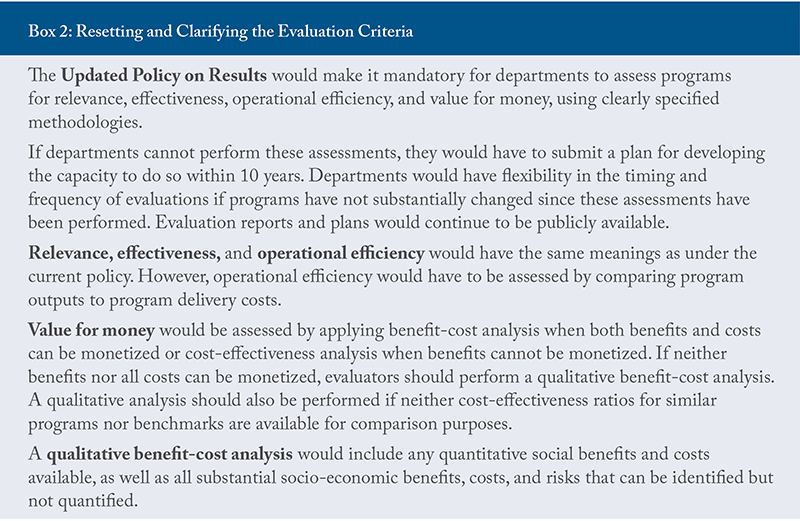
Given the diversity and complexity of government programming, allowing flexibility in evaluation approaches is good policy. However, this flexibility should be available only when mandatory evaluation requirements have been fulfilled. We recommend that the Policy on Results make value for money evaluations a mandatory requirement, replacing allocative efficiency and economy, while clarifying what is expected from each pillar of the framework (Box 2).
These mandatory evaluations should apply only to programs and spending above a threshold size. Currently, grant and contribution programs with a budget greater than $5 million are subject to the evaluation policy. However, since value for money assessments can be expensive to conduct and the $5-million threshold has not been updated since the introduction of the Policy on Results in 2016, the value threshold triggering a mandatory assessment should be higher, in the range of $10 to $15 million.
Value for money assessments would include the direct and indirect costs of delivering a program in the calculation of social costs. However, value for money assessments of programs do not necessarily examine how efficiently programs are delivered, so a separate operational efficiency assessment of delivery costs may be required. Further, program-level assessments of delivery costs should be supplemented by department-level value for money and operational efficiency assessments of internal services (e.g., policy development and analysis, human resources, IT, and corporate services), most of which support program delivery.
Operational efficiency assessments would compare program outputs, measured in monetary or non-monetary terms, with direct and indirect program costs.7 In many cases, calculating a cost-output ratio will provide a useful perspective on public sector productivity. However, this link could be strengthened, as discussed below, by including output-input ratios.
Concern is frequently expressed that not all programs can be assessed through a value for money lens. This is a legitimate concern, but the number of programs that are “out of scope” is small. As discussed in more detail below, benefit-cost analysis can be applied when both benefits and costs can be expressed in dollar amounts, which, based on experience with regulatory benefit-cost analysis, is possible for a surprisingly wide range of activities. When benefits cannot be expressed in dollar amounts, cost-effectiveness ratios can be calculated. However, cost-effectiveness ratios are less useful when they cannot be compared to similar programs or benchmarks. Further, cost-effectiveness ratios cannot be calculated when neither the benefits nor all costs of a program can be quantified in any way. In these two cases, a qualitative benefit-cost analysis should be performed. This is likely to apply to many international assistance programs due to data limitations,7Global Affairs Canada evaluates development assistance using 13 evaluation criteria developed by the Organisation for Economic Development and Cooperation (OECD 2019). One of the evaluation criteria is efficiency, but recent evaluations address operational efficiency only. Global Affairs Canada could also decide to prioritize supporting programs in foreign countries that have been subject to benefit-cost analyses. and to internal services and services provided directly to the public. Even when the benefit-cost analysis is purely qualitative, simply setting out the framework helps structure policy deliberations (World Bank 2026, 45-6).
Even when it is possible to undertake a benefit-cost analysis or to calculate useful cost-effectiveness ratios, in many cases they will not provide sufficient information to support decision-making. Assessing programs that address fairness issues such as income redistribution, reconciliation, and social trust is inherently subjective. Evaluators must therefore provide a thorough analysis of program impacts on fairness goals to complement the value for money perspective so that policymakers can weigh all the evidence when making decisions. Blending quantitative and qualitative analysis can help policymakers assess the trade-off between economic performance and fairness.
Robidoux also recommended creating an evaluator general position with a mandate to help build departmental evaluation capacity and to undertake value for money evaluations while departments are building capacity. This would help the evaluation function reach its full potential more quickly. The evaluator general would also exercise a challenge function with respect to departmental evaluations and undertake horizontal evaluations.
Performing high-quality value for money evaluations requires detailed information on program participants that can be linked to other economic and social data. It also requires skilled evaluators able to use these datasets to determine the incremental impacts on program beneficiaries. Fortunately, Statistics Canada is willing and equipped to assist departments in this work. Frenette et al. (2025) explain how linked datasets can be developed and illustrate the approach with a first application to the Canada Summer Job program. Drabo et al. (2026) provide a detailed review of contemporary methods for identifying the incremental impacts of programs serving businesses and illustrate them with an assessment of advisory services, loans, and grants to small and medium-sized enterprises provided by Crown corporations such as the Business Development Bank of Canada. Blueprint, in collaboration with the Future Skills Centre and ESDC through the Results for Canada initiative, is laying the foundation for a standardized, efficient, privacy-protected evidence system that could be used by all evaluators.
Advice on Performing Value for Money Evaluations
Increasing capacity to perform value for money evaluations requires evaluators to have a firm understanding of the methodology. Lester provided an overview of the methodology while Jérôme Mercier and Folkins discussed practical examples. Myers and Max Palamar discussed how to make better use of administrative data to improve both the quantity and quality of value for money evaluations.
In his overview of methodological issues, Lester emphasized that value for money evaluations should assume that programs are financed by higher taxes. Although most existing spending is financed by taxes, debt financing has played a substantial role in funding new federal spending in recent years. However, to prevent an unsustainable rise in debt, the federal government will eventually have to raise taxes to finance debt interest payments. An increase in debt-financed spending therefore implies an increase in taxes, now or in the future. With this financing assumption, the income received by program beneficiaries is offset by an income loss to the taxpayers providing the financing. If lump sum taxes were available, these two effects would offset each other, allowing the government to transfer income within the population without any consequences for economic performance.
However, the taxes available to governments harm economic performance by adversely affecting incentives to work, save, and invest. As a result, all value for money assessments should show the benefit generated by the amount spent on the program and the two costs associated with financing this spending: the income lost to higher taxation and the loss in economic efficiency arising from higher tax rates. The sum of these two costs is usually described as the marginal cost of public funds (MCPF), because it measures the social cost of raising an additional dollar in tax revenue.
These costs can be substantial. For individual taxes, MCPF estimates range from 1.13 for consumer taxes such as the GST to 2.86 for the federal personal income tax, which means raising a dollar in taxation could cause up to $1.86 in economic damage. Estimates for the MCPF are discussed in Box 3. Bev Dahlby made the point that the value used for the MCPF when evaluating federal programs should reflect the tax rates that governments have recently increased to finance spending. He recommends using a value of 1.75.

Considered in isolation, the MCPF will exceed benefits by the loss in efficiency caused by higher tax rates. However, programs typically affect the level of economic activity and hence tax revenues. For example, infrastructure investment can increase the productive capacity of the economy, leading to increases in tax revenues. It is important to calculate the induced effects on tax revenue, which can be negative or positive, because the program’s net fiscal cost determines the amount of revenue that must be raised using distortionary taxation. The net fiscal cost is reflected in the denominator of the MVPF, a concept discussed below.
The cost of applying for program benefits and complying with program requirements should also be included in all value for money assessments. These compliance costs reduce well-being because the resources used could have been deployed elsewhere to produce valued output. They can be a substantial fraction of benefits received under some programs. For example, recipients of the refundable Scientific Research and Experimental Development (SR&ED) tax credit incur compliance costs amounting to 12.5 percent of benefits received (Lester 2024b).
Other benefits and costs that should be included in a value for money assessment vary with the purpose and type of program. Business subsidies always cause an efficiency loss because they override market prices. If prices reflect all costs of production, they will allocate resources to their most efficient use. With this assumption, when capital and labour are deployed differently because of a subsidy, they will produce less output in their new location.
Yet, in some cases market prices do not reflect all costs, and correcting these market failures improves well-being:8Note that correcting the market failure does not eliminate the efficiency loss caused by redeploying capital and labour. This is easiest to see for a clean production subsidy, which causes a reduction in measured output offset by an increase in well-being from lower pollution/emissions that is not included in measured output.
- Pollution and greenhouse gases are often byproducts of a production process, but their cost – a negative spillover or externality – is not included in output prices, so putting a price on pollution or greenhouse gas emissions, or subsidizing clean production, results in a social benefit.
- There is a positive spillover associated with R&D. Some of the knowledge created through R&D leaks out or spills over to other firms, allowing them to benefit from the subsidy-induced R&D without performing it themselves. This social benefit is not reflected in the price of R&D, so a subsidy raises well-being.
- Financial assistance to individuals to pay for skills development addresses at least two market failures. First, risk aversion may cause individuals to value potential future earnings improvements too little relative to the upfront costs of training. Second, even if training is viewed as a good investment, individuals may not have sufficient financial resources to undertake it and may not have adequate access to credit either.
- Loan guarantee programs address a credit market failure: in a competitive loan market, lenders cannot recover the cost of assessing higher-risk loans, so they deny credit to higher-risk borrowers instead of pricing all loans to risk. A loan guarantee program that allows lenders to recover the cost of assessing higher-risk borrowers would increase lending and well-being.
In some cases, a business subsidy will attract incremental foreign investment, thereby expanding the productive capacity of the economy. Electric vehicle battery plant subsidies are a case in point; however, the benefit to Canada from a higher stock of foreign-owned capital is limited to the corporate income tax collected because the after-tax profits are paid to the foreign owners, not Canadians. There will also be upward pressure on wages since the demand for labour will rise without any increase in supply.9Assuming unemployment is structural rather than cyclical and that the effect of higher wages on the labour force participation rate is small enough to ignore. A loan guarantee program could have a similar impact. Incremental loans resulting from the program will be directly or indirectly financed by foreign investors.
On the cost side, evaluators should consider how a program affects the behaviour of beneficiaries. For example, an income redistribution program may reduce the labour supply of recipients, which represents a social cost. Similarly, some participants in training programs may leave paid employment to enrol in training programs, while others may already be unemployed when they enrol.
Evaluators should also consider the possibility that some of the business subsidy will be transferred to non-residents, which reduces the benefits to Canadians. A subsidy that reduces costs will result in some combination of lower prices and higher profits. If subsidized firms sell some or all their output on foreign markets, part of the subsidy will be transferred to non-residents. If some subsidized firms are foreign-owned, the increase in after-tax profits will accrue to foreigners. Consider a subsidy for a foreign-owned electric vehicle battery plant that exports 90 percent of its output. Almost all the subsidy would be transferred to non-residents, with only the corporate income tax paid accruing to Canadians.
An important conclusion from the preceding analysis is that transfer programs must address a market failure or succeed in attracting incremental foreign investment to pass a benefit-cost test. The direct impact of the “tax and spend” component of the subsidy is negative because of the economic cost of raising taxes. Compliance costs and the efficiency loss from overriding market prices drive the net benefit further into negative territory. Benefits arise only from correcting market failures and encouraging incremental foreign investment.
Cost-Effectiveness Analysis
The discussion so far has not distinguished between applying benefit-cost or cost-effectiveness analysis when assessing value for money. Benefit-cost analysis is most easily applied to economically oriented programs, since all benefits and costs can be expressed in dollar terms. However, experience with benefit-cost analysis of federal regulations demonstrates that the approach can be successfully applied to a wide range of activities. For example, Folkins discussed benefit-cost analyses of minimum performance standards for products that consume energy10See: Canada. 2025. “Regulations Amending the Energy Efficiency Regulations, 2016 (Amendment 18): SOR/2025-110.” Canada Gazette, Part II, 159(8). https://gazette.gc.ca/rp-pr/p2/2025/2025-04-09/html/sor-dors110-eng.html. and mandatory labelling of food containing nutrients raising public health concerns.11See: Canada. 2022. “Regulations Amending the Food and Drug Regulations (Nutrition Symbols, Other Labelling Provisions, Vitamin D and Hydrogenated Fats or Oils): SOR/2022-168.” Canada Gazette, Part II, 156(15). Another example is the Regulatory Impact Analysis Statement on foreign influence transparency and accountability. See: Canada. 2026. “Foreign Influence Transparency and Accountability Regulations.” Canada Gazette, Part I, 160(1). https://gazette.gc.ca/rp-pr/p1/2026/2026-01-03/html/reg1-eng.html.
Cost-effectiveness analysis is a variant of benefit-cost analysis that is used when some or all benefits cannot easily be expressed in monetary terms, but most costs can be monetized. In this approach, the costs, as would be estimated in a benefit-cost analysis, are expressed as a ratio to some non-monetary outcome measure. These ratios can be used to compare programs with similar objectives or against a benchmark.
This approach is a useful way to assess income redistribution programs because the benefits of redistributing income are subjective and cannot easily be expressed in dollar terms. In this case, the social costs of transferring income could be compared to a measure of the amount of income redistribution achieved. Programs affecting the same group can be objectively ranked with cost-effectiveness ratios, allowing decision makers to use this information to allocate funding across similar programs. However, cost-effectiveness ratios will not provide sufficient information for policymakers, who will also want detailed information on program recipients, including an analysis of the relative income of program recipients and the impact of redistribution programs on their relative position.
Cost-effectiveness analysis should also be applied to health protection and promotion measures, where outcomes are usually measured in terms of quality-adjusted life years. These outcome measures are subjectively determined, or utility-based, so this type of cost-effectiveness analysis is often described as cost-utility analysis.
Initiatives intended to reduce greenhouse gas emissions can be assessed using benefit-cost or cost-effectiveness analysis. Benefit-cost analysis is appropriate if evaluators are willing to put a price on emissions.12This is a requirement when applying benefit-cost analysis to regulatory initiatives affecting greenhouse gas (GHG) emissions. Using the global price, or social cost, of emissions implicitly includes benefits accruing to non-Canadians in the analysis. This can be avoided by calculating cost-effectiveness ratios with the reduction in emissions achieved in the denominator. These ratios can be compared to inform decisions on where to allocate funding to reduce emissions at the lowest cost, but the decision on how much funding to allocate to emissions reduction is subjective.
Comparing programs is more straightforward with benefit-cost analysis since the net benefit is expressed in dollar terms. However, when programs differ in size, the net benefit should be supplemented with a benefit-cost ratio to get a perspective on where to spend the marginal program dollar. This ratio has some limitations for comparing programs, and this prompted Nathan Hendren, an economics professor at the Massachusetts Institute of Technology and co-founder of Policy Impacts, to develop an alternative that makes it much easier to compare programs in a way that interests policymakers (Hendren and Sprung-Keyser 2020). This alternative approach, as well as comments on it by Dahlby, are discussed below.
Applying Benefit-Cost Analysis: Evaluating a Skills Development Program
The evaluation of the skills development component of the federal-provincial labour market development agreements presented by Mercier nicely illustrates how to undertake a rigorous value for money assessment using benefit-cost analysis. With some variations between provinces and territories, the skills development component supports unemployed individuals in selecting, arranging, and accessing training by providing direct financial assistance or through other arrangements. Training is tailored to the needs of participants through counselling and career orientation. It may include adult-based education, literacy and essential skills, language training, short-term training, and occupational training leading to certification from an accredited institution. Eligibility is restricted to current and former Employment Insurance claimants. The evaluation presented by Mercier analyzes outcomes for current claimants. For a detailed discussion of the evaluation results, see ESDC (2022) and Mercier et al. (2024).
The first step in the benefit-cost analysis is determining incremental impacts on program participants. This was achieved by comparing their outcomes with those of non-participants with similar characteristics who were eligible to participate at about the same time. Similarity between the two groups was established using propensity score matching along many dimensions. The main incremental outcomes assessed are employment earnings, the incidence of employment, and receipt of Social Assistance and Employment Insurance benefits.
Training typically lasted almost a year, which resulted in almost $11,000 in forgone earnings (Table 1). However, in the 10 years after receiving training, the average participant increased their compensation relative to projected no-training earnings by almost $28,000. There is also a small spillover effect, from higher income to improved health status to lower use of public healthcare facilities. All amounts are expressed in constant dollar present values using a 3 percent social discount rate, which is the rate recommended by the Treasury Board Secretariat when there is a trade-off between consumption now and in the future.13If the opportunity cost of the program is reduced business investment, the Treasury Board Secretariat recommends using the marginal social rate of return on investment, which, at 7 percent, is higher than the social discount rate due to taxes and a risk premium.
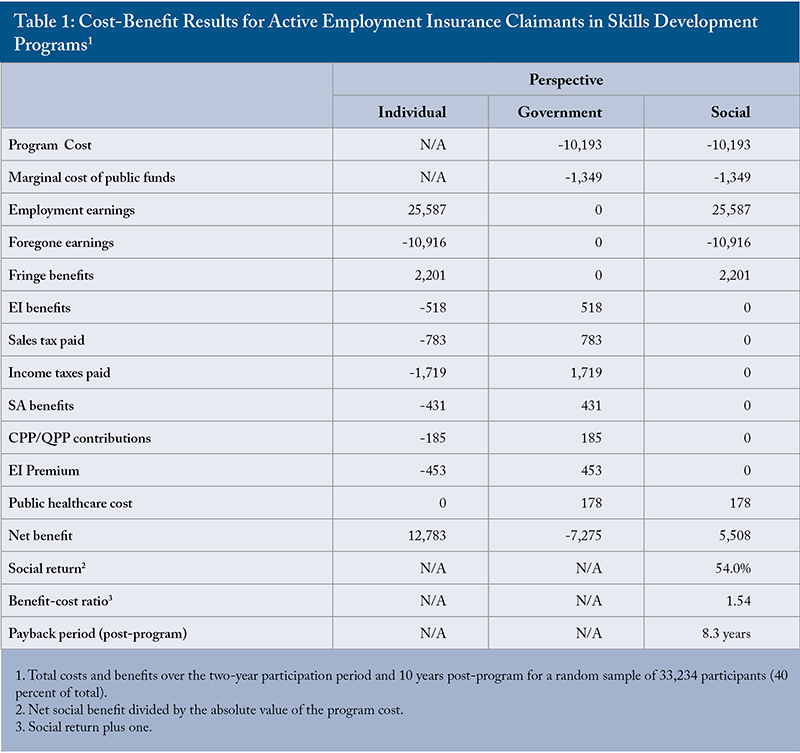
The gross fiscal cost of the program, including administration expenses, is approximately $10,200 per participant. The evaluation calculates carefully the induced effects of the program on government revenue and expenses. On the revenue side, the incremental impacts on income and sales taxes are estimated, as are contributions to government pension plans and Employment Insurance. On the spending side, reductions occur in Employment Insurance benefits, Social Assistance payments and, as mentioned above, public healthcare costs.14Health status is positively correlated with income, so the higher incomes resulting from skills development are assumed to result in lower use of publicly funded healthcare. Establishing the relationship requires complex analysis and calculations using the data on the distribution of public healthcare costs by income quintiles, from the report Lifetime Distributional Effects of Publicly Financed Health Care in Canada (2013) by the Canadian Institute for Health Information. See Mercier et al. (2024). The weighted average MCPF is assumed to be 1.2, which implies an efficiency loss from financing the program with distortionary taxes of $1,350. The reported net social gain is approximately $5,500.15An alternative would be to include the funding used to select, arrange, and pay for the training, not only as a cost to government but also as a benefit for individuals participating in the program. Including these payments would raise the net social benefit to almost $16,000. In the next section, we explore the impact of including these payments among social benefits in the evaluation framework developed in Hendren and Sprung-Keyser (2022).
The skills development evaluation follows good practice in other respects as well.
- In addition to the level of net social benefit, benefit-cost ratios, the social rate of return, and the time required for discounted benefits to equal discounted costs – the payback period – are reported.
- Sensitivity analysis was performed by examining the impact of changes in the discount rate, the marginal cost of public funds, and the length of time participants were followed after the end of training.
- There is an extensive discussion of the qualifications to the analysis, noting that some important factors could not be included because of data limitations.
- Complementary lines of evidence were used to interpret results, confirm the validity of assumptions regarding participants and non-participants, and provide additional context for assessing value for money.
Making Better Use of Administrative Data
Myers and Palamar made a very strong case that making better use of administrative data would strengthen evaluation. Administrative data can be used to measure long-term outcomes, estimate program effectiveness, and construct credible counterfactuals to assess incrementality. With those elements in place, value for money assessments using cost-effectiveness and benefit-cost analyses become feasible.
Administrative data has two components. First, data about programs themselves – who participated, what services they received, and, where possible, information on the nature and intensity of those services. Second, data from other administrative systems – tax, income, immigration, education, justice, and health – that allow evaluators to build a richer picture of who program participants are and what happens to them over time. The value of administrative data comes from linking these two components. Linkage requires a set of personal identifiers from each dataset, which are brought together in a secure environment, merged, and transformed into an analytical dataset. Despite the rich detail, individuals remain anonymous to researchers using the dataset.
In Canada, there are several different data-linkage environments, many of which operate within government departments, such as the dataset described by Mercier for federal-provincial skills development programs. The most comprehensive and general-purpose linkage environment is operated by Statistics Canada through the Social Data Linkage Environment (SDLE). It includes income and tax data, such as T1 files and information on income-transfer programs, which are critical for understanding labour market outcomes and income dynamics. The SDLE also includes education and training data, demographic data drawn from the census and population registries, rich health data covering hospitalizations and other system interactions, and increasingly strong justice data, including information on charges, court decisions, and sentencing. The breadth of the SDLE facilitates effectiveness and value for money assessments of a wide range of social programs.
Using administrative data strengthens evaluation in several ways. First, it allows longitudinal tracking of outcomes over timeframes that are not feasible using surveys. For example, knowledge of earnings five years after a training program is often critical to determining whether a program worked, but obtaining such information through primary data collection is expensive and subject to error. Using tax data is both cheaper and more accurate since it offers high coverage and avoids some of the attrition and non-response biases associated with surveys.
Second, it enables stronger impact estimation. Large administrative datasets can be used to construct high-quality comparison groups and counterfactuals of individuals who have similar characteristics to participants but did not receive the program. Third, administrative data captures participation in multiple programs, making it possible to assess overlap, duplication, and complementarity across programs. Finally, there is a meta-efficiency benefit. Re-using existing administrative data significantly reduces the cost and burden of repeated primary data collection, while still generating high-quality evidence.
Canada has vast amounts of administrative data and infrastructure that can be used for decision-making, but these resources are underused. Four changes are required to make better use of administrative data:
- Access to linked data needs to be faster and less cumbersome.
- More datasets need to be integrated into the SDLE.
- Capacity and expertise in the use of complex administrative data must be strengthened through training of evaluation teams.
- Development and use of administrative data must be an integral part of performance management and evaluation.
There was considerable interest from participants in the workshop in learning more about the existing data infrastructure – such as SDLE and infrastructure built at ESDC for training programs – and Statistics Canada’s capacity to support high-quality evaluations. This led Robidoux to suggest that holding a workshop on existing data opportunities and possible improvements to evaluations would be useful, particularly for evaluators.
A New Framework for Value for Money Evaluations
In the standard approach to evaluation, a program demonstrates value for money when a benefit-cost analysis shows that benefits exceed costs or when the program achieves relative cost effectiveness, compared to other programs or benchmarks. Differences in program size make it difficult to rank programs by the level of net benefit, so benefit-cost evaluations usually report the ratio of benefits to costs to provide a better perspective on how the marginal program dollar should be spent.
Hendren and Benjamin Sprung-Keyser have championed a new value for money indicator, the MVPF, that provides a better measure of where spending has the biggest bang for the buck (Hendren and Sprung-Keyser 2022). The MVPF compares the net social benefit of a program to its net fiscal cost. It differs from the more standard benefit-cost ratio in two ways. First, the net fiscal cost appears separately in the denominator instead of being subsumed with other costs, making it more relevant to policymakers who are particularly concerned about the fiscal implications of policy initiatives. Second, the MVPF abstracts from the cost of raising taxes to finance program spending. These costs generally appear in the denominator of the benefit-cost ratio, but are sometimes deducted from benefits in the numerator, which makes benefit-cost ratios more difficult to use for program comparisons. The advantage of considering separately the cost of raising taxes to finance a program is discussed below.
Dahlby traced the development of the MVPF to the Atkinson-Stern condition for the optimal provision of a publicly provided good or service financed by distortionary taxation (Atkinson and Stern 1974). The Atkinson-Stern condition equates the marginal benefit from a spending program, or more generally from the public provision of any good or service, to the marginal cost of providing it.
As discussed above, the marginal cost of financing a spending program equals the income lost to higher taxation plus the loss in economic efficiency arising from higher tax rates, or the MCPF. The MCPF must be adjusted for the actual amount of tax revenue that has to be raised, taking into consideration induced effects on tax bases (equation 1).

In equation 1, MB is the net marginal benefit of the program, usually measured as the willingness to pay for the program benefits; MCPF is the marginal cost of public funds; FC is the fiscal cost of the program, including administration expenses; and ΔTR is the change in tax revenue induced by the program.
Assuming the net fiscal cost (FC-ΔTR) is not zero, the Atkinson-Stern condition can be rewritten as:

which states that the optimal size of a program occurs when its marginal value equals the marginal cost of raising taxes to finance it. The marginal value of a program is its net social benefit calculated without considering the cost of financing the program.
Dahlby advocated using equation (2) as a summary indicator in value for money evaluations. He recommended using a standard value for the MCPF in all evaluations, tentatively set at 1.75. However, more research is required to select a definitive standard value to use, so Dahlby proposed convening a research workshop to develop the necessary evidence base.
The proposed approach is illustrated in Table 2, using a slightly modified version of the benefit-cost analysis of skills development programs discussed by Mercier. In this framework, the social benefits comprise the participants’ willingness to pay for the training and the resource savings from reduced healthcare costs. In the published evaluation, willingness to pay for the training corresponds to the increase in after-tax compensation adjusted for changes in social contributions and benefits that can be attributed to it, net of earnings forgone while participating in the program. In our alternative presentation, the payments made to individuals to purchase training services increase their willingness to pay. The increase in CPP/QPP contributions is also treated differently in the alternative presentation. Increases in contributions give rise to higher benefits in the future, so a good case can be made that the net impact on individuals is approximately zero. Further, the pension plans are administered as independent funds, so changes in contributions do not affect the government’s fiscal balance.

The gross fiscal cost of the program, comprising payments to participants and administration expenses, is approximately $10,200 per participant. Induced effects on government revenue and expenditures reduce the gross fiscal cost by 40 percent to $6,111.
The marginal value of public funds, defined as the net social benefit before financing costs divided by the net fiscal cost, is 3.76. That is well above the value of the marginal cost of public funds used in the skills development benefit-cost analysis and is also greater than 1.75, the value recommended by Dahlby based on his empirical work. The net social gain, defined as social benefits minus the net fiscal cost multiplied by the marginal cost of public funds, is between $12,228 and $15,649 per participant. We can safely conclude that the skills development program demonstrates value for money and that spending more on the program would be good public policy.
Hendren has applied this approach widely, although he does not use a standard measure of the MCPF in his assessments. With several collaborators, he has compiled a library of MVPF estimates for approximately 200 initiatives, using empirical evidence on program impacts from the literature. The library includes MVPFs and much other information for both spending programs and “revenue raisers,” which are, using Dahlby’s terminology, estimates of the MCPF for different tax measures.
Analyzing the marginal values and marginal costs of programs separately has the advantage of focusing attention on the trade-off between equity and efficiency in program design and financing. As an example, Hendren discussed changes to the US earned income tax credit, and the increases to top marginal income tax rates that were implemented in 1993 to finance it. The MVPF of the earned income tax credit is 1.11, substantially less than the 1.85 MCPF of the increase in the top marginal income tax rates, suggesting that the policy package should be rejected. However, the policy package affects the distribution of income, which makes the evaluation subjective. Quantifying the trade-off between efficiency and equity allows policymakers to make a more informed choice.
In his presentation, Hendren highlighted two general conclusions about program spending from his library of results:
- Programs supporting child development have had the highest MVPFs. Some programs supporting education and health have paid for themselves because the higher incomes resulting from these measures generate more additional tax revenue than the direct costs of the programs.
- The best way to fight climate change is through tax credits to utility companies to encourage clean electricity production. Electric vehicle subsidies were much less cost-effective, largely because lower prices have a relatively small impact on purchases. As a result, the size of the subsidy required to induce an additional purchase is much smaller than the environmental benefits that the purchase generates. The MVPF of these subsidies are very close to one, indicating that the subsidies are, to a close approximation, transfers to individuals who would have bought the cars without the subsidy.
Other Measures to Strengthen the Evaluation Function
While performing more and better value for money evaluations is key to strengthening the evaluation function, Robidoux identified several concerns with the Policy on Results, and suggested important structural changes to improve it.
The first concern he identified is that coverage of spending is incomplete. Spending programs authorized through the Income Tax Act are not subject to performance measurement and evaluation requirements. These programs consist of the Canada Child Benefit and refundable tax credits, such as the Canada Workers Benefit, the refundable portion of the SR&ED tax credit, and many “clean economy” investment tax credits.16While evaluation of these programs is not required, Finance Canada (2026) has recently released an evaluation of the Canada Child Benefit. However, the evaluation does not provide a value for money assessment of the program. Including these programs in the evaluation base would raise it by $45.2 billion, or almost 10 percent (Table 3).
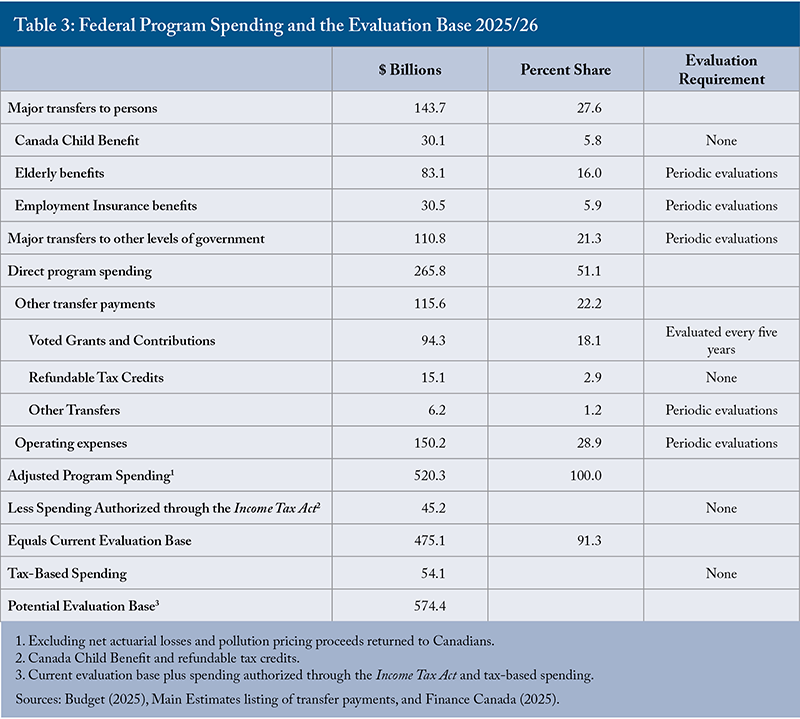
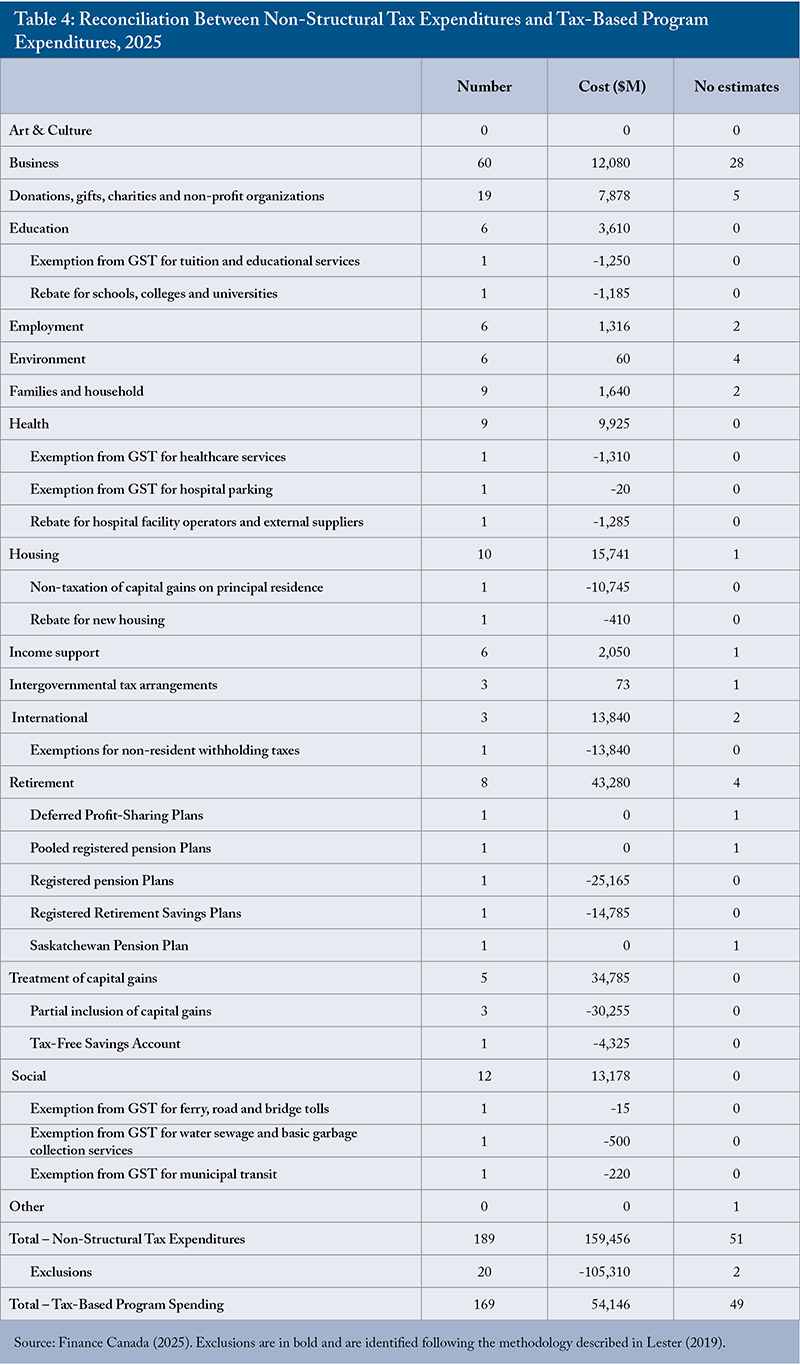
In addition, the government uses tax measures that are functionally equivalent to program spending to achieve social and economic objectives. There is no substantive difference between a spending program that subsidizes business investment and a tax credit provided for the same purpose. As detailed in the Appendix, these tax-based expenditures are estimated to cost at least $54.1 billion in 2025. Overall, inclusion of spending authorized through the tax system and tax-based spending would increase the evaluation base by almost $100 billion, or 21 percent (Table 3).
A second concern is that evaluation requirements are unbalanced: they are too stringent for grant and contribution programs, which account for only about 18 percent of the evaluation base, and are too flexible for other spending. As noted earlier, grant and contribution programs with an average annual budget of $5 million and over must be evaluated every five years and other programs must be evaluated periodically. A better approach would be to apply the Policy on Results to all programs, but to allow flexibility in the timing and frequency of evaluations when high-quality evaluations exist and programs have not substantially changed. The freed-up resources could be used to undertake in-depth performance assessments of a broader range of programs and organizational spending.
A third concern is that the potential for evaluation to contribute to measuring public sector productivity is not being realized. This is unexpected because, as discussed earlier, assessing operational efficiency is an evaluation requirement. The expectation is that this would involve assessing the efficiency of delivering a program or service. However, the Treasury Board Secretariat document lists nine approaches to assessing operational efficiency, only one of which addresses efficiency as it is commonly understood – a comparison of outputs and inputs.17The document notes that the approaches listed to evaluating efficiency “represent only a small sample of approaches” that evaluators may use.
We reviewed 10 evaluations that assessed operational efficiency.18These include: AgriRecovery (Disaster Relief), the Centre for Drug Research and Development, the Clean Growth Program, the Canada Centre for Community Engagement and the Prevention of Violence, Canada’s Climate Financing Programming, the Industrial Research Assistance Program, MITACS, Regional Economic Growth through Innovation, the Strategic Innovation Fund, and the Innovation Super Clusters Initiative. Only three discussed the efficiency of program delivery by reporting measures such as the ratio of delivery costs to program benefits or by describing efforts to reduce delivery costs. These evaluations instead focused on program reach, program delivery tools, the percentage of funding spent, client satisfaction, and job satisfaction of program staff. As with assessments of program allocative efficiency, excessive flexibility, combined with limited central direction, allows evaluators to satisfy the requirement to assess operational efficiency without providing a useful perspective on it.
We have recommended mandatory operational efficiency evaluations based on a comparison of program outputs and the dollar value of direct and indirect delivery costs. Output measures should be standardized by type of service offered to facilitate comparisons within groups of similar programs. Operational efficiency assessments of programs should include benefits received as one measure of output. A key cost-output ratio for programs would therefore be delivery costs relative to the transfer received by program beneficiaries. Other possible output measures include claims processed, clients served, or projects supported. These cost-output ratios should be supplemented with information on service standards to provide a more complete, albeit qualitative, measure of operational efficiency.
Consider services provided directly to the public, such as passport processing. An output measure could be the number of passports delivered, while the input measure could be the cost of processing applications, including the cost of internal services provided to processing units. Service standard information would include data on the elapsed time between applying for and receiving a passport – the average, mode, and number exceeding a pre-set standard.
The cost-output measure of operational efficiency provides a direct link from evaluation policy to the analysis of public sector productivity. This link could be strengthened in three ways. First, evaluators should be required to supplement the cost-output ratios with a measure more closely related to labour productivity analysis, which focuses on comparing outputs and inputs measured in quantities rather than in dollars, with outputs adjusted for changes in quality.
Consider passport delivery again. A productivity-oriented efficiency measure would compare the number of passports delivered to the total person hours of work required to deliver the passports. The evolution of delivery times and other elements of service standards would provide a useful indicator of changes in output quality. For example, an increase in hours worked by public servants would directly reduce productivity, but if it is accompanied by reduced delivery times, productivity could increase. Similarly, if an increase in hours worked resulted in less time spent by clients applying for passports, there could also be a productivity increase rather than a decrease.
Presenting a nuanced picture of outputs and inputs is an important part of evaluating operational efficiency. The information gathered will also help Statistics Canada develop useful measures of public sector productivity.
Second, in addition to publishing these operational efficiency evaluations, the government should prepare and publish a library of the quantitative results. These results would be important inputs into the regular publication of the state of service report, first released in 2025.19See: Service Canada. 2025. The State of Service. Employment and Social Development Canada. March. https://www.canada.ca/en/employment-social-development/corporate/reports/state-of-service/sos-report-2025.html.
Third, the government should also apply evaluation methodologies to assess investments intended to reduce the cost of providing government services and to raise their quality. For example, Treasury Board recently published the Government of Canada’s first public AI Register that provides Canadians with information about where and how AI is being used within the federal government.20Treasury Board of Canada Secretariat. 2025. “Government of Canada AI Register (Minimum Viable Product).” Open Government dataset. November 28. https://open.canada.ca/data/en/dataset/fcbc0200-79ba-4fa4-94a6-00e32facea6b. https://www.canada.ca/en/government/system/government-wide-reporting-spending-operations/committees-task-forces/working-group-public-service-productivity-overview/working-group-public-service-productivity-response.html. The register includes over 400 projects from 42 departments and agencies where AI is currently being developed or deployed. While it includes results expected or achieved, over 40 projects provide no information, and none provides a clear quantitative estimation of the expected or realized net gains (reductions in costs net of investment costs or better services). These investments should be assessed using benefit-cost analysis, which would allow the government to “develop a consistent approach to measuring the productivity impacts of AI use cases,” as suggested in its response to the recommendations of the Working Group on Public Sector Productivity.21Treasury Board of Canada Secretariat. 2025. “Working Group on Public Service Productivity: Treasury Board of Canada Secretariat Response to the Recommendations of the Working Group.” December 12. https://www.canada.ca/en/government/system/government-wide-reporting-spending-operations/committees-task-forces/working-group-public-service-productivity-overview/working-group-public-service-productivity-response.html.
A fourth concern is that policy proposals are not adequately assessed through a value for money lens. Policy proposals are approved in three steps. First, proposals are submitted to Finance Canada for funding approval by the minister of finance. These proposals are detailed in memoranda to cabinet and are also reviewed by a cabinet subcommittee and then by cabinet for policy approval. The final step is authorization for implementation by the Treasury Board.
Finance Canada guidance22Available at: https://wiki.gccollab.ca/images/4/4d/En_CNEL_Reference_Template_w_supplemental_guidance_260304.1.docx requires a strategic economic analysis of proposals involving net federal spending of more than $150 million. This analysis consists of a qualitative assessment and an optional quantitative assessment prepared by Finance Canada in consultation with the proposing department and other central agencies. The quantitative assessment reports projected impacts on employment, the cost per job created, and impacts on GDP. This information is inadequate to make an informed judgement about whether the program is likely to demonstrate value for money.
Memoranda to cabinet provide more information, including many mandatory topics and issues to be covered, but evaluation is not one of these. As a result, cabinet does not receive or discuss evaluation information for new programs or for changes to existing programs, including additional funding.
Treasury Board Secretariat guidance23Treasury Board of Canada Secretariat. 2026. “Guidance for Drafters of Treasury Board Submissions.” April 1. https://www.canada.ca/en/treasury-board-secretariat/services/treasury-board-submissions/guidance-for-drafters-of-treasury-board-submissions.html. on submitting proposals for approval raises the issue of value for money in the context of program design and cost. Submissions should explain why the proposed approach is best suited to achieve the expected outcome. They should also respond to the question “What is the value for money?” by considering expected efficiency. Submissions must also set out the total life cycle costs of a program and indicate whether these costs represent value for money. Treasury Board Secretariat guidance therefore opens the door to screening new proposals for value for money at the operational and overall performance level. However, as a practical matter, the value for money analysis is short – reflecting the limited analysis provided by most evaluations – and does not address benefits and costs in a systematic fashion.
Robidoux recommended that, mirroring Treasury Board submissions, memoranda to cabinet should include a mandatory section on evaluation. In addition, both Treasury Board submissions and memoranda to cabinet for new or modified programs should demonstrate that proposals pass a simplified value for money test. These documents should also set out a value for money evaluation plan.
A fifth concern is that the evaluation framework is unnecessarily complex, leading to confusion about when and how to perform value for money assessments. As discussed earlier, the Treasury Board Policy on Results and Directive on Results are the foundation of the policy framework for the federal evaluation system. This policy framework is supported by no less than 22 guides and backgrounders.24See: Treasury Board of Canada Secretariat. 2026. “Evaluation in the Government of Canada.” May 4. https://www.canada.ca/en/treasury-board-secretariat/services/audit-evaluation/evaluation-government-canada.html.
Velez-Guerra stated that the Treasury Board Secretariat plans to both clarify how performance measurement can support value for money assessments and to promote greater understanding of the approach by highlighting good practices and by offering specialized training. The key document that sets out how to perform value for money assessments, Assessing Program Resource Utilization When Evaluating Federal Programs (Treasury Board of Canada Secretariat 2013), will be updated and reissued.25This document was published in 2013 before the Policy on Results came into effect on July 1, 2016.
Robidoux recommended rewriting the evaluation framework to streamline, simplify, and clarify it. This could be achieved by implementing the recommendations emanating from the workshop. In doing so, the 22 existing guides and backgrounders should be merged into a single document. The framework would be completed by a separate guide on how to perform value for money assessments, using benefit-cost and cost-effectiveness analysis, and operational efficiency analyses, using cost-output and output-input ratios.
The general supporting document should continue to endorse a flexible approach to evaluation while making core evaluation requirements mandatory. Nevertheless, the non-core scope of evaluations should be narrowed to focus on a smaller set of effectiveness and operational efficiency measures that are of particular interest to policymakers.
A sixth concern is the amount of centralized direction of the evaluation function. The federal approach has varied over the years, from highly centralized to the highly decentralized approach now in place. Robidoux sees the need for a stronger central influence but, as discussed earlier, recommends creating an independent evaluator general position rather than adding to the responsibilities of the Treasury Board Secretariat.26See the Policy Options article for a discussion on the creation of an evaluator general position in the federal administration and, more recently, in an op-ed in The Globe and Mail. May, Kathryn. 2019. “The Case for Having a Federal Evaluator General.” Policy Options. June 13. http://policyoptions.irpp.org/2019/06/case-federal-evaluator-general/; Lavoie, Claude. 2024. “One Does Not Simply Gut the Public Service. Here’s the Proper Way to Make Cuts.” The Globe and Mail. December 19. https://www.theglobeandmail.com/business/commentary/article-one-does-not-simply-gut-the-public-service-heres-the-proper-way-to/. The Office of the Evaluator General27In its response to the recommendations of the Working Group on Public Service Productivity, the government made it clear that “establishing an independent organization to exercise a leadership function for evaluation in the public service” was not considered at this time because of other priorities. It was, however, silent on other recommended reforms to the evaluation function. See: Treasury Board of Canada Secretariat. 2025. “Working Group on Public Service Productivity: Treasury Board of Canada Secretariat Response to the Recommendations of the Working Group.” December 12. https://www.canada.ca/en/government/system/government-wide-reporting-spending-operations/committees-task-forces/working-group-public-service-productivity-overview/working-group-public-service-productivity-response.html. could be located within the Parliamentary Budget Office (PBO), where it would, for example:
- Assess and comment on departmental evaluations and evaluation plans, including the development of evaluation data sets, and suggest improvements to evaluation approaches.
- Ensure a strong professional community of evaluators in which the evaluator profession is recognized and evaluators are connected through a formal network and training.
- Conduct and publish its own evaluations, including thematic cross-departmental evaluations and value for money evaluations of major programs, when departments are unable to do so.
- Produce an annual public report that summarizes program evaluations performed during the year, provides a status report on federal programs that have been evaluated for value for money, and reports the marginal value of public funds for all programs for which this measure is available.
An evaluator general would play a key role in helping evaluation realize its potential for informing decisions on spending.
Summary of Recommendations to Strengthen Evaluation
The recommendations below reflect the main themes that emerged from the discussion at the C.D. Howe Institute’s Workshop on Strengthening the Federal Evaluation Function and the analysis presented in this rapporteurs’ report. They provide a roadmap for strengthening the federal evaluation function.
Changes to the evaluation framework:
- Make it mandatory for departments to assess programs for relevance, effectiveness, operational efficiency, and value for money, using the methodologies described in Box 2.
- Provide flexibility in the timing and frequency of evaluations when high-quality value for money evaluations exist and programs have not substantially changed.
- Rewrite the evaluation framework to streamline, simplify, and clarify it, ensuring it provides what policymakers are interested in.
Improve the quality of evaluations:
- Include the marginal cost of public funds and the ratio of net social benefits to the net fiscal cost of the program in value for money evaluations.
- Invest in talent and data by building on best practice evaluations, leveraging Statistics Canada and other administrative data, and providing training to evaluators for assessing programs for value for money.
- Make data development a joint responsibility of program managers and evaluators, and require deputy heads to ensure this responsibility has been fulfilled.
- Convene two technical workshops: one to determine the appropriate value of the marginal cost of public funds and another to promote more effective use of administrative data and identify possible improvements.
Broaden and extend the coverage of evaluation policy:
- Broaden the Policy on Results to cover both spending authorized under the Income Tax Act and tax measures that are functionally equivalent to spending programs.
- Mirroring Treasury Board submissions, memoranda to cabinet must include a section on evaluation. Both Treasury Board submissions and memoranda to cabinet for new or modified programs must demonstrate that the proposals pass a simplified value for money test. These documents should also set out a value for money evaluation plan.
Create an evaluator general position:
- Create an independent evaluator general position that would collaborate with and challenge departments’ evaluation units.
References
Atkinson, Anthony B., and Nicholas H. Stern. 1974. “Pigou, Taxation and Public Goods.” The Review of Economic Studies 41 (1): 119–28.
Baylor, Max, and Louis Beauséjour. 2004. Taxation and Economic Efficiency: Results from a Canadian CGE Model. Department of Finance. http://epe.lac-bac.gc.ca/100/200/301/finance/working_papers-ef/2004/10/wp2004-10e.pdf.
Bourgeois, Isabelle, and Stéphanie Maltais. 2023. “Translating Evaluation Policy Into Practice in Government Organizations.” American Journal of Evaluation 44 (3): 353–73. https://doi.org/10.1177/10982140221079837.
Dahlby, Bev, and Ergete Ferede. 2022. What Are the Economic Costs of Raising Revenue by the Canadian Federal Government? https://roam.macewan.ca/items/73cf71a0-209f-4634-91a7-98d019750638/full.
Drabo, Manassé, Landry Kuate, and Michael Willox. 2026. Applied Quantitative Impact Analysis: A Review of Contemporary Methods for Evaluating Programs Serving Businesses. No. 63. Analytical Studies: Methods and References, Catalogue no. 11-633-X. Statistics Canada. https://www150.statcan.gc.ca/n1/en/pub/11-633-x/11-633-x2026003-eng.pdf?st=4KMzbXWU.
Employment and Social Development Canada. 2022. “Horizontal Evaluation of the Labour Market Development Agreements.” https://www.canada.ca/content/dam/esdc-edsc/documents/corporate/reports/evaluations/horizontal-labour-market-development-agreements/SSPB-ED-LMDA_National_Report_PDF_EN_04.18.pdf.
Finance Canada. 2025. “Report on Federal Tax Expenditures: Concepts, Estimates and Evaluations.” https://www.canada.ca/en/department-finance/services/publications/federal-tax-expenditures/2025.html.
Finance Canada. 2026. “Evaluation of the Canada Child Benefit.” In Report on Federal Tax Expenditures. https://www.canada.ca/en/department-finance/services/publications/federal-tax-expenditures/2026/part-9.html.
Frenette, Marc, Winnie Chan, and Tomasz Handler. 2025. Leveraging Statistics Canada Data Integration Opportunities for Program Evaluation. Economic and Social Reports 5 (3). Statistics Canada. https://www150.statcan.gc.ca/n1/en/pub/36-28-0001/2025003/article/00002-eng.pdf?st=agznUSSg.
Hendren, Nathaniel, and Ben Sprung-Keyser. 2020. “A Unified Welfare Analysis of Government Policies.” The Quarterly Journal of Economics 135 (3): 1209–318.
Hendren, Nathaniel, and Ben Sprung-Keyser. 2022. The Case for Using the MVPF in Empirical Welfare Analysis. NBER Working Paper 30029. https://www.nber.org/papers/w30029.
Lester, John. 2012. “Managing Tax Expenditures and Government Program Spending: Proposals for Reform.” University of Calgary School of Public Policy Research Paper 5 (35). http://papers.ssrn.com/sol3/papers.cfm?abstract_id=2321923.
Lester, John. 2019. “Tax Expenditures in Canada—Historical Estimates and Analysis.” Canadian Tax Journal/Revue Fiscale Canadienne 67 (3): 755–73. https://doi.org/10.32721/ctj.2019.67.3.fon.
Lester, John. 2024a. Minding the Purse Strings: Major Reforms Needed to the Federal Government’s Expenditure Management System. E-Brief 359. Toronto: C.D. Howe Institute. September. https://cdhowe.org/publication/minding-purse-strings-major-reforms-needed-federal-governments-expenditure/.
Lester, John. 2024b. Spurring R&D: Canada Needs Focused Reforms to SR&ED and an IP Box. E-Brief 353. Toronto: C.D. Howe Institute. May. https://cdhowe.org/publication/spurring-rd-canada-needs-focused-reforms-sred-and-ip-box/.
Mayne, John. 2018. “Linking Evaluation to Expenditure Reviews: Neither Realistic nor a Good Idea.” Canadian Journal of Program Evaluation 32 (3): 316–26. https://doi.org/10.3138/cjpe.43178.
Mercier, Jérôme, Andy Handouyahia, Jamil Sayeed, Momath Wilane, Essolaba Aouli, and Azadeh Heydarirad. 2024. “Technical Report: Cost-Benefit Analysis -Incorporating Public Health Care Costs Savings in the Context of the Labour Market Programs Evaluation.” Employment and Skills Development Canada. https://www.canada.ca/content/dam/esdc-edsc/images/corporate/reports/technical/extended-cost-benefit-analysis/Extended_CBA_EN_V3.pdf.
Myers, Karen, and Jessica Schmidt. 2024. “Better Outcomes for People in Canada.” Conference Report. Blueprint. cdn.prod.website-files.com/5f805a9b45d5c1289b00e8d1/6672fefca7d5b9cc6ceb0d24_BEC-EN-FULL.pdf.
Nordstrom, Ardyn. 2026. “Evaluating ‘Effectiveness’ under the Policy on Results.” Canadian Public Administration 69 (1): 87–109. https://doi.org/10.1111/capa.70053.
OECD. 2019. Better Criteria for Better Evaluation: Revised Evaluation Criteria Definitions and Principles for Use. OECD Publishing. https://doi.org/10.1787/15a9c26b-en.
Treasury Board of Canada Secretariat. 2013. “Assessing Program Resource Utilization When Evaluating Federal Programs.” https://publications.gc.ca/collections/collection_2013/sct-tbs/BT32-43-2013-eng.pdf.
Treasury Board of Canada Secretariat. 2026. “Directive on Results.” https://www.tbs-sct.canada.ca/pol/doc-eng.aspx?id=31306.
Treasury Board of Canada Secretariat. 2026. “Policy on Results.” https://www.tbs-sct.canada.ca/pol/doc-eng.aspx?id=31300.
World Bank. 2026. “Hooked on Subsidies: The Case for Reform.” World Bank. https://documents1.worldbank.org/curated/en/099032626103039700/pdf/P181180-e35c998f-b657-49c8-843a-c7e319f81106.pdf.
Appendix
Derivation of Tax-Based Program Spending from Non-Structural Tax Expenditures as Reported in Finance Canada’s Tax Expenditure Report, 2025
The Report on Federal Tax Expenditures (Finance Canada 2025) identifies over 250 tax expenditures with an estimated fiscal cost of $189.3 billion for 2025. It further decomposes them into structural – 70 measures whose main objectives are internal to the tax system but not part of a narrowly defined benchmark or core tax structure – and 189 non-structural tax expenditures that have an estimated fiscal cost of $159.5 billion. In principle, these non-structural measures are substitutes for program spending. However, many of the non-structural measures address fundamental tax policy issues such as the treatment of capital gains, the taxation of other levels of government, and the taxation of income earned by non-residents.28See Lester (2019) for a more detailed discussion. They are therefore excluded from our estimate of tax-based spending, which comprises 169 measures that are functionally equivalent to program spending.
The $54.1 billion fiscal cost of tax-based spending measures is a minimum. The Report on Federal Tax Expenditures does not provide estimates for about 50 of the 169 tax-based spending measures. Further, the foregone revenue cost of each tax expenditure measure is calculated by assuming that other tax expenditures remain unchanged, which leads to an underestimation of tax expenditures because the income tax structure is progressive (Finance Canada 2025; Lester 2012).